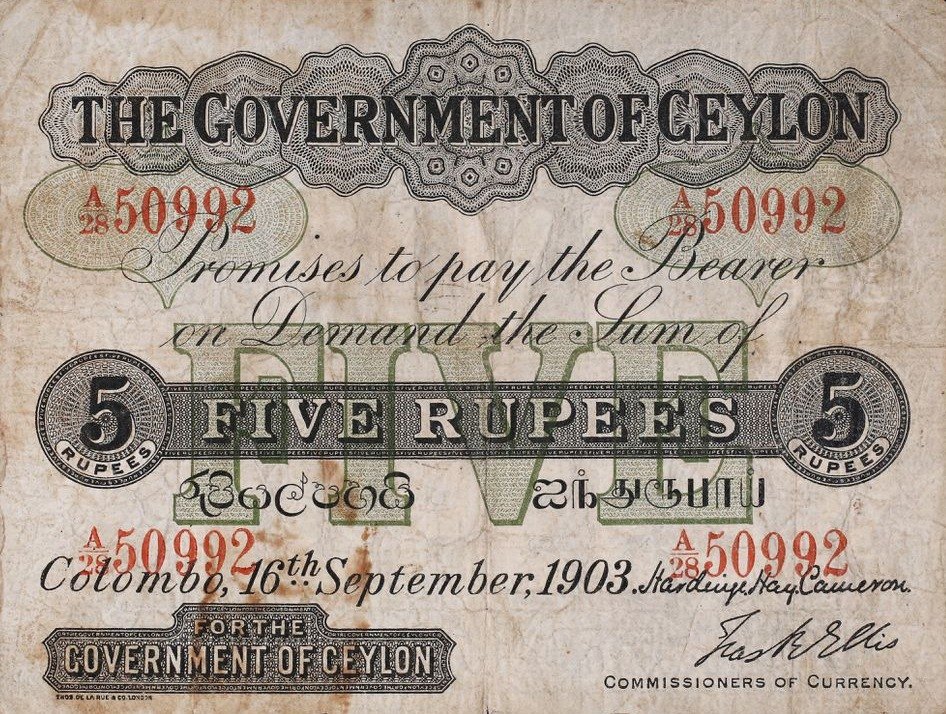
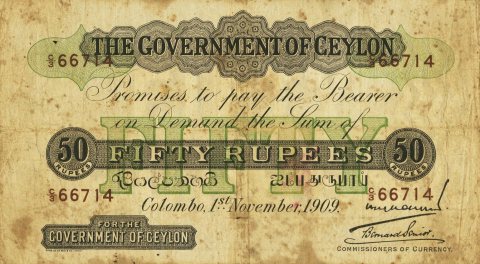
Between 1901 and 1903 the law behind the uniface notes of Ceylon, the 5 rupees, 10 rupees, 50 rupees, 100 rupees and 1,000 rupees, was changed twice on account of gold, and a Currency Commission sat twice. This article sets out what the Ceylon Sessional Papers of 1901 to 1905 print: the law of 6th November 1901, the two reports of the Currency Commission, its tables of the note issue, and the evidence on the state of the notes. The yearly totals from 1885 to 1931 are in Ceylon's first government rupee notes, 1884 to 1926; the monthly figures here are not.
6th November 1901: notes for sovereigns
The report of the Currency Commission, dated 20th January 1903 (Sessional Paper V of 1903), gives the order of events. An Order in Council of 26th September 1901 declared the sovereign legal tender in Ceylon. It was published in the Gazette of 25th October 1901, and the Ordinance that followed from it, No. 13 of 1901, was introduced and passed through the Legislative Council on 6th November. The proceedings of that day show the Bill read a first time, the Standing Orders suspended, the Bill read a third time and passed, and the Governor's assent announced by the Colonial Secretary at the same meeting.
The Ordinance amended "The Ceylon Paper Currency Ordinance, 1884" in three ways, as the report describes them:
- holders of notes were entitled to coin on demand, "which at the option of the Commissioners might be either the silver rupee of India or the sovereign";
- the Commissioners had to issue notes on demand for sovereigns, at 15 rupees to the sovereign;
- part of the coin reserve could be held in gold.
Section 11 of the Ordinance of 1884, as amended, read that the Commissioners "shall, on the demand of any person, issue currency notes in exchange for the amount thereof in silver rupees of India or in gold coin which is legal tender in this Colony".
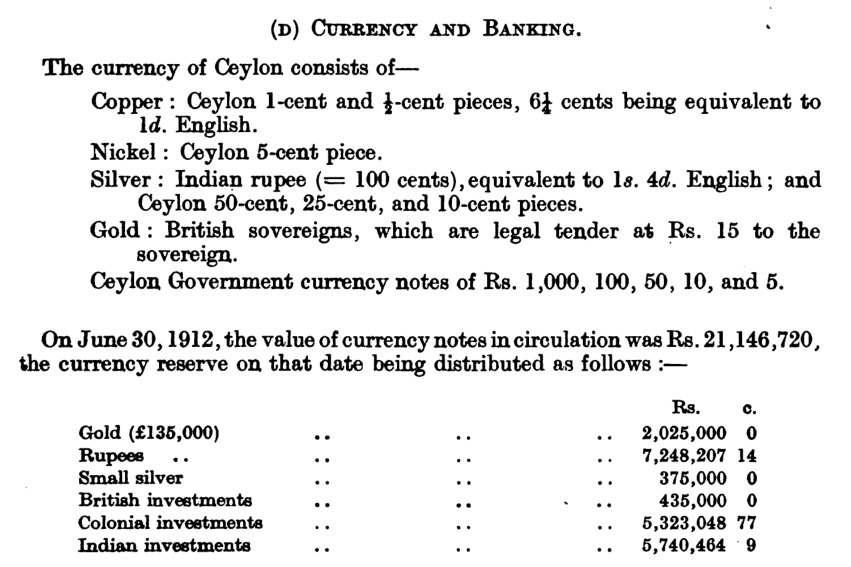
Opening the session of 1902, the Governor told the Council that the Ordinance had "led to a large importation of gold into the Colony in place of silver".
How the notes went out: the evidence of November 1902
George Van Hoff, Clerk to the Commissioners of Currency, was examined on 11th November 1902. Asked whether in practice the notes were mostly issued to the banks, Van Hoff said yes, and to the question whether the notes were brought into circulation through the agency of the banks: "Almost wholly so." Van Hoff gave the circulation that day twice, as Rs. 14,144,440 and as Rs. 14,444,000. Neither figure is the one in the report's own table, which has Rs. 14,012,440 on 11th November, and Return 6 gives Rs. 14,132,440 on 13th November. The four figures are printed as they stand.
Other witnesses spoke of the notes themselves.
- Under the heading of F. Bennett, Acting Agent of the Chartered Bank, the evidence reads: "There are too many small notes in circulation now in Colombo", and people "cannot get large notes for ordinary business transactions". A remark by Mr. Rosling, printed with it, is that there was great difficulty in getting change for a 50 rupee note up-country.
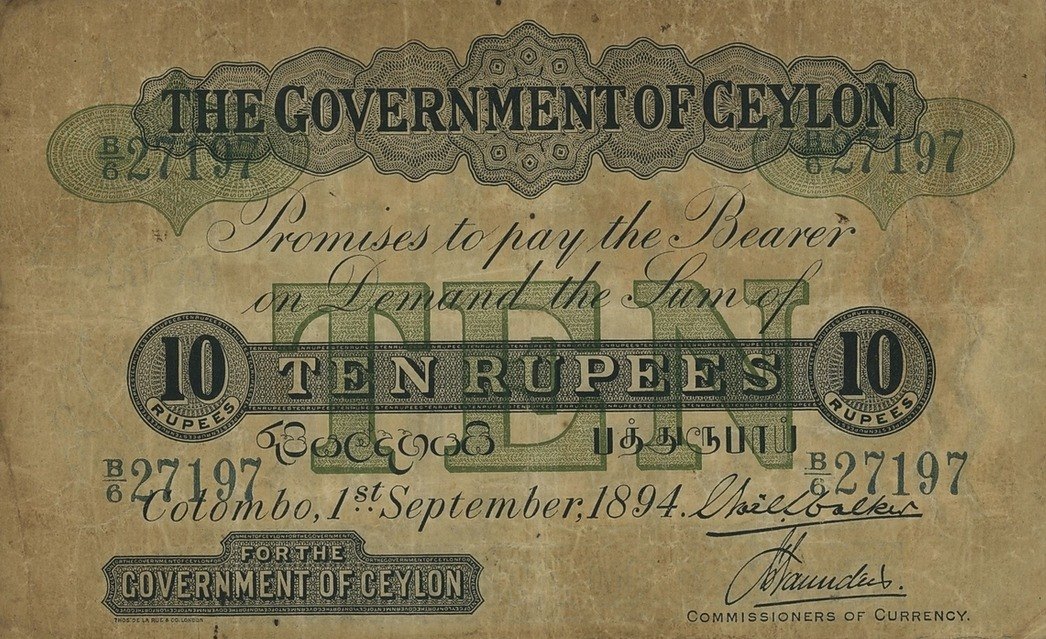
- Under the heading of J. H. Templer, Crown Counsel, a witness said that sovereigns had made it possible "to dispense with the filthy 5-rupee notes and forged and filthy 10-rupee notes". The witness had sent the Government a scheme ten months before for replacing the notes altogether, and held that notes should never be issued a second time. No series, number or count of the forged notes is given.
- The Treasurer, H. Hay Cameron, wrote to the Commission on 28th November 1902 with a statement of the Government's remittances to the Northern Province.
| 1902 | In notes | In rupees | In small silver |
|---|---|---|---|
| May | Rs. 50,000 | Rs. 50,000 | none |
| June | Rs. 50,000 | none | none |
| July | Rs. 36,000 | Rs. 60,000 | Rs. 2,000 |
| August | Rs. 74,000 | Rs. 50,000 | Rs. 3,000 |
| September | none | none | none |
| October | Rs. 68,000 | Rs. 32,000 | none |
A suggestion that notes of less than 5 rupees might ease the want of small change was put to the witnesses. The report says that "opinions were practically unanimously unfavourable to the proposal". No note below 5 rupees was issued until 1917.
The gold and silver behind the notes, December 1901 to December 1902
Paragraph 7 of the report prints the notes in circulation with the gold and the silver held by the Commissioners.
| Day | Notes in circulation | Gold reserve, to the value of | Silver reserve |
|---|---|---|---|
| 1st December 1901 | Rs. 13,058,950 | Rs. 787,500 | Rs. 5,256,609.56 |
| 1st January 1902 | Rs. 13,213,950 | Rs. 1,612,500 | Rs. 4,586,609.56 |
| 1st February 1902 | Rs. 11,456,450 | Rs. 645,000 | Rs. 3,796,609.56 |
| 1st March 1902 | Rs. 10,688,950 | Rs. 82,500 | Rs. 3,591,609.56 |
| 1st April 1902 | Rs. 10,023,200 | Rs. 126,750 | Rs. 2,881,609.56 |
| 1st May 1902 | Rs. 10,246,450 | Rs. 870,000 | Rs. 2,361,609.56 |
| 1st June 1902 | Rs. 10,166,450 | Rs. 892,500 | Rs. 2,259,109.56 |
| 1st July 1902 | Rs. 10,731,450 | Rs. 1,612,500 | Rs. 2,104,109.56 |
| 1st August 1902 | Rs. 11,296,450 | Rs. 2,857,500 | Rs. 2,264,109.56 |
| 1st September 1902 | Rs. 12,433,940 | Rs. 4,059,990 | Rs. 2,299,109.56 |
| 1st October 1902 | Rs. 12,239,940 | Rs. 4,112,490 | Rs. 2,176,309.77 |
| 11th November 1902 | Rs. 14,012,440 | Rs. 6,234,990 | Rs. 1,958,309.77 |
| 1st December 1902 | Rs. 13,955,440 | Rs. 6,159,990 | Rs. 1,844,309.77 |
| 31st December 1902 | Rs. 13,868,440 | Rs. 6,174,990 | Rs. 1,742,309.77 |
The report's Table A1 gives the coin reserve as a share of the notes: 30 per cent on 31st March 1902 and 57 per cent on 31st December 1902. The same table prints the circulation of 31st October 1900 as Rs. 18,377,450. Returns 6 and 7 in the appendix give Rs. 13,377,450 for that day, so the figure in Table A1 is a misprint.
The note issue month by month, 1900 to September 1903
The figures for 1900, 1901 and 1902 are from Return 6 of Sessional Paper V of 1903, which runs to 13th November 1902. The last months of 1902 and the figures for 1903 are from the Treasury returns in Sessional Paper XXVII of 1903, which run to 16th September 1903. Each is the circulation at the end of the month unless a day is given.
| Month | 1900 | 1901 | 1902 | 1903 |
|---|---|---|---|---|
| January | Rs. 14,152,450 | Rs. 12,767,450 | Rs. 11,456,450 | Rs. 13,372,450 |
| February | Rs. 13,912,450 | Rs. 11,882,450 | Rs. 10,688,950 | Rs. 12,036,950 |
| March | Rs. 13,087,450 | Rs. 10,846,450 | Rs. 10,023,200 | Rs. 12,672,950 |
| April | Rs. 12,162,450 | Rs. 10,446,450 | Rs. 10,246,450 | Rs. 12,496,090 |
| May | Rs. 12,057,450 | Rs. 10,256,450 | Rs. 10,166,450 | Rs. 12,244,090 |
| June | Rs. 11,692,450 | Rs. 11,406,450 | Rs. 10,731,450 | Rs. 11,936,090 |
| July | Rs. 13,407,450 | Rs. 11,831,450 | Rs. 11,296,450 | Rs. 13,276,590 |
| August | Rs. 13,847,450 | Rs. 12,081,450 | Rs. 12,433,940 | Rs. 14,840,190 |
| September | Rs. 12,937,450 | Rs. 12,156,450 | Rs. 12,239,940 | Rs. 15,704,090 on 16th September |
| October | Rs. 13,377,450 | Rs. 12,026,450 | Rs. 13,872,440 | not given |
| November | Rs. 13,922,450 | Rs. 13,058,950 | Rs. 13,955,440 | not given |
| December | Rs. 13,292,450 | Rs. 13,213,950 | Rs. 13,868,440 | not given |
The highest and lowest issue of each year, 1886 to 1903
Return 5 of the Commission's appendix gives the highest and the lowest note issue of every year from 1886 to 1901, each with its day. The Treasury return in Sessional Paper XXVII of 1903 repeats it and adds 1902 and 1903 to 16th September.
| Year | Day of the highest | Highest note issue | Day of the lowest | Lowest note issue |
|---|---|---|---|---|
| 1886 | 23rd December | Rs. 5,012,165 | 8th July | Rs. 3,612,160 |
| 1887 | 19th December | Rs. 5,171,705 | 4th July | Rs. 3,676,705 |
| 1888 | 21st December | Rs. 5,529,705 | 1st May | Rs. 4,609,705 |
| 1889 | 23rd December | Rs. 6,444,375 | 29th May | Rs. 4,669,705 |
| 1890 | 10th December | Rs. 6,394,375 | 26th June | Rs. 4,614,375 |
| 1891 | 25th November | Rs. 7,567,375 | 13th March | Rs. 5,918,375 |
| 1892 | 16th December | Rs. 9,004,575 | 28th March | Rs. 5,977,375 |
| 1893 | 6th January | Rs. 8,704,575 | 5th July | Rs. 6,913,005 |
| 1894 | 6th December | Rs. 9,010,000 | 18th June | Rs. 6,125,000 |
| 1895 | 21st December | Rs. 10,230,000 | 6th April | Rs. 7,105,000 |
| 1896 | 15th December | Rs. 11,468,700 | 13th May | Rs. 7,365,000 |
| 1897 | 5th January | Rs. 11,308,700 | 21st April | Rs. 7,943,700 |
| 1898 | 9th September | Rs. 11,443,700 | 7th April | Rs. 7,473,325 |
| 1899 | 29th December | Rs. 14,455,950 | 24th February | Rs. 10,198,700 |
| 1900 | 5th January | Rs. 14,702,450 | 5th July | Rs. 11,632,450 |
| 1901 | 23rd December | Rs. 13,713,950 | 11th June | Rs. 10,096,450 |
| 1902 | 6th November | Rs. 14,153,940 | 8th April | Rs. 9,836,450 |
| 1903, to 16th September | 7th September | Rs. 15,803,090 | 13th March | Rs. 11,842,950 |
The return prints the day of the lowest issue of 1889 as 29th May 1899, a slip for 1889. It gives the figures without comment.
1903: a limit on gold
The first report recommended that section 11 be written again, so that the Commissioners must issue notes for Indian silver rupees but may decline to issue them for gold whenever it is inexpedient to add to the gold reserve.
London's conditions came in a despatch from Mr. Chamberlain, No. 290 of 11th August 1903: gold and rupees in transit might be counted in the coin reserve only if the coin actually in the hands of the Commissioners was never less than one-third of the note issue. The Commission was appointed again on 16th September 1903 and met on 29th and 30th September and 8th October. Its second report proposed 200,000 pounds as the highest gold reserve, which it called one-quarter of the average note circulation of recent years, put at Rs. 12,000,000. It held that an amount equal to half the note circulation ought ordinarily to be kept in coin, and remarked that the circulation was then very high, Rs. 15,704,090 on 16th September. A 5 rupees of the catalogue carries that same date, 16th September 1903, with the signatures of Cameron and Ellis.

Governor Sir J. West Ridgeway sent the Secretary of State the draft of a notification on 26th October 1903: the Commissioners "will receive sovereigns in exchange for currency notes only so long as the gold reserve does not exceed £200,000", and three months' notice would be given of any change. The draft leaves the number of the Ordinance blank, and the day it was published is not in the volume.
The Bill "to further amend The Ceylon Paper Currency Ordinance, 1884" passed the Legislative Council on 31st October 1903. Its draft, dated at Colombo on 23rd October 1903, gives section 11 its new form and provides that the laws together be cited as "The Ceylon Paper Currency Ordinances, 1884 to 1903". The Sessional Papers do not print its number. The Blue Books for 1903 and 1904 list it as Ordinance No. 6 of 1903.
In the same papers the Treasury in London declined to make the half-sovereign legal tender in Ceylon, on the ground that its place was "already adequately supplied by currency notes of the smaller denominations".
Worn notes
The complaint about dirty notes left a mark on the estimates. A supplementary vote of 1903 gave Rs. 1,000 for the "destruction of old currency notes". Presenting the estimates for 1904 on 26th October 1903, the Governor said that the vote for the destruction of unserviceable currency notes had been raised by Rs. 800, "and should, for sanitary reasons, be hereafter further increased".
What the papers do not give
- Any figure by value of note. Every return is a total for all values together.
- The numbers of notes issued, cancelled or destroyed in a year.
- The series or numbers of the forged 10 rupee notes of 1902. The counterfeit of the 10 rupees that is recorded is on the page of that note.
- The Sessional Papers for 1904 to 1905 and the Blue Book for 1905 were not among the volumes read, so the working of the gold limit after 1903 is not followed here. The annual reports on Ceylon show gold still in the reserve later: 141,500 pounds, entered as Rs. 2,122,500, on 31st December 1909, and Rs. 2,025,000 on 30th June 1912.
Sources
- Ceylon Sessional Paper V of 1903: Report of the Ceylon Currency Commission, 20th January 1903, paragraphs 1 to 7, 31 and 52 to 55; Table A1; Appendix B, minutes of evidence (George Van Hoff, 11th November 1902; F. Bennett; J. H. Templer); Appendix D, the Treasurer's letter of 28th November 1902 with Statement B; Appendix E, Returns 5, 6 and 7.
- Ceylon Sessional Paper XXVII of 1903, Papers relating to the Commissions on the Scarcity of Silver: Mr. Chamberlain to the Governor, No. 290 of 11th August 1903; the Treasury to the Colonial Office on the half-sovereign; the Governor to the Secretary of State, 26th October 1903, with the draft notification; the report of the Commission appointed again on 16th September 1903; Treasury Returns 5, 6 and 7.
- Proceedings of the Legislative Council of Ceylon: 6th November 1901; the Governor's address at the opening of the session of 1902; the Governor's address of 26th October 1903; the meeting of 31st October 1903.
- Supplementary Supply, 1903, Statement No. 2 (Sessional Papers of 1902 to 1903).
- Ceylon Blue Books for 1903 and 1904, the list of legislation and the currency return.
- Colonial Reports, Annual, No. 653, Ceylon, 1909, page 7; No. 758, Ceylon, 1911-12, page 9.
Member comments
Log in or register to post a comment.