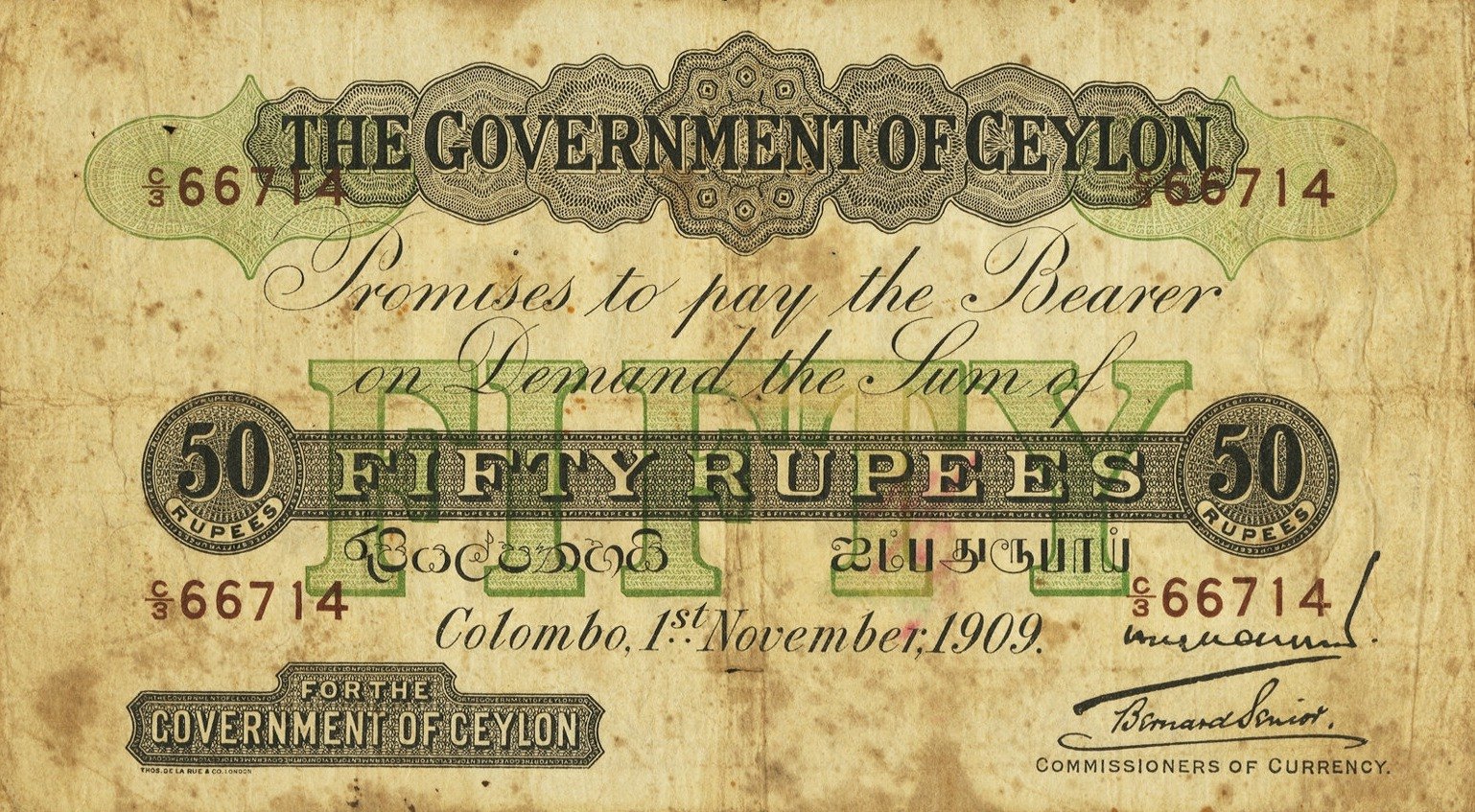
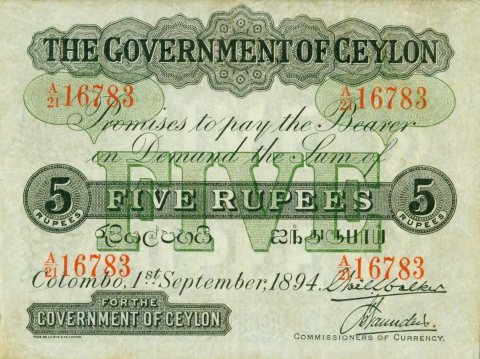
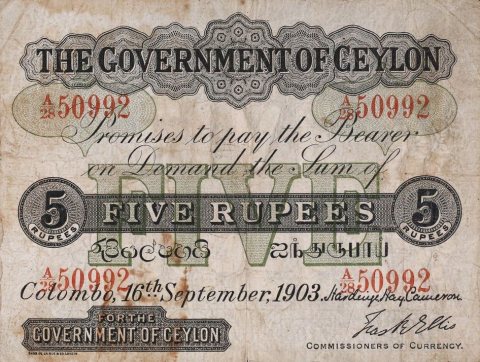
From the 5 rupees of 1885 onward the notes of the Government of Ceylon were payable in coin on demand at the Commissioners' office in Colombo, and the law required a reserve to stand behind them. This article collects what the Ceylon Blue Books, the Sessional Papers, Chalmers' History of Currency in the British Colonies (1893) and the annual reports on Ceylon print about that reserve from 1885 to 1931. The notes in circulation in the same years are in Ceylon's first government rupee notes, 1884 to 1926, and the years 1900 to 1903, when gold came into the reserve, are in Gold for notes in Ceylon, 1900 to 1903.
The rules
Chalmers (pages 358 and 359) gives the rule of Ordinance No. 32 of 1884: the Commissioners were to hold "a reserve in silver coin of one-half, at the least, of the amount of currency notes in circulation", and the rest might be invested. The draft section agreed in London on 12th November 1884 let the Commissioners issue notes "equal to the whole amount of coin and securities" in their hands, and Lord Derby's telegram of 12th February 1885 repeated it: paper currency could not be issued beyond the coin and securities held (Sessional Paper I of 1886).
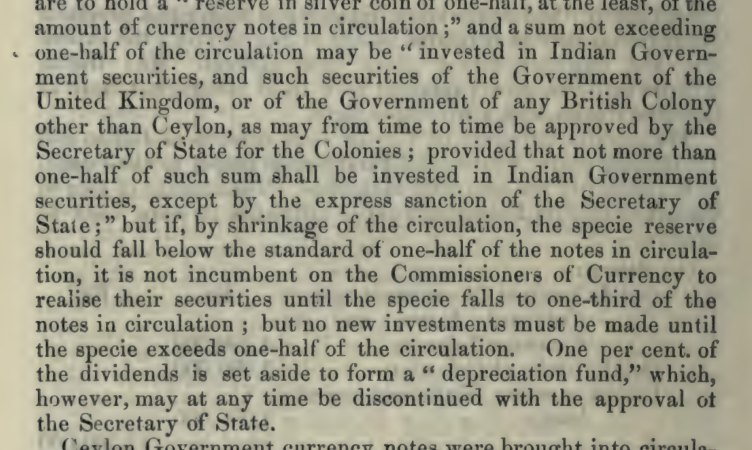
The invested part was held in London. A Colonial Office letter of 13th February 1885 appointed Sir Robert Herbert and Mr. Wingfield joint trustees with the Crown Agents on behalf of the Currency Commissioners, under the 15th section of the Ordinance, and put a reserve of 43,600 pounds into their names.
Two later rulings are printed in the papers of 1903. The Secretary of State would let coin in transit count in the reserve only if the coin actually in the hands of the Commissioners was never below one-third of the note issue (despatch No. 290 of 11th August 1903). The Currency Commission, reporting that autumn, held that an amount equal to half the note circulation ought ordinarily to be kept in coin (Sessional Paper XXVII of 1903).
The Reserve Fund in the Colony's accounts, 1886 to 1906
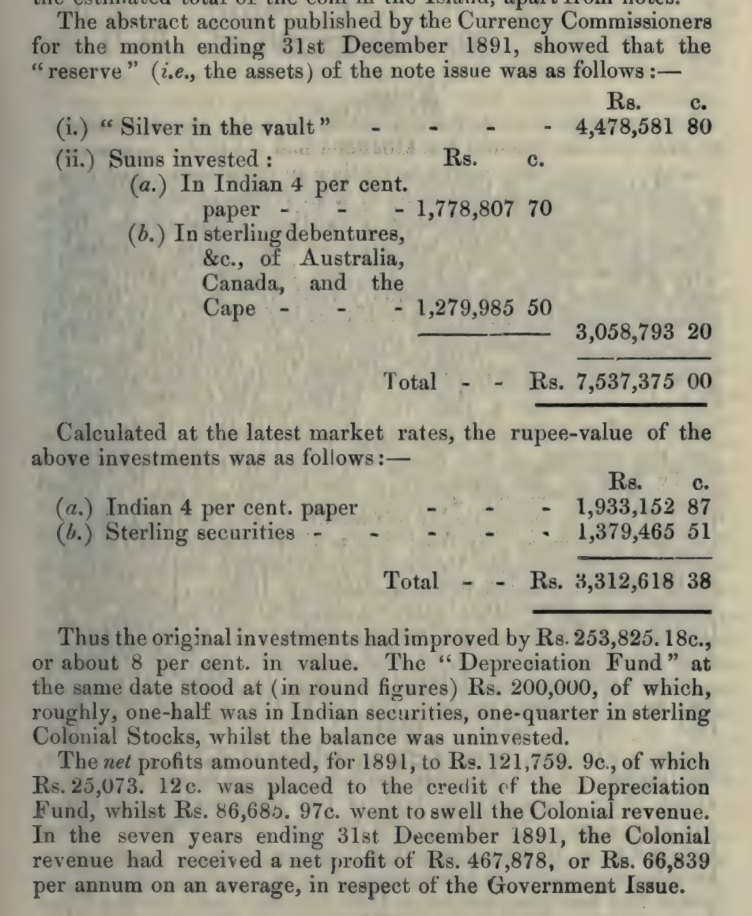
The Government's statement of assets and liabilities shows a Currency Notes Reserve Fund "in deposit" each 1st January. It is the deposit shown in the Colony's accounts, and the invested part of the reserve is not in it. Where another source gives the coin held on the same day the two figures agree to the rupee: Chalmers has Rs. 4,478,581.80 of silver in the vault for the month ending 31st December 1891, and the Currency Commission's table has a coin reserve of Rs. 6,277,609 on 31st December 1900.
| Day | Currency Notes Reserve Fund in deposit | Source |
|---|---|---|
| 1st January 1886 | Rs. 2,287,023.19 | Blue Book for 1885 |
| 1st January 1887 | Rs. 3,071,203.71 | Blue Book for 1886 |
| 1st January 1888 | Rs. 2,930,743.51 | Blue Book for 1887 |
| 1st January 1889 | Rs. 2,863,551.50 | Blue Book for 1889; Sessional Papers of 1889 |
| 1st January 1890 | Rs. 3,381,664.62 | Blue Books for 1889 and 1890 |
| 1st January 1891 | Rs. 3,235,585.78 | Blue Book for 1890 |
| 1st January 1892 | Rs. 4,478,581.78 | Blue Book for 1891 |
| 1st January 1893 | Rs. 3,178,193.50 | Blue Book for 1892 |
| 1st January 1894 | Rs. 2,388,618.50 | Blue Book for 1893 |
| 1st January 1895 | Rs. 4,845,155.11 | Blue Book for 1894 |
| 1st January 1900 | Rs. 8,439,777.46 | Blue Book for 1900 |
| 1st January 1901 | Rs. 6,277,609.54 | Blue Book for 1900 |
| 1st January 1902 | Rs. 6,199,109.54 | Blue Book for 1901 |
| 1st January 1903 | Rs. 7,917,299.75 | Blue Book for 1902 |
| 1st January 1904 | Rs. 7,917,809.88 | Blue Book for 1903 |
| 1st January 1905 | Rs. 6,807,323.31 | Blue Book for 1904 |
| 31st December 1906 | Rs. 7,029,745.01, as "Currency Reserve" | Blue Book for 1906 |
Three remarks belong to the table. The figure for 1st January 1888 is printed as Rs. 2,930,743.51 in one volume of the Sessional Papers and as Rs. 2,930,743.71 in the next. A further Rs. 90.50 on 1st January 1886 and 1887, and Rs. 96.50 on 1st January 1888, 1889 and 1890, is shown in the hands of the Crown Agents. The years 1896 to 1899 and 1906 are missing because the Blue Books for 1895 to 1899 and for 1905 were not among the volumes read.
The first two statements also carried the notes themselves as a liability of the Government, Rs. 4,192,165 on 1st January 1886 and Rs. 5,012,165 on 1st January 1887, with an advance of the same sum to the Currency Commissioners on the other side. From the statement for 1st January 1888 those two lines are gone. The annual report on Ceylon for 1909 says so in plain words: "The assets and liabilities of the Commissioners of Currency are no longer included in the balance sheet of the Colony."
The invested reserve
For the invested part the papers give a figure only now and then.
| Day | Invested on account of the note reserve | Source |
|---|---|---|
| Month ending 31st December 1891 | Rs. 3,058,793.20 | Chalmers, page 359 |
| 1st August 1901 | Rs. 7,014,840 | Governor's address, 18th October 1901 |
| 1st August 1902 | Rs. 6,174,840 | Governor's address, session of 1902 |
| 2nd May 1903 | Rs. 5,951,140 | F. R. Ellis, Report on the Financial Affairs of Ceylon 1896-1902 |
| 1st August 1903 | Rs. 5,943,280 | Governor's address, 26th October 1903 |
| 1st September 1905 | Rs. 6,925,595 | Governor's address, December 1905 |
| 30th September 1919 | Rs. 21,310,495.09, purchase price | Blue Book for 1919 |
The Blue Books for 1913 to 1916 list the investments of the Currency Reserve in three sums at purchase value: Rs. 5,994,180.00, Rs. 253,650.00 and Rs. 5,740,464.09 on 30th June 1913, and Rs. 8,130,650.00, Rs. 1,290,186.00 and Rs. 5,740,464.09 on 30th September of 1914, 1915 and 1916. By 30th September 1916 part of the reserve was in War Loan, and by 30th September 1919 most of it was in Indian War Loan 5 per cent stock.
The Crown Agents' accounts show money going into these investments: Rs. 299,994 in 1887 and Rs. 145,167.63 in 1888 for the Reserve and Depreciation Funds together, and nothing in 1886 (Sessional Papers of 1889). In 1894 the Crown Agents received Rs. 86,519.18 of interest on the investments made for the Currency Commissioners (Blue Book for 1894). Chalmers puts the net profit of the note issue to the revenue from 1885 to 1891 at Rs. 467,878. The annual report for 1922 says the interest on the currency investments again went to revenue.
How the reserve was made up on six days
| Day | Notes in circulation | Coin | Securities | Source |
|---|---|---|---|---|
| Month ending 31st December 1891 | Rs. 7,537,375 | silver in the vault Rs. 4,478,581.80 | Indian 4 per cent paper Rs. 1,778,807.70; sterling debentures of Australia, Canada and the Cape Rs. 1,279,985.50 | Chalmers, page 359 |
| 2nd May 1903 | not given | Rs. 6,552,810 | Rs. 5,951,140 | Ellis, Report on the Financial Affairs of Ceylon 1896-1902 |
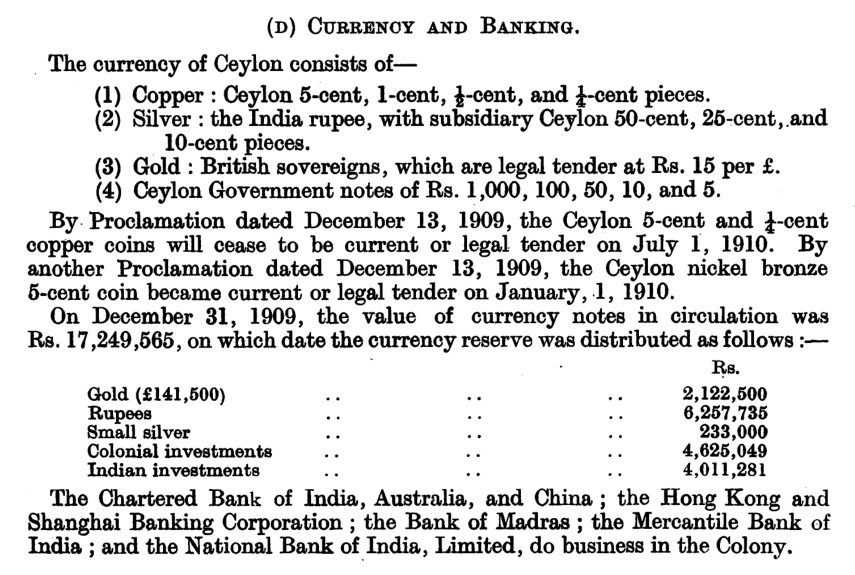
| 31st December 1909 | Rs. 17,249,565 | gold Rs. 2,122,500 (141,500 pounds); rupees Rs. 6,257,735; small silver Rs. 233,000 | Colonial investments Rs. 4,625,049; Indian investments Rs. 4,011,281 | annual report for 1909, No. 653, page 7 |
| 30th June 1912 | Rs. 21,146,720 | gold Rs. 2,025,000; rupees Rs. 7,248,207.14; small silver Rs. 375,000 | British Rs. 435,000; Colonial Rs. 5,323,048.77; Indian Rs. 5,740,464.09 | annual report for 1911-12, No. 758, page 9 |
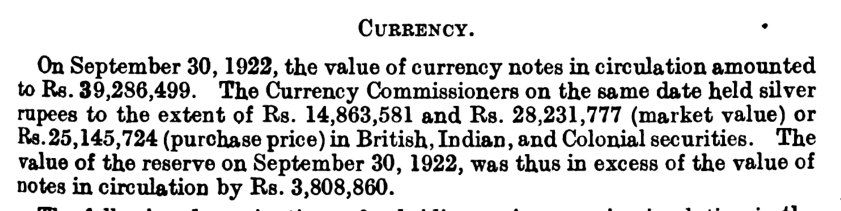
| 30th September 1922 | Rs. 39,286,499 | silver rupees Rs. 14,863,581 | British, Indian and Colonial securities Rs. 28,231,777 at market value | annual report for 1922, No. 1172, page 5 |
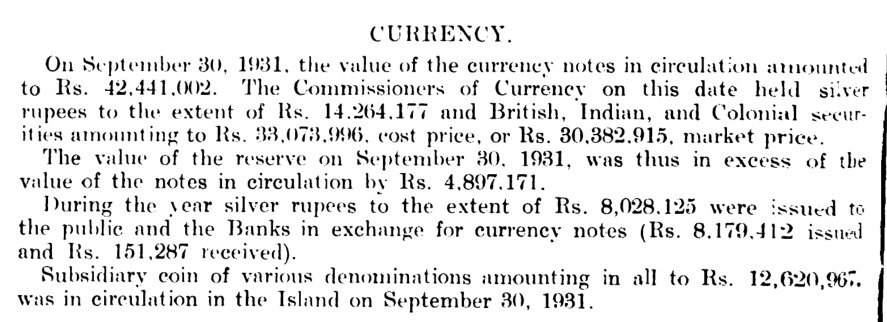
| 30th September 1931 | Rs. 42,441,002 | silver rupees Rs. 14,264,177 | British, Indian and Colonial securities Rs. 33,073,996 at cost, Rs. 30,382,915 at market price | annual report for 1931, No. 1611 |
Chalmers also gives the market value of the securities of December 1891: Rs. 1,933,152.87 for the Indian paper and Rs. 1,379,465.51 for the sterling securities. The report for 1922 puts the reserve Rs. 3,808,860 above the notes, and the report for 1931 puts it Rs. 4,897,171 above them. The report for 1931 adds that Rs. 8,028,125 in silver rupees was paid out net in exchange for notes during the year.
Gold is in the reserve in 1909 and 1912 and is not named in 1922 or 1931. The papers read do not say when it left.
The Depreciation Fund
A second fund covered losses on the investments. The sub-committee on the Paper Currency Bill set its limit at twenty per cent on 18th November 1884 (Sessional Paper XII of 1884). F. R. Ellis, the Auditor-General, described it in 1903 as the sum set aside to meet possible losses on investments, any excess being paid to revenue when it accumulated, and noted that an exceptional Rs. 52,500 had been credited to revenue from it in 1898.
| Day | Currency Depreciation Fund | Source |
|---|---|---|
| 1st January 1887 | Rs. 1,064.86 | Blue Book for 1886 |
| 1st January 1888 | Rs. 421.64 | Blue Book for 1887 |
| 1st January 1890 | Rs. 21,102.83 | Blue Book for 1890 |
| 1st January 1891 | Rs. 22,737.27 | Blue Book for 1890 |
| 1st January 1892 | Rs. 45,564.89 | Blue Book for 1891 |
| 1st January 1893 | Rs. 24,785.55 | Blue Book for 1893 |
| 1st January 1894 | Rs. 54,357.10 | Blue Book for 1893 |
| 1st January 1895 | Rs. 20,747.52 | Blue Book for 1894 |
| 1st January 1902 | Rs. 49,300.17 | Blue Book for 1902 |
| 1st January 1903 | Rs. 18,150.00 | Blue Book for 1902 |
| 1st January 1904 | Rs. 39,589.97 | Blue Book for 1903 |
| 30th September 1919 | Rs. 4,994,757.64 | Blue Book for 1919 |
A mistake of the first years was put right in 1888, when the Council voted Rs. 59,278.71 "to adjust the depreciation fund of the Currency Commissioners, which had been erroneously credited with one per cent. only of the interest on the Commissioners' investments instead of with one per cent. on their investments" (report on the Supplementary Supply Bill, Sessional Papers of 1888).
Three figures in this fund are in doubt in the papers themselves. The fund on 1st January 1886 reads Rs. 244.86 or Rs. 214.86 on the scan. For 1st January 1889 one statement prints Rs. 7,262.09 and the statement of the next year prints Rs. 16,262.09; both are left out of the table. For 1st January 1892 the Blue Book for 1891 has Rs. 45,564.89, as in the table, and the Blue Book for 1892 has Rs. 45,564.39. On 30th September 1916 the Blue Book gives the fund as 96,591 pounds 4 shillings, entered as Rs. 1,314,790.30, with Rs. 719,100 of Indian paper beside it.
What the figures do not tell
- No return gives the reserve against each value of note, and none gives the notes by value.
- The Blue Books give the coin and the invested part in different places and on different days, so the whole reserve on one day is known only for the six days in the table above.
- The Blue Books for 1888, 1895 to 1899, 1905, 1907 to 1911, 1917 and 1918 were not among the volumes read. Of the yearly annual reports on Ceylon only those for 1909, 1911-12, 1922 and 1931 have been read; the others may give the reserve on one day of each year in the same way.
- The figures stop in 1931. Ordinance No. 21 of 1941, which made the Ceylon rupee and reworded the notes, is dealt with in Ceylon in wartime, 1941 to 1949.
Sources
- Robert Chalmers, A History of Currency in the British Colonies (London, 1893), pages 358 and 359.
- Ceylon Blue Books for 1885 to 1887, 1889 to 1894, 1900 to 1904, 1906, 1913 to 1916 and 1919: the statement of assets and liabilities and the list of investments held by the Colony.
- Ceylon Sessional Paper I of 1886: the Colonial Office to the Treasury, 12th November 1884; Lord Derby's despatch of 20th February 1885; the Colonial Office to the Crown Agents, 13th February 1885.
- Ceylon Sessional Paper XII of 1884, report of the sub-committee on the Government Paper Currency Bill, 18th November 1884.
- Ceylon Sessional Papers of 1887 to 1890: the statements of assets and liabilities; the report on the Supplementary Supply Bill of 1888; the statement of sums received and paid by the Crown Agents, 1886 to 1888.
- Proceedings of the Legislative Council of Ceylon: the Governor's addresses of 18th October 1901, of the session of 1902, of 26th October 1903 and of December 1905.
- Ceylon Sessional Paper V of 1903, Report of the Ceylon Currency Commission, Table A1; Sessional Paper XXVII of 1903, Mr. Chamberlain's despatch No. 290 of 11th August 1903 and the Commission's second report; Sessional Paper XXVIII of 1903, F. R. Ellis, Report on the Financial Affairs of Ceylon 1896-1902.
- Colonial Reports, Annual: No. 653, Ceylon, 1909; No. 758, Ceylon, 1911-12; No. 1172, Ceylon, 1922; No. 1611, Ceylon, 1931.
Member comments
Log in or register to post a comment.