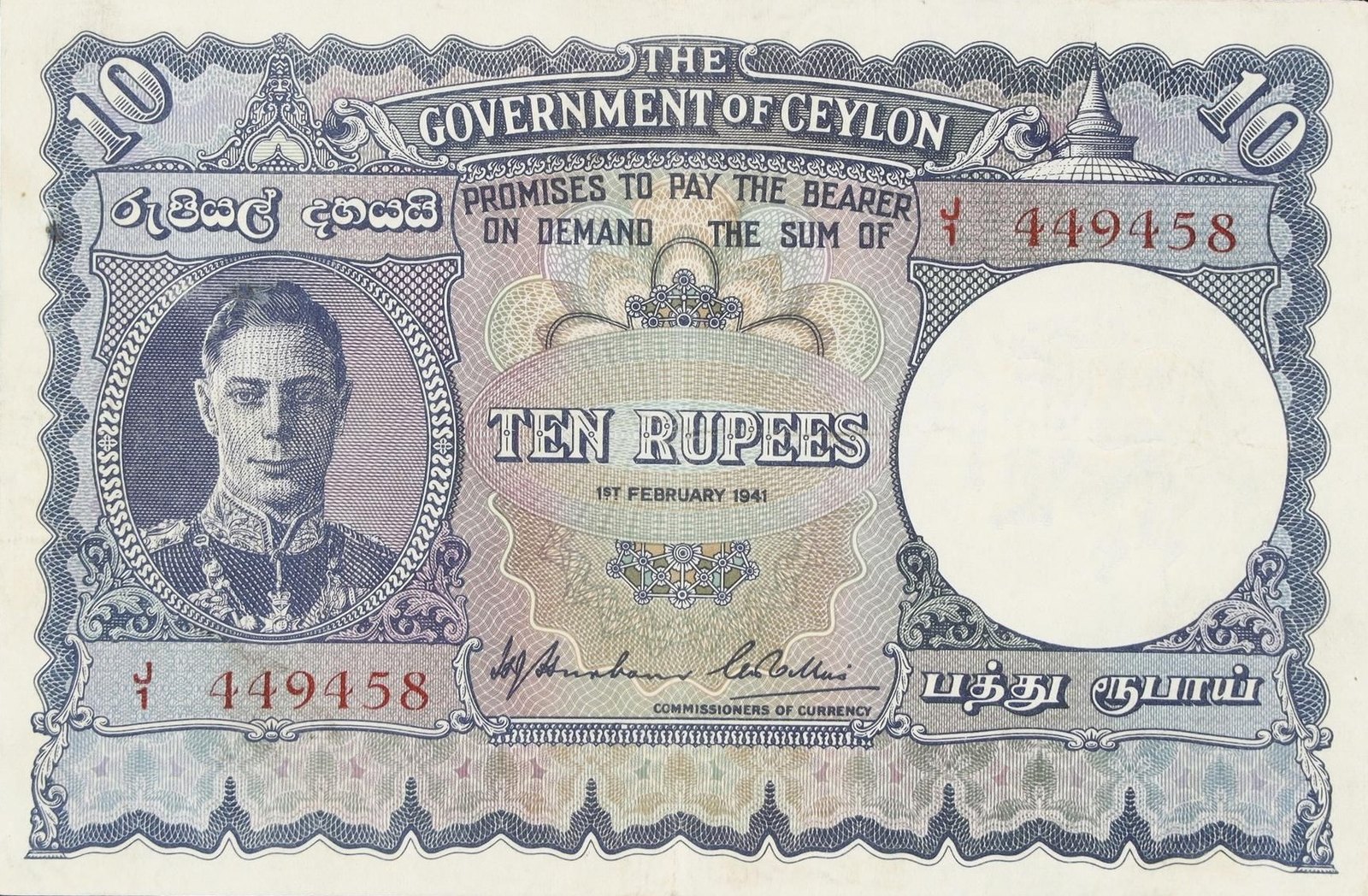
This article covers the notes of the Government of Ceylon dated from 1st February 1941 to 1st December 1949: two issues of rupee notes printed in India, the small change notes of 1942, and the 10,000 rupees. It is drawn from the pages of the notes, whose figures for notes never surrendered come from the demonetisation notices, and from what auction houses have written about single pieces, given as their statements.
The first issue: 1st February 1941
The notes dated 1st February 1941 are the 1 rupee, 2 rupees, 5 rupees and 10 rupees. They carry the portrait of King George VI and were printed in India. The text at the upper centre begins "PROMISES TO PAY", and the heading reads THE GOVERNMENT OF CEYLON.
Stack's Bowers (7 May 2026, lot 51108) calls this the first series printed for Ceylon in India. A 1,000 rupees dated 1st February 1941, signed Huxham & Collins, is known with an all-zero serial number and the blue SPECIMEN / C•N•P / INDIA mark in the watermark panel. Sources mention an issue of that date; no such note has been recorded, and the point is not settled.
The second issue: "THIS NOTE IS LEGAL TENDER"
The new wording followed Ordinance No. 21 of 1941, which created the Ceylon rupee at par with the Indian rupee, the Board paying out Indian currency at Bombay; payment in sterling through London was added in 1944. The text at the upper centre now begins "THIS NOTE IS LEGAL TENDER", and the heading lost its first word: GOVERNMENT OF CEYLON. Stack's Bowers (7 May 2026, lot 51109) puts it that the financial backing of the Ceylon rupee changed with this issue.
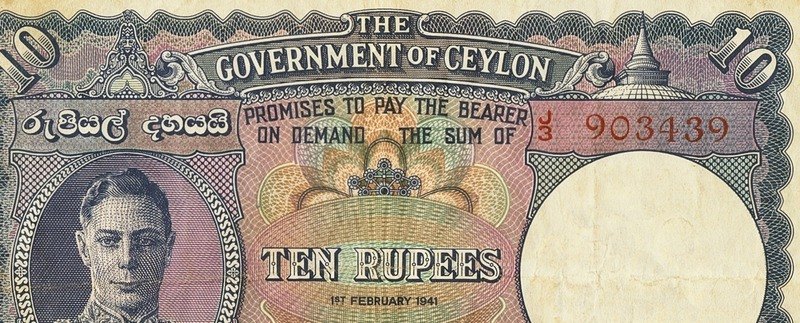
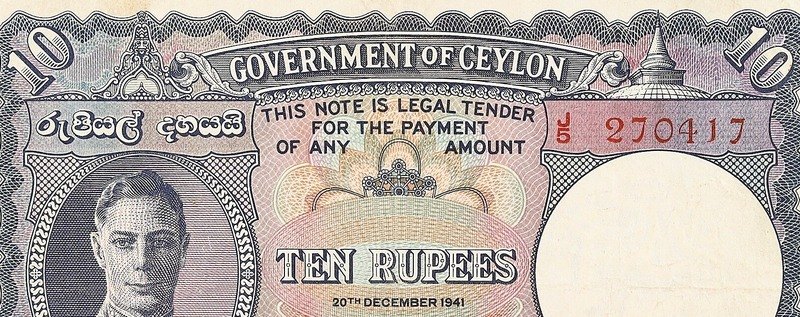
The prefixes did not start again. A/11 on the 1 rupee, E/4 on the 2 rupees, G/4 on the 5 rupees and J/4 on the 10 rupees each run across the change, so the heading and the date decide which issue a note belongs to, not the prefix.
| Value | Dates | Prefixes, as the page gives them |
|---|---|---|
| 1 rupee | 20th December 1941 to 1st March 1949, nine dates | from A/11 |
| 2 rupees | 20th December 1941 to 1st March 1949, nine dates | E/4 to E/56 |
| 5 rupees | 20th December 1941 to 1st March 1949, nine dates | G/4 to G/48 |
| 10 rupees | 20th December 1941 to 1st June 1948, seven dates | J/4 to J/47 |
| 50 rupees | 1st September 1941 to 24th June 1945, five dates | K/1 to K/20 |
| 100 rupees | 1st September 1941 to 1st March 1947, five dates | not given |
| 1,000 rupees | 1st September 1941 and 12th July 1944 | not given |
The page of the 1,000 rupees says it is known primarily in specimen form.
The signers
Four pairs sign the second issue. Huxham & Collins sign the notes of 1941 to 12th July 1944, Goonetilleke & Collins those of 24th June 1945, Goonetilleke & Jones those of 7th May 1946 and 1st March 1947, and Jones & Perera those of 1st June 1948 and 1st March 1949. The pages do not give the offices these signers held.
Booklets
The 1, 2 and 5 rupees of both issues were also issued in booklets, stapled at the left to a perforated counterfoil: 25 notes of 1 rupee, 25 notes of 2 rupees, 20 notes of 5 rupees. A booklet note has a perforated left edge, and a few 1 rupee notes keep the counterfoil. With its counterfoil the booklet is 4¾ inches wide for the 1 rupee, 5¼ inches for the 2 rupees and 5¾ inches for the 5 rupees. The 10 rupees and higher values were not issued in booklets.
What the houses describe
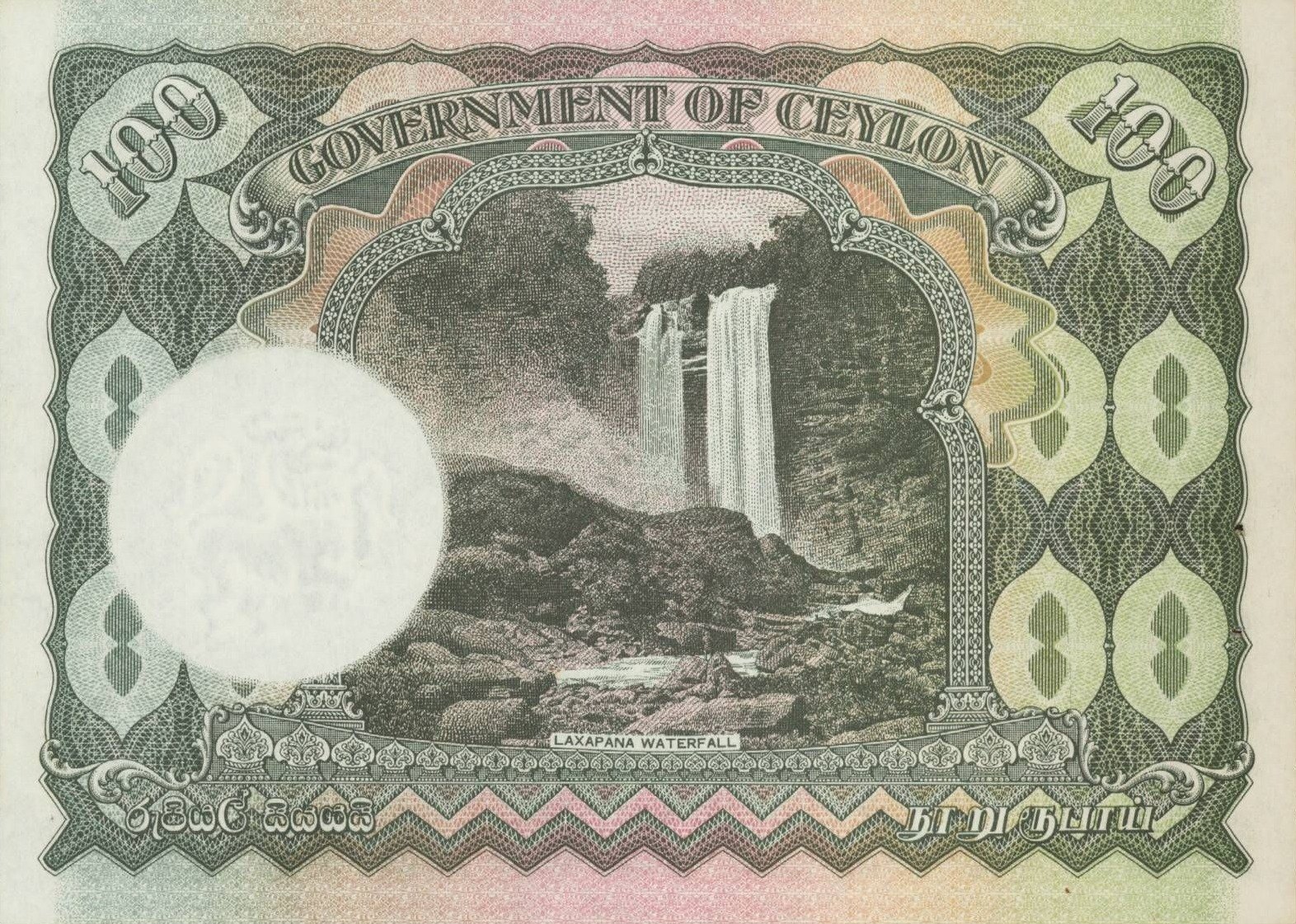
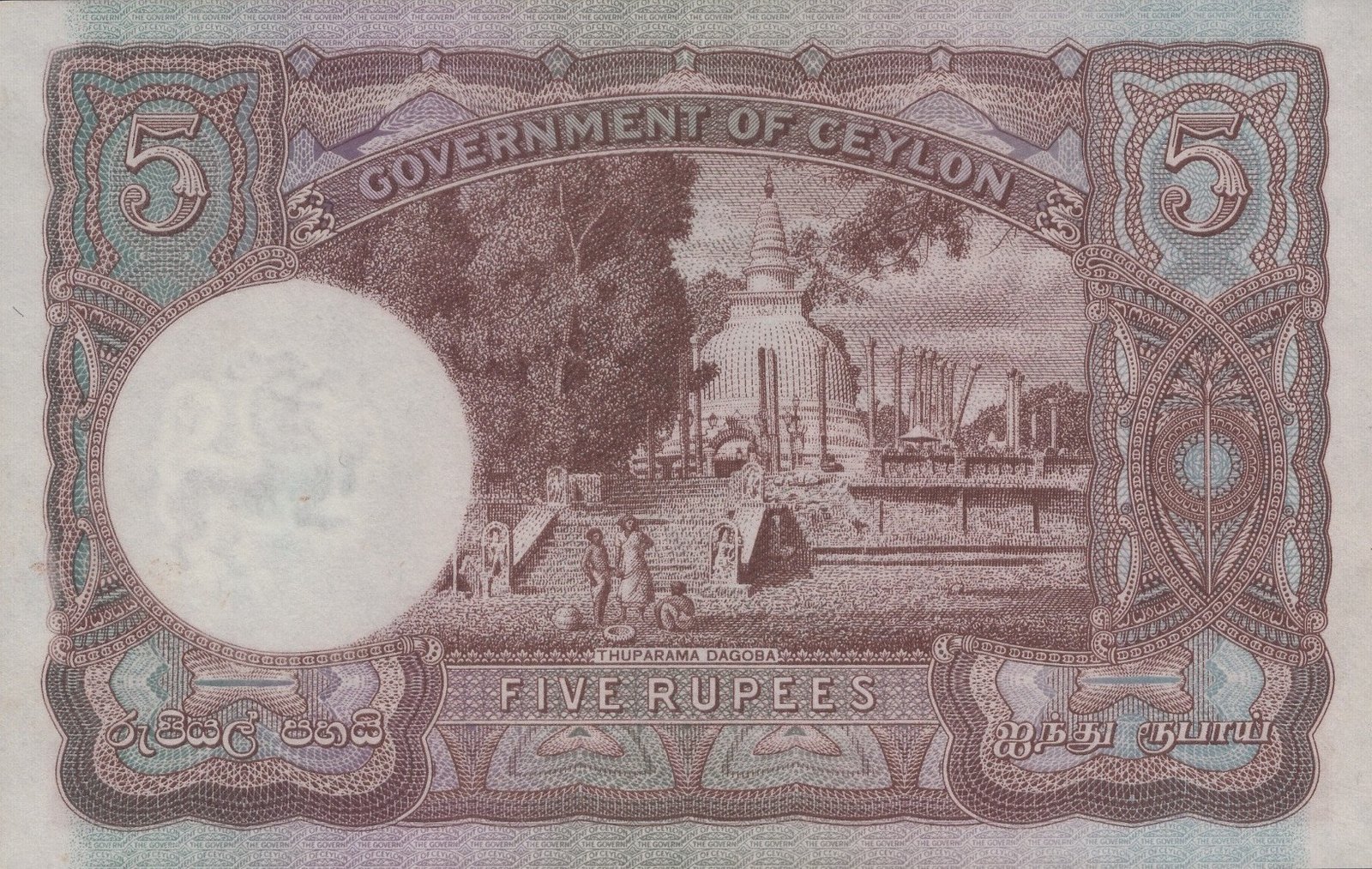
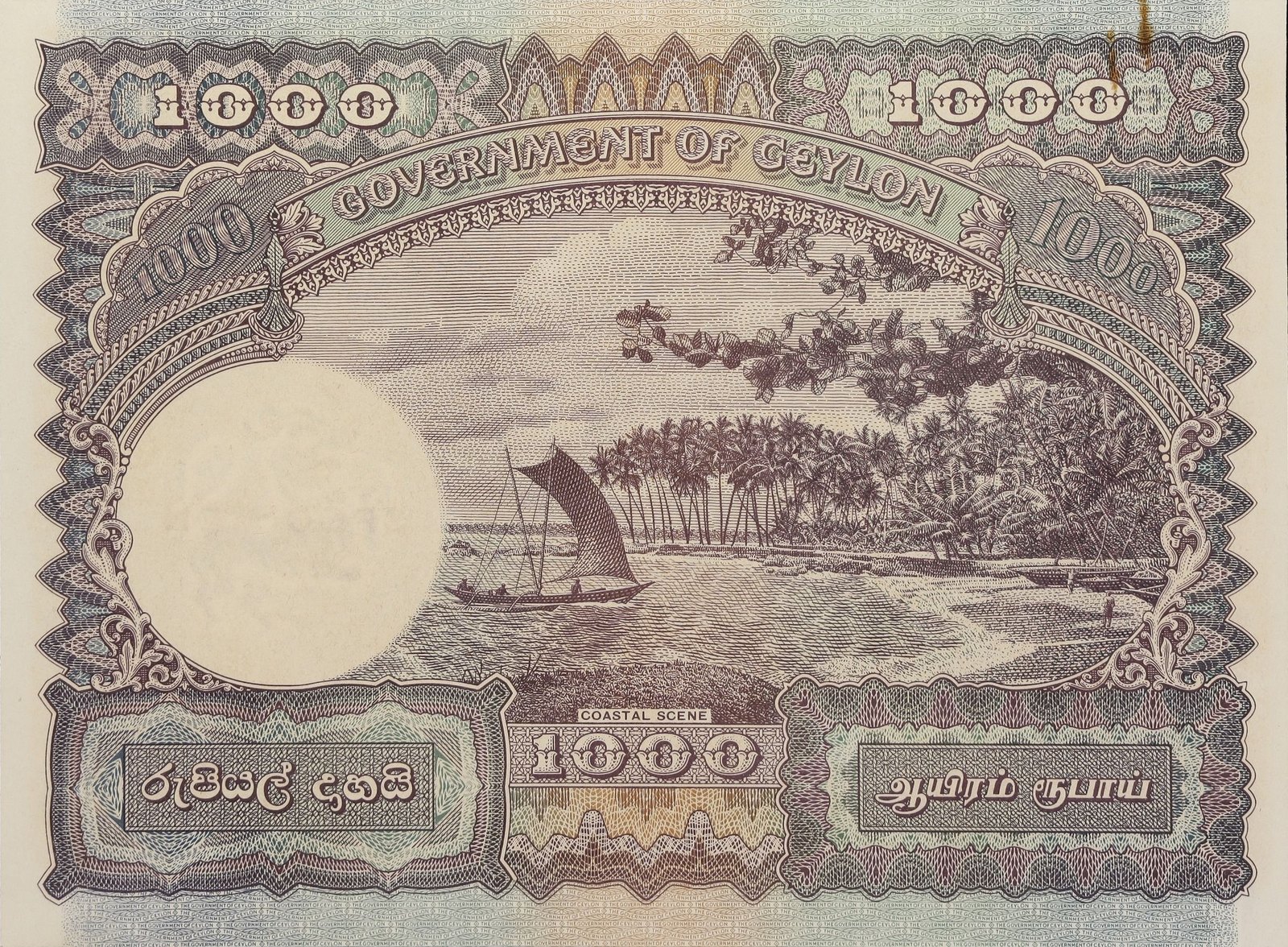
London Coins (2 December 2019, lot 1466) describes the back of the 100 rupees as showing the Laxapana waterfall, and Spink (8 July 2015, lot 91) the back of the 5 rupees as the Temple of the Tooth. Stack's Bowers (7 May 2026, lot 51112) notes that the 1,000 rupees was printed by the India Security Press without an imprint, with a lake view on the back.
Small change, 1942
Two sets of small change notes were made in 1942: three printed in Colombo by the Ceylon Government Press and demonetised in 1942 and 1943, and three printed by the India Government Security Press that stayed in use.
| Note | Printer | Dates | Demonetised | Ceased to be legal tender |
|---|---|---|---|---|
| 25 cents | Ceylon Government Press | 1st January 1942 | 19th June 1942 | 15th July 1942 |
| 50 cents | Ceylon Government Press | 1st January 1942 | 19th June 1942 | 15th July 1942 |
| 5 cents | Ceylon Government Press | 1st June 1942 | 14th July 1943 | 30th September 1943 |
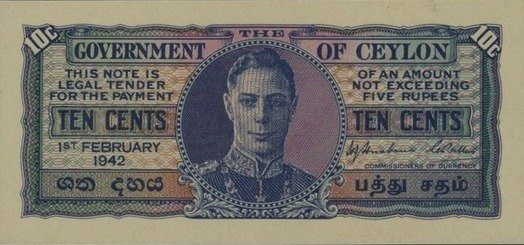
| 10 cents | India Government Security Press | 1st February 1942 to 23rd December 1943 | 26th August 1955 | 31st August 1956 |
| 25 cents | India Government Security Press | 1st February 1942 to 1st December 1949 | 26th August 1955 | 31st August 1956 |
| 50 cents | India Government Security Press | 1st February 1942 to 1st December 1949 | 26th August 1955 | 31st August 1956 |
The Colombo printings
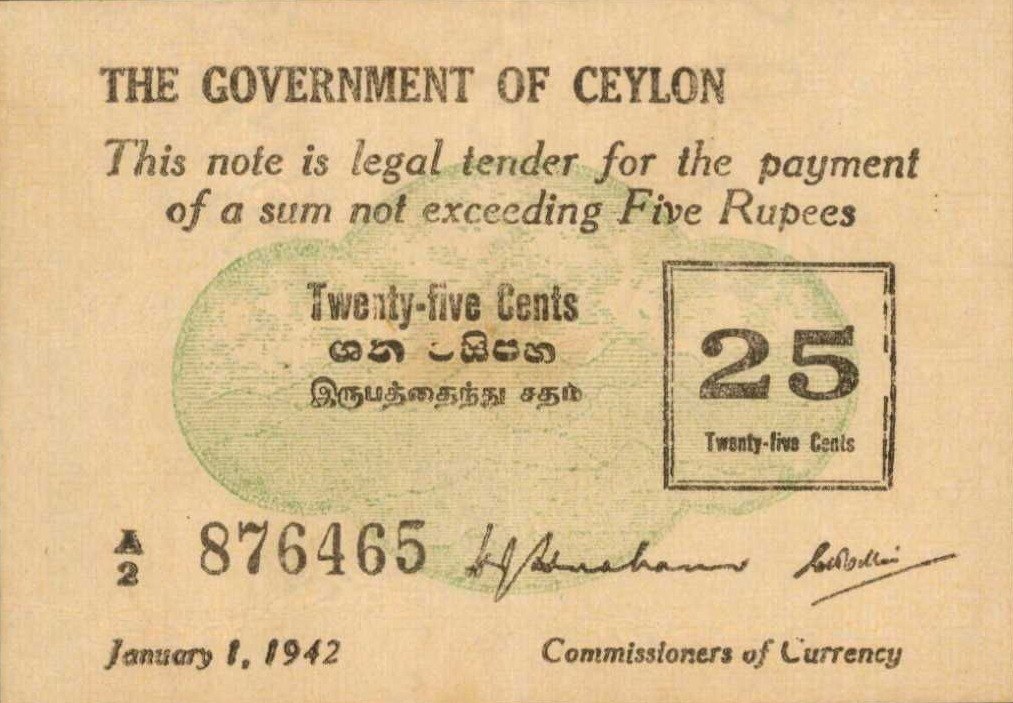
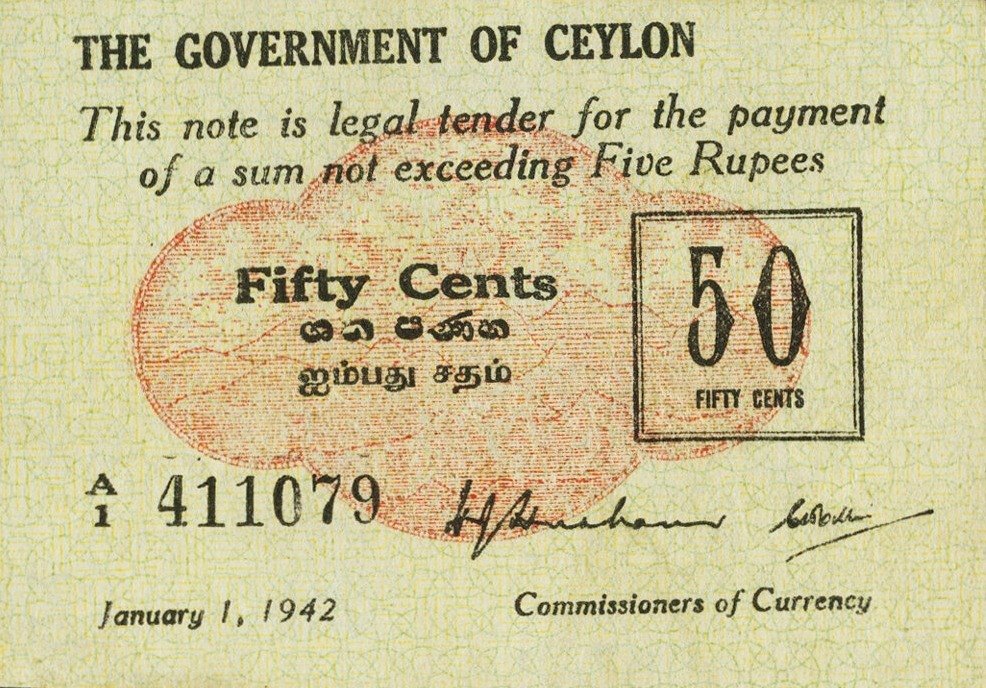
The 25 and 50 cents of 1st January 1942 were printed on one side of the government security paper used for the tea and rubber export coupons, watermarked CEYLON / RESTRICTION / GOVERNMENT, so that each note shows only part of the watermark. They share one layout, the 25 cents with a green underprint and the 50 cents with a red one, and both are signed by the two Commissioners of Currency.
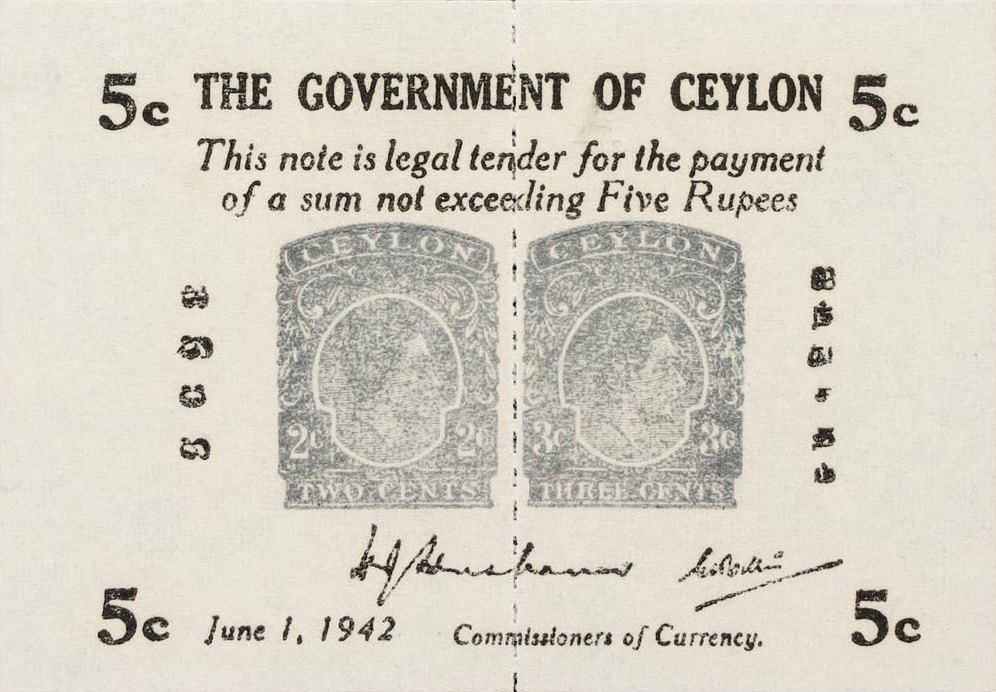
The 5 cents of 1st June 1942 is on plain paper with no watermark. The two stamps on its front are pictures of 2 cents and 3 cents stamps with the King's head, of the kind printed on Ceylon postal stationery; the note is not printed on postcards. One form has a roulette down the centre, so that the note could be torn into a 2 cents and a 3 cents piece.
The Indian printings
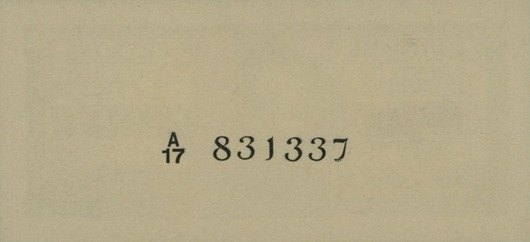
The 10, 25 and 50 cents printed in India have the serial number on the back, and the fractional prefix runs on through all the dates of each value: A/1 to A/74 on the 10 cents, A/1 to A/71 on the 25 cents and A/1 to A/50 on the 50 cents. An India Security Press 25 cents dated 14th July 1942 in another layout, with the King's portrait at the right, was never issued and is known only as a specimen.
How many were never handed in
| Note | Printed or issued | Never surrendered |
|---|---|---|
| 25 cents of 1st January 1942 | not given | 107,276, or 2.6% |
| 50 cents of 1st January 1942 | not given | 99,496, or 4.83% |
| 5 cents of 1st June 1942 | 4,560,000 issued | 1,771,000, or 38.8% |
| 10 cents, 1942 to 1943 | 74 million printed | about 4.9 million |
| 25 cents, 1942 to 1949 | more than 71 million printed | about 2 million |
| 50 cents, 1942 to 1949 | more than 50 million printed | about 0.8 million |
Some numbered blocks of the Colombo printings were probably never issued, because the demonetisation notices do not mention them: A/4 120001 to A/4 240000 of the 25 cents; A/2 060001 to A/4 015200 of the 50 cents, which were printed; and F 480001 to F 720000 and G 480001 to G 720000 of the 5 cents.
The 10,000 rupees, 1946 and 1947
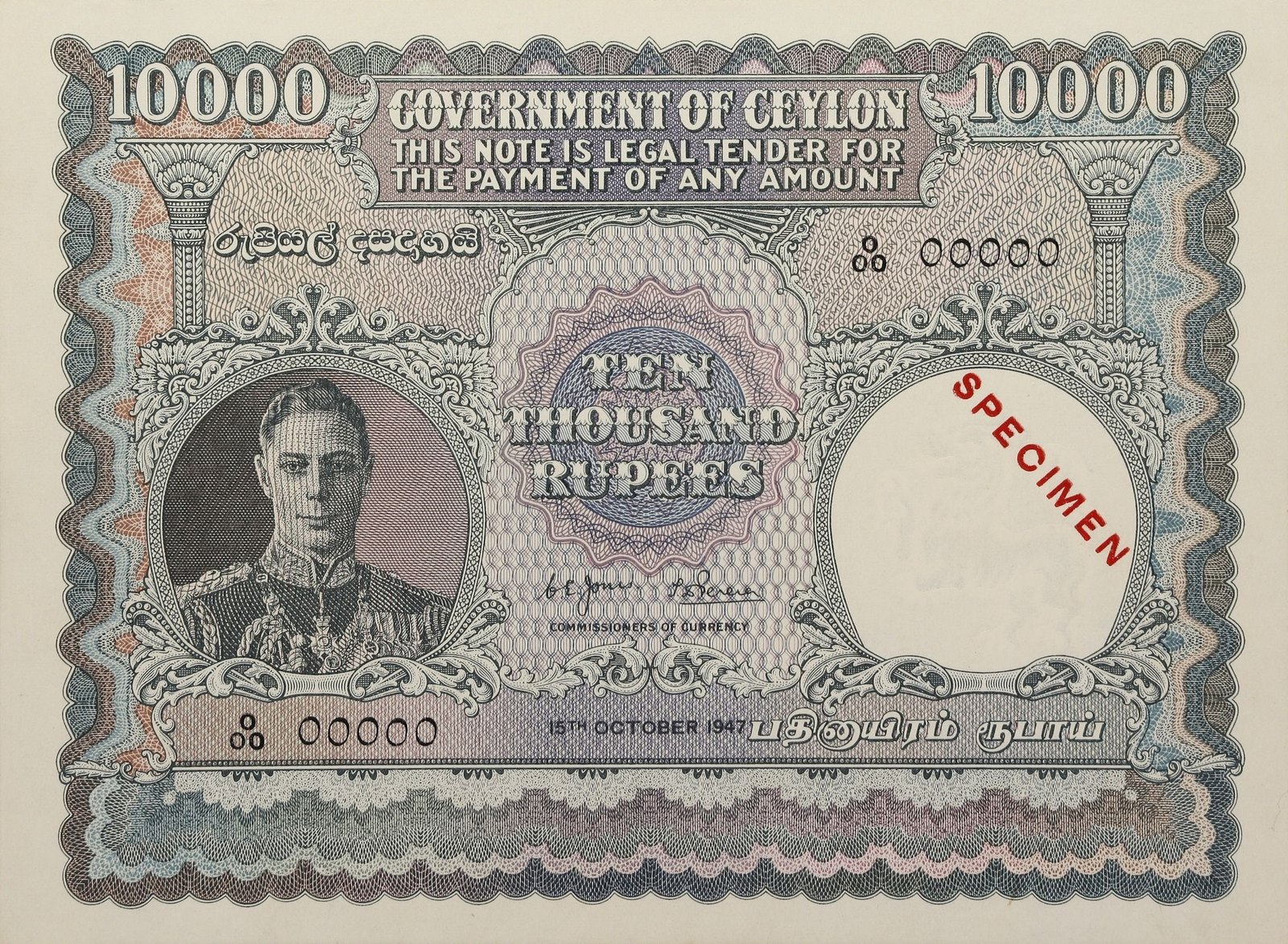
The 10,000 rupees was intended for interbank transactions only. Only specimens are recorded, dated 7th May 1946 and 15th October 1947; the note of 15th October 1947 was introduced in December 1947. No notice withdrawing it has been found.
Stack's Bowers sold a specimen of 15th October 1947 on 7 May 2026 (lot 51113) and another on 23 October 2026 (lot 31293). The house's descriptions say the note was printed by the India Security Press without an imprint, with the King's portrait at the left of the front and the shore of Kandy Lake on the back, and with text in English, Sinhala and Tamil on both sides. They add that the type seems first to have been made as a proof dated 1946 in different colours before the form dated 1947. Of the first specimen the house said it was the only one in the PMG population report at the time.
The end of the wartime notes
All 500 and 1,000 rupees notes were demonetised on 15th November 1945 and ceased to be legal tender after 31st January 1946. Notes of 10 rupees and lower dated before 31st December 1950 were demonetised on 26th August 1955 and ceased to be legal tender with effect from 31st August 1956. The 50 and 100 rupees dated before 26th October 1970 ceased to be legal tender with effect from 3rd November 1970. The notes that came before and after these are set out in The notes of Ceylon, 1885 to 1954.
Sources
- The Pick pages of Ceylon in this catalogue for the notes of 1941 to 1949, which name Ordinance No. 21 of 1941 and the demonetisation notices.
- London Coins, 2 December 2019, lot 1466.
- Spink, 8 July 2015, lot 91.
- Stack's Bowers, 7 May 2026, lots 51108, 51109, 51112 and 51113; 23 October 2026, lot 31293.
Member comments
Log in or register to post a comment.