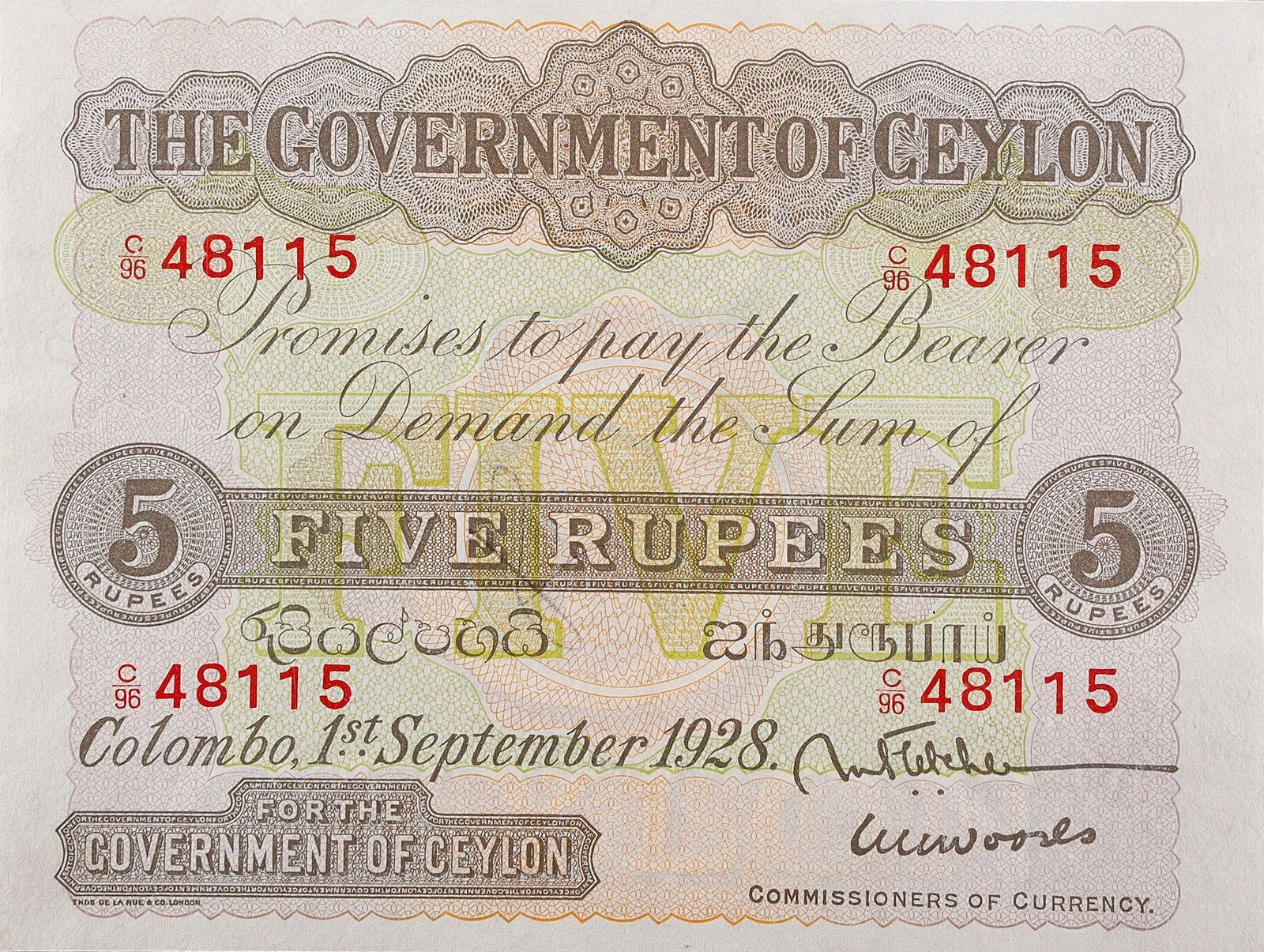
This article sets out the notes of Ceylon in the catalogue in order of time, from the first government rupee notes of 1885 to the last notes with the Queen's portrait in 1954. It is drawn from the pages of the notes themselves, with what the auction houses have written about single pieces given as their statements. The law and the circulation figures of the first forty years have an article of their own: Ceylon's first government rupee notes, 1884 to 1926.
1885 to 1926: the Commissioners of Currency and the uniface notes
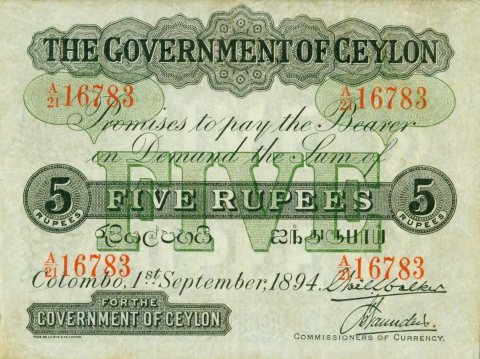
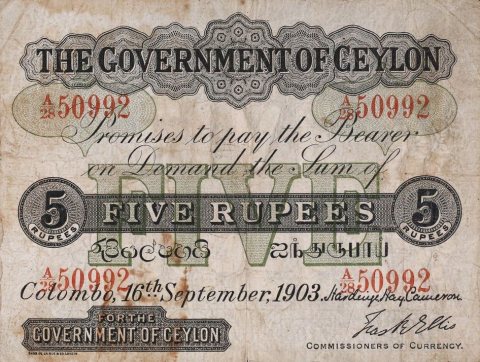
The Government of Ceylon took over the note issue after the Oriental Bank Corporation failed on 3rd May 1884. Ordinance No. 32 of 1884 set up the Commissioners of Currency, and each note was signed by two of the three. The first notes, dated 1st January 1885, were the 5 rupees, the 10 rupees and the 50 rupees. The 100 rupees followed with the date 1st October 1885 and the 1,000 rupees with the date 1st August 1899.
All were printed by Thomas De La Rue & Co. in London in black on white paper, with the value in words and the serial number panels in colour, and with a blank back. The earliest dates carry a handwritten signature. Secret marks were added to the notes from 1913 and 1914: from A/74 20001 on the 5 rupees and B/33 25001 on the 10 rupees, both on the notes of 20th January 1913, and from C/3 79001 on the 50 rupees and F/1 35001 on the 1,000 rupees, both on the notes of 1st April 1914. On the 100 rupees they begin at D/2 54501.
1917: the 1 and 2 rupees
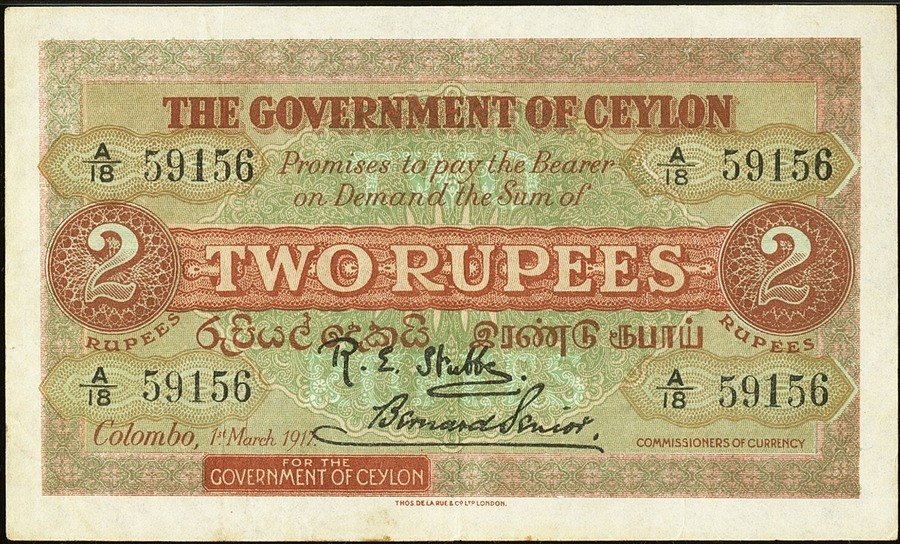
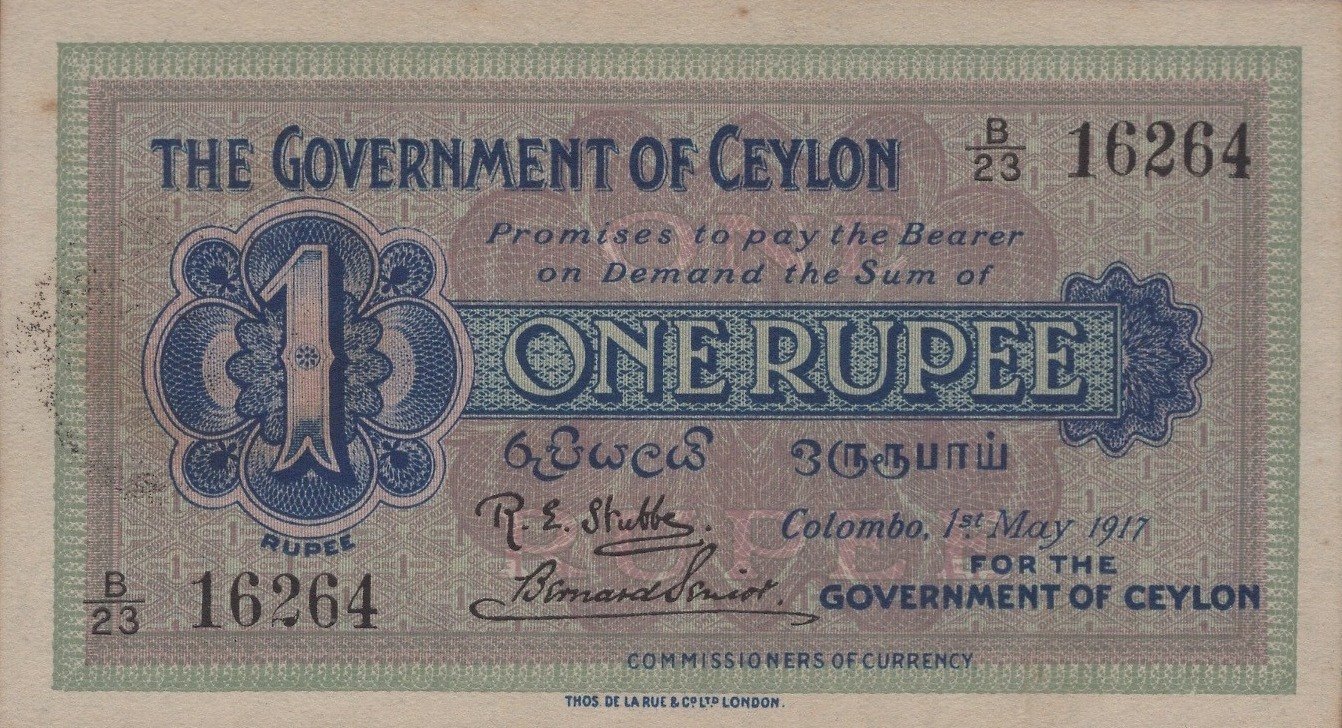
The 1 and 2 rupees were new denominations in 1917: Ordinance No. 1 of 1917 amended the currency ordinance of 1884 to allow them. B. W. Fernando's Ceylon Currency: British Period 1796-1936 (Ceylon Government Press, 1939), as transcribed on coins.lakdiva.org.lk (the printed book was not seen), says both were issued in May 1917 as a war measure, and that the same ordinance made every currency note legal tender in Ceylon for the payment of any amount. The pages of the notes give no month of issue: the first 2 rupees is dated 1st March 1917 and the first 1 rupee 1st May 1917.
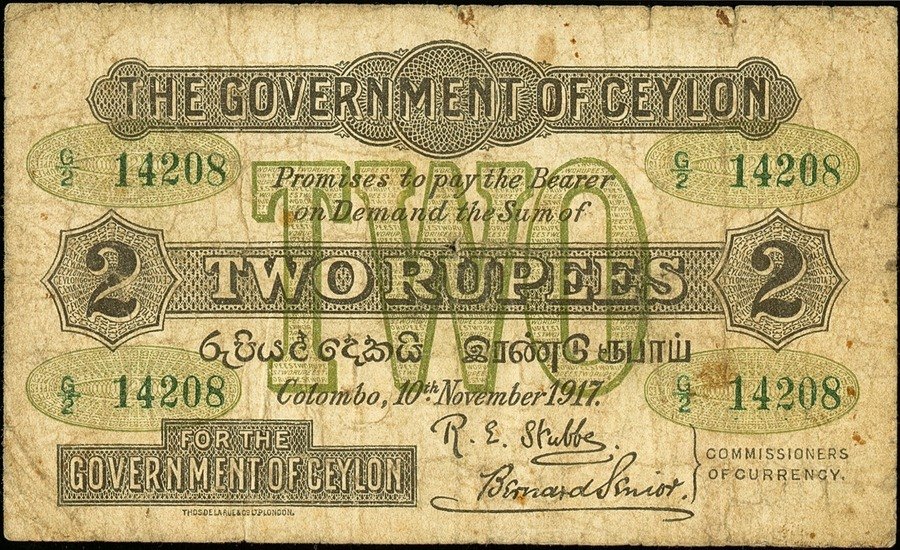
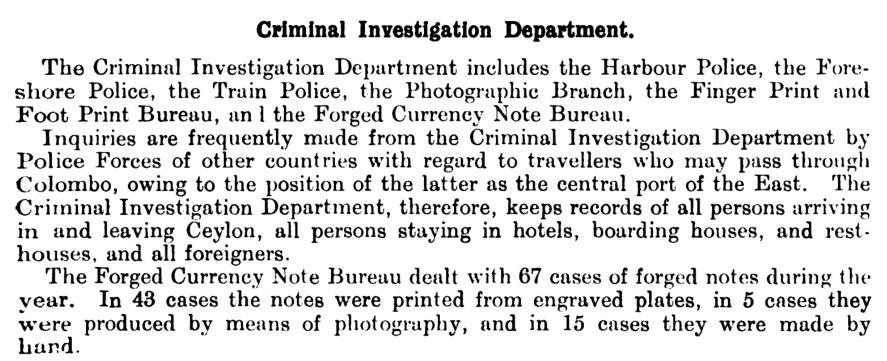
Three different 2 rupees were issued. The first, dated 1st March 1917 only and signed Stubbs & Senior, is printed in red brown on a green ground. Notes A/8 50001 to A/12 50000 of it were lost in transit on 23rd June 1917, when the SS Mongolia struck a German mine about 50 miles south-west of Bombay; they never reached Ceylon. The second, in black or dark green with coloured panels and a blank back, has three dates from 10th November 1917 to 1st October 1921. Its page records that these notes were successfully counterfeited, and that no 2 rupees was issued for some time afterwards. The third, with the same front and an elephant between palm trees on the back, runs from 1st October 1925 to 2nd October 1939.
The 1 rupee was issued on 22 dates from 1st May 1917 to 2nd October 1939, each with its own prefix block; a 23rd date, 8th December 1919, is in doubt. Fernando's book of 1939, as transcribed on coins.lakdiva.org.lk, says the 1 rupee note had become so popular that it had driven the silver rupee almost entirely out of circulation.
1925 to 1939: the elephant backs
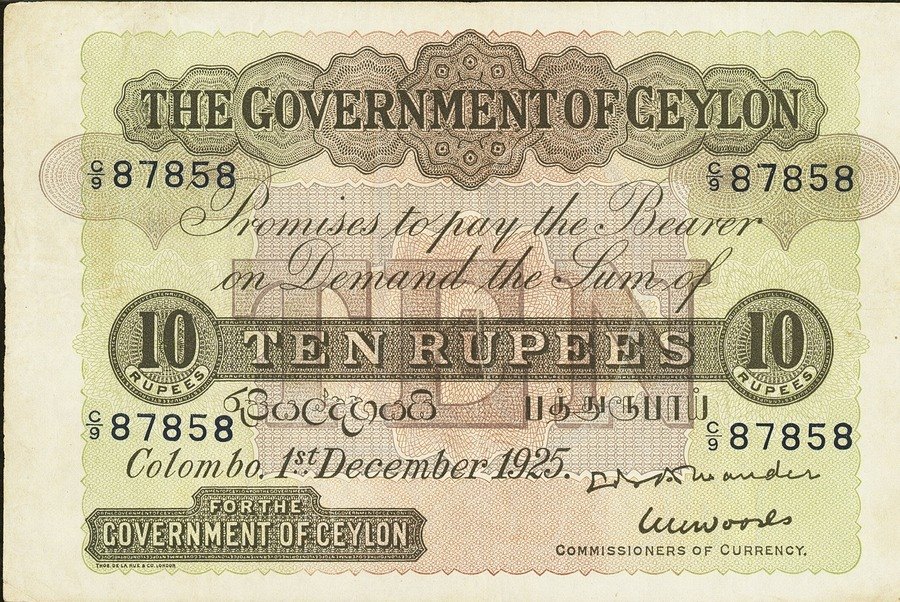
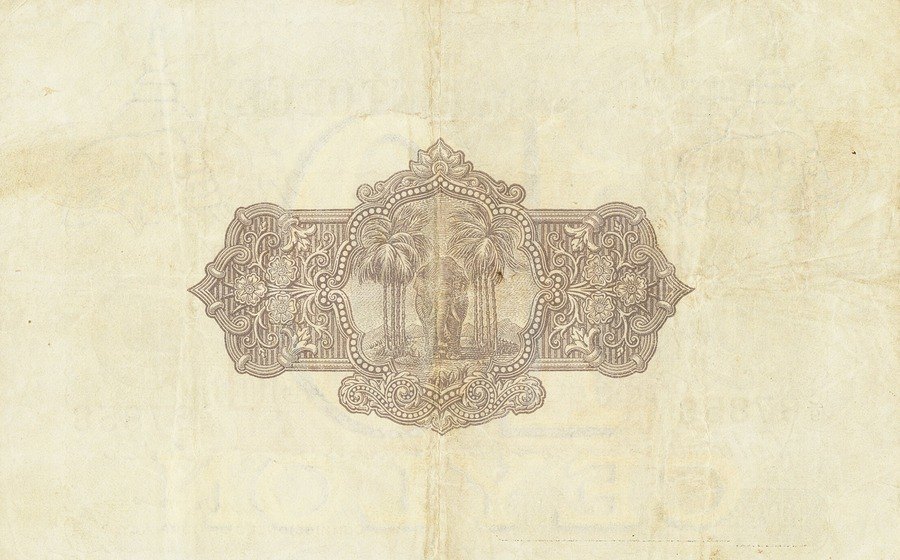
From 1925 the higher values were redrawn with a coloured underprint over the whole front and an elephant between palm trees on the back, the wording and the layout of the front staying as they were. The 5 rupees and the 10 rupees of this design have 1st December 1925 as their first issued date; specimens of both dated 1st October 1925 are recorded. In 1929 both were made smaller: the 5 rupees of 1929 to 1939 measures 140 by 89 mm against 168 by 129 mm, and the 10 rupees of 1929 to 1939 152 by 102 mm against 195 by 126 mm. The 50 rupees and the 1,000 rupees took the new design with the notes of 1st July 1929. The pages record that the prefixes run on across these changes: D/2 to D/3 on the 5 rupees in 1929, C/57 on the 10 rupees in 1929, C/6 on the 50 rupees and F/2 on the 1,000 rupees.
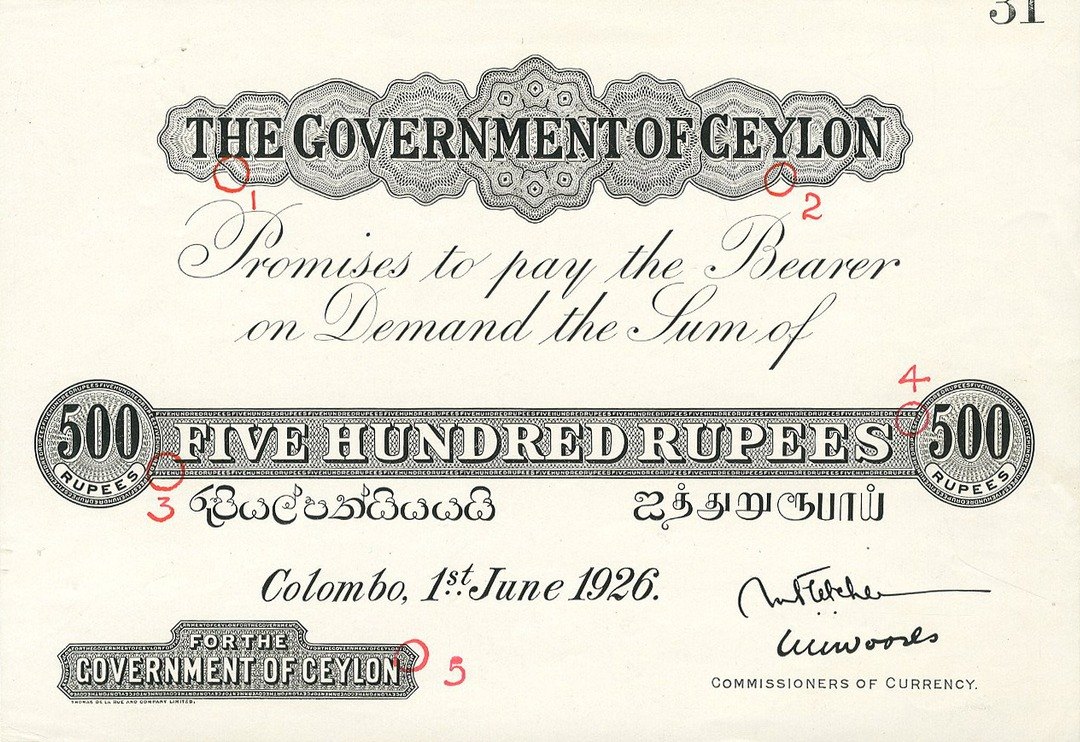
The 500 rupees, allowed by the ordinance since 1884, has one date, 1st June 1926, and one signature pair. Of the 50,000 printed, 2 were never surrendered. The page says the 500 rupees was not issued before 1926 and gives no month of issue. Fernando's book, as transcribed on coins.lakdiva.org.lk, gives April 1927 as the month the 500 rupees was issued and says its circulation was very small.
No elephant-back 100 rupees has been photographed or sold. The catalogue number P-27, given to a 100 rupees of "1926-1939", therefore shares the page of the uniface 100 rupees.
Booklets
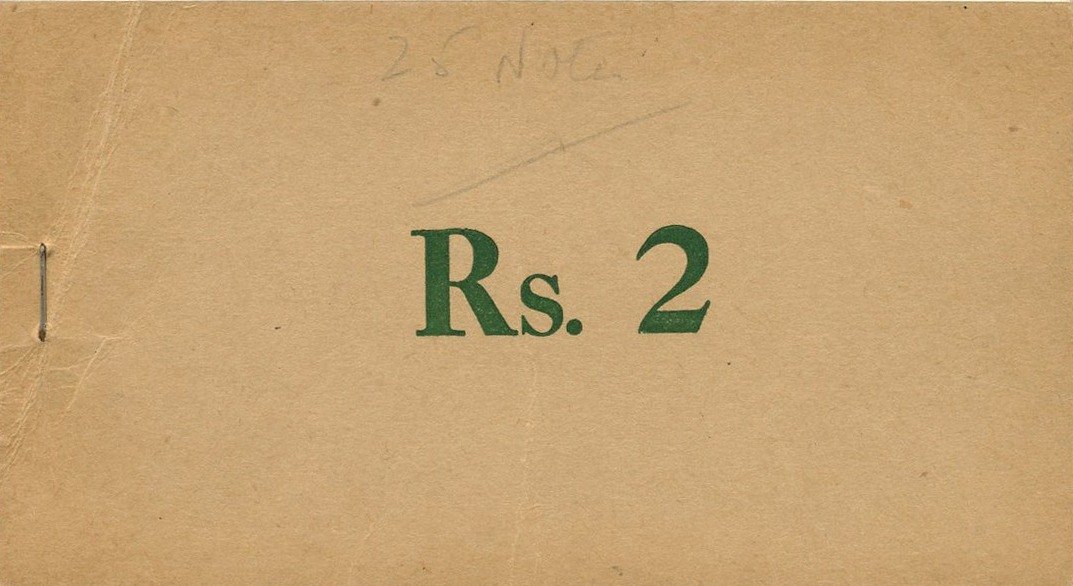
The three lowest values were also issued bound in booklets, stapled at the left to a perforated counterfoil, so that a note could be torn out as needed: 25 notes of 1 rupee, 25 notes of 2 rupees and 20 notes of 5 rupees. A booklet note has a perforated left edge, the others a straight cut. The pages of the notes date the booklets from 1922 for the 1 rupee, 1926 for the 2 rupees and 1929 for the 5 rupees. Fernando's book, as transcribed on coins.lakdiva.org.lk, gives 1923, 1927 and 1930. The two sets of years differ by one year throughout, and which is right is not settled here.
Forgery in 1931
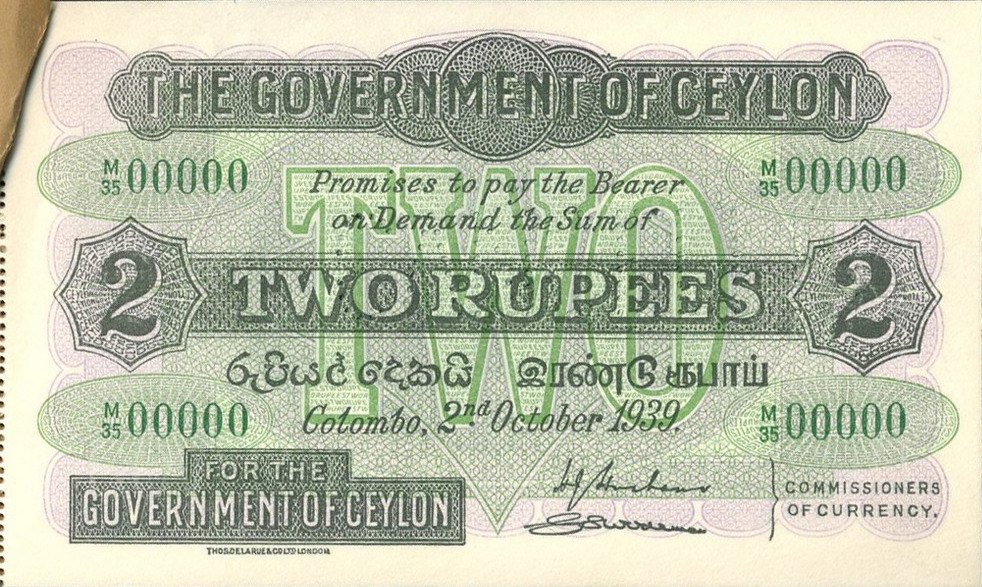
The annual report for 1931 says the police had a Forged Currency Note Bureau, which dealt with 67 cases of forged notes that year, most of them printed from engraved plates. Rs. 42,441,002 in government notes were in circulation on 30th September 1931 (the annual report for 1931). The pages do not say which values were forged.
A range that was invalidated
Sources mention that the 1 rupee notes of 2nd October 1939 numbered R/44 50001 to R/46 50000 were lost, damaged or destroyed through enemy action and were invalidated.
Designs that were not issued, 1928 and 1938
Spink (5 December 2013, lot 173) sold photographic proofs on card of an unissued 10 rupees dated 1st January 1928, with an elephant, a mountain and a lake on the front and a beach scene with palm trees and a boat on the back.
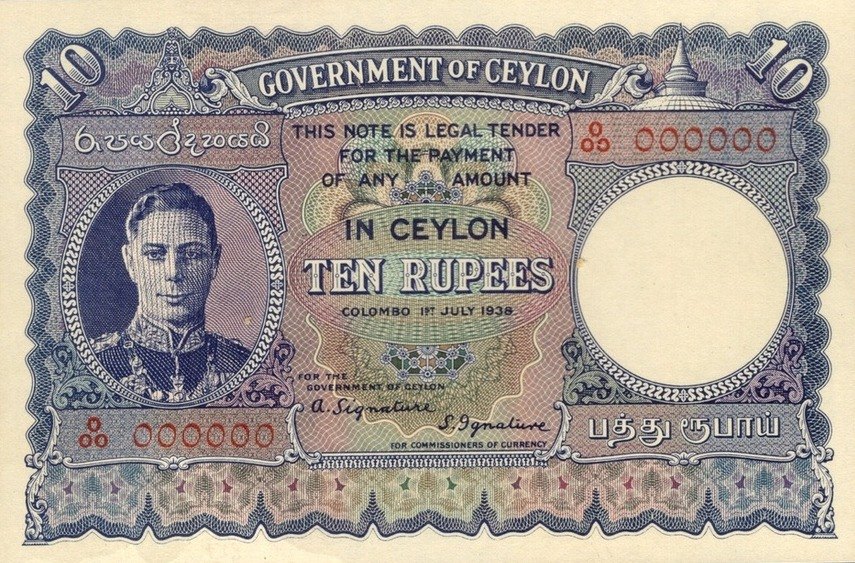
A King George VI series dated 1st July 1938 was prepared and never issued. The catalogue records a 10 rupees and a 1,000 rupees, both as printer's designs with all-zero serial numbers and fictitious signatures, and gives the India Security Press as printer. Spink, selling the 10 rupees (14 April 2010, lots 181 and 182), called it presumably an experimental issue for the new series. Stack's Bowers, selling photographic proofs of a 5 rupees of the same date (17 January 2025, lot 20121), says that Thomas De La Rue prepared that design and that it was most likely the outbreak of war that kept it from being printed. The two statements on the printer do not agree, and no document read for the catalogue settles it. Other unissued designs with the two Kings are described in Notes that never were.
1941 to 1949: notes printed in India
From 1941 the notes carry the portrait of King George VI and were printed in India. The first issue, dated 1st February 1941, still begins "PROMISES TO PAY"; from September and December 1941 the text reads "THIS NOTE IS LEGAL TENDER", following Ordinance No. 21 of 1941. Small change notes of 5, 10, 25 and 50 cents were added in 1942. These issues are set out in Ceylon in wartime, 1941 to 1949.
1951 to 1954: the Central Bank of Ceylon
The Central Bank of Ceylon was set up by the Monetary Law Act No. 58 of 1949 and opened on 28th August 1950. Its first Governor, John Exter, was an American citizen. The notes were printed by Bradbury Wilkinson.
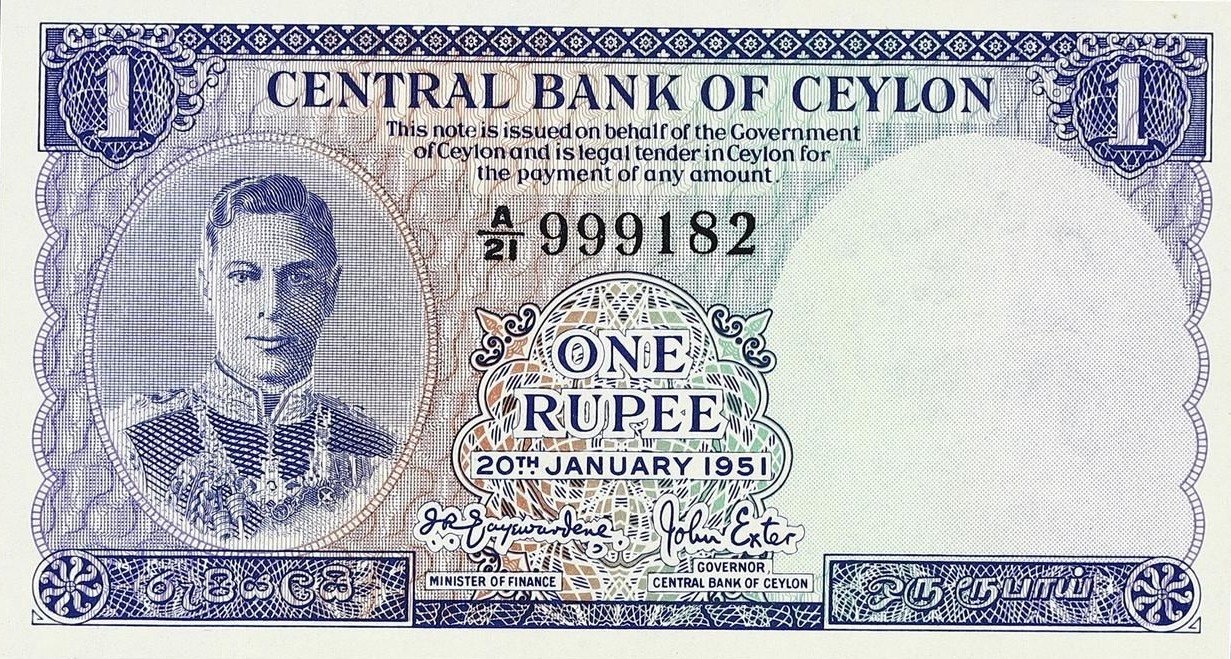
The first issue is dated 20th January 1951 and has the portrait of King George VI. Only two values were issued, both signed by Jayewardene as Minister of Finance and Exter as Governor: the 1 rupee, prefixes A/1 to A/30, and the 10 rupees, prefixes L/1 to L/20. A 2 rupees, a 5 rupees, a 50 rupees and a 100 rupees with the King were prepared with the prefixes E/1, G/1, R/1 and V/1 and are known only as proofs. One proof of the 2 rupees is overprinted AS SUBMITTED 21-1-52. Lyn Knight (9 June 2011, lot 138) sold a proof of the 100 rupees marked as the third proving of 30th October 1951, and says many parts of its design were used again for the Queen's 100 rupees.
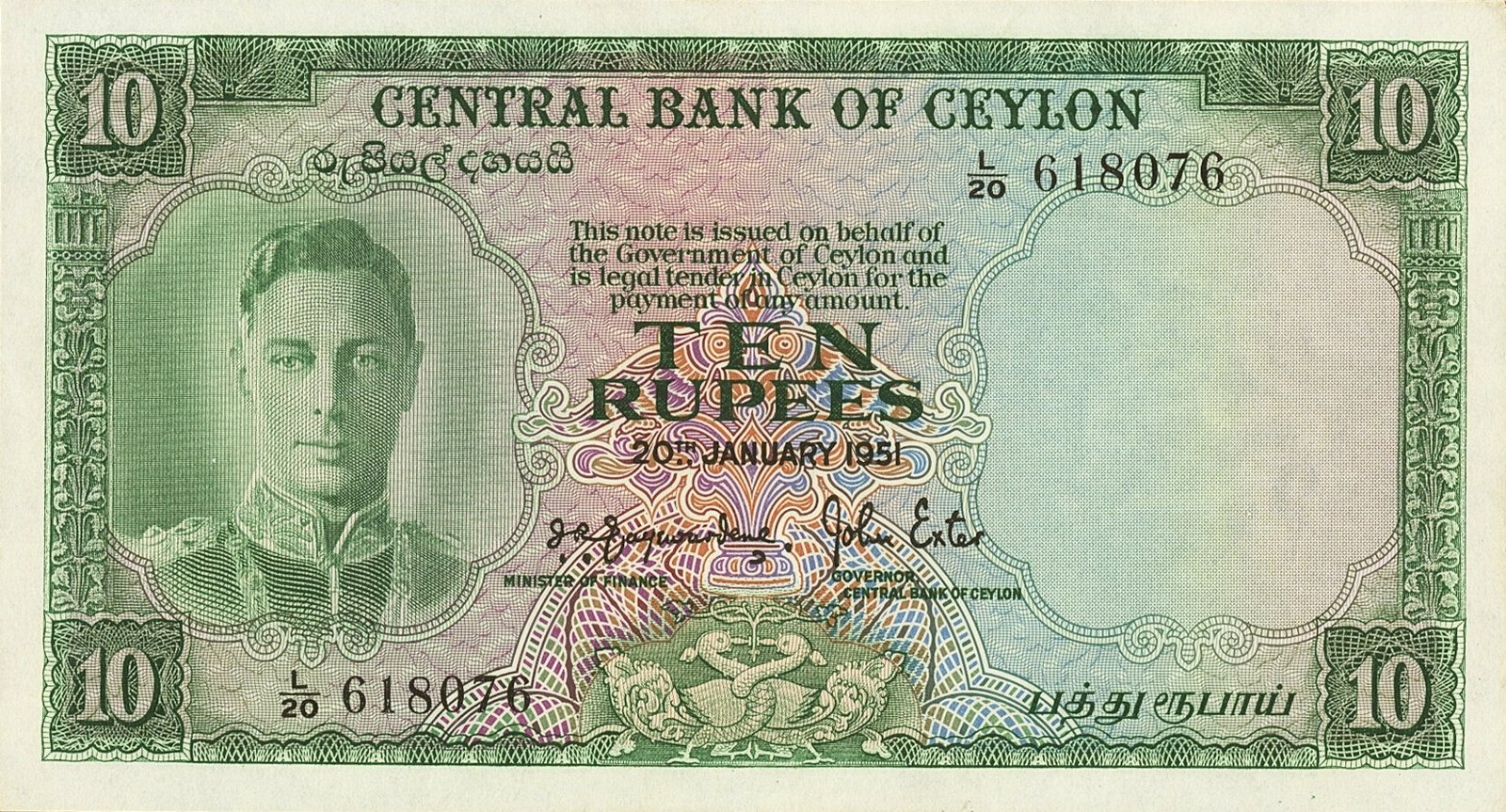
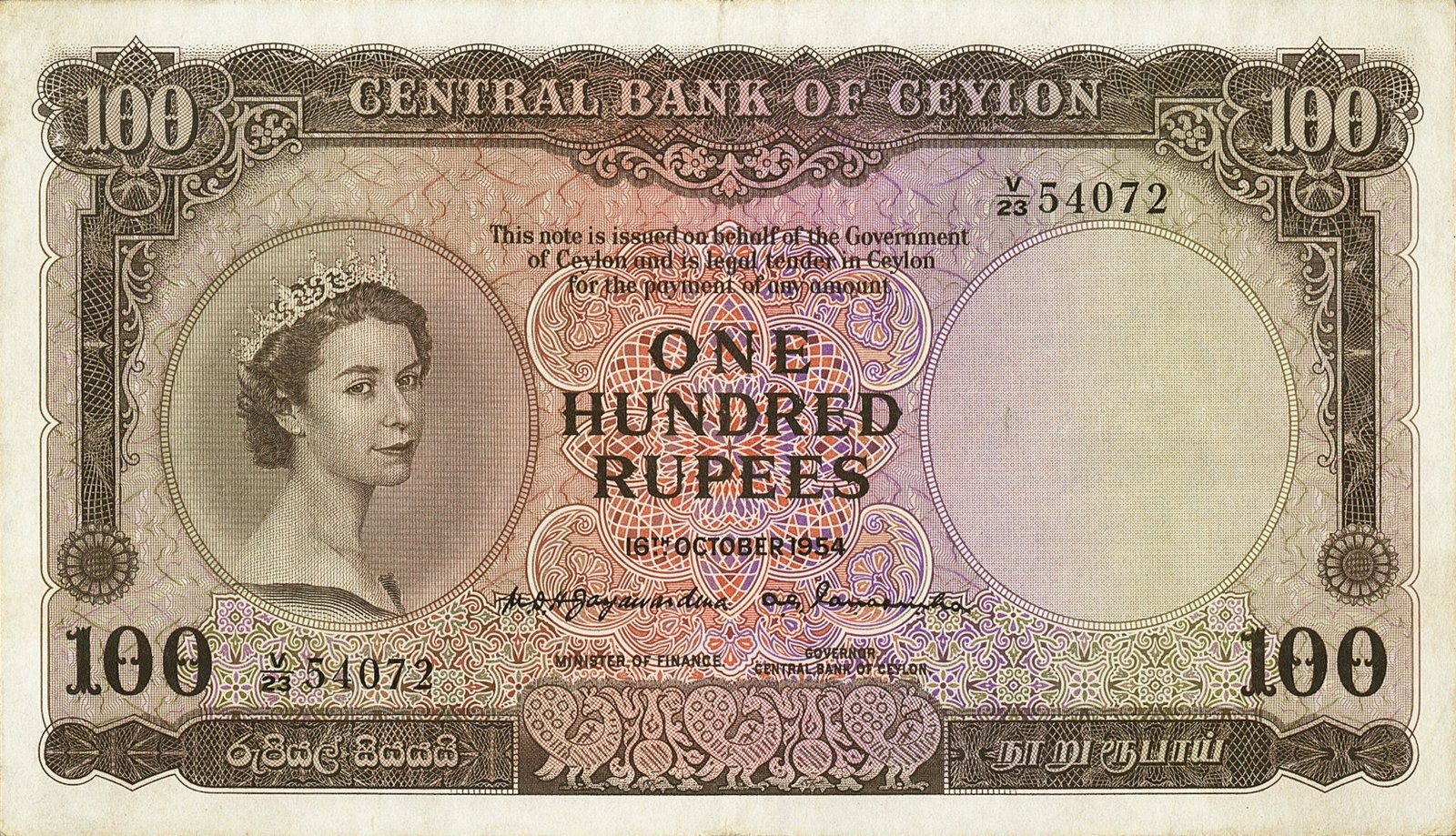
The Queen Elizabeth II notes took over the same prefix letters. The table gives the dates and signers as the pages have them.
| Date | Values | Minister of Finance | Governor |
|---|---|---|---|
| 3rd June 1952 | 1, 2, 5, 50 and 100 rupees | Jayewardene | Exter |
| 1st July 1953 | 10 rupees | Jayewardene | N. U. Jayawardena |
| 12th May 1954 | 50 rupees | Goonetilleke | Jayawardena |
| 16th October 1954 | 1, 2, 5, 10 and 100 rupees | Jayawardena (M. D. H. Jayawardena on the page of the 10 rupees) | Ranasinha |
The pages are the 1 rupee, 2 rupees, 5 rupees of 1952, 5 rupees of 1954, 10 rupees, 50 rupees and 100 rupees. Two different Jayawardenas sign the 10 rupees: N. U. Jayawardena as Governor in 1953 and M. D. H. Jayawardena as Minister of Finance in 1954. The 5 rupees of 1954 is in different colours from that of 1952 and has a page of its own; Heritage (8 December 2023, lot 22149) describes the change as from purple to orange and gives no reason for it. Sources mention that the Queen's portrait, facing left, follows a 1952 photograph by Dorothy Wilding, engraved by Bradbury Wilkinson.
Before the Central Bank opened under that name, notes were drawn for a "Reserve Bank of Ceylon"; see Central banks that never opened.
Withdrawal
| Notes | Demonetised | Ceased to be legal tender |
|---|---|---|
| 500 and 1,000 rupees, all dates | 15th November 1945 | after 31st January 1946 |
| All other notes dated before 1st January 1940 | 13th April 1946 | with effect from 31st July 1946 |
| Notes of 10 rupees and lower dated before 31st December 1950 | 26th August 1955 | with effect from 31st August 1956 |
| 50 and 100 rupees dated before 26th October 1970 | not given | with effect from 3rd November 1970 |
Of the 318,000 notes of 1,000 rupees printed across the ten dates from 1899 to 1944, 12 were never surrendered to the issuing authority. No notice withdrawing the 10,000 rupees has been found.
What the auction houses say about single pieces
These are the houses' statements, not counts made here.
- 100 rupees of 1st June 1926. Heritage (16 June 2026, lot 22025) says that only two prefixes are recorded for the date, that its note was the only graded example in the PMG population report, and that no other issued example had been traced on the market.
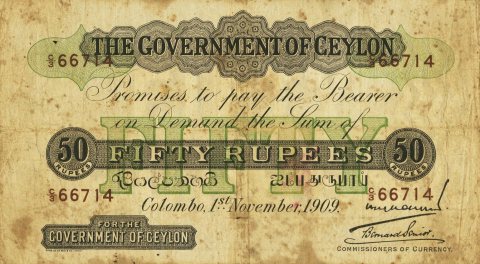
- 50 rupees of 1st November 1909. Heritage (4 September 2014, lot 26158), selling the note from the Ruth W. Hill Collection, says the date was unlisted in the Pick catalogue and that the note may be the only 50 rupees of 1909 to survive. Heritage offered a 50 rupees of the same date again on 4 January 2018 (lot 28172).
- Specimens with ordinary serial numbers. Stack's Bowers sold the Bay of Bengal Collection on 7 May 2026. Of a 2 rupees of 1st March 1917 (lot 51099), a 1,000 rupees of 23rd March 1918 (lot 51098) and a 50 rupees of 1st July 1891 (lot 51101), each stamped SPECIMEN over a normal serial number, the house says they were probably issued notes stamped after they were withdrawn, and adds for the 50 rupees that the exact status of such pieces remains unclear. The house reads the signatures on the 50 rupees as E. N. Walker and F. R. Saunders and on the 1,000 rupees as R. E. Stubbs and Bernard Senior.
- 1,000 rupees of 1st July 1938. Spink (27 September 2011, lot 516) says no other example is believed to exist; the same piece was offered again by Spink (2 October 2012, lot 214).
Sources
- The Pick pages of Ceylon in this catalogue, which name their own sources: Ordinance No. 32 of 1884, Ordinance No. 1 of 1917, Ordinance No. 21 of 1941, the Monetary Law Act No. 58 of 1949, the annual report on Ceylon for 1931 and the demonetisation notices.
- B. W. Fernando, Ceylon Currency: British Period 1796-1936 (Ceylon Government Press, 1939), chapter VII, as transcribed at coins.lakdiva.org.lk. The printed book was not seen.
- Heritage Auctions, 4 September 2014, lot 26158; 4 January 2018, lot 28172; 8 December 2023, lot 22149; 16 June 2026, lot 22025.
- Lyn Knight, 9 June 2011, lot 138.
- Spink, 14 April 2010, lots 181 and 182; 27 September 2011, lot 516; 2 October 2012, lot 214; 5 December 2013, lot 173.
- Stack's Bowers, 17 January 2025, lot 20121; 7 May 2026, lots 51098, 51099 and 51101.
Member comments
Log in or register to post a comment.