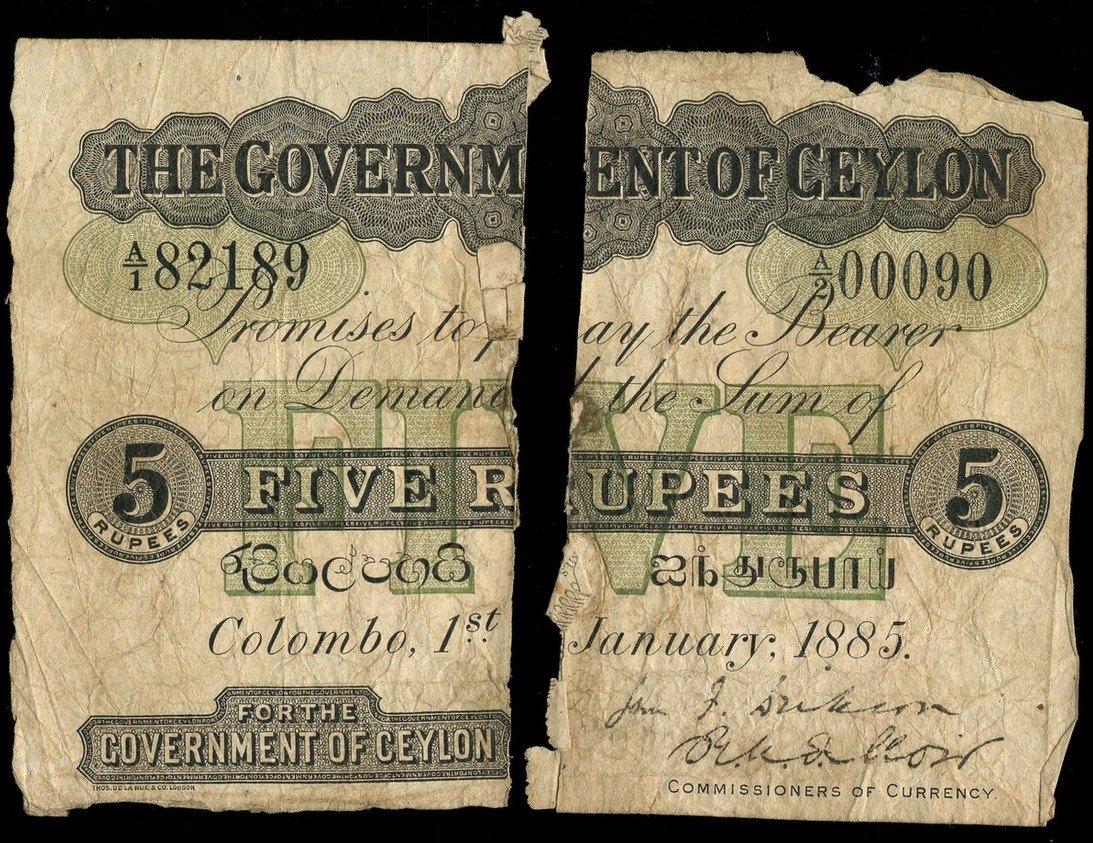
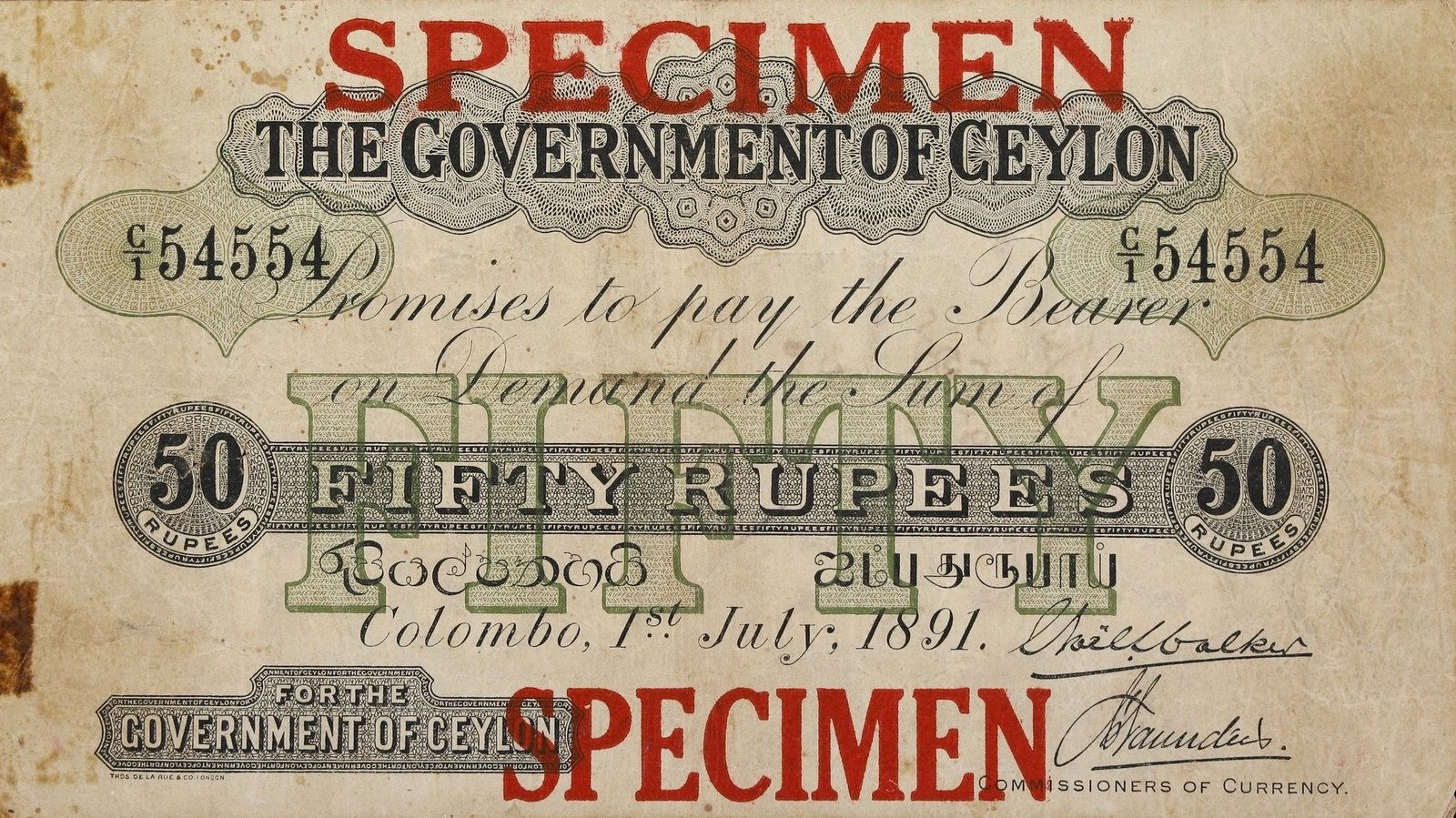
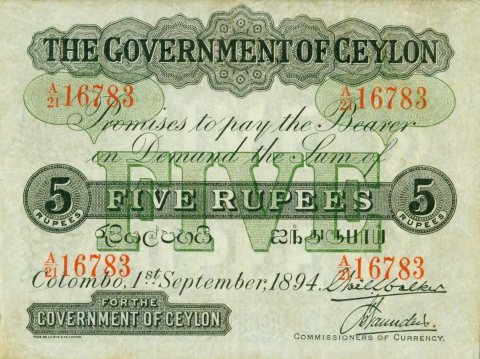
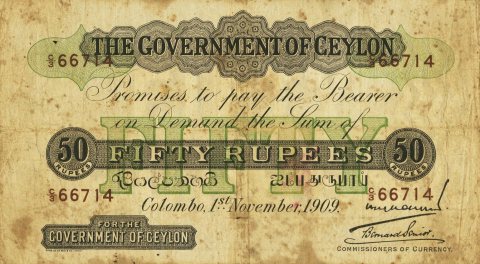
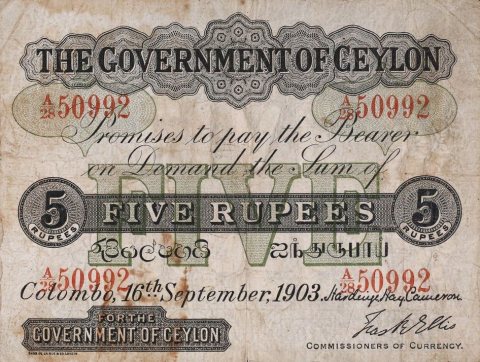
This article covers the uniface notes of the Government of Ceylon, the type that ran from 1885 to 1926: the 5 rupees, the 10 rupees, the 50 rupees, the 100 rupees and the 1,000 rupees. It is drawn from the Ceylon Blue Books of 1885 to 1919, the Sessional Papers of the Legislative Council of 1884 to 1906, Chalmers' History of Currency in the British Colonies (1893) and the annual reports on Ceylon. What tells one date or signature from another stays on the page of each note.
Government paper before the rupee notes
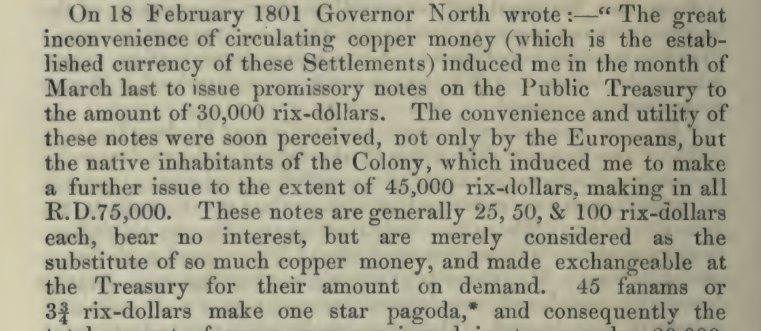
The notes of 1885 were the first in rupees, not the first government notes of Ceylon. Chalmers' History of Currency in the British Colonies (1893) records three earlier issues:
- promissory notes on the Public Treasury issued by Governor North from March 1800, 75,000 rix-dollars in all and mostly of 25, 50 and 100 rix-dollars;
- paper rix-dollars, nearly 2,500,000 of them in 1820, called in under Regulation No. 8 of 1825;
- convertible Treasury notes of 90,000 pounds issued in their place under Regulation No. 8 of 1827, of which 87,427 pounds were still out on 20th August 1832.
Government notes in sterling were still in circulation later: 48,706 pounds of them at the end of 1847, and 925 pounds were still outstanding on 1st January 1863 (Reports on the Present State of the Colonial Possessions). The Blue Book for 1885 still shows Rs. 8,920 of old Treasury notes outstanding beside the new notes. No example of any of these notes is recorded in the catalogue, and Chalmers gives no values for the paper rix-dollars after 1800 or for the Treasury notes of 1827.
May 1884: the Oriental Bank fails
The Government of Ceylon took over the note issue after the Oriental Bank Corporation failed on 3rd May 1884. To head off a panic the Governor guaranteed that bank's notes on 5th May 1884, when Rs. 3,200,000 of them were in circulation in Ceylon (Chalmers' History of Currency in the British Colonies, 1893, page 36). Chalmers adds that the Governor acted under pressure from the banks and the Chamber of Commerce.
Ordinance No. 32 of 1884 then set up the Commissioners of Currency, who issued the first government rupee notes in 1885. The ordinance received the Governor's assent on 17th December 1884. The private banks lost the right to issue notes, and Oriental Bank notes ceased to be legal tender after 31st March 1885. From 1887 the Blue Books show no bank notes in circulation.
What Ordinance No. 32 of 1884 said
The ordinance provided for notes of 5, 10, 50, 100, 500 and 1,000 rupees. Each was signed by two of the three Commissioners of Currency: the Colonial Secretary, the Treasurer and the Auditor-General. By 1913 the Controller of Revenue had taken the Auditor-General's place: the Blue Books for 1913 to 1916 call the Controller of Revenue, A. S. Pagden, "a Currency Commissioner". The notes were changeable on demand for Indian silver rupees at the Commissioners' office in Colombo.
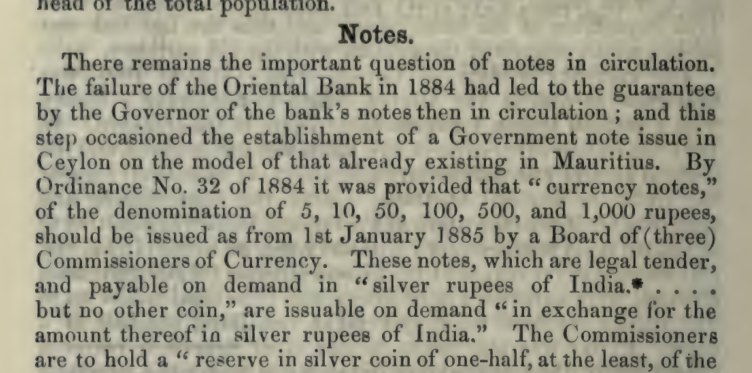
The law required at least half the issue to be held in silver coin; the rest could be invested. B. W. Fernando's Ceylon Currency: British Period 1796-1936 (Ceylon Government Press, 1939), chapter VII, as transcribed on coins.lakdiva.org.lk (the printed book was not seen), adds two points. It says that Ordinance No. 12 of 1886 made the Board a corporation under the name "The Ceylon Currency Commissioners", because until then every change among the Commissioners had needed a fresh power of attorney for the agent in India who collected the interest. It also says that the sections on the issue of notes, as amended by Ordinance No. 13 of 1901, require each note to bear the signatures, or facsimiles of the signatures, of any two of the Commissioners holding office at the date on the note.
Two laws brought gold into the system. Ordinance No. 13 of 1901, passed on 6th November 1901, let the Commissioners pay out gold sovereigns instead of rupees, at 15 rupees to the sovereign, and bound them to give notes for sovereigns. Ordinance No. 6 of 1903 made the issue of notes for gold optional again.
The first order, September 1884
The notes had been planned in London in September 1884 with Warren De La Rue, on the pattern of the Indian government note, relying mainly on the watermark against forgery. The plan is in Sir J. Douglas's memorandum of 9th September 1884, printed in Sessional Paper I of 1886. The first supply planned was:
| Value | Notes |
|---|---|
| 5 rupees | 250,000 |
| 10 rupees | 250,000 |
| 50 rupees | 10,000 |
| Total | 510,000 notes, Rs. 4,250,000 |
These numbers agree with the serial ranges of the notes dated 1st January 1885. According to the same memorandum De La Rue promised 250,000 notes of 5 and 10 rupees by 15th December 1884 and 250,000 more by the end of the year. The notes were given in exchange for Oriental Bank notes from 15th February to 31st March 1885. Chalmers writes that they were "brought into circulation on 1st January 1885", which is the date on the notes and the legal start, not the day the public first received them.
Five rupees was fixed as the lowest value in September 1884. The Governor had asked for a note of 2 rupees 50 cents, which London refused, and no lower note came until the 1 and 2 rupees of 1917. What the printer charged, and how many notes were in fact received in 1885, is not in the papers read: only the plans and promises of September 1884 are printed.
The values that were not in the first order
The draft ordinance agreed in London in November 1884 allowed notes of 5, 10 and 50 rupees only. A sub-committee of the Legislative Council added the 100, 500 and 1,000 rupees on 18th November 1884, to help trade (Sessional Paper XII of 1884).
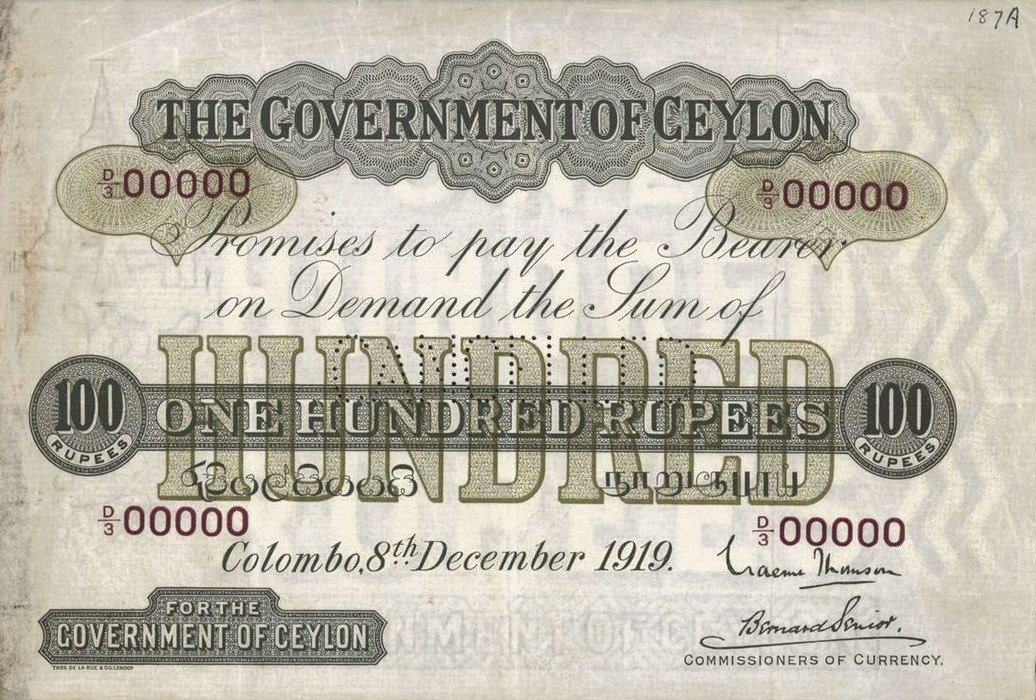
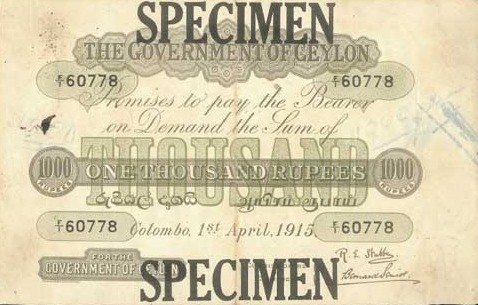
The first 100 rupees is dated 1st October 1885. The first 1,000 rupees is dated 1st August 1899, and Fernando's book of 1939, as transcribed on coins.lakdiva.org.lk, also gives August 1899 as the month it was issued. The Blue Book's yearly currency return, however, first lists a 1,000 rupees among the government notes for 1901; the returns for 1890 to 1900 name only the 5, 10, 50 and 100 rupees. The returns may only repeat old wording, so they neither prove nor disprove an issue in 1899. The 500 rupees was not issued before 1926: its one date is 1st June 1926. Fernando's book, as transcribed on coins.lakdiva.org.lk, gives April 1927 as the month the 500 rupees was issued; the page of the note gives no month of issue.
Notes in circulation, 1885 to 1931
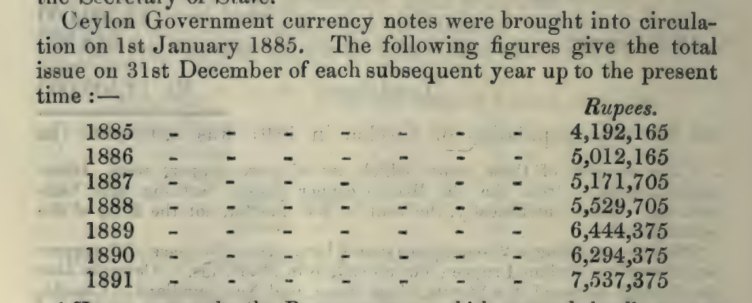
The Blue Book return gives one total a year and never a count by value. Chalmers prints the total at 31st December for each year from 1885 to 1891, and where the Blue Book return was also read the two agree. For 1888 and 1889 no Blue Book return was read: the returns printed with the Currency Commission's report give the same two figures as the highest issue of the year, on 21st December 1888 and 23rd December 1889, where Chalmers gives them for 31st December. Where the return is missing from the volumes read, the highest issue of the year is given instead, from the returns printed with the Currency Commission's report (Sessional Paper V of 1903).
| Year | Day of the figure | Government notes in circulation | Source |
|---|---|---|---|
| 1885 | 31st December | Rs. 4,192,165 | Blue Book for 1885; Chalmers |
| 1886 | 31st December | Rs. 5,012,165 | Blue Book for 1886; Chalmers |
| 1887 | 31st December | Rs. 5,171,705 | Blue Book for 1887; Chalmers |
| 1888 | 31st December | Rs. 5,529,705 | Chalmers; Fernando's book as transcribed on coins.lakdiva.org.lk |
| 1889 | 31st December | Rs. 6,444,375 | Chalmers |
| 1890 | 31st December | Rs. 6,294,375 | Blue Book for 1890; Chalmers |
| 1891 | 31st December | Rs. 7,537,375 | Blue Book for 1891; Chalmers |
| 1892 | 31st December | Rs. 8,784,575 | Blue Book for 1892 |
| 1893 | 31st December | Rs. 7,995,000 | Blue Book for 1893 |
| 1894 | 31st December | Rs. 8,915,000 | Blue Book for 1894 |
| 1895 | 21st December, highest of the year | Rs. 10,230,000 | Sessional Paper V of 1903 |
| 1896 | 15th December, highest of the year | Rs. 11,468,700 | Sessional Paper V of 1903 |
| 1897 | 5th January, highest of the year | Rs. 11,308,700 | Sessional Paper V of 1903 |
| 1898 | 9th September, highest of the year | Rs. 11,443,700 | Sessional Paper V of 1903 |
| 1899 | 29th December, highest of the year | Rs. 14,455,950 | Sessional Paper V of 1903 |
| 1900 | 31st December | Rs. 13,292,450 | Blue Book for 1900 |
| 1901 | 31st December | Rs. 13,213,950 | Blue Book for 1901 |
| 1902 | 31st December | Rs. 13,868,440 | Blue Book for 1902 |
| 1903 | 31st December | Rs. 17,111,090 | Blue Book for 1903 |
| 1904 | 31st December | Rs. 13,633,770 | Blue Book for 1904 |
| 1906 | 31st December | Rs. 16,264,175 | Blue Book for 1906 |
| 1909 | 31st December | Rs. 17,249,565 | annual report on Ceylon |
| 1912 | 30th June | Rs. 21,146,720 | annual report on Ceylon |
| 1912 | 31st December | Rs. 23,183,370 | Blue Book for 1912, supplement |
| 1913 | 30th June | Rs. 23,462,000 | Blue Book for 1913 |
| 1914 | 30th September | Rs. 27,902,000 | Blue Book for 1914 |
| 1915 | 30th September | Rs. 27,325,500 | Blue Book for 1915 |
| 1916 | 30th September | Rs. 27,885,000 | Blue Book for 1916 |
| 1919 | 30th September | Rs. 40,533,042 | Blue Book for 1919 |
| 1922 | 30th September | Rs. 39,286,499 | annual report on Ceylon |
| 1931 | 30th September | Rs. 42,441,002 | annual report for 1931 |
The annual report that gives the figure for 30th June 1912 names the values then current as 1,000, 100, 50, 10 and 5 rupees. Fernando's book, as transcribed on coins.lakdiva.org.lk, says the note circulation reached its highest level in 1926, at Rs. 62,868,615 on 5th November. The years with no line in the table (1905, 1907, 1908, 1910, 1911, 1917, 1918 and most of the 1920s) are years for which no return was read.
The reserve at the end of 1891
Against the Rs. 7,537,375 in circulation at the end of 1891 the Commissioners held Rs. 4,478,581 in silver and Rs. 3,058,793 invested in Indian Government 4 per cent paper and sterling debentures of Australia, Canada and the Cape (Chalmers, page 359). Chalmers splits the invested part into Rs. 1,778,807 of Indian paper and Rs. 1,279,985 of sterling debentures.
The signers and their offices
The names on the notes fit the holders of the three offices as the Blue Books list them. Clementi Smith was Lieutenant-Governor and Colonial Secretary to 1887 and Ravenscroft Auditor-General and Controller of Revenue from 1877 to 1890. Walker was Colonial Secretary from 10th November 1887 and Saunders Treasurer from 18th October 1890. Cameron was Treasurer, acting in 1900 and substantive from 11th June 1901, and Ellis Auditor-General from 1st March 1902. Ashmore was Colonial Secretary from September 1904 and Nicolle Treasurer from 6th September 1904. Senior was Treasurer from 12th December 1908 and Stubbs Colonial Secretary from 2nd January 1913. Thomson was Colonial Secretary in October 1919.
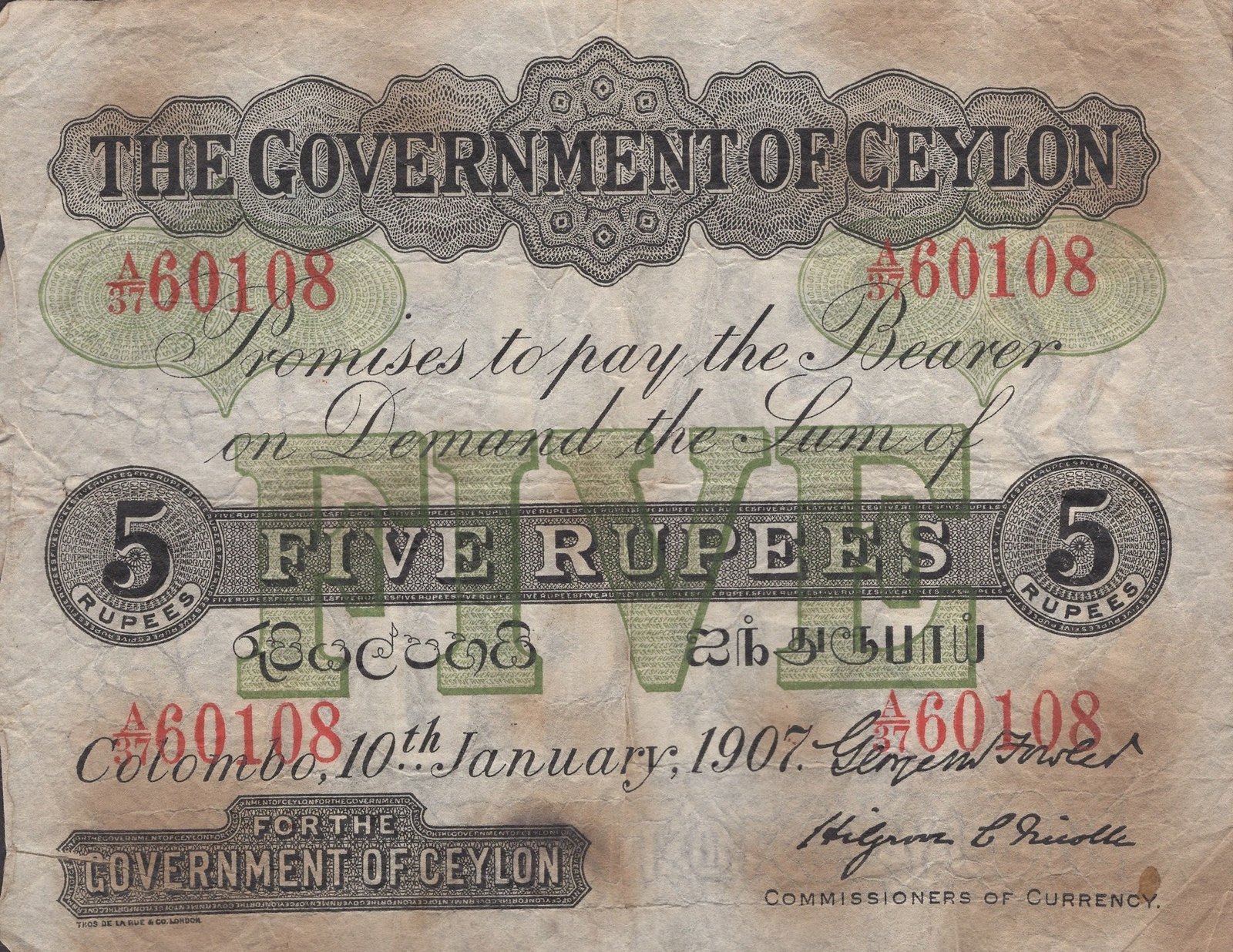
The 5 rupees of 10th January 1907 is signed Fowler & Nicolle: the Blue Book for 1906 shows G. M. Fowler acting as Colonial Secretary from 5th December 1906. Pagden, who signs with Senior on 15th May 1919, was the Controller of Revenue, appointed in November 1913. Whether Pagden signed in 1919 as Controller of Revenue or as acting Colonial Secretary is not stated in the papers read.
New supplies, worn notes and cut notes
Worn notes were destroyed, and new supplies of notes were voted for 1890 and for 1893, the second to replace notes soiled by use. The papers name no values and no dates for these supplies, so they cannot be tied to the notes dated 1st July 1891 or 1894.
From a notification of 10th March 1887 the Commissioners of Currency would change a cut note only if both halves were brought in together. A notice of 7th December 1904 set out when a half of a lost or destroyed note would be paid.
Forged 10-rupee notes were about in 1902: a witness before the Currency Commission of that year spoke of "forged and filthy" 10-rupee notes, without giving numbers. The counterfeit of the 1885 10 rupees that is recorded is described on the page of the 10 rupees.
The end of the uniface notes
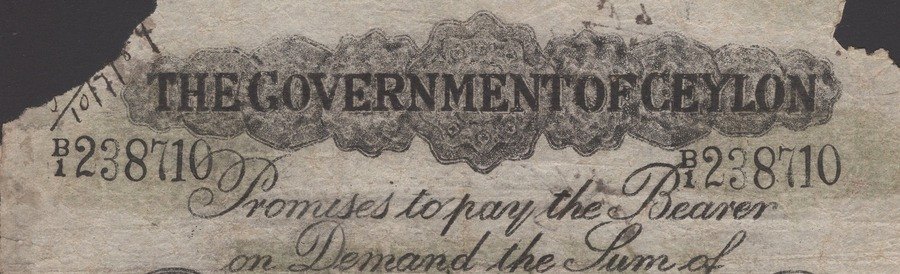
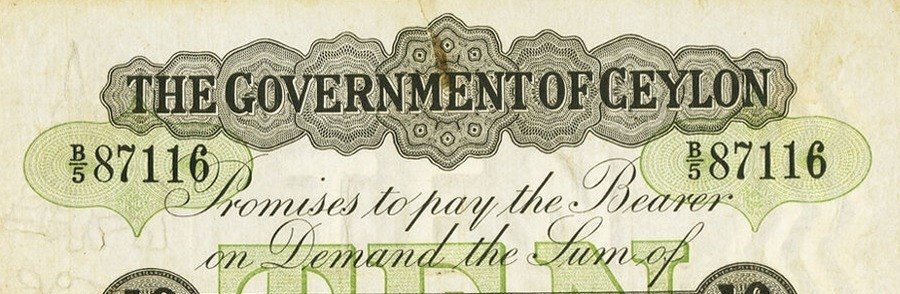
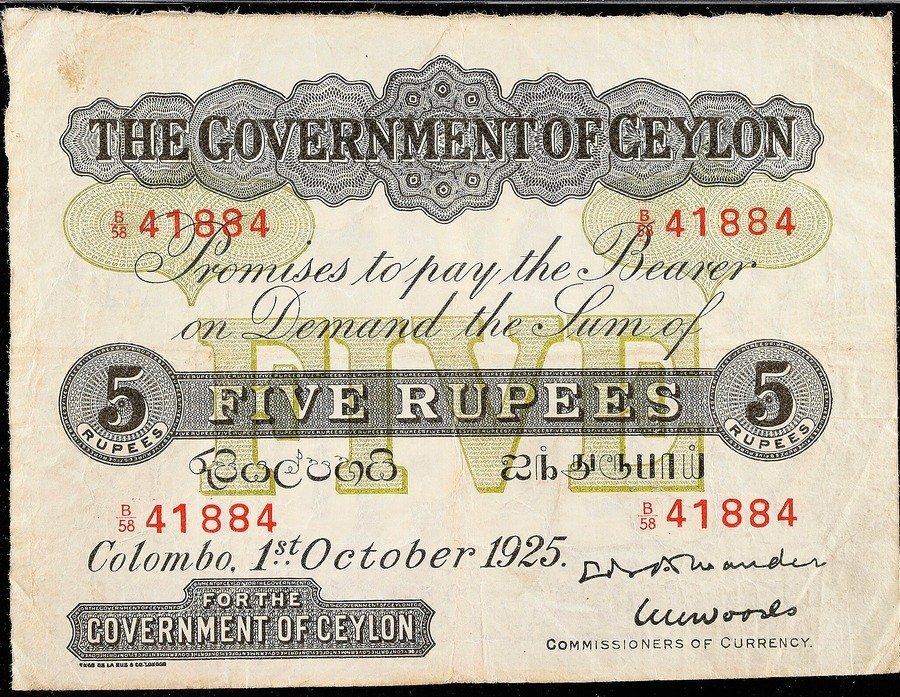
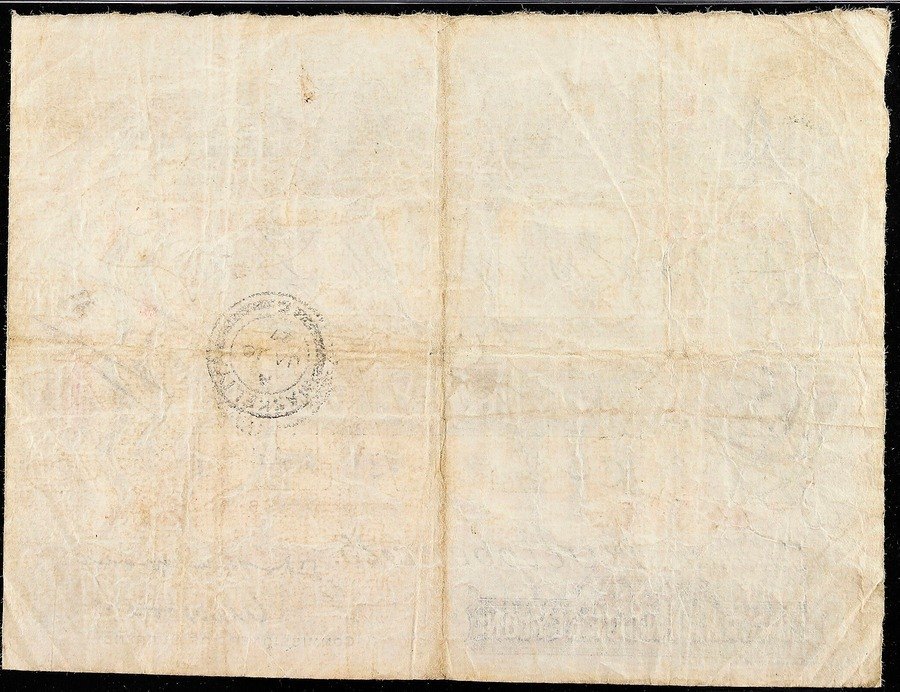
The 5 and 10 rupees kept the uniface design to 1st October 1925, the 50, 100 and 1,000 rupees to 1st June 1926. All notes dated before 1st January 1940 were demonetised on 13th April 1946 and ceased to be legal tender with effect from 31st July 1946; the 500 and 1,000 rupees had gone earlier, demonetised on 15th November 1945 and no longer legal tender after 31st January 1946. What followed the uniface notes is told in The notes of Ceylon, 1885 to 1954.
Sources
- Robert Chalmers, A History of Currency in the British Colonies (London, 1893), page 36 and chapter XXXV, pages 351 to 359.
- Ceylon Blue Books for 1885 to 1894, 1900 to 1904, 1906, 1912 (supplement), 1913 to 1916 and 1919: the Currency and Banking return, the Executive Council returns and the civil lists.
- Ceylon Sessional Papers: Sessional Paper XII of 1884 (report of the sub-committee on the Paper Currency Bill, 18th November 1884); Sessional Paper I of 1886 (the despatches on the government note issue, with Sir J. Douglas's memorandum of 9th September 1884); Sessional Paper V of 1903 (report and evidence of the Currency Commission).
- Reports on the Present State of the Colonial Possessions, for the sterling notes outstanding in 1847 and 1863.
- The annual reports on Ceylon that give the circulation on 31st December 1909, 30th June 1912 and 30th September 1922, and the annual report for 1931.
- B. W. Fernando, Ceylon Currency: British Period 1796-1936 (Ceylon Government Press, 1939), chapter VII, as transcribed at coins.lakdiva.org.lk. The printed book was not seen.
Member comments
Log in or register to post a comment.