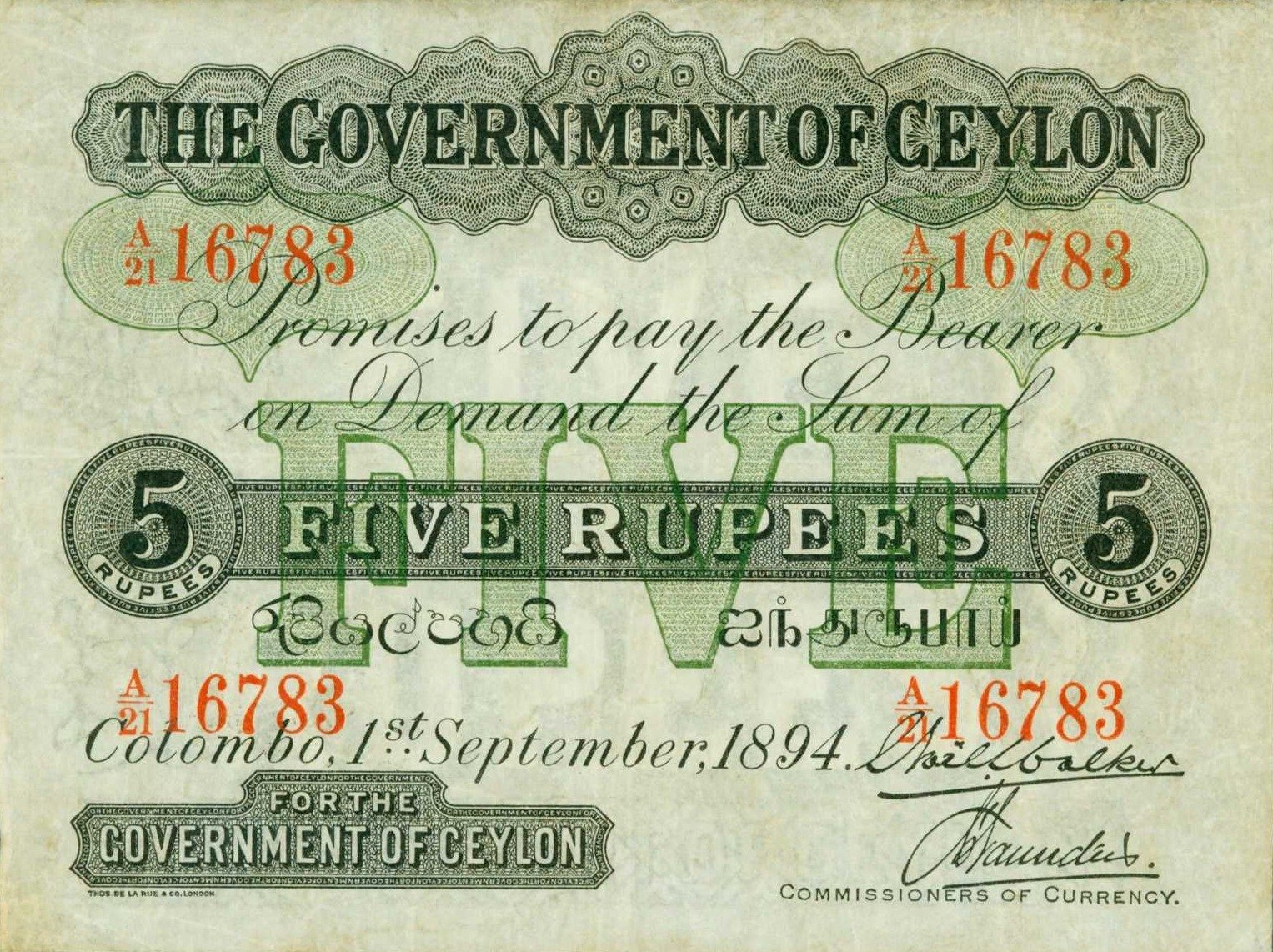
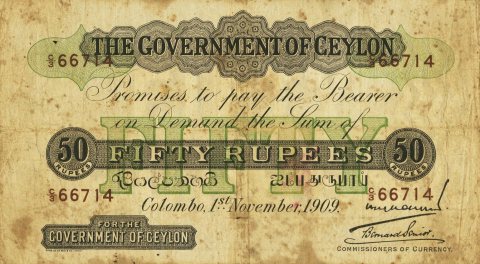
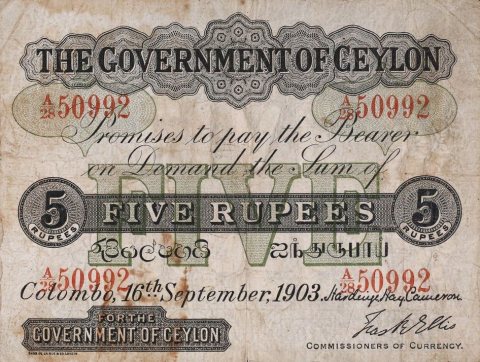
The notes of the Government of Ceylon carry two signatures, those of two of the three Commissioners of Currency. The Blue Books never print a list of Commissioners as such: the Board was three offices, and whoever held or acted in an office was a Commissioner. This article sets out the law of the Board as the papers give it, and then the holders of the three offices in every year for which a Blue Book or a Council paper was read, from 1884 to 1919. The signers are named in one paragraph of Ceylon's first government rupee notes, 1884 to 1926; the table here adds the years between, the acting officers and the officers whose names are on no note.
The Board in the law
| Ordinance | Day | What the papers read give |
|---|---|---|
| No. 32 of 1884 | assent announced 17th December 1884 | "An Ordinance to provide for the issue of Government Paper Currency". The draft's section 2 made the deputies or representatives of the Colonial Secretary, the Treasurer and the Auditor-General act as Commissioners in their absence (the Colonial Office to the Treasury, 15th October 1884). Sections 4 and 5, as printed with the amendment of 1886: notes of five, ten, fifty, one hundred, five hundred and one thousand rupees, each to bear the signatures or facsimiles of any two of the Commissioners holding office at its date, payable only at the Commissioners' office in Colombo in silver rupees of India. |
| No. 12 of 1886 | 1st November 1886; passed by the Council on 27th October 1886 | A law "relating to the Board of Currency Commissioners for Ceylon". The Blue Book and the proceedings give its title and passage only. What B. W. Fernando's book of 1939 says of it is in Ceylon's first government rupee notes, 1884 to 1926. |
| No. 13 of 1901 | 6th November 1901 | Notes for gold sovereigns as well as for silver rupees. |
| No. 6 of 1903 | passed by the Council on 31st October 1903 | The Commissioners may decline gold. The laws to be cited together as "The Ceylon Paper Currency Ordinances, 1884 to 1903". |
| No. 33 of 1914 | listed in the Blue Book for 1914 | An amendment of the Paper Currency Ordinance. The text is not printed, and the currency return in the Blue Book for 1919 does not name it. |
| No. 1 of 1917 | named in the Blue Book for 1919 | The amendment under which, in the return for 1919, the 1 and 2 rupees are listed with the other notes. |
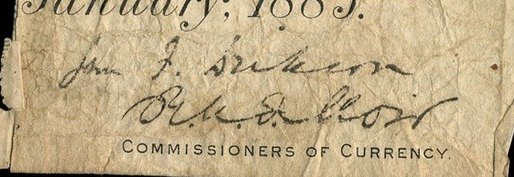
The sub-committee of 18th November 1884 had already widened the forgery clause of the first Ordinance to cover "any facsimile of the signatures of any of the Commissioners" (Sessional Paper XII of 1884). The notes of 1885 were signed by hand. The papers read do not say who signed them. On the 5 rupees of 1st January 1885 photographed in the catalogue the two signatures read Jno. F. Dickson and R. W. D. Moir. The same sub-committee report names J. F. Dickson as Acting Colonial Secretary and R. W. D. Moir as Acting Treasurer, two of the three offices of the Board.
An open point: 1914 or 1917
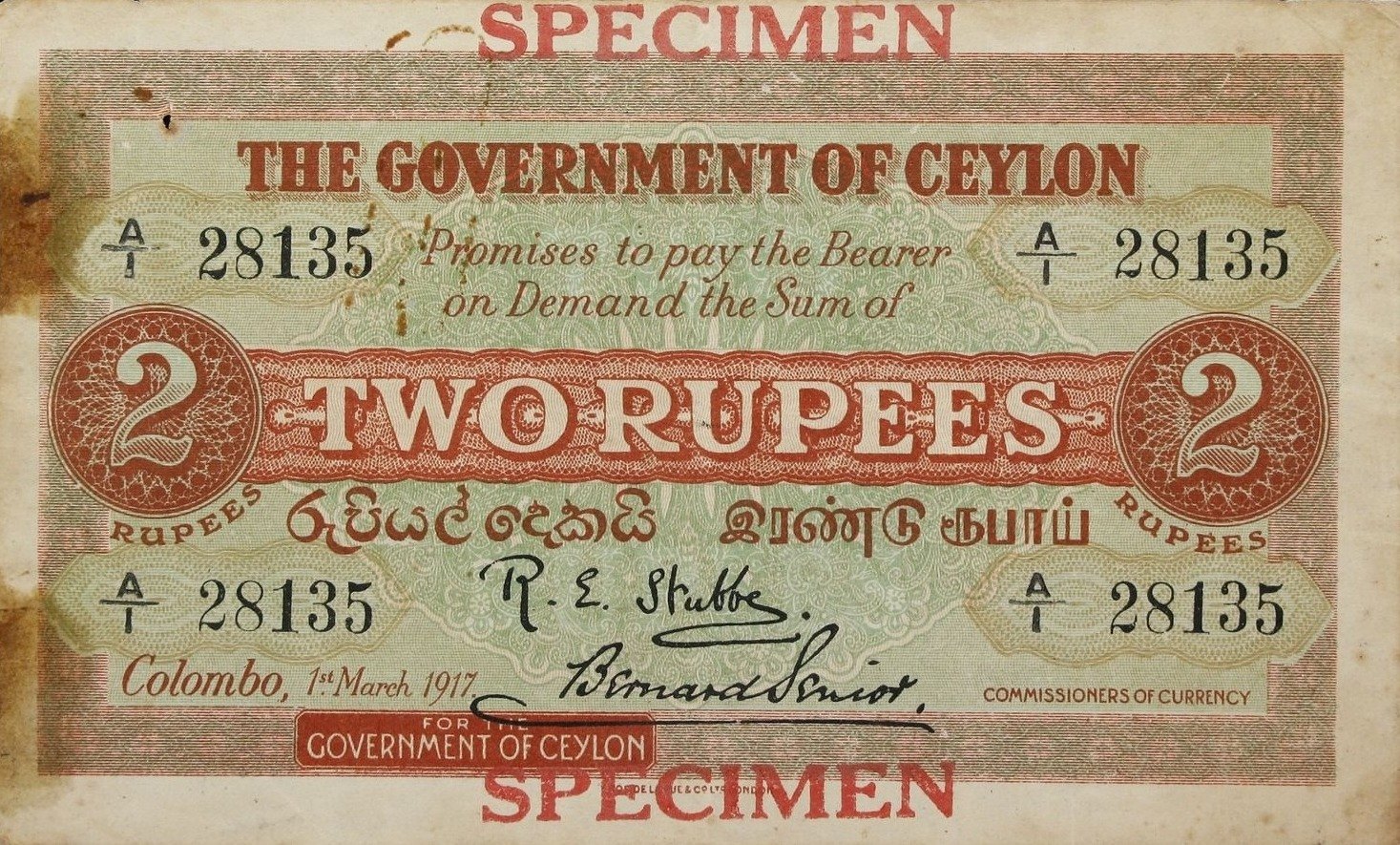
The pages of the 1 rupee and of the 2 rupees of 1917 say that Ordinance No. 1 of 1917 amended the currency ordinance of 1884 to allow those two values, and the Blue Book for 1919 names that Ordinance as authority. A circular of the Currency Department of the Central Bank of Ceylon of 15th March 1984, as reproduced on notes.lakdiva.org.lk, the collectors' site kept by Kavan Ratnatunga, says instead that it was "by amendment to the Currency Ordinance in 1914" that the Commissioners were empowered to issue notes of one and two rupees. The Blue Book for 1914 does list an amending Ordinance, No. 33 of 1914, by title alone, and the Blue Books for 1914 to 1916 say nothing of small notes. The point is open: the circular was read only as the collectors' site gives it, and what No. 33 of 1914 changed would be settled by its text in the Ceylon Government Gazette of 1914, which has not been read. What Fernando's book of 1939 says of the Ordinance of 1917 is in The notes of Ceylon, 1885 to 1954.
The three offices
Under the Ordinance of 1884 the Commissioners were the Colonial Secretary, the Treasurer and the Auditor-General. In 1886 the third office was one post, "Auditor-General and Controller of Revenue", held by W. H. Ravenscroft. The Blue Book for 1901 describes the Treasurer and the Auditor-General, and that for 1903 the Colonial Secretary and the Auditor-General, each as "a Currency Commissioner". By 1913 the two halves of Ravenscroft's old post were separate, and the Blue Books for 1913 to 1916 give the words "a Currency Commissioner" to the Controller of Revenue, A. S. Pagden, not to an Auditor-General. When the change was made, between 1906 and 1913, is not in the volumes read. The Blue Book for 1919 names only two Commissioners of Currency, the Colonial Secretary and the Treasurer.
The holders, year by year
Each line is the state of things in the volume named. A day is the day of appointment as the Blue Book prints it.
| Year | Colonial Secretary | Treasurer | Auditor-General, later Controller of Revenue | Source |
|---|---|---|---|---|
| 1884 | J. F. Dickson, acting | R. W. D. Moir, acting | not named | Sessional Paper XII of 1884 |
| 1886 | Sir Cecil Clementi Smith, Lieutenant-Governor and Colonial Secretary to 1887 | G. T. M. O'Brien, from 6th August 1886 | W. H. Ravenscroft, from 23rd May 1877 | Blue Books for 1886 and 1887; statement signed by Ravenscroft, 26th May 1886 |
| 1887 | E. N. Walker, appointed 10th November 1887; O'Brien acting from 15th October 1887 | O'Brien; J. B. A. Bailey acting from 1st November 1887 | Ravenscroft; R. W. D. Moir acting from 14th April 1887 | Blue Book for 1887 |
| 1889 | Sir E. Noel Walker | O'Brien | Ravenscroft | Blue Book for 1889; Council minutes of 27th November 1889 |
| 1890 | Walker | F. R. Saunders, from 18th October 1890 | O'Brien, from 18th October 1890 | Blue Book for 1890 |
| 1892 | Walker | Saunders, on leave; G. S. Williams acting from 1st May 1892 | J. A. Swettenham, from 30th or 31st July 1891 | Blue Books for 1892 and 1893 |
| 1893 and 1894 | Walker | Saunders | Swettenham | Blue Books for 1893 and 1894 |
| 1900 | Walker, on leave; W. T. Taylor acting | C. E. D. Pennycuick, from 5th December 1899; H. H. Cameron acting from 26th April 1900 | W. T. Taylor, from 10th June 1895; Pennycuick acting from 26th April 1900 | Blue Book for 1900 |
| 1901 | E. F. im Thurn, from 18th June 1901; R. W. Ievers acting | Cameron, from 11th June 1901; C. A. Murray acting | Taylor; F. R. Ellis acting | Blue Book for 1901 |
| 1902 | im Thurn | Cameron | Ellis, from 1st March 1902, on leave; Murray acting | Blue Book for 1902 |
| 1903 | im Thurn | Cameron | Ellis | Blue Book for 1903 |
| 1904 | A. M. Ashmore, in the Legislative Council from 10th September and the Executive Council from 23rd October 1904 | H. C. Nicolle, from 6th September 1904 | Ellis | Blue Book for 1904 |
| 1905 | Sir Alexander Ashmore; G. M. Fowler acted | Nicolle | Ellis, on leave; Fowler acted, and Nicolle acted in addition to the Treasury | Governor's address, December 1905 |
| 1906 | Fowler, acting from 5th December 1906 | Nicolle | H. W. F. C. Brodhurst, acting from 19th December 1906 | Blue Book for 1906 |
| 1913 | R. E. Stubbs, from 2nd January 1913 | Bernard Senior, from 12th December 1908, on leave 27th April to 31st December; A. G. Clayton acting | A. S. Pagden, Controller of Revenue, appointed November 1913; J. G. Fraser acting from 6th October 1913 | Blue Book for 1913 |
| 1914 | Stubbs | Senior, absent 1st to 24th January | Pagden, absent 1st January to 17th July | Blue Book for 1914 |
| 1915 | Stubbs, administering the Government at the end of the year | Senior | Pagden, acting Colonial Secretary from 4th December 1915; Fraser acting Controller from that day | Blue Book for 1915 |
| 1916 | Stubbs | Senior | Pagden | Blue Book for 1916 |
| 1919 | Sir Graeme Thomson, in the Executive Council from 20th October 1919 | Senior | no third Commissioner named | Blue Book for 1919 |
Three entries need a word. Swettenham's appointment as Auditor-General is printed as 30th July 1891 in one volume and 31st July 1891 in another. Pagden's is printed as 14th November 1913 in the Blue Book for 1913 and 12th November 1913 in that for 1914. And the Governor's address of October 1901 tells the changes of that year in one passage: Walker retired and was succeeded by im Thurn, Taylor gave up the Auditor-General's post to Ellis on promotion to the Straits Settlements, and Pennycuick retired and was succeeded as Treasurer by Cameron.
The names on the notes
Set against the table, each signature pair listed below falls inside the terms of office of the two signers. The pairs are those the catalogue's pages give for these dates. The first pair is read from the one hand-signed note photographed in the catalogue: the table names both men in 1884 and has no line for 1885, and who signed the other notes of that date is not known.
| Date on the notes | Signatures | Offices, from the table |
|---|---|---|
| 1st January 1885 | Dickson & Moir, signed by hand | acting Colonial Secretary and acting Treasurer, as named in November 1884 |
| 1st January 1887 | Clementi Smith & Ravenscroft | Colonial Secretary and Auditor-General |
| 1st July 1891, 1894 | Walker & Saunders | Colonial Secretary and Treasurer |
| 16th September 1903 | Cameron & Ellis | Treasurer and Auditor-General |
| 1st November 1904 | Ashmore & Nicolle | Colonial Secretary and Treasurer |
| 10th January 1907 | Fowler & Nicolle | acting Colonial Secretary and Treasurer |
| 1913 to 1918 | Stubbs & Senior | Colonial Secretary and Treasurer |
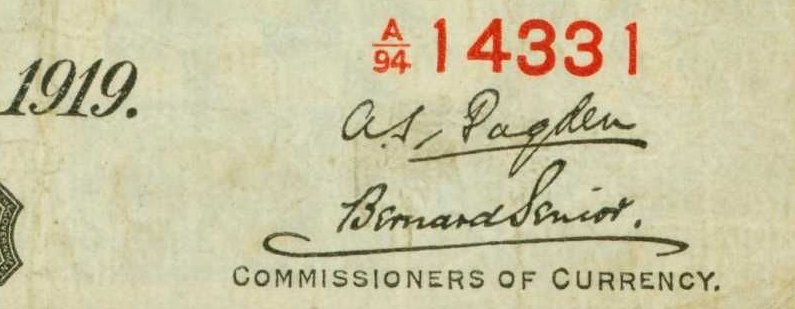
| 15th May 1919 | Pagden & Senior | see below; Treasurer |
| 8th December 1919 | Thomson & Senior | Colonial Secretary and Treasurer |
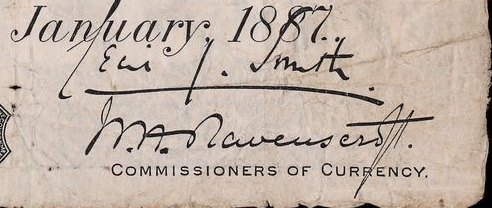
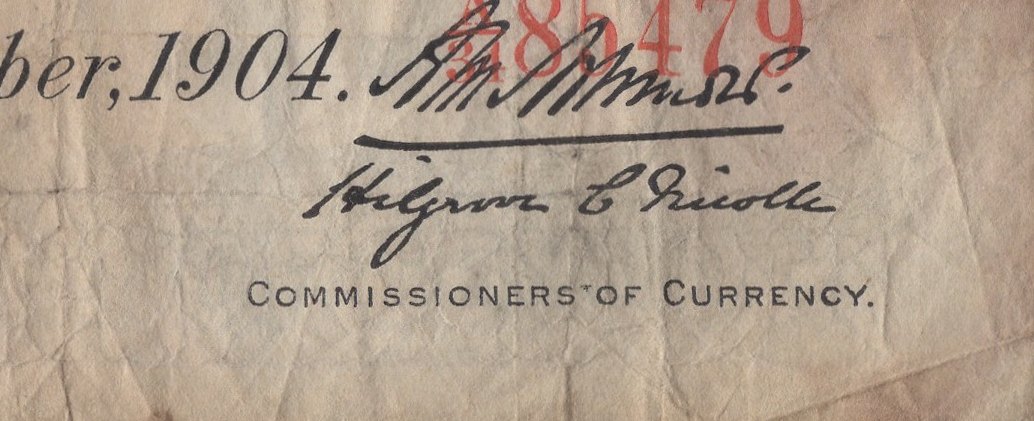
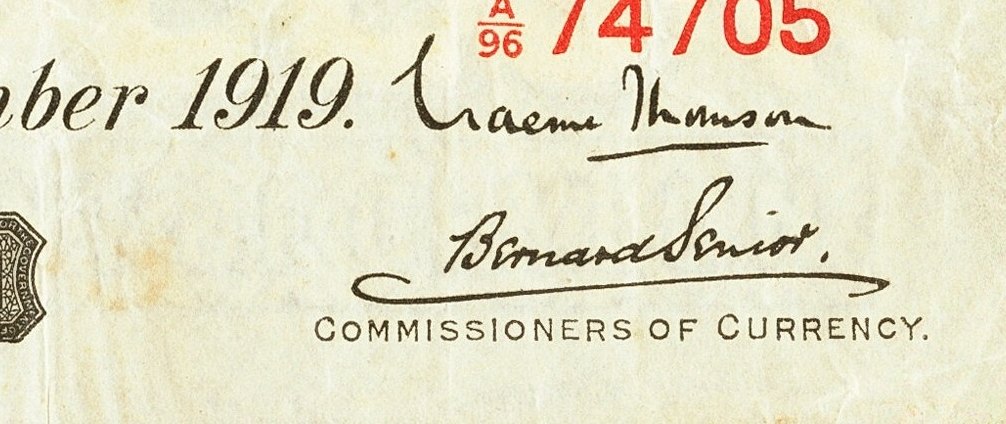
The pair of 1st November 1904 cannot be earlier than September 1904, when both Ashmore and Nicolle took office. The 5 rupees of 10th January 1907 is dated five weeks after Fowler began to act as Colonial Secretary.
Pagden's signature of 15th May 1919 is not explained by the papers. Pagden was Controller of Revenue and "a Currency Commissioner" from 1913 to 1916 and acted as Colonial Secretary from December 1915. The Blue Book for 1919 has no list of the civil establishment, so it does not show who was absent or acting in May 1919, and it no longer calls the Controller of Revenue a Commissioner. In which of the two capacities Pagden signed is therefore not stated.
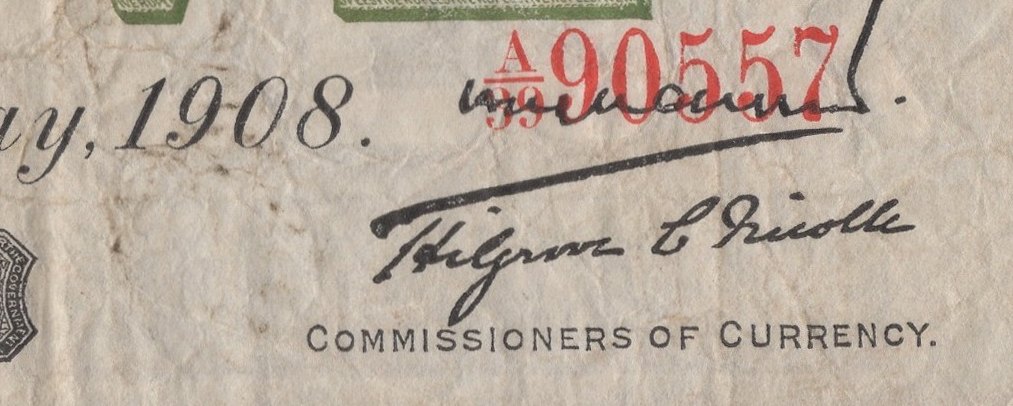
The signers of 18th May 1908 are an open point. The collectors' site notes.lakdiva.org.lk, on its page for the 5 rupees, gives them as H. Clifford and Bernard Senior. The catalogue's rows for that date have Nicolle, not Senior, among the signers, read from its photographs of the 5 rupees. The Blue Books have Nicolle as Treasurer from 6th September 1904 and Senior as Treasurer only from 12th December 1908. The Blue Books for 1907 and 1908, which would show who held the two offices in May 1908, were not among the volumes read, so the office lists settle nothing here.
Commissioners with no note
Several officers in the table held one of the three offices, and were Commissioners by it, though no note signed by them is listed in the catalogue: Swettenham, Taylor, Pennycuick and im Thurn among them. The names of O'Brien and of those who only acted (Bailey, Williams, Ievers, Murray, Brodhurst, Clayton and Fraser) are likewise not among the signature pairs set out above. J. A. Swettenham is named as Auditor-General of Ceylon in 1892 to 1893 in the preface to the Ceylon chapter of Chalmers' History of Currency in the British Colonies (1893). The notes dated 1891 and 1894 are signed by the other two Commissioners of those years, Walker and Saunders.

The staff below the Board appears twice. The estimates for 1885 provided a clerk, a kanakapillai and a counter at the Treasury for the note issue. The Blue Book for 1900 lists a note-issue cashier at the Treasury, C. L. Ramenaden, kanakapillai since 1st August 1892, and in November 1902 George Van Hoff gave evidence to the Currency Commission as Clerk to the Commissioners of Currency.
What was not read
The Blue Books for 1888, 1895 to 1899, 1905, 1907 to 1911, 1917 and 1918 were not among the volumes read, and nothing after 1919 was read at all. The table therefore has no line for those years, and the signers of the notes of 1908 to 1912 and of 1920 onward are not checked here against the office lists. The 1912 supplement and the Blue Book for 1919 have no civil list.
Sources
- Ceylon Blue Books for 1885 to 1887, 1889 to 1894, 1900 to 1904, 1906, 1913 to 1916 and 1919: the returns of the Executive and Legislative Councils, the civil establishment, the lists of legislation and the currency return.
- Ceylon Sessional Paper XII of 1884, report of the sub-committee on the Government Paper Currency Bill, 18th November 1884; Sessional Paper XIII of 1884, report on the Supply Bill for 1885.
- Ceylon Sessional Paper I of 1886: the Colonial Office to the Treasury, 15th October 1884.
- Proceedings of the Legislative Council of Ceylon: 17th December 1884; 27th October 1886; 27th November 1889; the Governor's addresses of 18th October 1901 and December 1905; 6th November 1901; 31st October 1903.
- Ordinance No. 32 of 1884 as amended by No. 12 of 1886, sections 4 and 5, printed page 349, in the copy held in the Johns Hopkins archive of currency boards.
- Ceylon Sessional Paper V of 1903, minutes of evidence of the Currency Commission, 11th November 1902.
- Robert Chalmers, A History of Currency in the British Colonies (London, 1893), page 349.
- Currency Museum Circular No. 7, Currency Department, Central Bank of Ceylon, 15th March 1984, as given on the collectors' site notes.lakdiva.org.lk at Early Paper Money Systems of Lanka, and the same site's page on the 5 rupees for its signers of 18th May 1908. Read in a copy saved on 4th November 2026 and opened online on 24th November 2026.
Member comments
Log in or register to post a comment.