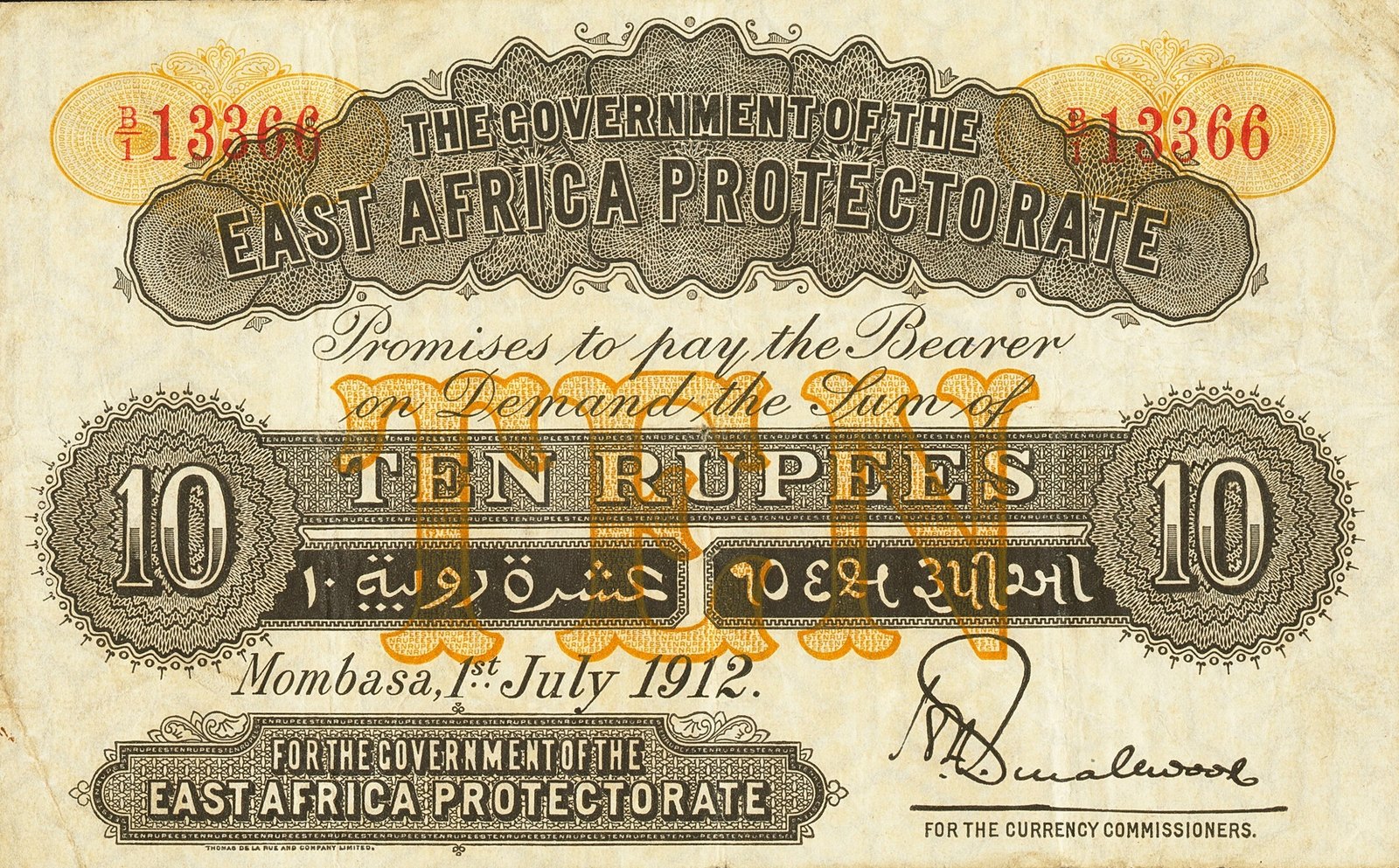
The notes of East Africa name very few people: one signer on the rupee notes, the members of a Board in London on the later ones. The Official Gazette names many more. This article lists the Currency Commissioners of the East Africa Protectorate from 1906 to 1920, the Currency Officers of the East African Currency Board from 1920 to 1962 and the Board's own officials of 1963 and 1964, each with the notice that names them. It is drawn from the Official Gazette of the Protectorate and of Kenya for 1906 to 1965, the Uganda Official Gazette, the Colonial Office Lists and the Blue Books. The terms of office of the four signers of the rupee notes are told more shortly in The rupee notes of the East Africa Protectorate, 1905 to 1919.
One signature for three Commissioners
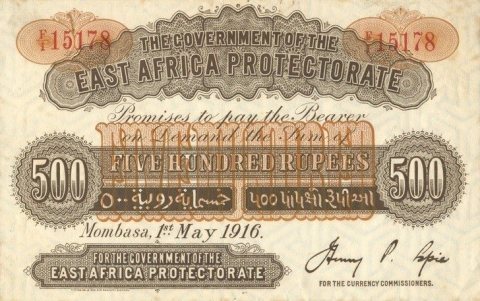
Under the East Africa and Uganda Order in Council of 10th February 1905 the notes were issued by a Board of three: the Treasurer of the Protectorate and two other officers. A rupee note carries the signature of one of them only, over the words "For the Currency Commissioners". The catalogue's lists of signers give Bowring for the notes of 1905, Smallwood for 1912 to 1914, Espie for 1916 to 1918 and Kempe for 1918 to 1919. Every other name in the next table sat on the Board, signed its accounts or its notices, and never appears on a note.

The Currency Commissioners, 1906 to 1920
The Board sat at Mombasa. The dates are those of the appointment or of the paper signed.
| Date | Who | As | Where it is printed |
|---|---|---|---|
| 1st April 1906 | C. C. Bowring (Treasurer), R. M. Combe, A. Marsden | appointed "to act together ... as Currency Commissioners to form a Currency Board" | Official Gazette, 1st April 1906, p. 96 |
| 1st May 1906 | J. T. Gosling | acting in place of A. Marsden, absent | Official Gazette, 1st May 1906 |
| 9th July 1906 | D. J. Wilson | acting in place of Gosling, on leave (notice dated Nairobi, 7th July 1906) | Official Gazette, 15th July 1906 |
| 22nd December 1906 | G. E. Powter | Acting Treasurer and Currency Commissioner | Official Gazette, 1st January 1907 |
| 20th June 1907 | C. C. Bowring, R. M. Combe, A. Marsden | sign the accounts for 1906-07 | Official Gazette, 1st July 1907 |
| 1908 | H. P. Espie, Deputy Treasurer | acting in place of R. M. Combe, on leave | Official Gazette, 1st May 1908 |
| 15th June 1908 | C. C. Bowring, J. Gosling, Henry P. Espie | sign the statement of notes in circulation on 31st March 1908 | Official Gazette, 1st July 1908 |
| 10th December 1908 | C. C. Bowring, R. M. Combe, J. Gosling | sign the conditions for paying half notes | Official Gazette, 15th December 1908 |
| 10th January 1910 | J. W. H. Parkinson | signs the monthly abstract "for Currency Commissioners" | Official Gazette, 15th January 1910 |
| 10th February 1910 | F. W. Major | signs the monthly abstract | Official Gazette, 15th February 1910 |
| 29th June 1910 | C. C. Bowring, F. W. Major, J. W. H. Parkinson | sign the accounts for 1909-10 | Official Gazette, 15th July 1910 |
| 16th January 1912 | William Radford | signs half-note notices "for the Currency Commissioners" | Official Gazette, 1st February 1912 |
| 28th June 1912 | H. A. Smallwood, F. W. Major, William Radford | sign the statement of 31st March 1912 | Official Gazette, 15th July 1912 |
| 16th August to 14th October 1912 | J. Corbet Ward | signs notices as "One of the Currency Commissioners" | Official Gazette, September to November 1912 |
| September 1912 | F. W. Major, also Chief of Customs | "One of the Currency Commissioners" | Official Gazette, 15th September 1912 |
| 25th June 1913 | H. A. Smallwood, F. W. Major, J. W. H. Parkinson | sign the statement of 31st March 1913 | General Notice No. 399, Official Gazette, 15th July 1913 |
| March and April 1914 | Hobley | signs half-note notices "for the Currency Commissioners" | Uganda Official Gazette, 1914 |
| 28th July 1914 | H. P. Espie, J. W. H. Parkinson, C. S. Hemsted | sign the statement of 31st March 1914 | Uganda Official Gazette, Notice No. 426 of 1914 |
| 28th January 1915 | F. W. Major | "One of the Currency Commissioners" | General Notice No. 65, Official Gazette, 3rd February 1915 |
| April 1917 to February 1918 | J. W. H. Parkinson, also Administrator General | "One of the Currency Commissioners" | Official Gazette, May 1917 to March 1918 |
| 8th September 1917 | H. P. Espie, F. W. Major, J. W. H. Parkinson | sign the statement of 31st March 1917 | Uganda Official Gazette, Notice No. 401 of 1917 |
| 23rd September 1918 | the same three | sign the statement of 31st March 1918 | Uganda Official Gazette, Notice No. 562 of 1918 |
| 11th September 1919 | W. A. Kempe, F. W. Major, Lindsay Allan | sign the statement of 31st March 1919 | Uganda Official Gazette, Notice No. 550 of 1919 |
| 19th January 1920 | Lindsay Allan | "One of the Currency Commissioners", at Mombasa | General Notice No. 122 of 1920 |
| 24th February 1920 | G. Walsh | "One of the Currency Commissioners", at Mombasa | General Notice No. 246 of 1920 |
| 29th April to 10th July 1920 | J. W. H. Parkinson | signs notices and the monthly abstracts as "One of the Currency Commissioners" | General Notices Nos. 497, 581, 741 and 835 of 1920 |
The Legislative Council of the Protectorate met ten times in 1907. Its typed record has nothing on currency or notes, but it shows two of the three Commissioners sitting in the Council: Mr Bowring as Treasurer and Mr Combe as Crown Advocate.
The four signers, as the lists give their offices
| Signer | What the sources print | Source |
|---|---|---|
| C. C. Bowring | "treas., East Africa Prot., 1st Oct., 1901"; "chief sec. to govt, E.A.P., Apl., 1911"; "ag. govr., Feb. to Oct., 1912" | Colonial Office List for 1913, record of services; the List for 1922 the same |
| H. A. Smallwood | Treasurer "Sept. 14, 1911"; the Executive Council return gives 13th September; the Colonial Office Lists give "Oct., 1911"; gone by 30th March 1915 "on transfer to the Federated Malay States" | Blue Books for 1913-14 and 1914-15; Colonial Office Lists |
| H. P. Espie | first assistant treasurer July 1895, from the Imperial British East Africa Company; deputy treasurer 1st April 1903; "treas., 1915"; "Mar. 30, 1915" | Colonial Office List for 1920; Blue Book for 1914-15 |
| W. A. Kempe | from the Audit Department; Deputy Treasurer "Mar. 30, 1915"; "acting treasurer and member of councils 1919" | Blue Book for 1914-15; Colonial Office List for 1920 |
The Gazette adds three things to these entries. Smallwood signs as a Commissioner on 28th June 1912, three days before the date on the first notes with the Smallwood signature, 1st July 1912, such as the 10 rupees of 1912 to 1918. Espie sat as an acting Commissioner as early as 1908; the first Espie notes are dated 1st May 1916. Kempe, who signs notes of 1st December 1918 and 1st May 1919 such as the 500 rupees of 1912 to 1919, audited the Board's accounts in June 1908 as Acting Local Auditor. No notice appoints Espie or Kempe as signer in the years their notes are dated, and the copy of the Gazette that was read has no issue for 1916.
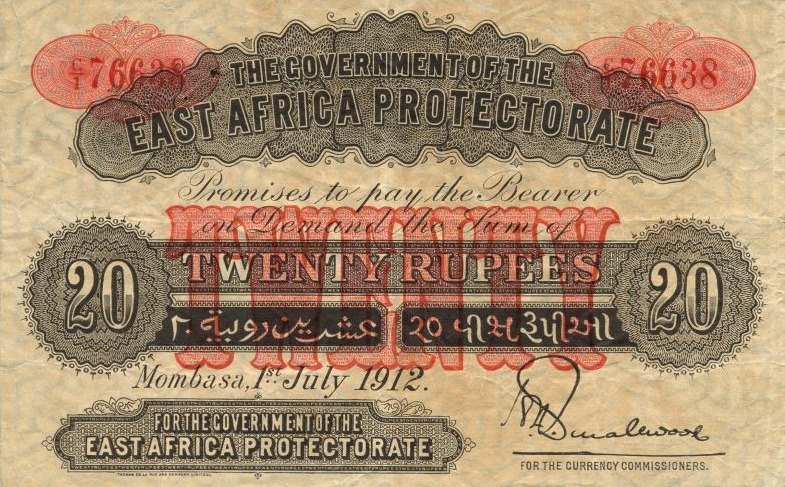
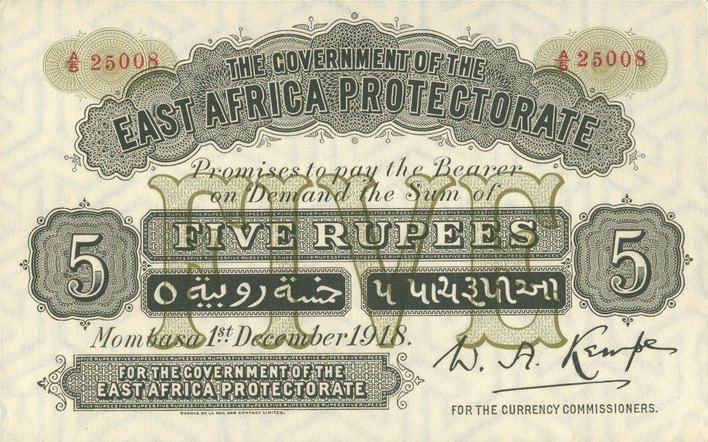
For the notes dated 1st September 1905, such as the 5 rupees, the Gazette shows Bowring as Treasurer and Commissioner from the first day of the Board, 1st April 1906, seven months after the date on the notes.
Marsden: two sources, two dates
The Gazette of 1st April 1906 appoints A. Marsden a Currency Commissioner on that day. The Colonial Office Lists of 1910 to 1919 all print "currency comsnr., 22nd May, 1908" in the entry for Marsden, who was Chief of Customs from 6th August 1895 to April 1908. The Red Book of 1909, written about October 1908, gives the Commissioners as the Treasurer, R. M. Combe and John Gosling, "Gosling in place of A. Marsden". The two dates are left side by side here. For Combe the List for 1909 agrees with the Gazette: "currency comsnr., 1st Apr., 1906". For Parkinson, the Administrator-General, the Lists of 1917 to 1923 give "currency comsnr., E.A.P., 1909".
Secretaries and auditors
- G. E. Powter was Secretary to the Currency Commissioners in 1910, and J. A. Bakewell acted during Powter's leave (Official Gazette, 1st August 1910).
- J. A. R. Eliot was Secretary from 18th April 1914 (a corrigendum in the Gazette of 1914).
- The Board's statements were audited by W. A. Kempe, Acting Local Auditor (15th June 1908), R. W. Lambert, Assistant Auditor (28th June 1912) and H. C. E. Barnes, Auditor (10th May 1920).
From Commissioners to a Currency Officer, 1920
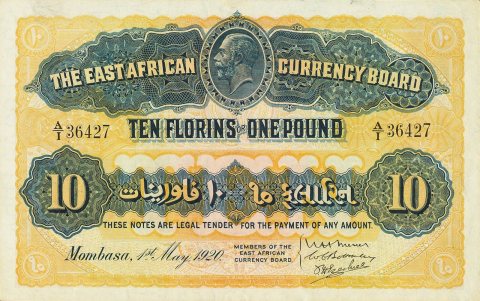
The East Africa and Uganda (Currency) (No. 2) Order, 1920, of 26th April 1920, provided in Article 9 that the Board of 1905 should hand its powers, money and assets to a new Board of Commissioners of Currency, and that it should carry on until then. The last abstract signed by "One of the Currency Commissioners" in the Gazette is that of 10th July 1920. General Notices Nos. 942 and 943, dated 16th and 19th August 1920, are the first to come from the "Offices of the Currency Officer, Mombasa", and are signed by F. W. Major, who had signed for the Commissioners since February 1910. The page of the 1 florin names Major as the Board's first Currency Officer at Mombasa.
| Date of the notices | Who | As |
|---|---|---|
| 16th and 19th August 1920 | F. W. Major | Currency Officer, Mombasa |
| 5th January to 26th October 1921 | G. D. Kirsopp, H. Pickwoad, G. Walsh, J. S. Ross | each signs "for Currency Officer", Mombasa |
| 30th December 1921 and 3rd January 1922 | F. W. Major | signs "for Currency Officer", and as Commissioner of Customs of Kenya and Uganda |
| 13th March 1922 | G. Walsh | Currency Officer |
| 14th November 1922 | F. V. Hodgson | "for Currency Officer", Mombasa |
| 15th January 1923 to 1925 | R. Clifton Grannum | Currency Officer, Mombasa; the Currency Department was at Nairobi by June 1925 |
| 12th September 1929 and 8th February 1930 | H. L. Bayles | Currency Officer, Nairobi |
| 6th June 1930 | H. H. Rushton | Currency Officer, Nairobi |
| 6th March 1933 and 25th January 1934 | G. R. Sandford | for Currency Officer, then Currency Officer |
| 19th July 1933 | P. C. M. Watson | for Currency Officer |
| 26th June 1934 to 31st December 1936 | G. Walsh | Currency Officer |
| 14th January and 21st July 1938 | G. Beresford Stooke | Currency Officer |
| 14th May and 3rd June 1941 | P. C. M. Watson | Currency Officer |
| 15th March 1945 to 5th December 1949 | H. J. Webster, also Accountant General | Currency Officer |
| 29th June 1948 | G. E. Bowles | for Currency Officer |
| 10th July and 11th December 1950 | R. W. Smith | Acting Currency Officer, also Acting Accountant General |
| 13th September 1951 to 21st October 1952 | E. J. Petrie, also Accountant General | Currency Officer |
| 30th July to 12th November 1953 | C. L. Todd, also Accountant General | Currency Officer |
| 15th December 1959 to 25th May 1962 | H. C. O'Brien | Currency Officer, the Treasury, later the Currency Office, Nairobi |
| from 24th April 1960 | Roy Miller | to act as Currency Officer (Gazette Notice No. 3164) |
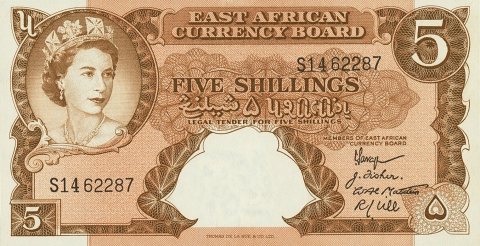
A printed "J. Walsh" of 6th September 1921 is taken to be the same G. Walsh. The four notices of 23rd June 1924 are dated at Nairobi and those of 18th July 1924 at Mombasa again. H. H. Rushton, Currency Officer in June 1930, was Treasurer of Kenya in the Legislative Council debates of June 1931. It was H. C. O'Brien who signed Gazette Notice No. 4943 of 15th December 1959, which announced the day of issue of the new 5 shillings.
The Blue Books and annual reports of Kenya, Uganda and Tanganyika read for East Africa name two more Currency Officers, Taylor and Allen, and give Hirst as Assistant Treasurer from 1928. Which volume names each was not noted, and no dates were taken for Taylor or Allen.
Three other offices appear in the notices of claims: E. E. Roden, Currency Officer at the Treasury, Dar es Salaam (13th December 1947); an Assistant Currency Officer at Jinja, not named (February 1947); and F. X. de Goa, Currency Officer, Zanzibar (4th December 1952). A George Turner is listed as Assistant Currency Officer, Mombasa, in a roll of names in the Gazette of 6th February 1924.
The advisory board of 1921
Government Notice No. 79, dated at the Secretariat, Nairobi, 2nd March 1921, announces an Advisory Board "to assist the Currency Board and this Government in currency matters". It names offices, not persons: the Treasurer and the Managers of the Nairobi branches of the National Bank of India, the National Bank of South Africa and the Standard Bank of South Africa. Whether this is the "Currency Committee appointed in Kenya in February, 1921" of which the Secretary of State spoke in the House of Commons on 30th May 1921 the notice does not say.
The Board in London, and then in Nairobi
For the East African Currency Board itself the Gazette is silent. No notice of 1920 to 1964 appoints a member. The Board's Regulations, published at Nairobi on 16th July 1924 (Government Notice No. 257), say only that the members and the Secretary are appointed by the Secretary of State and that the notes "carry facsimile signatures of the members in office". So nothing in the Gazette confirms or dates Mercer, Bottomley, Ezechiel, Kershaw or any later signer.
What the other sources give:
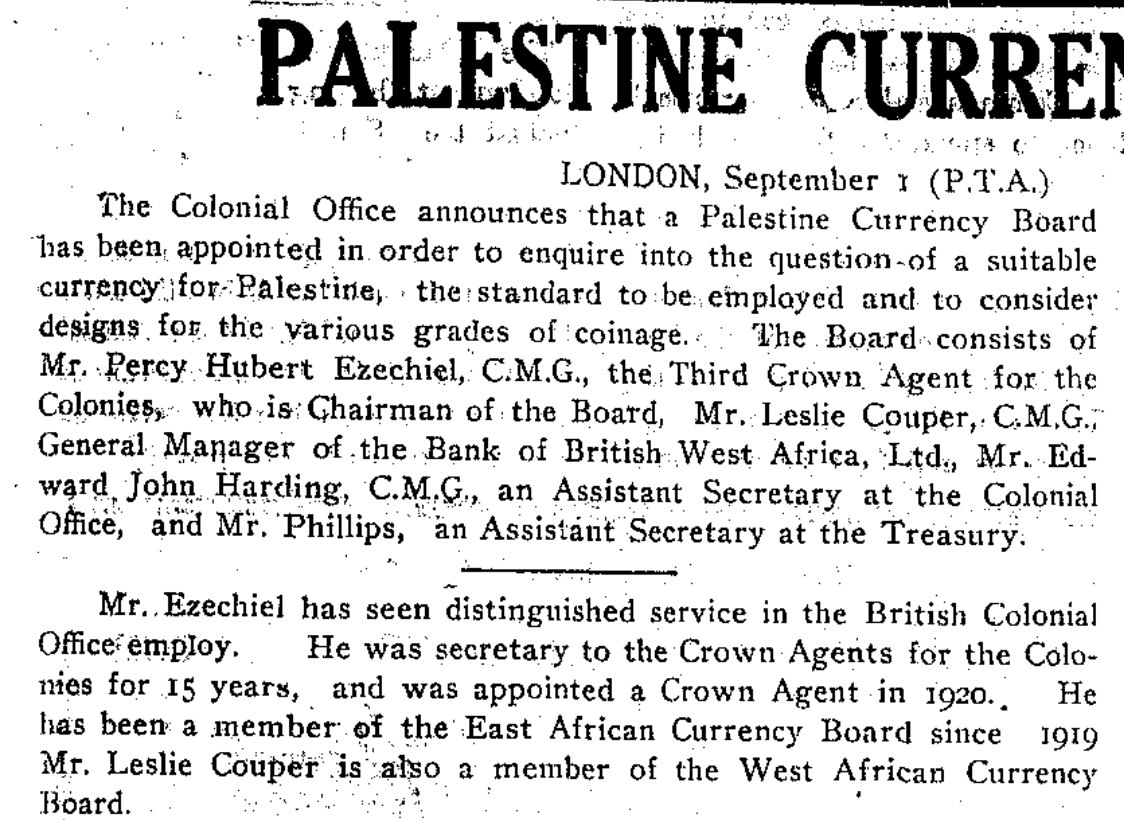
- The Palestine Bulletin of 1st September 1926, p. 1, says that Percy Hubert Ezechiel had been a member of the East African Currency Board since 1919, was Secretary to the Crown Agents for fifteen years and a Crown Agent from 1920.
- Dr. David Lott, in Bank Note Reporter of March 1985, names the three original members as Sir W. H. Mercer, W. C. Bottomley and P. H. Ezechiel, calls Ezechiel the secretary, and says that Bottomley was still signing notes in 1941 and that R. N. Kershaw signed from 1933 to 1953. Lott adds that a fourth member was added in 1942, that the Board had six members in 1960 and seven in 1961.
- On the notes themselves, the 1 shilling of 1st January 1943 is signed by the four members of the Board at that date, Bottomley, Kershaw, Seel and Caine.
- The annual report on Kenya for 1960 is the first to say that the Board's headquarters are in Nairobi.
Once the Board sat in East Africa its own officials sign in the Gazette:
| Date | Who | As | Notice |
|---|---|---|---|
| 22nd April 1963 | H. R. Hirst | Secretary, East African Currency Board | Gazette Notice No. 1793 |
| 25th February 1964 | H. J. Hinchey, with H. R. Hirst | Acting Chairman, signing the balance sheet for 31st December 1963 | Gazette Notice No. 684 |
| 7th October 1964 | D. A. Omari | Chairman | Gazette Notice No. 3584 |
| 12th November 1964 | R. Miller | Acting Secretary | Gazette Notice No. 3882 |
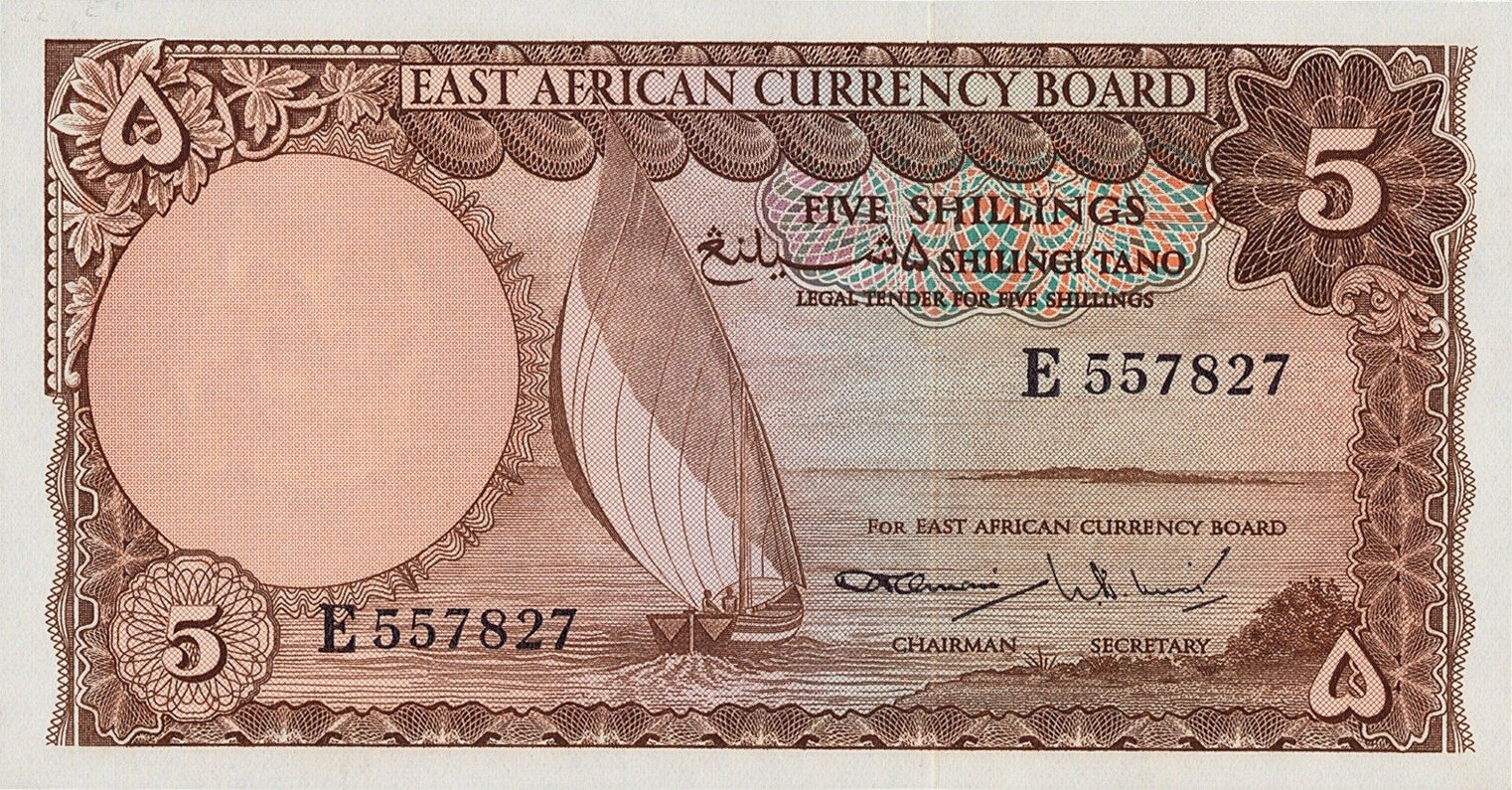
The last notes of the Board, such as the 5 shillings of 1964, are signed by the Chairman and the Secretary. The catalogue gives Omari as the Chairman on them, and the Gazette shows Omari in that office on 7th October 1964 and Hirst as Secretary through 1964. Hinchey, Acting Chairman in February 1964, is not named on any page of the catalogue.
Not found
- Any notice that appoints a member of the East African Currency Board, 1920 to 1964.
- The appointment of H. A. Smallwood, H. P. Espie or W. A. Kempe as a Commissioner in the years of the notes each signed.
- A machine reading of one notice gave an "appointment" of F. W. Major on 1st August 1920. It could not be confirmed on the page and is not used here.
- The East African Currency Board (Amendment) Regulations of 1961 (Legal Notice 723) and 1963 (Legal Notice 59), which may bear on the size of the Board, are listed in the contents of the Gazette only. The supplements with their text were not in the copy read.
Sources
- Official Gazette of the East Africa and Uganda Protectorates, later of the East Africa Protectorate, of the Colony and Protectorate of Kenya, and the Kenya Gazette, 1906 to 1964: the notices named in the tables.
- Uganda Official Gazette: Notices No. 426 of 1914, No. 401 of 1917, No. 562 of 1918 and No. 550 of 1919; half-note notices of 1914 and 1919.
- East Africa and Uganda Order in Council of 10th February 1905; East Africa and Uganda (Currency) (No. 2) Order, 1920, Article 9.
- Colonial Office Lists for 1909, 1910 to 1919, 1913, 1920, 1922 and 1917 to 1923; the Red Book of 1909.
- Blue Books of the East Africa Protectorate for 1913-14 and 1914-15.
- Legislative Council of the East Africa Protectorate, sittings of 1907; Legislative Council Debates of Kenya, 1931, volume I.
- Regulations of the East African Currency Board, Government Notice No. 257 of 1924.
- Hansard, House of Commons, 30th May 1921, volume 142, columns 596 to 598.
- The Palestine Bulletin, 1st September 1926, p. 1.
- Dr. David Lott, "East African paper money has tangled history", Bank Note Reporter, March 1985, pp. 26 and 27.
- Annual report on Kenya for 1960.
Member comments
Log in or register to post a comment.