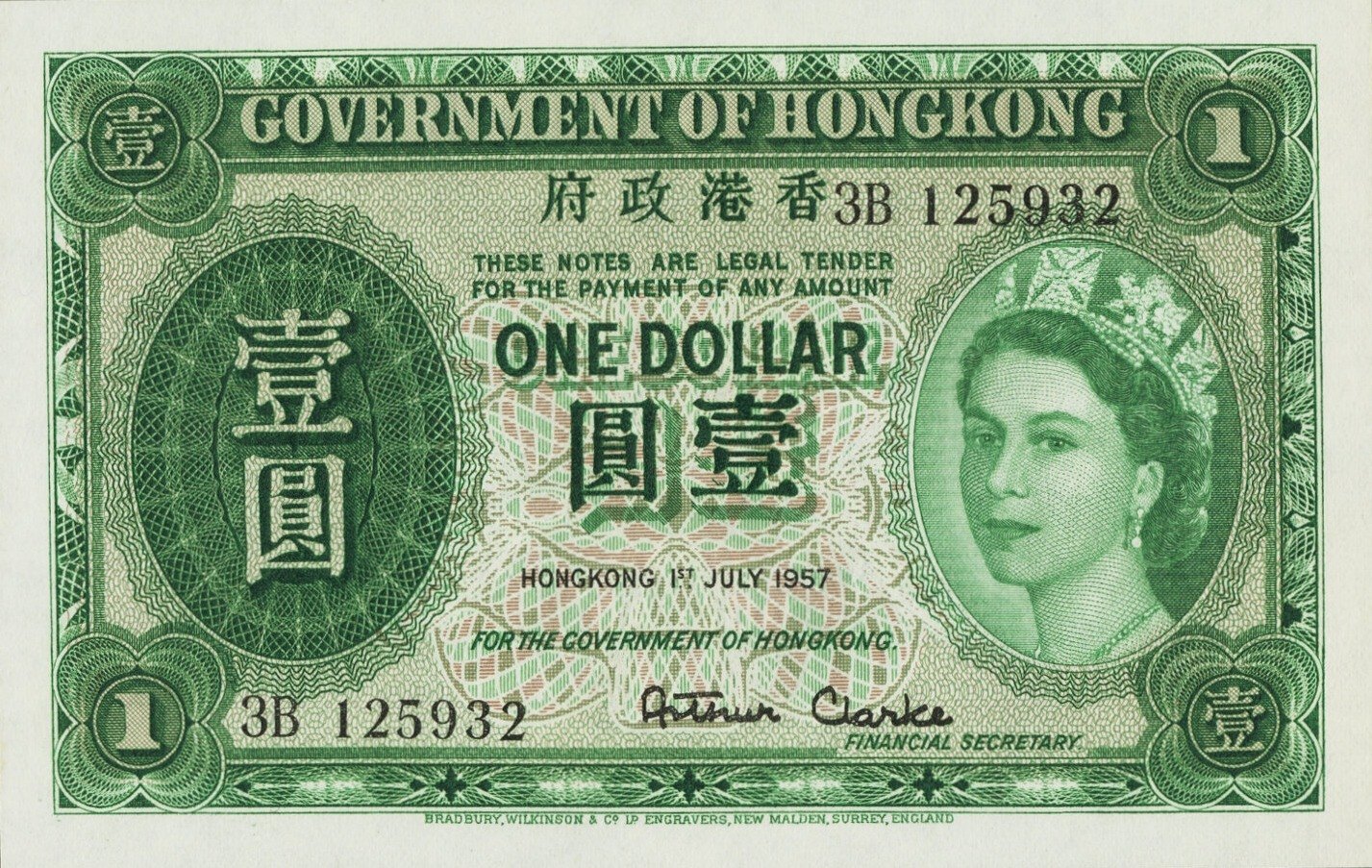
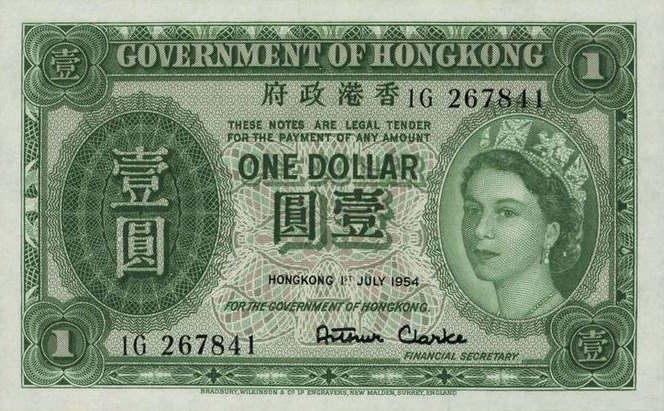
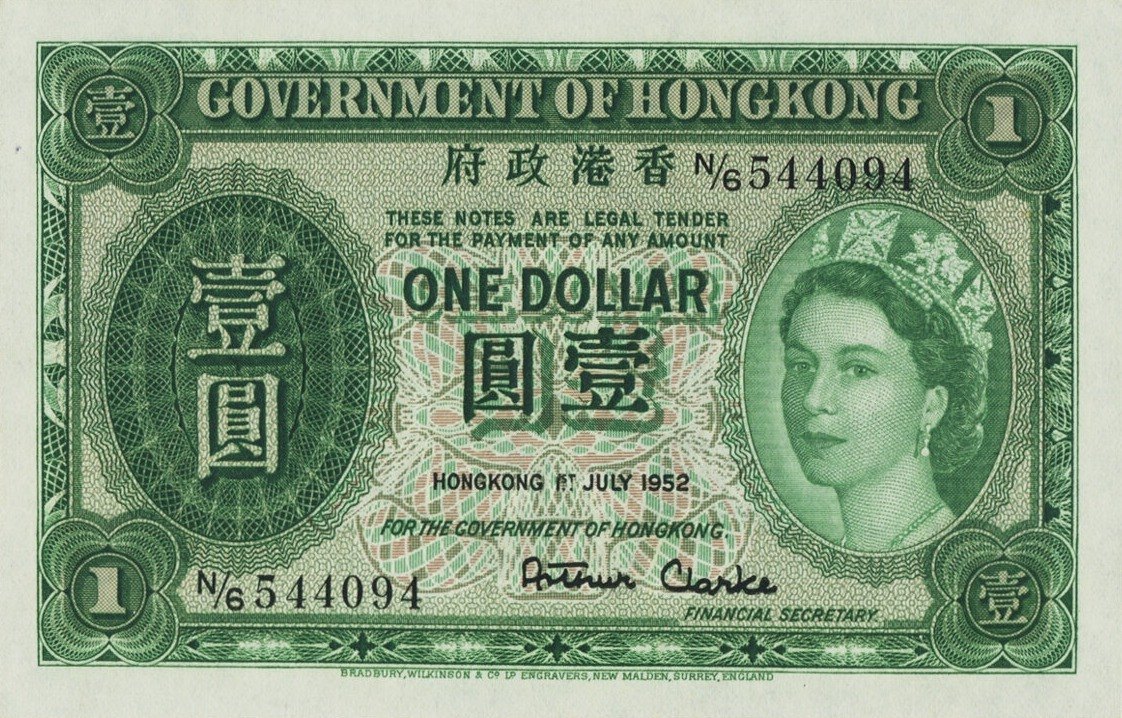
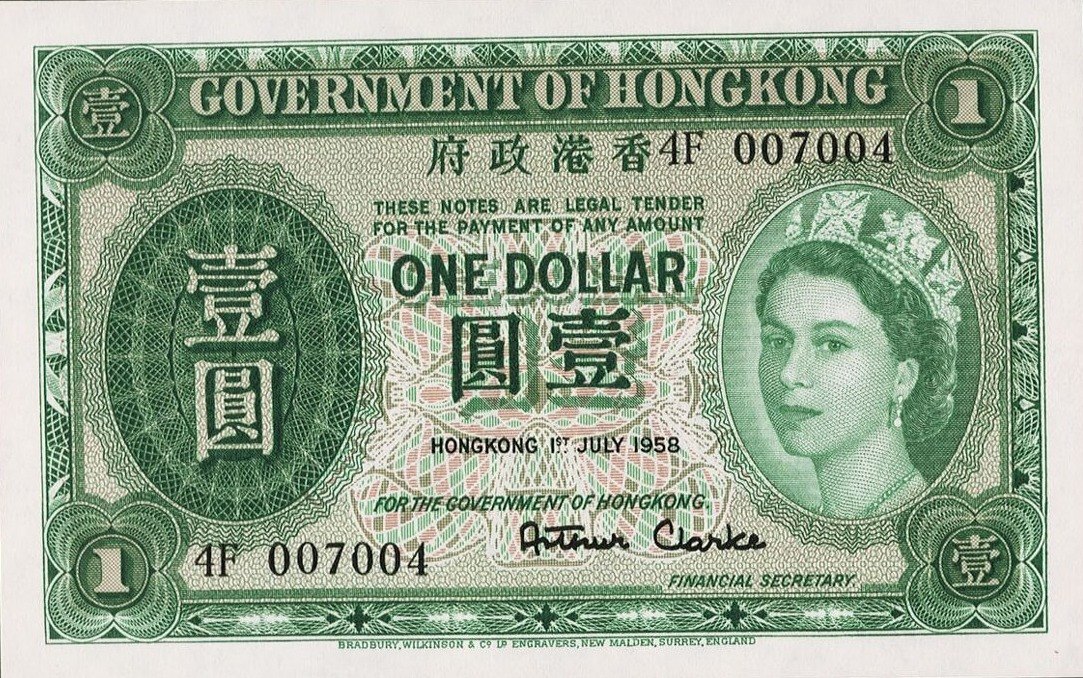
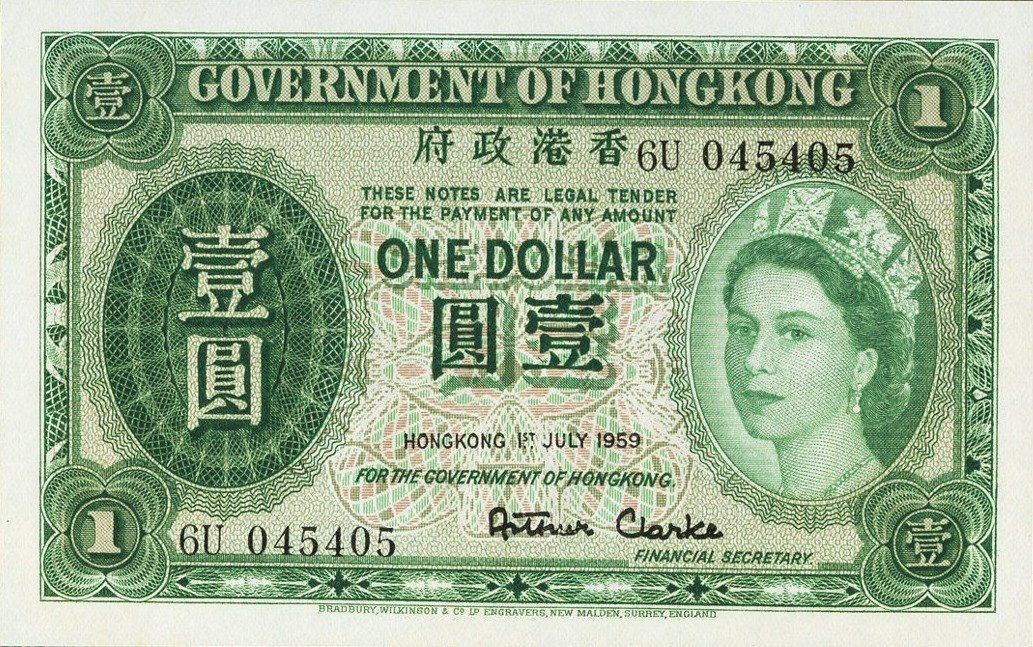
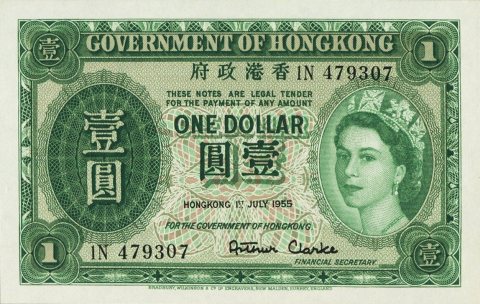
The green 1 dollar with Queen Elizabeth II, dated from 1st July 1952 to 1st July 1959 and signed Clarke, was the last 1 dollar note of the Government of Hong Kong. This article gathers what the Financial Secretary told the Legislative Council about it year by year, mostly in the budget speeches of 1955 to 1963, and sets beside it the figures K. Y. Tang printed in Bank Note Reporter in September 1975. The Council's papers give the notes in circulation and the notes burned. They give no number printed for any date.
A demand nobody expected, 1952
In the budget speech of 2nd March 1955 the Financial Secretary, A. G. Clarke, looked back to 1952. For the first time since the war there had been an ample reserve of small coins, and the demand for them was small. The demand for 1 dollar notes was not: in the six weeks before Chinese New Year 1952 approximately ten million were issued. The reserve was only just enough, and large orders were placed at once. The demand came back in each year after that, and the speech calls a large rise in the issue around Chinese New Year normal by then.
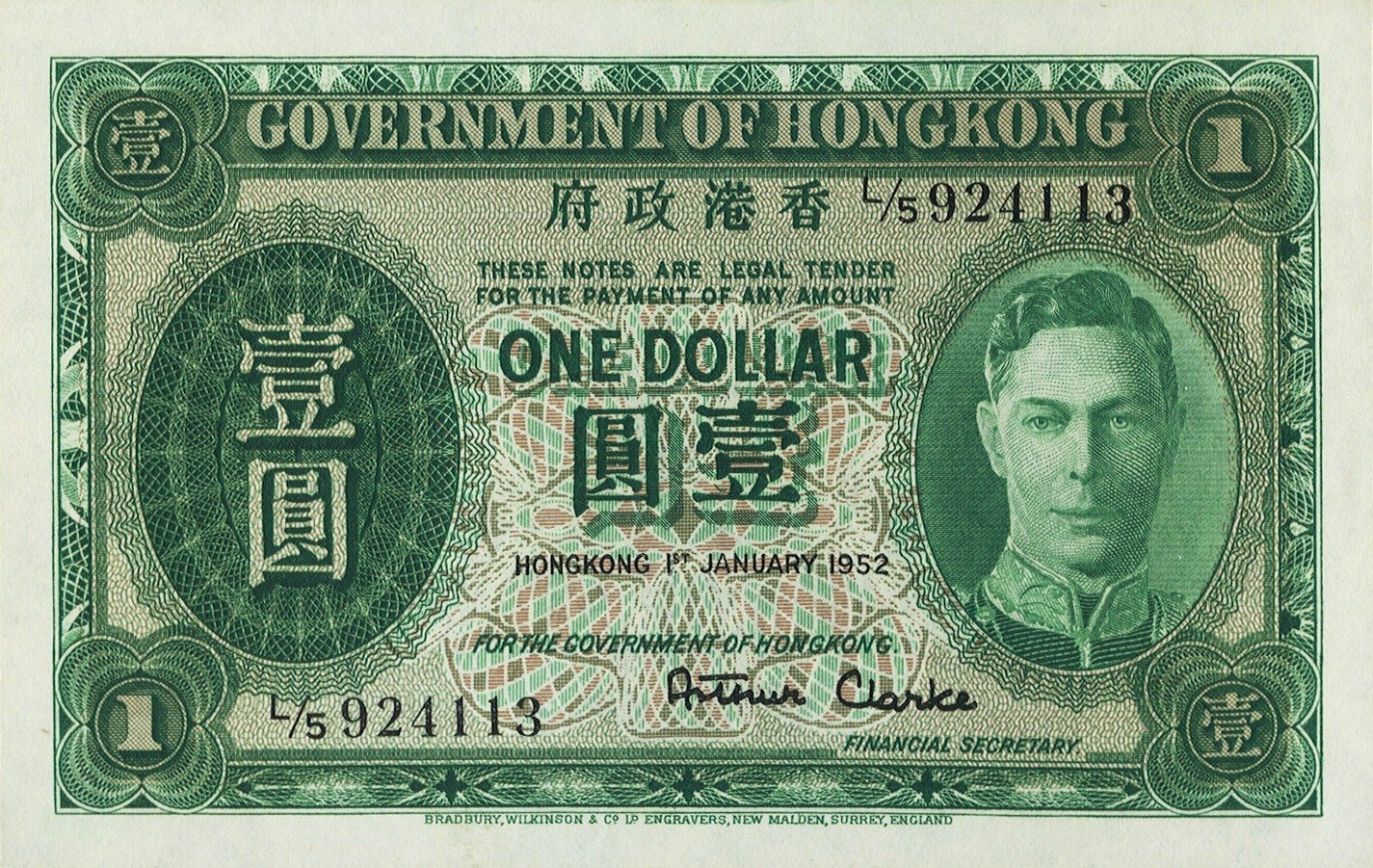
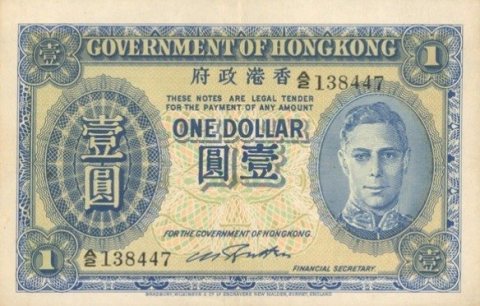
The date on the notes changed in that year. The green 1 dollar with King George VI carries 1st January 1952, the first note with the Queen 1st July 1952.
Two years in the hand
In the same speech of March 1955 the Financial Secretary said that for a couple of years almost a million dirty notes a month had been destroyed. Against a circulation of about 25 million, that gave a 1 dollar note an average life of only two years. Notes on paper specially treated to wear better in local conditions were then being brought in. The speech does not say which date of note was the first on the treated paper.
The note fund felt it. The dollar note security fund, set up under the Ordinance of 1935, had shown a deficit on its working for the second year running, and the Financial Secretary said outright that the Government was losing money on the issue of dollar notes. A coin in place of the note had been suggested, the speech adds, but had not been favourably received.
Very large orders of new notes followed from 1957. In March 1958 the Financial Secretary said they had been placed to withdraw the many dirty notes in circulation and to build up a reserve. A year later the condition of the notes was still, in the speech's words, very bad.
Notes burned
| Year | 1 dollar notes burned | Source |
|---|---|---|
| the couple of years before March 1955 | almost a million a month | budget speech of 2nd March 1955 |
| 1958 | 27¾ million | budget speech of 25th February 1959 |
| 1959 | 23 million | budget speech of 24th February 1960 |
| 1960 | 26 million, half a million each week on average | budget speech of 1st March 1961 |
Notes in circulation
The speeches usually give the figure at Chinese New Year, when the circulation stood at its yearly peak. The table keeps each figure as its source gives it. Some are counted in notes and some in dollars, which for this note is the same thing.
| Date | 1 dollar notes in circulation | Source |
|---|---|---|
| 31st December 1954 | 26,891,500 dollars | the colony's annual report for 1954, as given in Money in British East Asia (1957) |
| about March 1955 | about 25 million | budget speech of 2nd March 1955 |
| Chinese New Year 1955 | 33 million dollars | budget speech of 29th February 1956 |
| 11th February 1956 | almost 37 million dollars | budget speech of 29th February 1956 |
| Chinese New Year 1957 | over 40 million dollars; 40.3 million | budget speeches of 27th February 1957 and 6th March 1958 |
| Chinese New Year 1958 | 43.4 million | budget speech of 6th March 1958 |
| 7th February 1959 | almost 56 million dollars | budget speech of 25th February 1959 |
| 1960 | 43,821,487 dollars | K. Y. Tang, Bank Note Reporter, September 1975 |
| end of 1961 | over 30 million notes still outstanding | budget speech of 28th February 1962 |
| 1962 | 26,671,487 dollars | K. Y. Tang, Bank Note Reporter, September 1975 |
| February 1963 | 23 million notes not yet withdrawn | budget speech of 27th February 1963 |
| 5th February 1969 | 11.5 million dollars, in theory | the Financial Secretary on the Dollar and Subsidiary Currency Notes Bill |
Two things should be said of these figures. The first is that the "about 25 million" of March 1955 and the 33 million of Chinese New Year 1955 come from two speeches a year apart and do not measure the same day. The rise from about 25 million in 1955 to almost 56 million at Chinese New Year 1959 is therefore a rise between a figure given in March and a New Year peak. The second is that Tang's two figures are Tang's: they have not been found in an official paper read for these pages. Tang gives them for the Government 1 dollar notes of all issues together. Looking back in 1969, the Financial Secretary put the peak at 55 million dollar notes.
The speech of 29th February 1956 adds that 10,200,000 dollars of notes had to be issued between 1st January and noon on 11th February of that year. The speech of 27th February 1957 says that some shipments counted on for the New Year were still at sea, because the Suez Canal was closed, and that every demand was met all the same.
The losses of the note fund
| Year of account | What the Financial Secretary reported | Speech |
|---|---|---|
| 1952/53 and 1953/54 | a deficit on working, two years running | 2nd March 1955 |
| 1954/55 | a small profit | 29th February 1956 |
| at 1st April 1956 | liabilities over assets by something over 1.3 million dollars, from the writing down of investments | 27th February 1957 |
| 1956/57 | a loss again | 6th March 1958 |
| 1957/58 | the debit balance up from about 1.2 million to 2.1 million dollars | 25th February 1959 |
| year to 31st March 1959 | a loss of a little over 162,000 dollars | 24th February 1960 |
| 1959/60 | the accumulated loss up from 1,713,000 to 2,245,000 dollars | 1st March 1961 |
| early 1963 | a deficit of 2 million dollars turned into a surplus of half a million, two years after the notes ceased to be replaced | 27th February 1963 |
The coin
In the budget of 25th February 1959 the Financial Secretary announced that the decision had been taken to replace the 1 dollar note by a coin. The reasons given were the two that fill the earlier speeches: the note issue ran at a loss, and the notes wore out fast. The coin was to be of cupro-nickel and of the size of the British florin. Its design was not yet settled.
A year later, on 24th February 1960, the order had been placed with the Royal Mint and the coin was not expected before the end of the year. The estimates for 1960 to 1961 held 8 million dollars for coins, mainly the new dollar.
By Chinese New Year 1961 that stock had fallen to two million. Worn notes were no longer replaced. In 1969 the Financial Secretary said that no 1 dollar notes had been issued since December 1960.
Where the notes went
The notes did not come back as fast as the coins went out. At the end of 1961 over 30 million notes were still outstanding, three quarters of the whole 1 dollar circulation. In February 1963 the Financial Secretary, by then J. J. Cowperthwaite, reported that the coins had at last overtaken the notes. 80,000,000 dollar coins had been struck at a cost of 10¼ million dollars. 23 million notes had not been withdrawn, they were seldom seen, and appeals to the banks to send them in for destruction brought little. The Financial Secretary thought some might be lost or destroyed and never have to be redeemed.
An answer came in the budget debate of 18th March 1963. An unofficial member, Y. K. Kan, owned to hoarding the notes, and said that the Chinese public on the whole did not like the dollar coins and would sooner see the notes restored.
They were not. The Dollar and Subsidiary Currency Notes Ordinance, passed on 13th March 1969, ended the legal tender status of the 1 dollar note with that of the 5 and 10 cent notes. The notes can still be exchanged at face value. The wider story is in The Government of Hong Kong's own notes, 1935 to 1995.
What is not known
No source read for these pages gives the number of 1 dollar notes printed for any of the seven dates, or the cost of printing them. Tang's article of September 1975 prints a table of an amount issued for each date, drawn as the article says from the Gazette and the Accountant General, but what it measures is not clear, and it is not used here. The first date on the treated paper is not known.
Sources
- Reports of the sittings of the Legislative Council of Hong Kong, the budget speeches of the Financial Secretary: 2nd March 1955, 29th February 1956, 27th February 1957, 6th March 1958, 25th February 1959, 24th February 1960, 1st March 1961, 28th February 1962 and 27th February 1963; the budget debate of 18th March 1963; the second reading of the Dollar and Subsidiary Currency Notes Bill, 5th February 1969, and its passing on 13th March 1969.
- Money in British East Asia (London, 1957), for the annual report's figure of 31st December 1954.
- K. Y. Tang, "$1 Government Notes of Hong Kong: Part II, Elizabeth II Notes", Bank Note Reporter, September 1975, p. 17.
Member comments
Log in or register to post a comment.