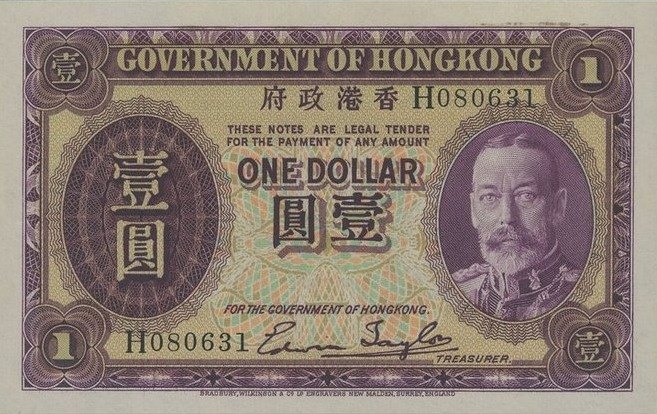
This article follows the notes that the Government of Hong Kong issued in its own name, from the 1 dollar of November 1935 to the 1 cent that lasted until 1995. The notes of the banks are not part of it. It is written from the pages of this catalogue and from the official papers behind them: the reports of the Legislative Council's sittings from 1935 to 1969, the Blue Books, the Colonial Office List, Chalmers' History of Currency in the British Colonies (1893) and an article by K. Y. Tang in Bank Note Reporter of August 1975.
Before 1935: no Government note
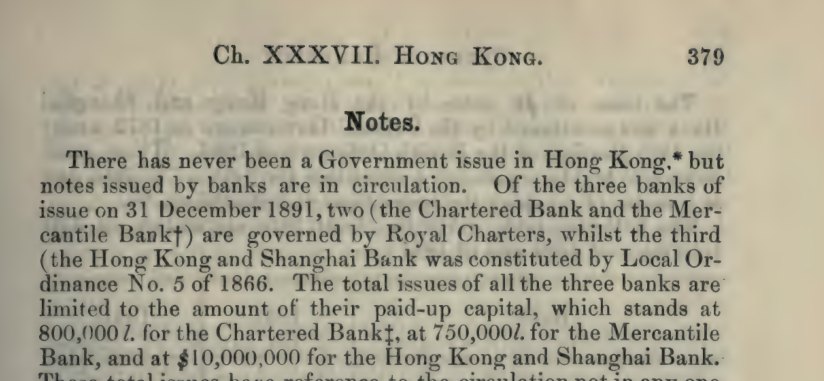
Chalmers' History of Currency in the British Colonies (1893) says that there had never been a Government issue in Hong Kong, and that only the notes of the banks were in circulation. In a footnote the book adds that a proposal for 1 dollar notes of the Colonial Government had been considered a few years earlier and dropped. The Blue Books from 1914 to 1934 enter nothing under Government paper money.

The 1 dollar of November 1935
Hong Kong left the silver standard on 9th November 1935. On the same day the Legislative Council met in an emergency meeting, suspended its Standing Orders and passed the Dollar Currency Notes Bill through all its stages. It became Ordinance No. 42 of 1935. The report of the sitting gives its two main clauses: the Treasurer might issue and reissue one-dollar currency notes in the Colony, and the notes were legal tender for the payment of any amount. Clause 4 made the Treasurer set up a note security fund, kept on deposit at banks in the Colony, into which all money received for the notes was paid.
The Objects and Reasons printed with the Bill say what the note was for. It was to take the place of the silver dollar coin, not of the banks' notes. The Bill called it an emergency measure, not meant to stay: arrangements had been made for the banks to supply one-dollar notes of their own, and once enough of those were to hand no more Government notes were to be issued. That is not what happened. The Government went on issuing its 1 dollar until 1960.
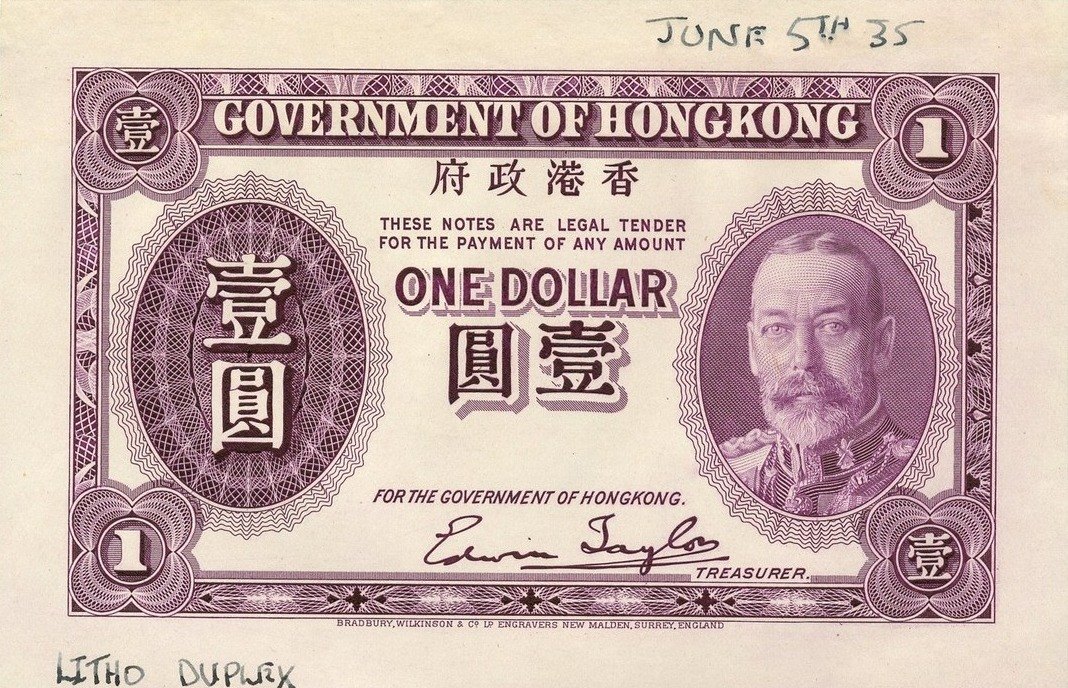
The catalogue's page gives 12th November 1935, three days after the Ordinance, as the day the first note, the 1 dollar of 1935, was issued. It is purple, shows King George V at right, is signed by Taylor as Treasurer and runs through the prefixes A to H. The pages of this catalogue give Bradbury Wilkinson and Company as the printer of this note and of every later Government note but one. The Council's papers never name a printer. The nearest they come is in 1938, when the Objects of an amending Bill say that the fund had been charged with the cost of manufacture, freight and other expenses of the issue.
The Blue Books put the Government 1 dollar notes in circulation at about 1,280,000 dollars at the end of 1935, 2,300,000 at the end of 1936, 3,625,000 at the end of 1937 and 5,571,000 at the end of 1938. The Economic Survey of the Colonial Empire for 1935 says that 1,300,000 dollars of the notes were issued to prevent a shortage of currency at the beginning of the new system. No source read for these pages gives the number of notes printed.
Two further laws belong to these years. The Currency Ordinance of 5th December 1935 set up the Exchange Fund and made the banks' notes full legal tender. The Dollar Currency Notes Amendment Ordinance, read a first time on 10th November 1938 and passed on 24th November 1938, let the note security fund bear the cost of the issue and pay any surplus over the face value of the notes in circulation into general revenue at the end of each year.
King George VI and the blue note, 1939 to 1941
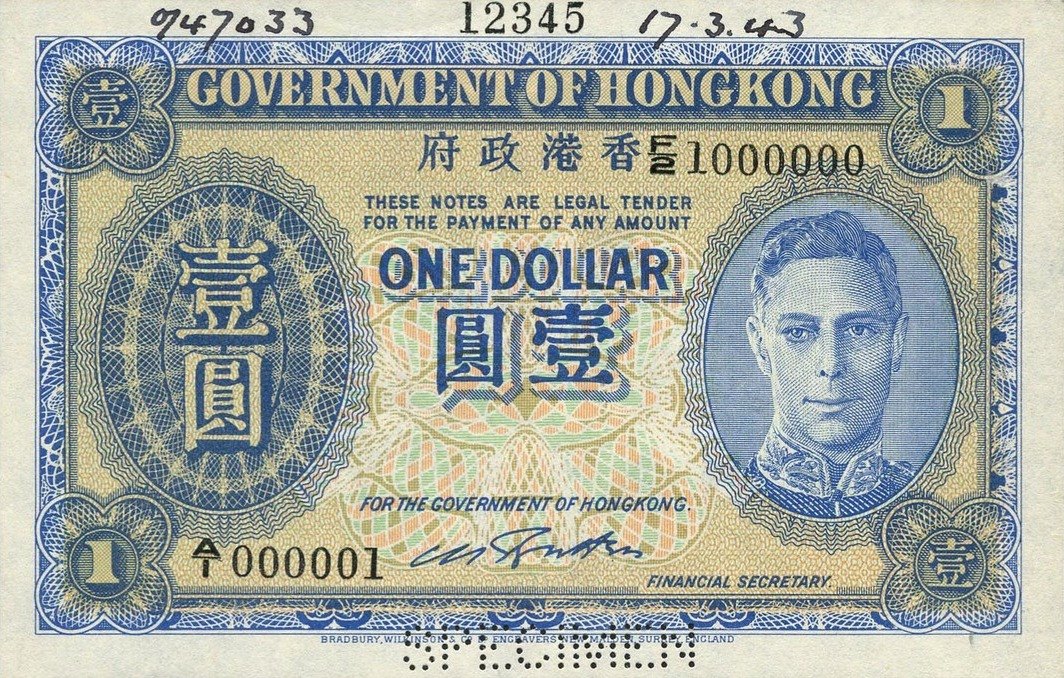
The 1 dollar with King George VI is the same purple note with the portrait changed. It is signed by Caine as Financial Secretary, carries the prefixes J to Y, and the catalogue's page gives 21st November 1939 as the day it came in. Sources mention 1936, the year of the accession, and K. Y. Tang's article in Bank Note Reporter of August 1975 says the same. The Blue Book for 1937 speaks against it: Caine took office only on 16th July 1937.
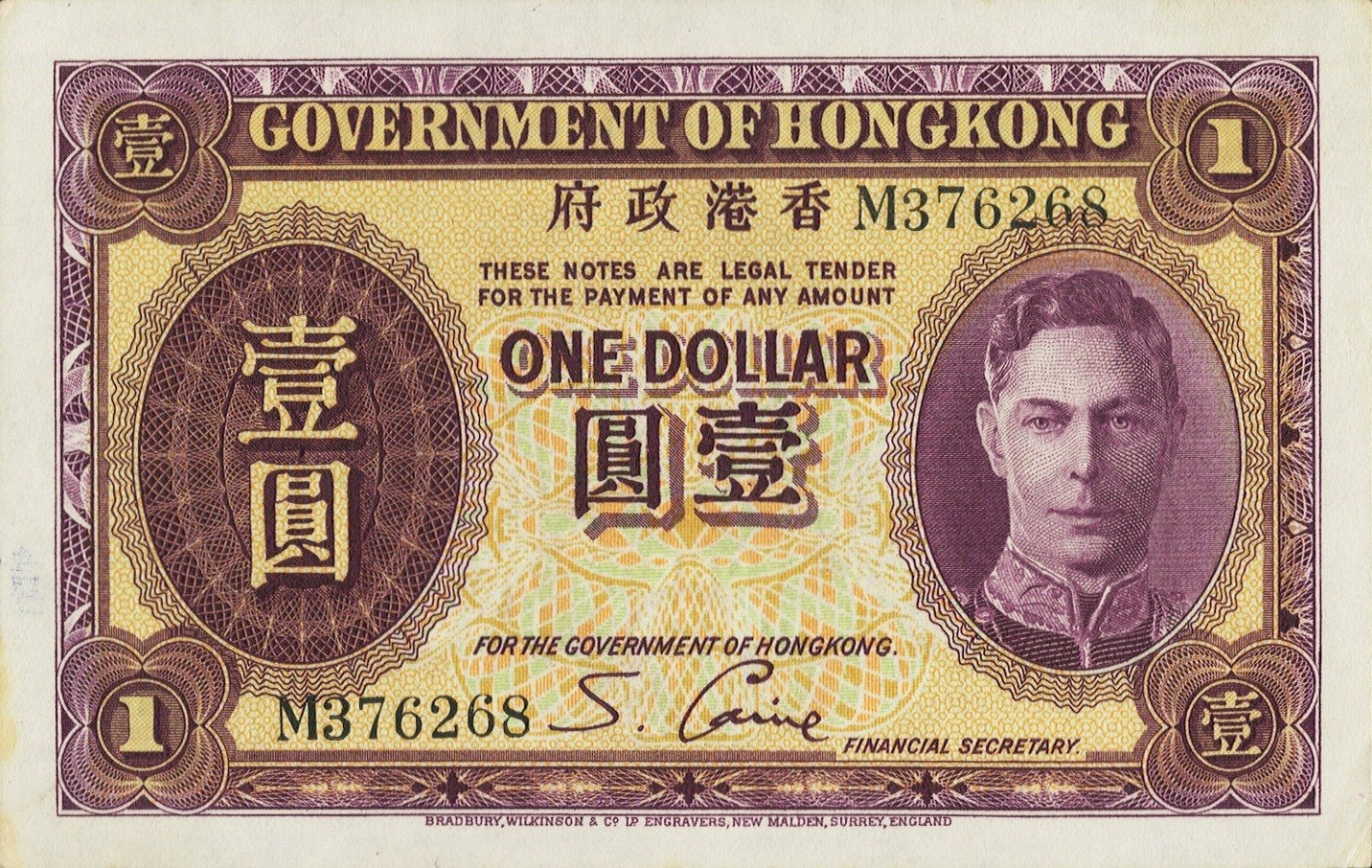
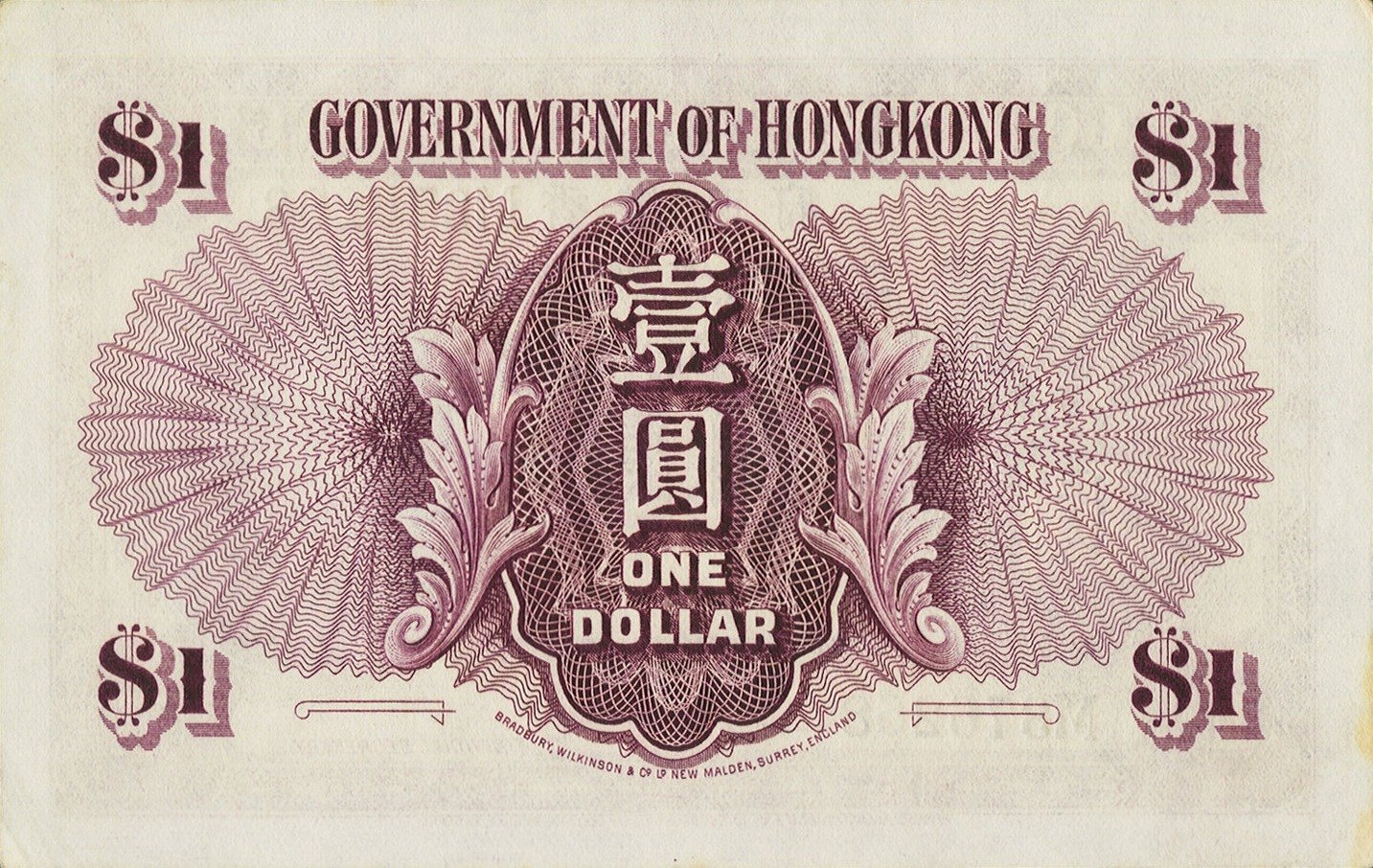
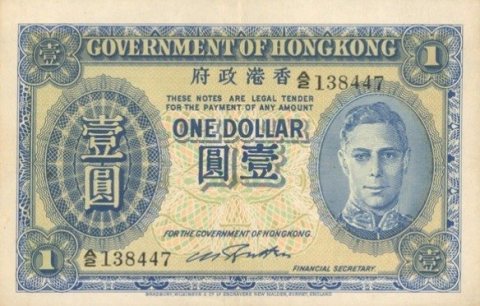
The blue 1 dollar signed Butters, with fractional prefixes from A/1 to G/2, is dated 1940 to 1941 by the catalogue's page. K. Y. Tang, in Bank Note Reporter of August 1975, says instead that it was released on 12th September 1945; no official paper read for these pages bears out that date, and neither is settled here. In 1941 the Government also issued 1, 5 and 10 cent notes, and during the siege of December 1941 an emergency 1 dollar. These are the subject of Hong Kong's cent notes of 1941 and the emergency 1 dollar of the siege.
The notes of 1945 and the green dollars
Three uniface small-change notes with King George VI, the 1 cent, the 5 cents and the 10 cents, were printed by Bradbury Wilkinson and flown into the colony in September 1945, after the Japanese surrender. They carry no serial number and still bear the signature of Butters, Financial Secretary until the fall of Hong Kong in December 1941.
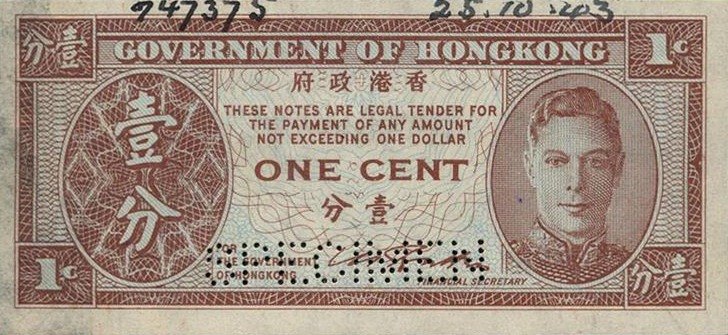
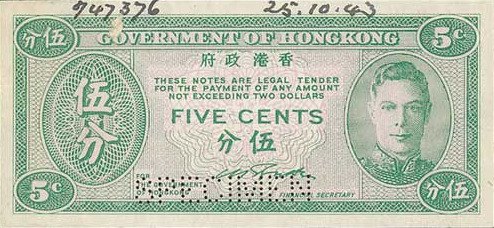
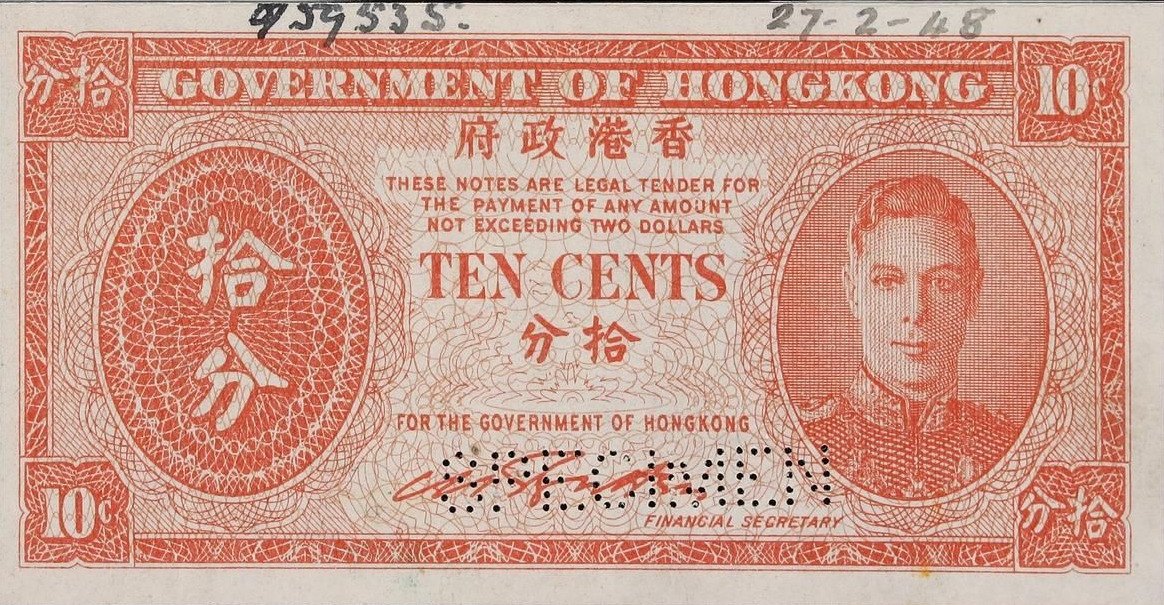
In the Legislative Council on 5th February 1969 the Financial Secretary said that no 10 cent notes had been issued since 1949 and no 5 cent notes since 1950, when new coins of those values came out. The budget speech of 7th March 1951 says the 10 and 5 cent notes were still in use then and could be withdrawn completely once more coins were out. On 6th February 1952 the Financial Secretary told the Council that the coins had almost completely displaced the old ten and five cent notes.
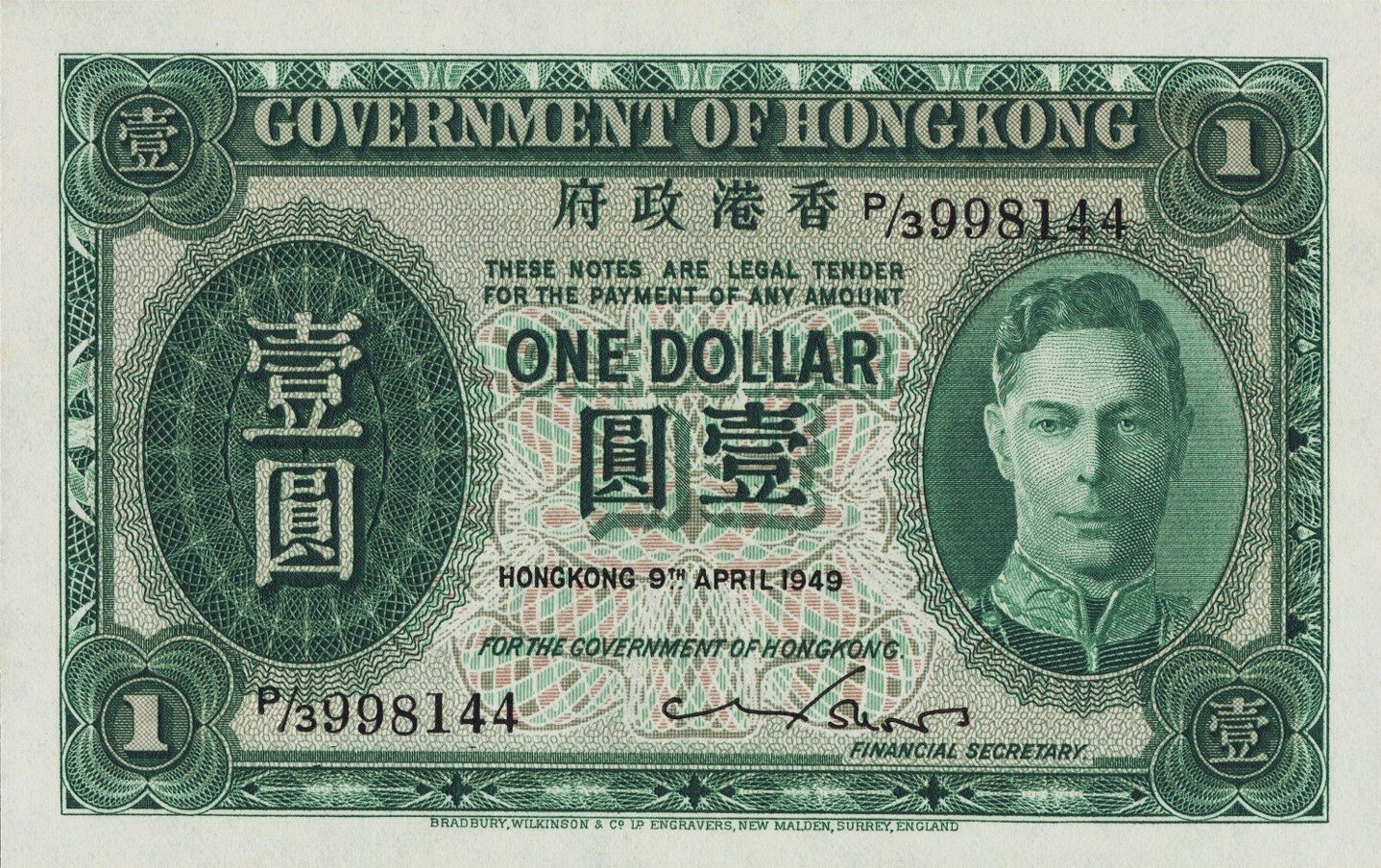
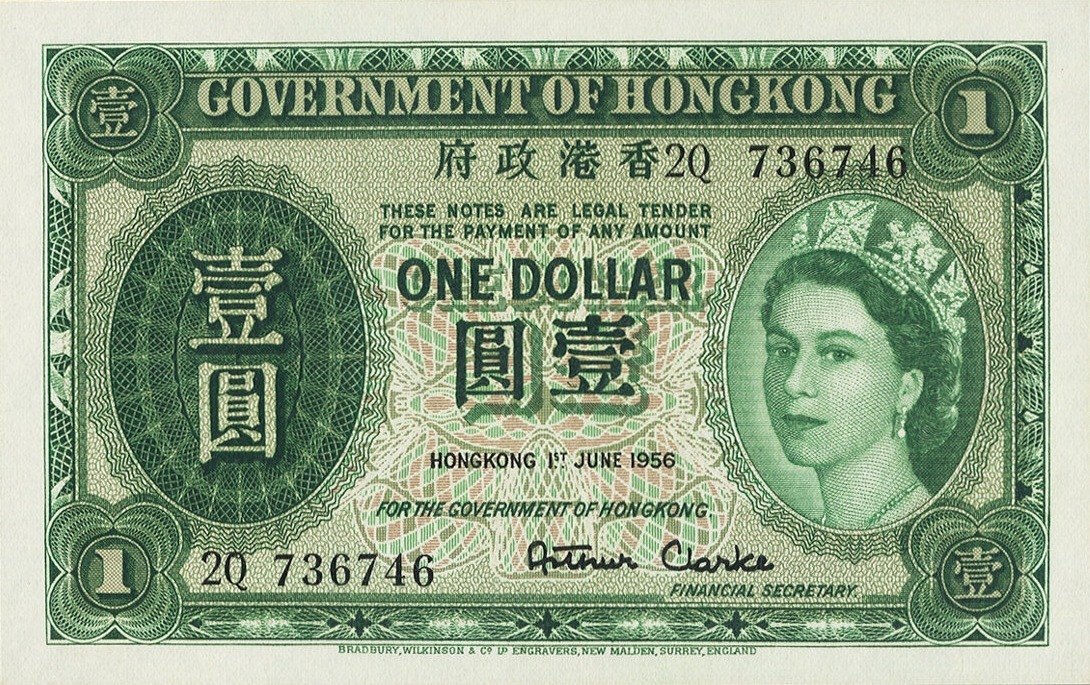
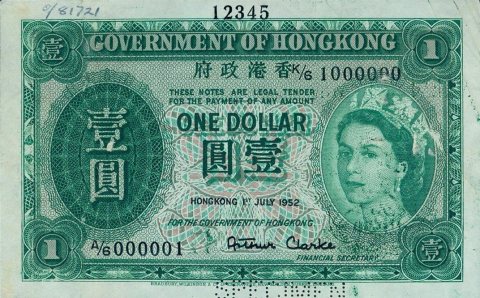
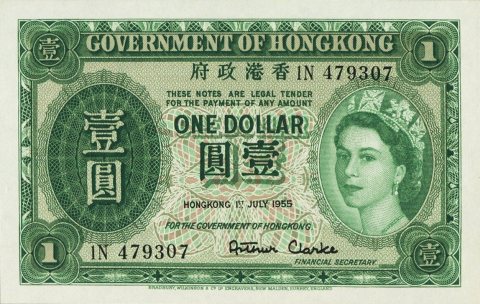
The 1 dollar changed colour again after the war. The green 1 dollar with King George VI has two dates, 9th April 1949 signed Follows and 1st January 1952 signed Clarke. The green 1 dollar with Queen Elizabeth II, all signed Clarke, has seven dates from 1st July 1952 to 1st July 1959. Its short life in the hand, the yearly figures and its replacement by a coin first issued on 12th December 1960 are told in The Government 1 dollar note of Hong Kong, 1952 to 1963.
The cent notes of the 1960s
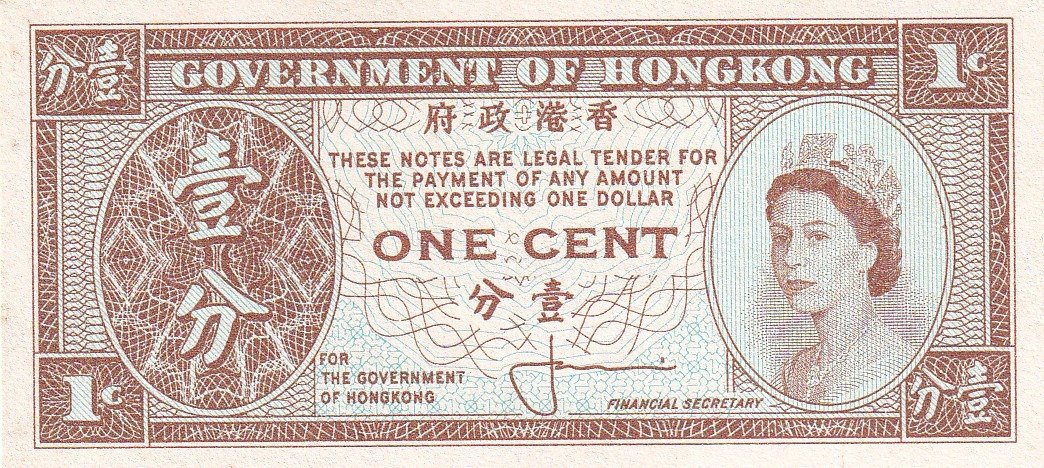
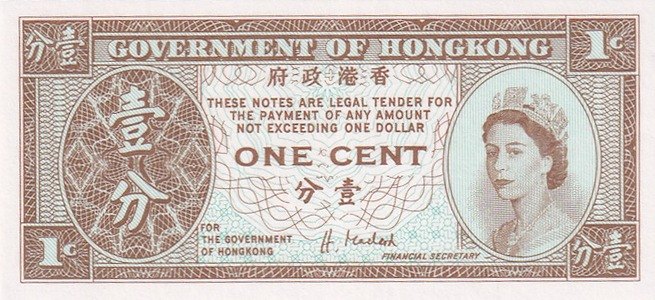
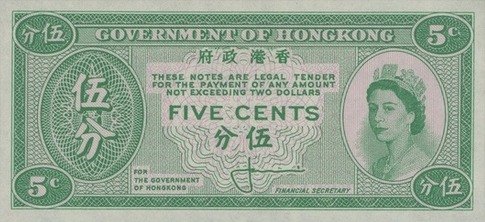
The uniface 1 cent with Queen Elizabeth II has no date and no serial number. Its five issued varieties are told apart only by the printed signature of the Financial Secretary: Cowperthwaite (1961), Haddon-Cave (1971), Bremridge (1981), Jacobs (1986) and Macleod (1992).
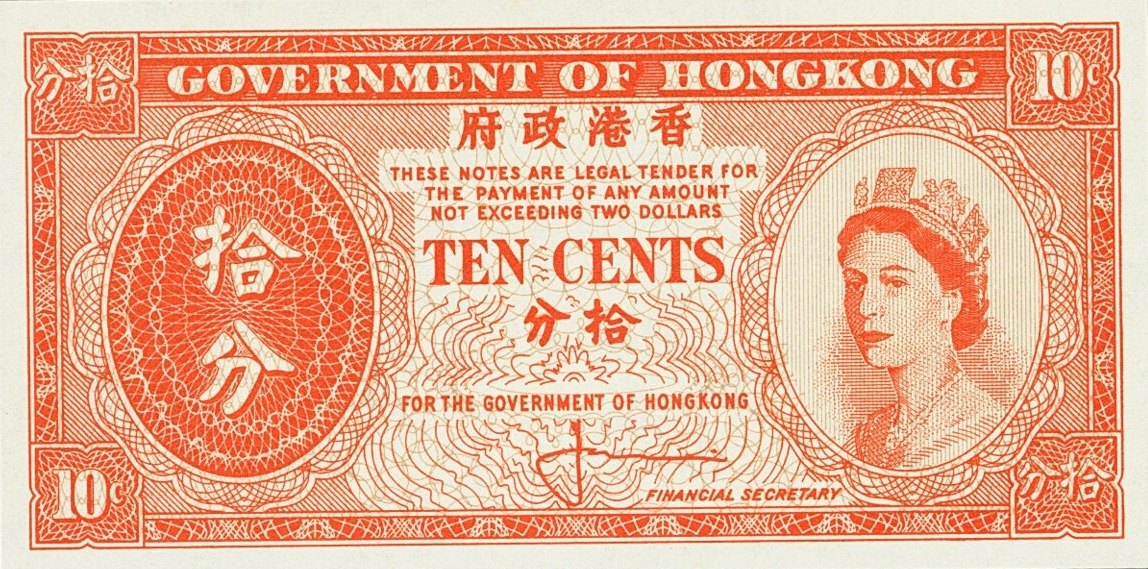
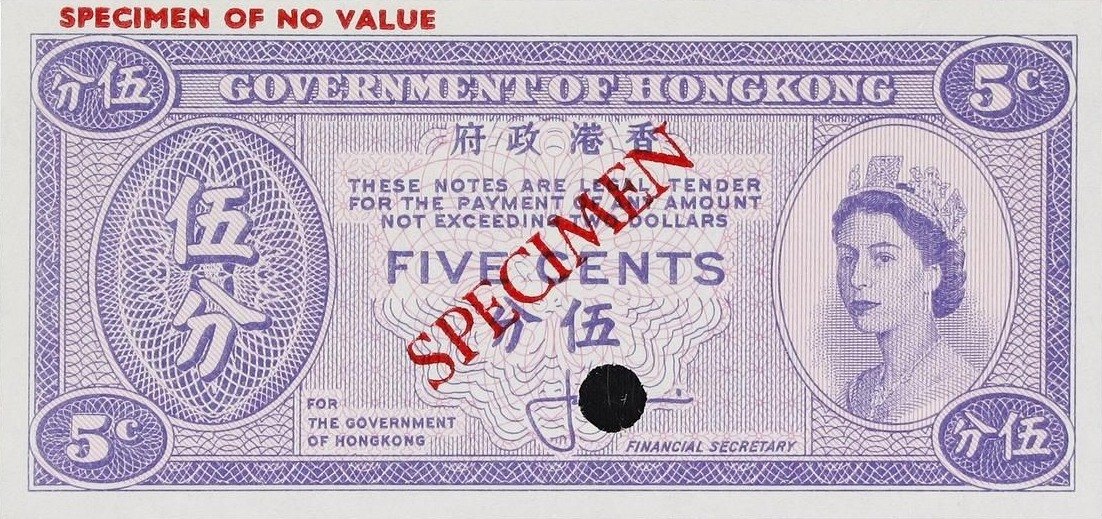
The 5 cents and 10 cents with the Queen, both signed Cowperthwaite, were a special issue. The Financial Secretary, the same Cowperthwaite, told the Legislative Council on 5th February 1969 that 5 and 10 cent notes were issued in 1965 because coins ran short at Chinese New Year, and that apart from this no 10 cent notes had been issued since 1949 and no 5 cent notes since 1950. Sources mention January 1961 for the 10 cents and 1961 to 1965 for the 5 cents. The sittings of 1961 to 1965 say nothing of either note.
The Ordinance of 1969 and the last 1 cent
The Dollar and Subsidiary Currency Notes Bill was read a first and a second time on 5th February 1969 and passed by the Legislative Council, without amendment, on 13th March 1969. It ended the legal tender status of all Government 1 dollar, 10 cent and 5 cent notes. Their value was not cancelled: the Accountant General must still exchange them at face value, and the leading banks act as agents. The 1 cent notes stayed legal tender. The catalogue's pages give 1st September 1969 as the day the 1 dollar, 10 cent and 5 cent notes were withdrawn. The sittings give only the day the Bill was passed, not the day it came into force.
In moving the Bill the Financial Secretary gave some figures. At its peak the circulation had risen to 55 million dollar notes and 5.3 million dollars of the other values. No 1 dollar notes had been issued since December 1960. On that day, 5th February 1969, 11.5 million dollars of 1 dollar notes and 2.8 million dollars of other notes were still outstanding in theory, and the rate of withdrawal had dropped to a trickle. The 1 cent was the only note the Government still issued.
The Bill also wound up the two funds that had backed the notes, the dollar note security fund of 1935 and the Subsidiary Note Security Fund, and paid their assets into general revenue. The budget speech of 26th February 1969 expected 14 million dollars from this. And it kept a power in reserve: the Financial Secretary might again issue 1, 5 and 10 cent notes as legal tender, up to 10 million dollars in all, should coins run short as they had at Chinese New Year 1965.
The 1 cent went on after 1969. The catalogue's pages give 1st October 1995 as the day the 1 cent notes were withdrawn, the notes of 1941 and 1945 among them. Hong Kong Memory, the website of the Leisure and Cultural Services Department, says likewise that all Government notes were abolished in 1969 except the one-cent note, which stayed in circulation until 1995. The Council's sittings after 1969 were not read for these pages.
The signers and their offices
| Note | Signer | Office, and the source |
|---|---|---|
| 1 dollar of 1935 | Taylor | Colonial Treasurer on the attendance lists of the Legislative Council from November 1935 to October 1936 |
| 1 dollar of 1939 | Caine | took office on 16th July 1937 (Blue Book for 1937); Financial Secretary and Colonial Treasurer on the list of 13th October 1937, Financial Secretary from November 1938 |
| blue 1 dollar; cent notes of 1945 | Butters | acting Financial Secretary in 1940, Financial Secretary in 1941, interned from 1941 to 1945 (Colonial Office List, 1948) |
| 1 cent of 1941 | Todd | acting Financial Secretary on the lists of 29th May, 26th June and 16th October 1941 |
| 1 dollar of 9th April 1949 | Follows | Financial Secretary from 1946 (Colonial Office List, 1948) |
| 1 dollar of 1952 to 1959 | Clarke | Financial Secretary in the budget speeches of 1955 to 1961 |
| cent notes of 1961 and 1965 | Cowperthwaite | Financial Secretary in the budget speeches from 1962 |
Taylor left on leave before retirement on 25th March 1937, and W. J. Carrie acted as Treasurer until Caine took office (Blue Book for 1937). No note signed by Carrie is known. The first notes name the Treasurer, the later ones the Financial Secretary. In 1966 the Ordinance of 1935 itself was amended because, as the Objects of the amending Bill say, the title of Treasurer was no longer in use.
Proofs, specimens and colour trials
The catalogue records specimens of nearly every note, colour trial specimens of the 1 dollar of 1939, the 10 cents of 1945, the Queen's 1 dollar, the Queen's 1 cent and the 5 cents of 1965, a die proof of the 1 dollar of 1935, and progressive proofs of the blue 1 dollar and of the 5 cents of 1965. What the auction houses have written about three of these pieces adds a little.
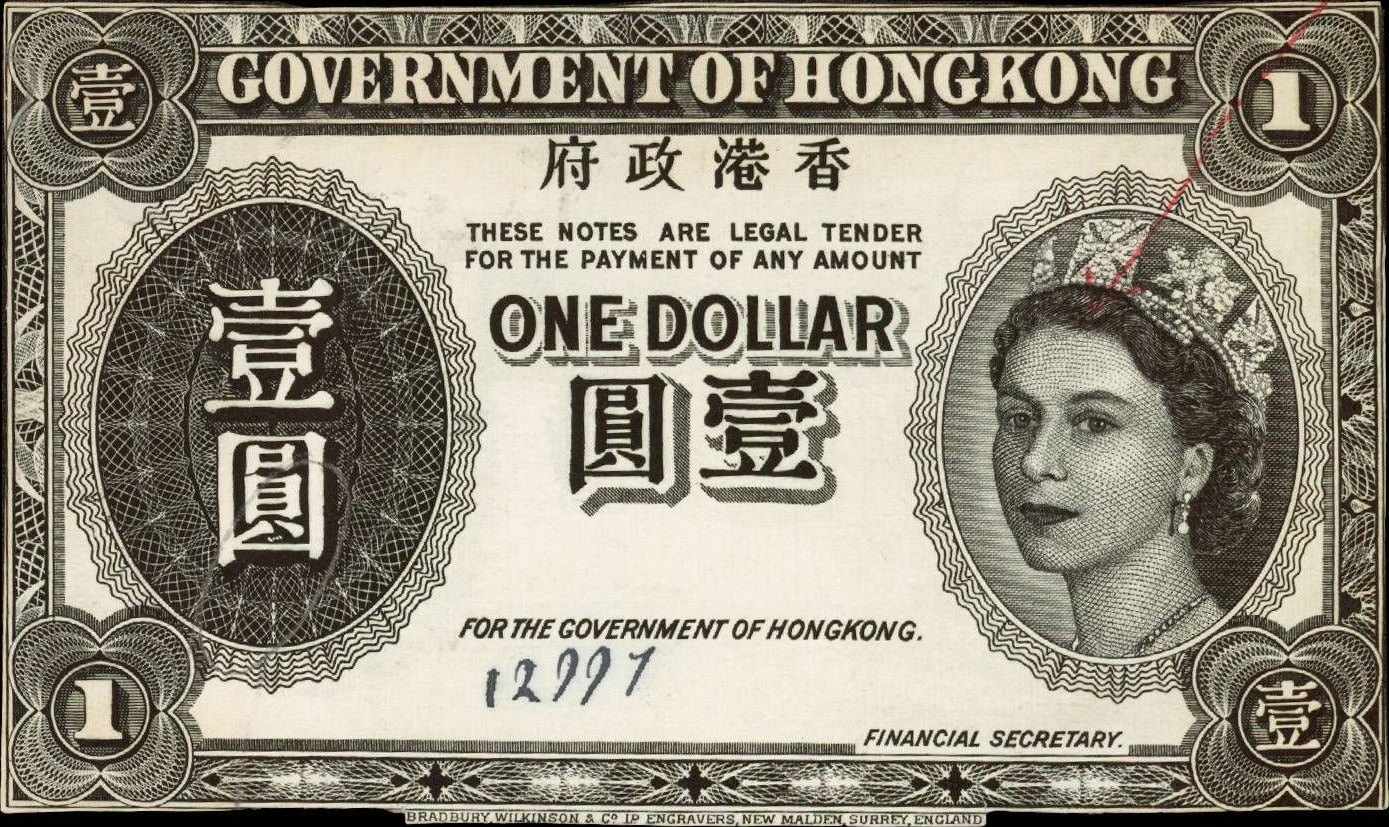
Stack's Bowers, in its sale of 16th November 2012, lot 12625, described a face proof of the Queen's 1 dollar printed in black on white paper by Bradbury Wilkinson. The house says a red arrow is drawn on it pointing at the forehead of the Queen's portrait, and that the point marked appears to have been corrected on the issued note. The house also says it had not handled such a proof before.
Stack's Bowers, in its Hong Kong sale of 18th April 2026, lot 31267, described the colour trial of the 5 cents of 1965 as printed in purple where the issued note is green, and gave the grading service's count of such pieces as 15 at that time.
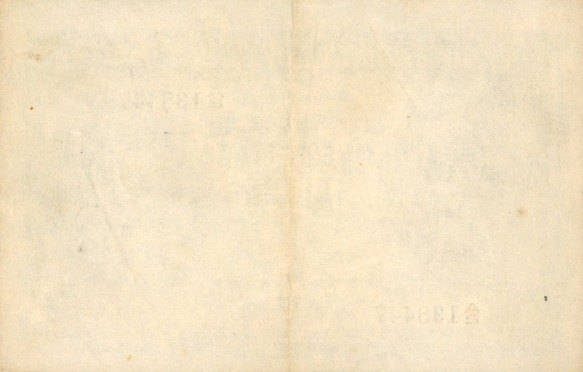
Stack's Bowers, in its Hong Kong sale of 22nd June 2026, lot 30233, offered a blue 1 dollar with the whole printing of the back missing, from what the house calls the Grass Unweeded Collection.
What the sources do not give
The Legislative Council's sittings from 1935 to 1969 give no number printed for any note, no printer, no description of a design, and nothing on the change of portrait or the blue note. They do not give the day of first issue of the 1 dollar in 1935, only the day the Ordinance passed. They have no word on forgeries of the Government notes, although the catalogue records counterfeits of the 1 dollar notes of 1935, 1939 and 1940 and of the 10 cents of 1945. The Objects of the Counterfeit Currency (Convention) Bill of 22nd April 1936 note only that the law had put currency notes on the same footing as bank notes for forgery since 1924. The Council did not sit from 1942 to 1945. The Blue Books after 1938 were not to hand.
Sources
- Reports of the sittings of the Legislative Council of Hong Kong: 9th November 1935, 5th December 1935, 22nd April 1936, 13th October 1937, 10th and 24th November 1938, 29th May, 26th June and 16th October 1941, 7th March 1951, 6th February 1952, 6th April 1966, 5th and 26th February 1969, 13th March 1969.
- Hong Kong Blue Books for 1914 to 1938, the currency return and the Executive Council notes.
- An Economic Survey of the Colonial Empire, 1935.
- The Colonial Office List, 1948.
- Robert Chalmers, A History of Currency in the British Colonies (London, 1893), chapter XXXVII.
- K. Y. Tang, "Hong Kong $1 Notes: Part II", Bank Note Reporter, August 1975.
- Stack's Bowers, 16th November 2012, lot 12625; 18th April 2026, lot 31267; 22nd June 2026, lot 30233.
- Hong Kong Memory, "Hong Kong's Currency after the Second World War", Leisure and Cultural Services Department.
Member comments
Log in or register to post a comment.