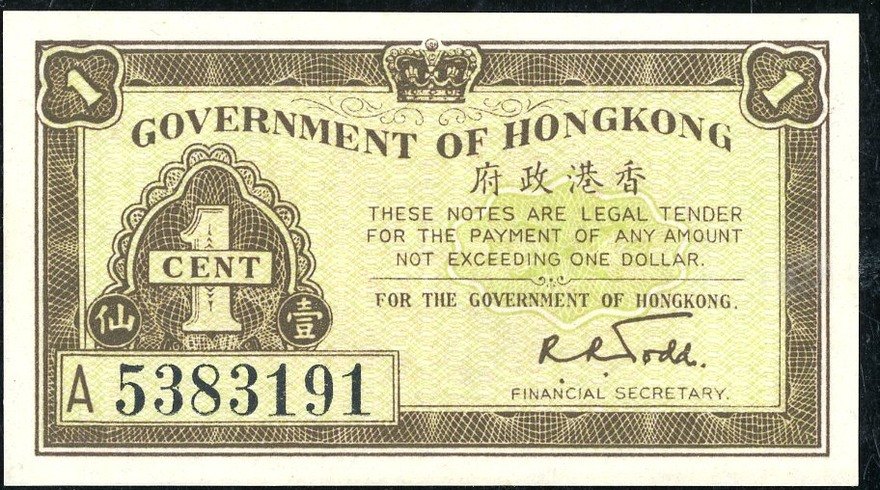
In 1941 the Government of Hong Kong put paper in the place of small coin twice, in May and in October, and in December, under siege, made 1 dollar notes out of another country's bank notes. This article sets out what the reports of the Legislative Council's sittings of 1941, the Colonial Office List and the study Money in British East Asia (1957) say of these notes, and what they leave out.
The 1 cent of May 1941
The One-Cent Currency Notes Bill was taken through all its stages by the Legislative Council on 29th May 1941, with Standing Orders suspended. It became Ordinance No. 10 of 1941; the catalogue's page dates the Ordinance 30th May 1941. The Objects and Reasons call the note a temporary measure: one-cent copper coins were short, and the coins on order had been delayed. The Bill followed the lines of the Ordinance of 1935 for the 1 dollar note. The notes were issued by the Financial Secretary, were legal tender for any amount up to one dollar, and were backed by a fund of their own, the One-cent Note Security Fund.
The 1 cent of 1941 shows a crown and no portrait. It is signed by Todd as Financial Secretary. The attendance lists of the Council name R. R. Todd as acting Financial Secretary on 29th May, 26th June and 16th October 1941, and H. R. Butters as Financial Secretary again on 13th November 1941, so Todd was acting in the post from May to October 1941, while Butters was away.
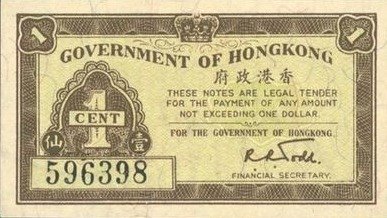
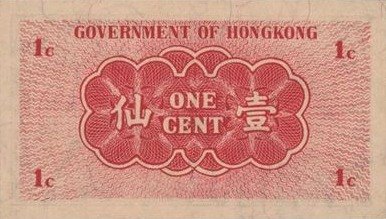
The first printing is on paper with security fibres and has no serial prefix. The later printings are on plain paper with the prefix A or B. The printer is not known, and this is the one Government note of Hong Kong for which the catalogue names no printer.
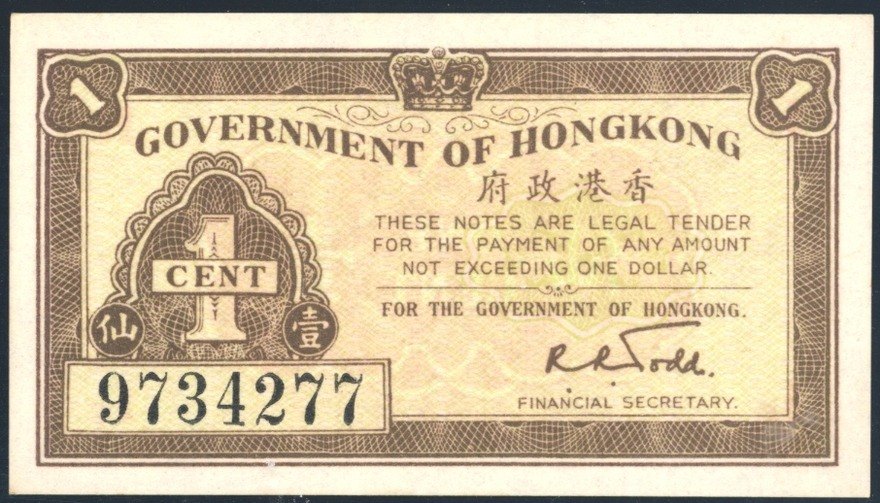
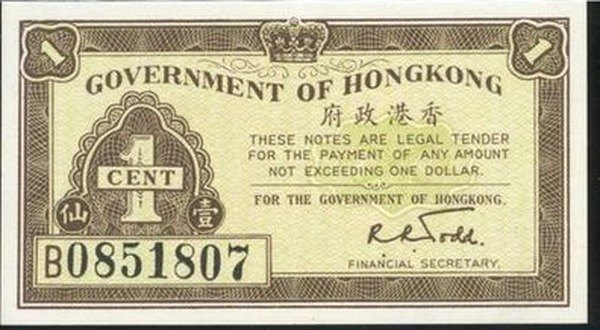
Among the papers laid before the Council on 26th June 1941 is an order of the Financial Secretary, dated 13th June 1941, fixing the premium that money changers might charge for one-cent notes, so the notes were in use by that day. The figure is not printed in the report of the sitting.
The 5 and 10 cents of October 1941
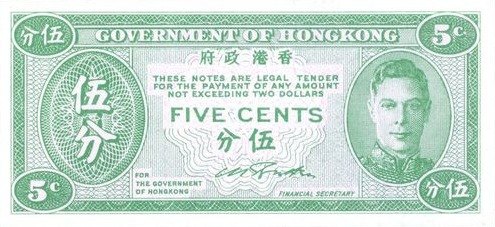
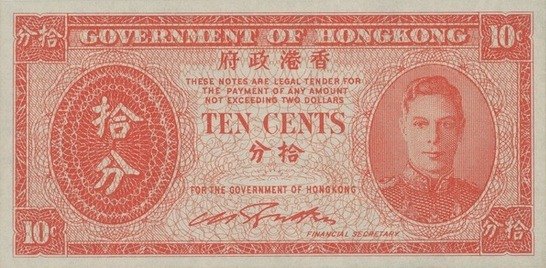
The Subsidiary Currency Notes Bill was passed through all its stages on 16th October 1941. The Attorney General called it an urgent measure, because so large a quantity of the nickel subsidiary coins had been withdrawn from public use. The catalogue's page says that the coins had been hoarded; the Attorney General spoke only of withdrawal from public use.
The new Ordinance repealed the one-cent Ordinance and took its place. It kept the 1 cent note, legal tender up to one dollar, and added notes of 5 and 10 cents, legal tender up to two dollars. The fund became the Subsidiary Note Security Fund. An order of the Financial Secretary dated 31st October 1941, laid before the Council on 13th November, fixed the premium on five-cent and ten-cent notes. They were therefore in use by 31st October 1941.
The 5 cents (P-314) and the 10 cents (P-315) show only guilloches. They are not catalogued here.
Looking back in the Council on 5th February 1969, the Financial Secretary said that ten cent, five cent and one cent notes were issued from October 1941, because of wartime shortages of metal. For the 5 and 10 cents that agrees with the papers of 1941. For the 1 cent the order of 13th June 1941 shows the note in use by June.
The blue 1 dollar and its signer
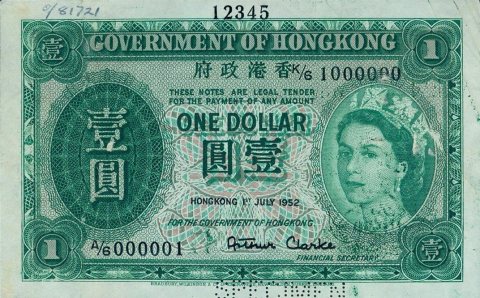
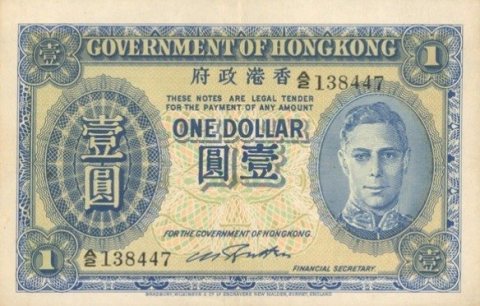
The Government's 1 dollar of these years is the blue note signed Butters, with fractional prefixes from A/1 to G/2. The catalogue dates it 1940 to 1941. The Colonial Office List of 1948 gives the service of Henry Robert Butters: a cadet in Hong Kong from 1922, acting Financial Secretary in 1940, Financial Secretary in 1941, interned from 1941 to 1945.
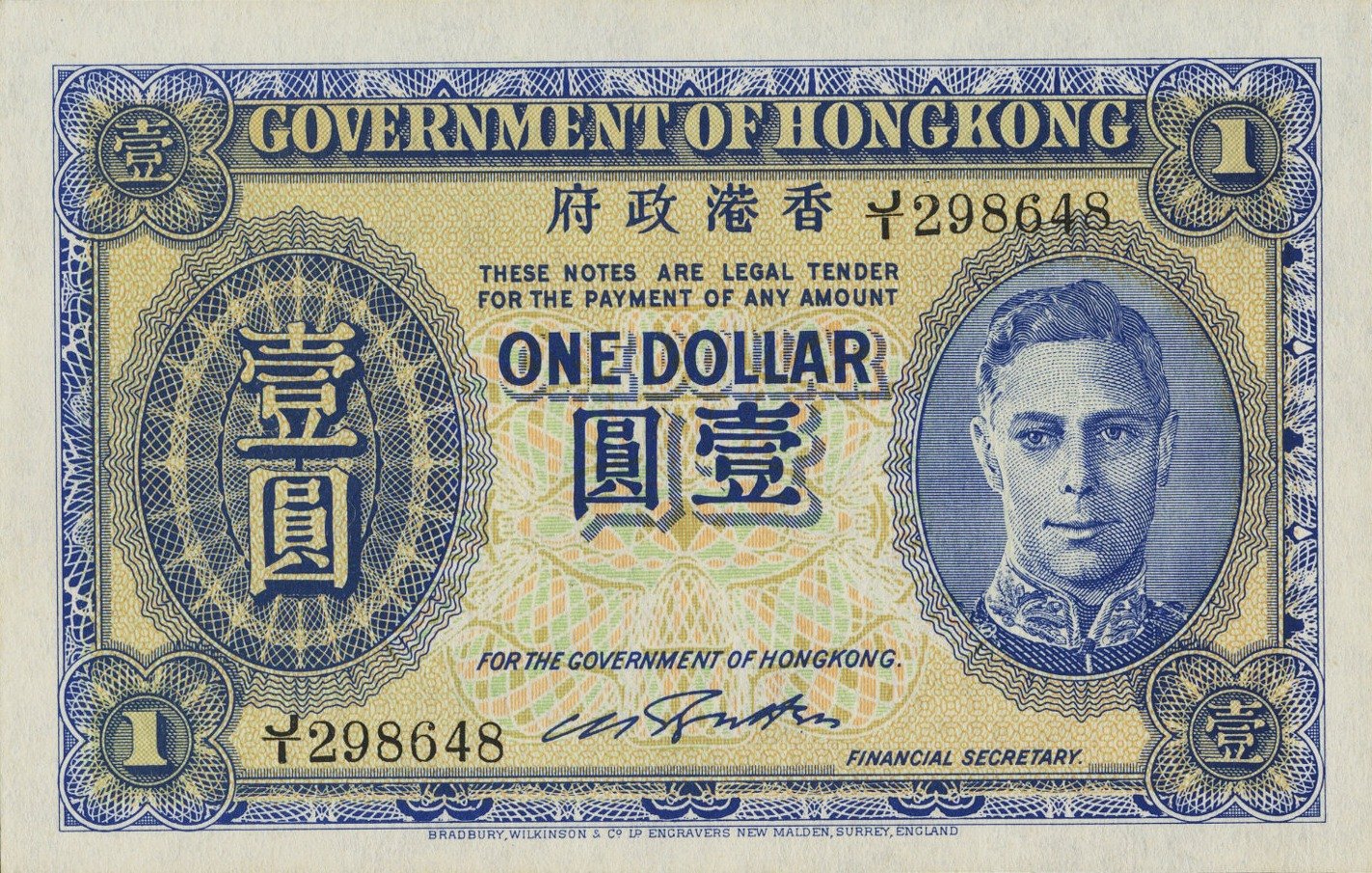
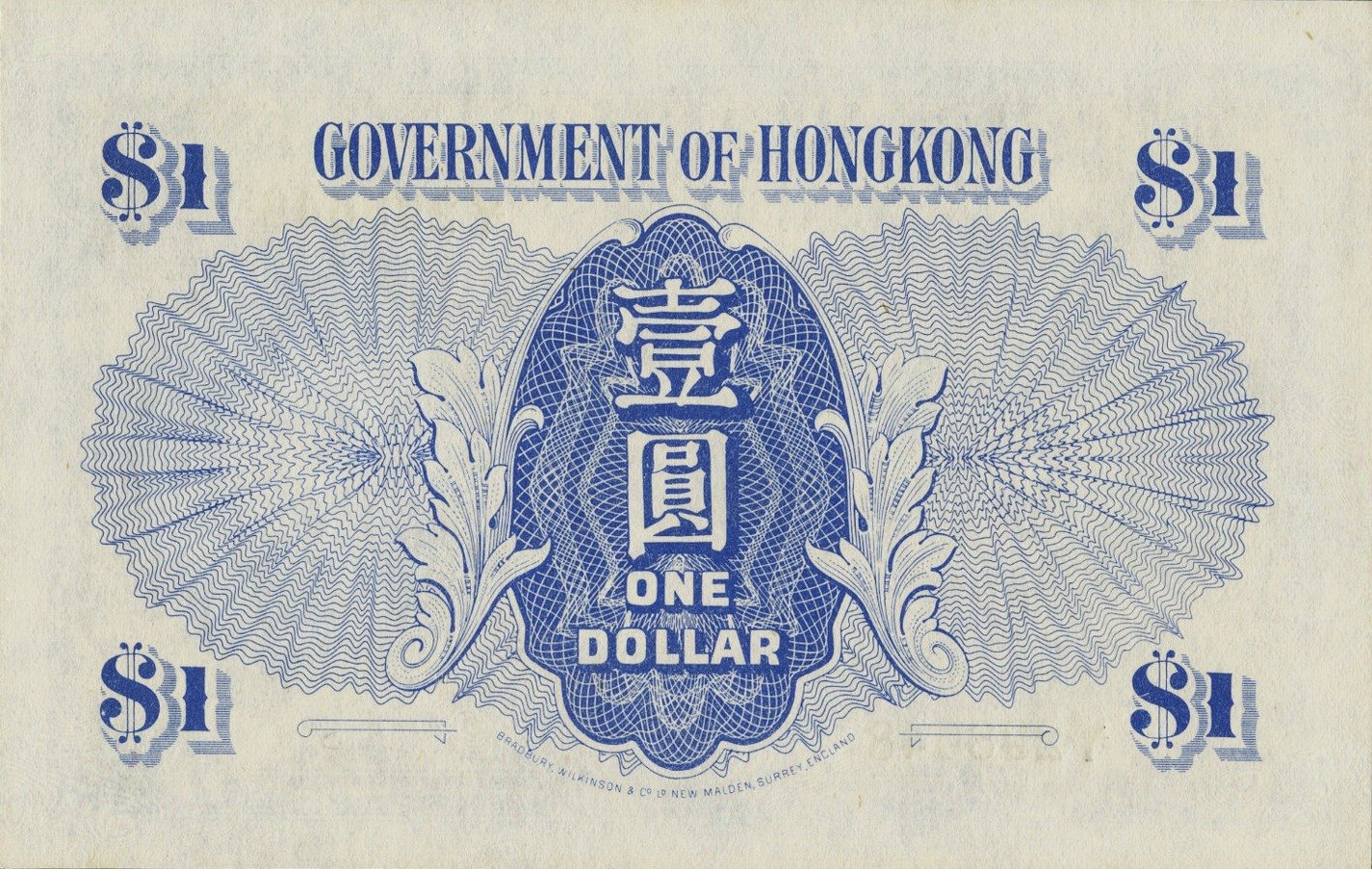
One writer dates the note differently. K. Y. Tang, in Bank Note Reporter of August 1975, says that the blue and yellow notes with the signature of Butters were released on 12th September 1945 and circulated from 1945 to 1948. No official paper read for these pages bears out that date, and the same article dates the purple note of Caine to 1936, although the Blue Book for 1937 has Caine taking office only on 16th July 1937. Whether the blue notes were first paid out in 1940 and 1941, as the catalogue has it, or in 1945, as Tang has it, is not settled by anything read here.
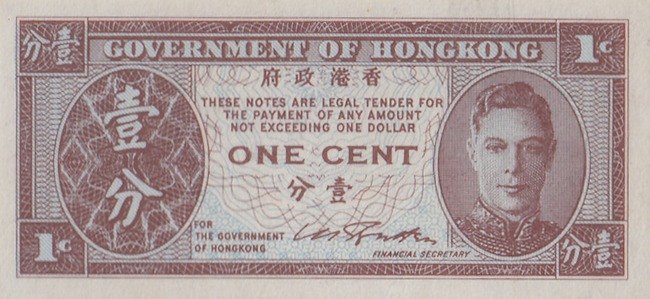
The signature of Butters outlived the term of office. The 1 cent, 5 cents and 10 cents flown into the colony in September 1945 still carry it.
The emergency 1 dollar of December 1941
During the siege of Hong Kong the Government also issued emergency 1 dollar notes. They were made by overstamping unissued bank notes of the Chinese National Government that had been printed in Hong Kong and were awaiting shipment. The source is a footnote on page 113 of Money in British East Asia (1957).
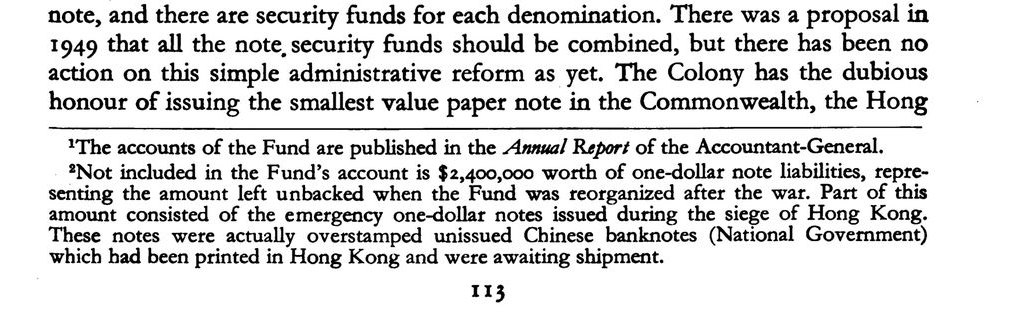
The same book gives two figures. The footnote says that 2,400,000 dollars of one-dollar note liabilities were left without backing when the note fund was reorganised after the war, and that the emergency notes were part of that sum. A note to the Government 1 dollar notes in the book's table of the currency of 1949 to 1955 (Table 25, page 171) says that the figures leave out a "1941 Issue", estimated at 2,420,000 dollars. The book is a study written from the fund's accounts, not an order of 1941. It does not say which Chinese notes were used, what the overstamp said, on what day the notes were issued, or how many of the 2,400,000 dollars they made up.
No such note is catalogued here, because no picture of one has been found.
Under the occupation
The Council did not sit from 1942 to 1945. What its later sittings say of those years concerns the dollar as a whole and not the Government's notes by name. In the debate on the Debtor and Creditor (Occupation Period) Bill on 16th June 1948 a member, D. F. Landale, said that the Hong Kong dollar stayed the legal tender of the colony until 31st May 1943. The acting Attorney General had said on 27th August 1946 that it ceased to be legal tender in 1943 and was later restored by the Currency Proclamation.
After 1945
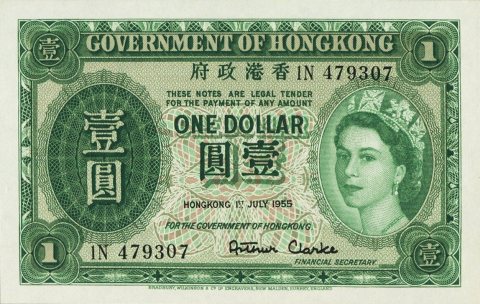
The Ordinance of 1969 that ended the 1 dollar, 10 cent and 5 cent notes left every 1 cent note legal tender, that of 1941 included. The rest of the story is in The Government of Hong Kong's own notes, 1935 to 1995.
What is not known
The sittings of 1941 give no amount, no printer and no day of first issue for the 1, 5 and 10 cent notes: only the two premium orders show them in use. The day the Governor assented to the one-cent Ordinance is not in the sittings, which is why the page gives 30th May 1941 for the Ordinance and 29th May for its passing. Nothing read here gives the value of cent notes in circulation in 1941.
Sources
- Reports of the sittings of the Legislative Council of Hong Kong: 29th May 1941, 26th June 1941, 16th October 1941, 13th November 1941, 27th August 1946, 16th June 1948, 5th February 1969.
- The Colonial Office List, 1948, record of service of H. R. Butters.
- Money in British East Asia (London, 1957), p. 113, footnote 2, and p. 171, Table 25.
- K. Y. Tang, "Hong Kong $1 Notes: Part II", Bank Note Reporter, August 1975, p. 14.
- Hong Kong Blue Book for 1937.
Member comments
Log in or register to post a comment.