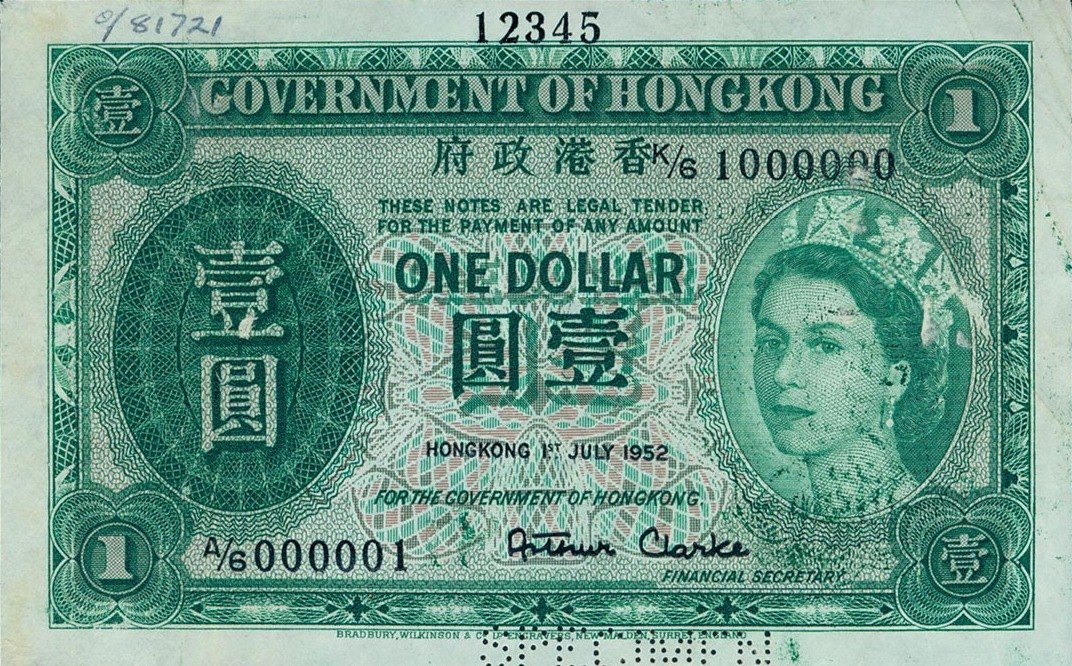
The notes of the Government of Hong Kong were never the subject of a long study in the official papers, and most of what collectors know of them was first written in the collectors' own journals. This article goes through what the IBNS Journal and Bank Note Reporter printed about them from 1963 to 2022, as far as those journals were read for the catalogue, and says what the official sources and the catalogue's pages have since made of each point. The emergency overprints of 1941 and 1945, which take up much of the same writing, have their own article: Hong Kong's emergency overprints of 1941 and 1945. The end of the article lists the old sales and the collection in which the notes are recorded.
K. O. Mao, 1963
The first account in the IBNS Journal is K. O. Mao's "A Short Account of Hong Kong's Currency" in the issue of Christmas 1963 (vol. 3 no. 3, pp. 12 to 14), written from Hong Kong. It is mostly about coin and the banks. On the Government's paper it says only, under the years after 1872, that the Government issued 1 cent and 5 cent paper notes while the banks issued the notes from 5 dollars up. Mao gives no dates for those notes and does not describe the Government's 1 dollar of 1935, though the 1 dollar overprints of 1941 and 1945 are both described.
K. Y. Tang's series of 1975
The first study of the Government notes themselves is the series of three articles by K. Y. Tang in Bank Note Reporter of July, August and September 1975. Tang was the owner of Paramount Numismatics in Hong Kong, and the editor's note to the first part says the series was part of a book by Tang on the bank notes of Hong Kong, to be published a few months later.
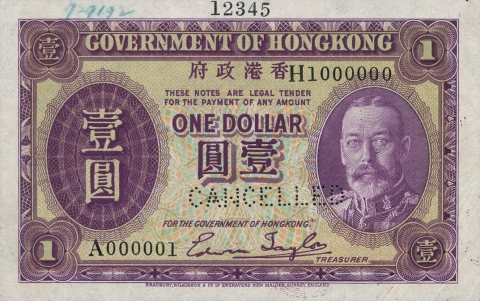
Part I, "The $1 Hong Kong Note of 1935" (July 1975, pp. 7 and 9). Tang describes the 1 dollar of 1935: undated, 79 by 126 mm, printed by Bradbury Wilkinson in dark violet, with two ovals on the front, "one dollar" in Chinese in the left and King George V in the right, the value in English and Chinese between them, the printed signature of Edwin Taylor, Treasurer, above the lower border, and a geometric design on the back. That design, Tang says, became the standard for the 1 dollars of King George VI and Queen Elizabeth II. Tang writes that the George V notes were in circulation only "roughly a year", because the King died on 20th January 1936. Against that stand the catalogue's page for the George VI note, which gives 21st November 1939 as the day it came in, and the Blue Books, which show the Government 1 dollar notes rising every year from 1935 to 1938 (all of King George V, by the catalogue's dates).
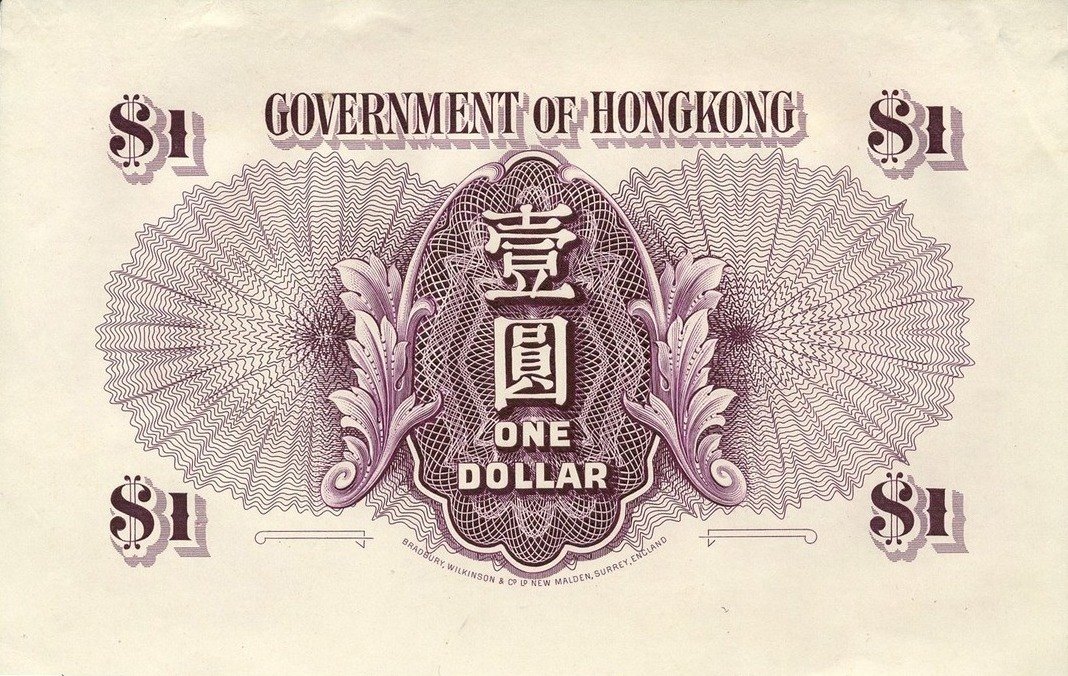
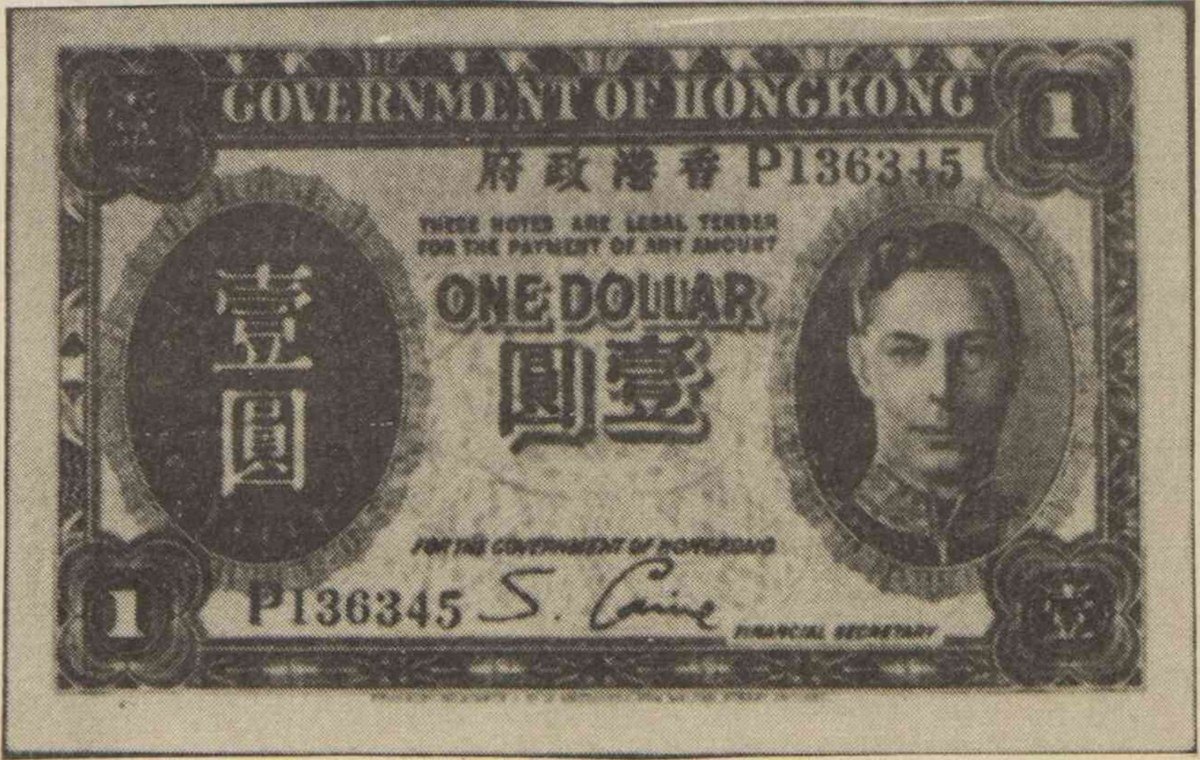
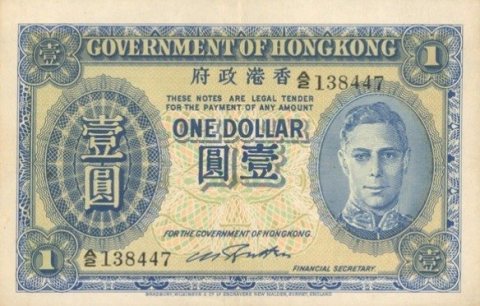
Part II, "Hong Kong $1 Notes" (August 1975, pp. 14 to 15). The George VI notes, Tang writes, are the most varied: three colours and four Financial Secretaries. The first, dark violet and signed S. Caine, circulated "during the pre-war years of 1936-1941"; the second, light blue and yellow and signed H. R. Butters, was released on 12th September 1945 and circulated from 1945 to 1948; then came the green notes of 9th April 1949, signed C. G. Follows, and of 1st January 1952, signed Arthur Clarke. Tang gives the size of the violet note as 125 by 79 mm in the text and 126 by 79 mm in a caption. Against the year 1936 for the Caine note, the Blue Book for 1937 has Caine taking office on 16th July 1937, as the catalogue's page says. Tang's date for the blue note, and its conflict with the catalogue's 1940 to 1941, are set out in The Government of Hong Kong's own notes, 1935 to 1995. Tang also argued that the note of 1st January 1952 circulated for only six months before the first Queen's note appeared, so that fewer were issued than of any other date; no figure is given for it, and the catalogue's page for the green George VI dollar gives that date the prefixes A/5 to Q/5.
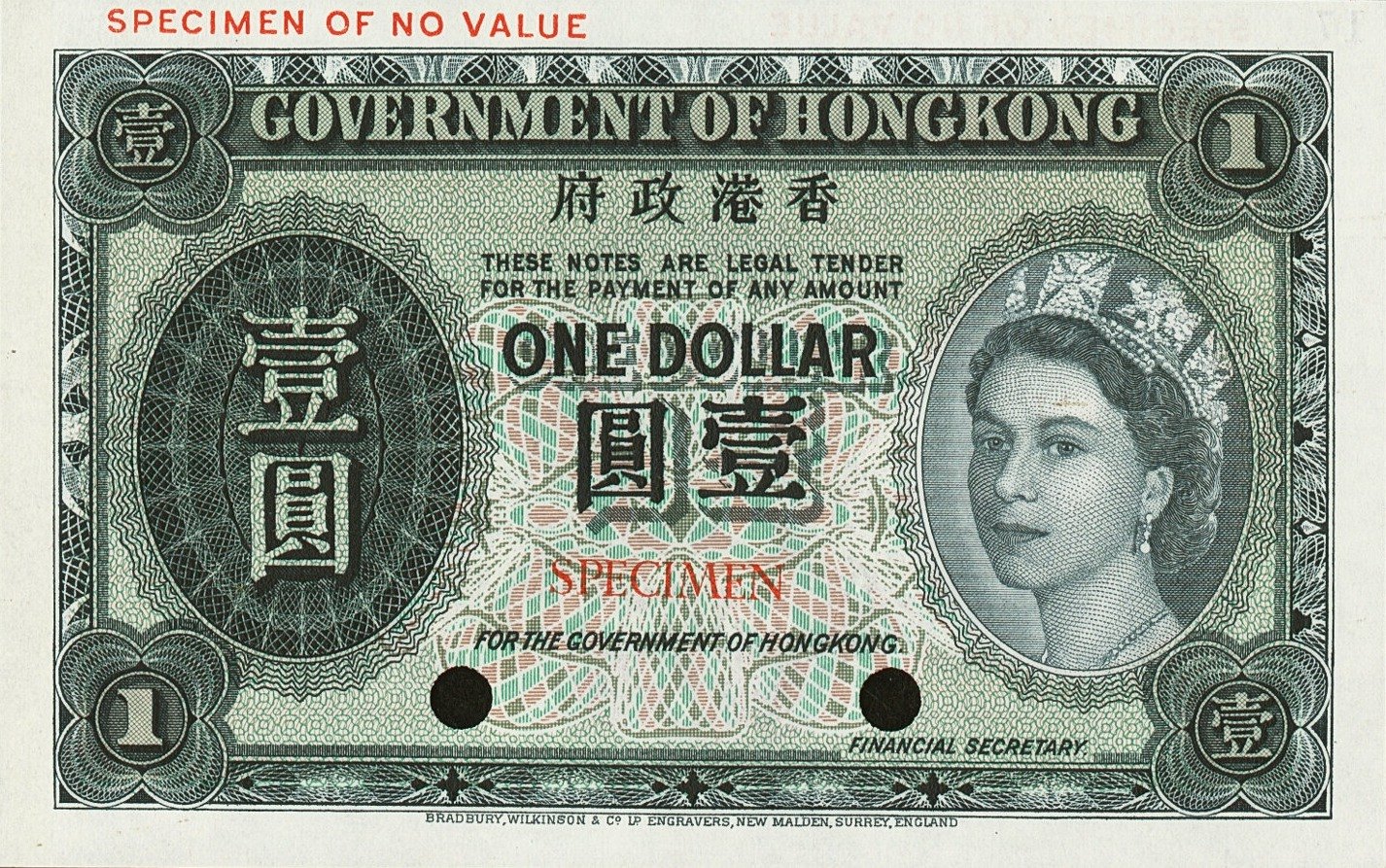
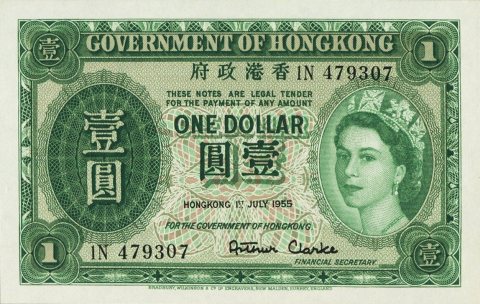
Part III, on the Queen's notes (September 1975, p. 17). Tang dates the green notes of Queen Elizabeth II to 1952 and 1954 to 1959, prints a table of "amount issued" for each date and gives the mintage of the dollar coin of 1960 as 68,225,000. The table is set beside the official figures in The Government notes of Hong Kong in figures, 1935 to 1962. Tang adds a survey of the firm's own: fewer than two thousand uncirculated notes of the Queen's 1 dollar were then in the stock of the dealers of Hong Kong. That is Tang's statement for 1975.
Yasha Beresiner on the 1 cent, 1975
In "Currency Units and Denominations" in the IBNS Journal of 1975 (vol. 14 no. 2), Yasha Beresiner compares the Fiji penny notes of 1942 with the 1 cent of 1941. The Hong Kong notes, Beresiner writes, were printed in huge quantities, many of which never saw circulation, and the World Paper Currency Collector Society printed its membership cards of 1973 on the back of them. No figure of the quantity is given, and none is known from the official papers.
Fred Schwan and the four George VI dollars, 1984
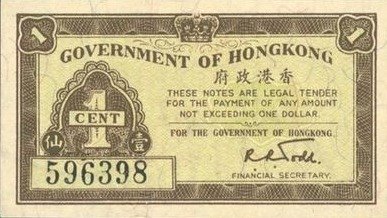
Fred Schwan's column in Bank Note Reporter of April 1984 (pp. 42 to 43), part of a series on the wartime and emergency issues of the British colonies, has the closest look at the Government 1 dollars of King George VI in the journals read. Of the four similar notes, Schwan says, the two green ones of 1949 and 1952 are routine post-war issues. Of the other two, the violet and the blue, one was the last pre-war issue, in circulation in December 1941, and the other the liberation issue, delivered on or about 16th September 1945. Schwan also points out that the picture of the note of 1936 in Pick's listing of the time was in fact of the note of 1949, whose date can be read on it.
Schwan sets out the differences between the notes:
| Violet (Caine) | Blue (illegible signature) | Green (1949, 1952) | |
|---|---|---|---|
| Prefix | one large letter; only N, P and Q seen | letter over figure, horizontal bar | letter over figure, diagonal bar |
| Printing | engraved, face and back | lithographed, of high quality | engraved, face and back |
| Portrait | more of the King's right shoulder shows | less of the shoulder shows | more of the King's right shoulder shows |
The borders and the shading round the imprint on the back differ too. Schwan's reasoning is that the lithographed blue note looks hastily made, from the engraved design, for the liberation, and was replaced by the engraved green notes when time allowed in 1949. The signatures, Schwan says, bear this out: the violet notes carry the signature of S. Caine, found on no other issue, while the illegible signature on the blue note matches that on the 1, 5 and 10 cent notes of the liberation, which binds the four pieces together as one issue.
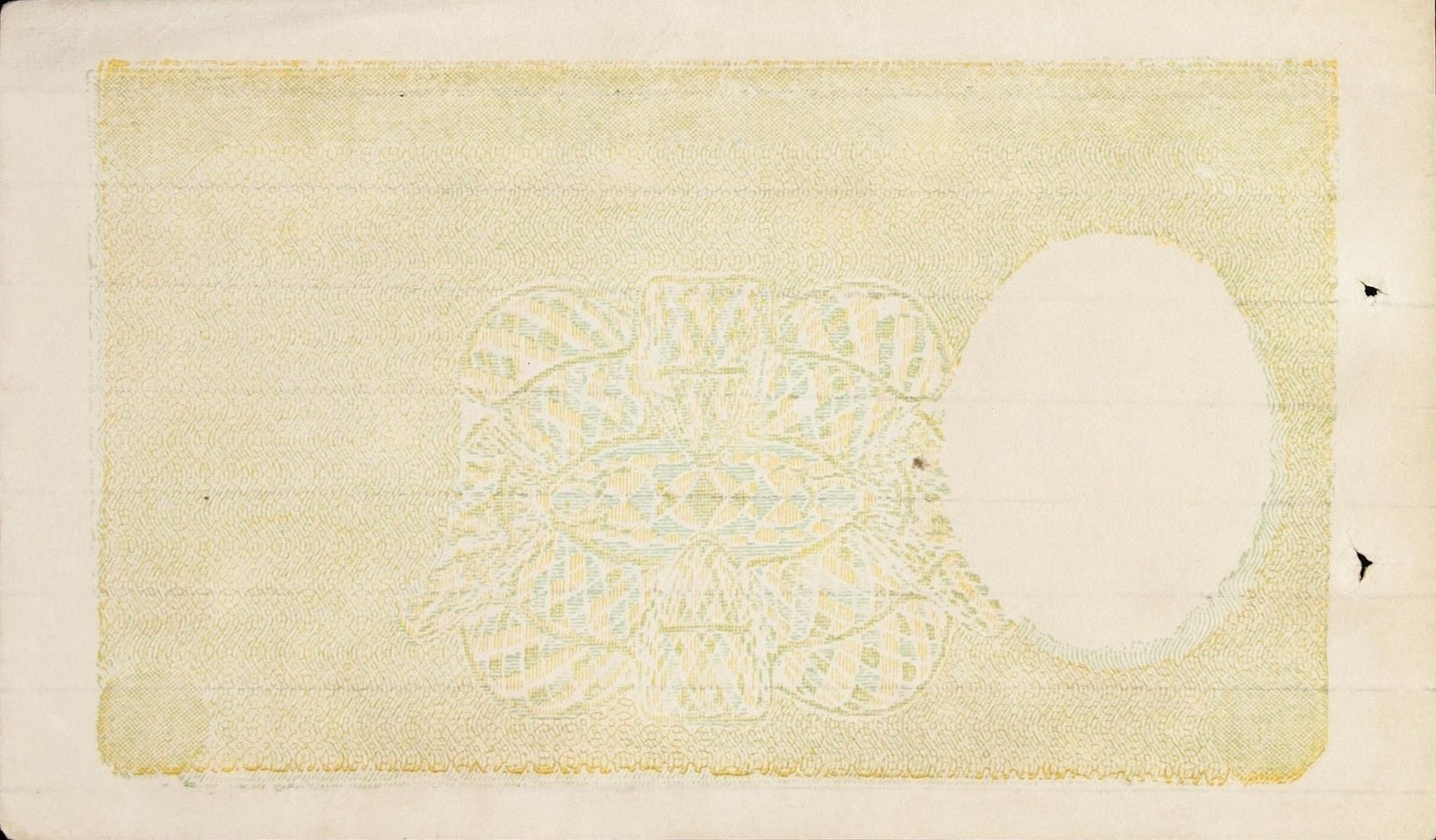
The catalogue gives the signature on the blue 1 dollar and on the 1 cent, 5 cents and 10 cents of 1945 as that of Butters, the same on all four, and Schwan's matching of the signatures agrees with that. Where the two part is the date. The catalogue dates the blue note 1940 to 1941, the years in which Butters was acting Financial Secretary and Financial Secretary (Colonial Office List, 1948); Schwan, like Tang, makes it the note of September 1945. No official paper read for the catalogue settles which 1 dollar was paid out in 1945.
The same column says that the 1, 5 and 10 cents of 1941, signed R. R. Todd, are lithographed, printed on both sides, on paper without security devices, and serially numbered. The catalogue's page for the 1 cent of 1941 has the first printing on paper with security fibres and the later printings on plain paper.
The 1993 sale of A 000001
Bank Note Reporter of September 1993 (p. 1) reported that the first Government 1 dollar with King George V, serial A 000001, long in a private collection in Mongkok, was to be sold by Sotheby's in London on 8th and 9th October 1993. The picture shows the whole front with no cancellation. No result was reported in the issues read. In the same year a reader's letter in the December issue told of buying a Hong Kong 1 dollar of 1935 from the Tatham Stamp and Coin Company in about 1943, in answer to a column by Neil Shafer on the early dealers.
The portrait, the catalogues and the ad notes, 2005 to 2007
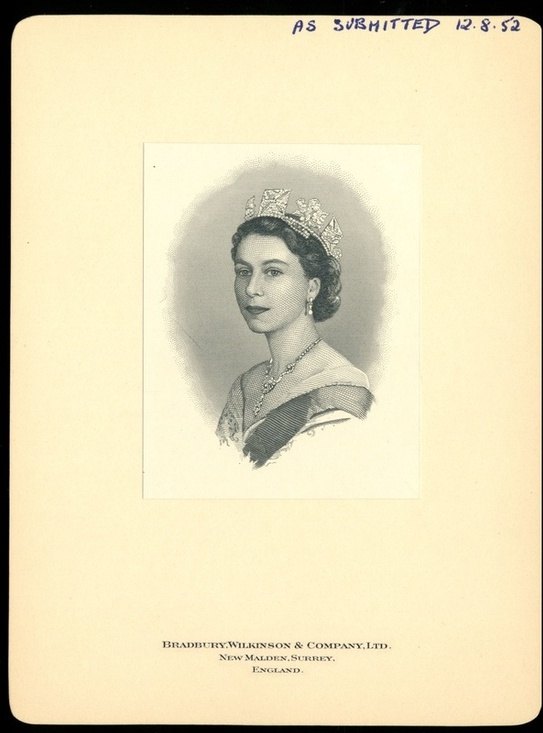
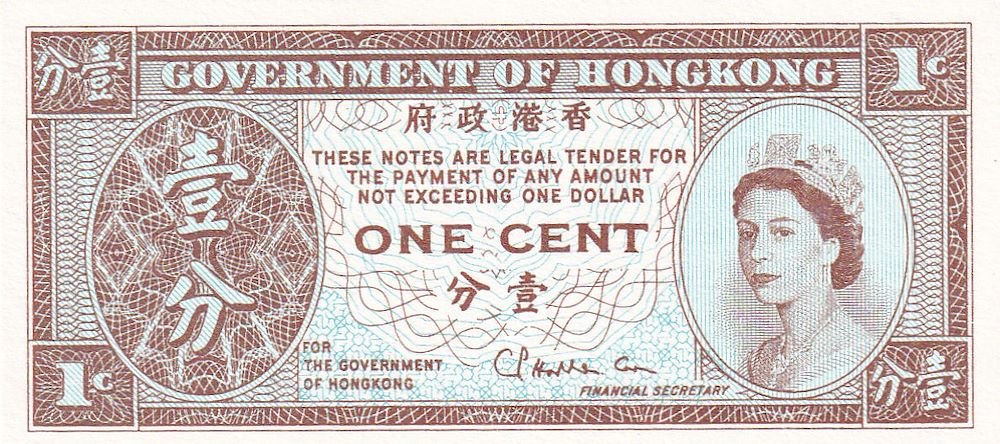
Peter Symes, "The Portraits of Queen Elizabeth II on World Bank Notes", in the IBNS Journal of 2005 (vol. 44 no. 2, pp. 8 to 14), puts the Queen's 1 dollar and the 1 cent, 5 cents and 10 cents among the notes with the portrait Symes numbers 4a: Dorothy Wilding's photograph of 1952, with the George IV State Diadem and the necklace given by the Nizam of Hyderabad, in Bradbury Wilkinson's engraving, which Symes tells apart by the heavy shading on the Queen's right cheek and the tilt of the head. This is the article behind the words "sources mention" on those four pages.
The column Paper Money News and Views in Bank Note Reporter of May 2006 (p. 79) explains why the Hong Kong banks stood in the general volume of the Standard Catalog of World Paper Money when bank issues were otherwise put in the specialised one: the banks were plainly sponsored by the Government, since the only notes the Government itself issued were small change and various 1 dollars.
Neil Shafer, in Bank Note Reporter of March 2007 (p. 80), wrote that the small 1 cent notes of King George VI and Queen Elizabeth II were among the commonest bases for advertising notes, being handy, well made and printed on one side only. Most of those Shafer had seen came from the United States, four from Canada, and Shafer guessed they were mainly of 1960 to 1980.
The archive in London and the issuers, 2016 and 2021
Richard Scott Morel, in "World Paper Money Resources at the British Library: The Crown Agents' Philatelic and Security Printing Archive", IBNS Journal 2016 (vol. 55 no. 4), describes the paper money section of the Crown Agents' archive, lent to the British Library in 1985: about 4,000 notes of forty-eight authorities, in eight regions. The seventh region is the small denomination notes of the Government of Hong Kong. The archive was not among the sources read for the catalogue.
In an interview in Bank Note Reporter of June 2021 (p. 76), Jeremy Lee counted eight banks that issued or tried to issue notes in Hong Kong from the late 1850s, nine issuers with the Government, "which issued notes of a dollar and below starting 1935".
The old sales and a collection
The Government notes appear in many of the old sales read for the catalogue. Those with a run of them:
- Glendining, London, 9th June 1975, the R. J. Ford collection, catalogued by Spink and Son: lots 274 to 278, from the 1 cent of 1941 in its three printings through the cent notes of 1945 and 1961 to 1965 to the 1 dollars of 1935, 1939, 1940, 1949, 1952 and the Queen's dates.
- Henry Christensen, Madison, New Jersey, 31st October 1975, the sale of the Knoke, Pennell and Wait collections: lots 1336 to 1342, the 1 dollars of 1935 to 1959 and the cent notes of 1941 and 1945.
- NASCA, 7th December 1981, the Stanley Gibbons collection, part II: lots 1150, 1151 and 1153, listed only by the old Pick numbers, so that the Government notes in them cannot be placed.
- Spink, 25th June 1994, lot 586: a 1 dollar of King George V, described with the catalogue numbers of Pick (1) and Ma (G10).
- R. M. Smythe, sale 221, New York, 29th July 2002: lots 3464 to 3470, 1 dollars of 1935, 1939, 1940 and 1949, with the Bank of China 5 yuan surcharged "Hong Kong Government $1" (Smythe's "P-317") in lots 3468 and 3470 and a 10 cents of 1941 in lot 3446.
- Lyn Knight, Memphis, 12th June 2011, lot 2530: "a group of 1,480 notes from the Government of Hong Kong" (Bank Note Reporter, August 2011, p. 119), the values not given.
The collection ledgers of Ruth Hill, kept until 1994, list on their second Hong Kong sheet the Government notes from the 1 cent of 1941 in its three printings to the 1 dollar of 1958, numbered after Pick, together with the three emergency overprints. All but one of the pictures in Joseph E. Boling's study of the "Hongkong Government" overprints of 1942, in the IBNS Journal of 1980, are credited "courtesy of Ruth Hill", photographed by Boling.
Sources
- K. O. Mao, "A Short Account of Hong Kong's Currency", IBNS Journal, Christmas 1963 (vol. 3 no. 3), pp. 12 to 14.
- K. Y. Tang, "The $1 Hong Kong Note of 1935", Bank Note Reporter, July 1975, pp. 7 and 9; "Hong Kong $1 Notes: Part II", August 1975, pp. 14 to 15; "$1 Government Notes of Hong Kong: Part II, Elizabeth II Notes", September 1975, p. 17.
- Yasha Beresiner, "Currency Units and Denominations", IBNS Journal, 1975 (vol. 14 no. 2).
- Fred Schwan, column in Bank Note Reporter, April 1984, pp. 42 to 43.
- Bank Note Reporter, September 1993, p. 1; December 1993, letters.
- Peter Symes, "The Portraits of Queen Elizabeth II on World Bank Notes", IBNS Journal, 2005 (vol. 44 no. 2), pp. 8 to 14.
- Bank Note Reporter, May 2006, p. 79, Paper Money News and Views; Neil Shafer, March 2007, p. 80; August 2011, p. 119.
- Richard Scott Morel, "World Paper Money Resources at the British Library: The Crown Agents' Philatelic and Security Printing Archive", IBNS Journal, 2016 (vol. 55 no. 4).
- Tracy Schmidt, "Behind the Bank Note with Jeremy Lee", Bank Note Reporter, June 2021, p. 76.
- Joseph E. Boling, "Notes of the South China Expeditionary Army", IBNS Journal, 1980 (vol. 19 no. 2), pp. 40 to 44.
- Sale catalogues: Glendining, 9th June 1975; Henry Christensen, 31st October 1975; NASCA, 7th December 1981; Spink, 25th June 1994; R. M. Smythe, 29th July 2002.
- Ruth Hill's collection ledgers, Hong Kong sheet 2.
- Hong Kong Blue Books for 1935 to 1938; the Colonial Office List, 1948.
- Bank Note Reporter, April 1975, p. 3 (K. Y. Tang as owner of Paramount Numismatics).
Member comments
Log in or register to post a comment.