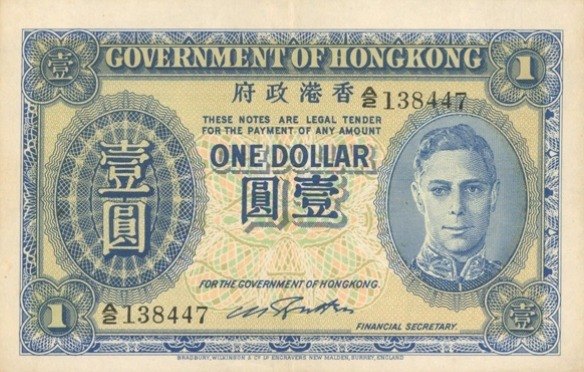
Twice in the Second World War the name of the Government of Hong Kong was printed over other notes: on Chinese notes in 1941, and on Japanese and Chinese notes in September 1945. The catalogue lists neither: the page for the blue 1 dollar says of the note of 1941 only that no such note is catalogued here, and the overprints of 1945 were left out of the catalogue. The official papers say almost nothing of them. This article sets out what each source read for the catalogue says: the study Money in British East Asia (1957), the IBNS Journal from 1963 to 2015, Bank Note Reporter from 1984 to 2022, a collector's ledger and three sales. It also covers a third group that carries the Government's name and was never the Government's. The sources disagree on dates, on the notes used and on whether some of the pieces were issued at all, and those disagreements are left standing.
The 1 dollar on a Chinese 5, 1941
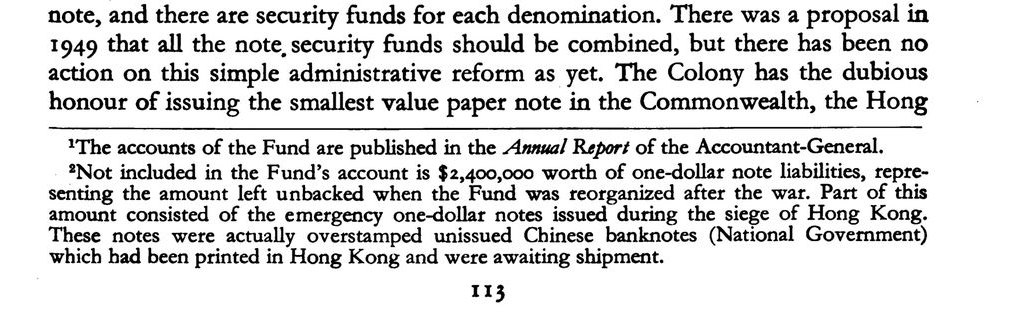
The official study. Money in British East Asia (1957, p. 113, footnote 2) says that during the siege of Hong Kong the Government issued emergency 1 dollar notes, made by overstamping unissued Chinese bank notes of the National Government that had been printed in Hong Kong and were awaiting shipment. They were part of 2,400,000 dollars of 1 dollar note liabilities left without backing when the note fund was reorganised after the war; the book's Table 25 (p. 171) leaves out of its figures a "1941 Issue" estimated at 2,420,000 dollars. This is told more fully, and dated to the siege as the book has it, in Hong Kong's cent notes of 1941 and the emergency 1 dollar of the siege.
K. O. Mao, 1963. The first account in the IBNS Journal, K. O. Mao's "A Short Account of Hong Kong's Currency" (Christmas 1963, vol. 3 no. 3, p. 13), names the note and gives an earlier date. To meet a shortage of 1 dollar notes, Mao writes, the Government overprinted the 5 dollar note of the Bank of China with the words "Hong Kong Government $1" in English and Chinese, in red, and this note was issued on 16th July 1941. The notes, Mao adds, were printed by the Commercial Press Ltd. in Hong Kong in 1941, in blue, with a Chinese palace as the main design. Mao puts the paragraph after the start of the occupation, which makes the order of events unclear in the article itself.
Francis Braun, as Fred Schwan told it, 1984. Fred Schwan's column in Bank Note Reporter of April 1984 (p. 42), drawing on Francis Braun's book The Banknote that Never Was, says that the 1 dollar overprint on the 5 yuan Bank of China note, "previously considered to be an emergency issue immediately after the liberation, can now be attributed as an emergency issue for 1941", as the companion of the 1, 5 and 10 cents of that year.
Later records. The collection ledger of Ruth Hill, kept until 1994, lists a 1 dollar "O/P on Bank of China #93" and dates it "ND (Dec 1941)". R. M. Smythe's sale 221 in New York on 29th July 2002 had the note in lots 3468 and 3470, as "P-317", a Bank of China 5 yuan note surcharged "Hong Kong Government $1" in red, described as emergency money, with no date given and a plate on p. 215 of the catalogue. At a meeting of the East Midlands Chapter of the IBNS in June 2015, reported in the IBNS Journal (vol. 54 no. 3), a visitor, Craig Butler, showed a Bank of China note overprinted by the Hong Kong Government in 1941, legal tender for only a short time; the report adds that many forged overprints exist and that the members took this piece for a genuine one. Bank Note Reporter of April 2022 (p. 86) pictured a "Government of Hong Kong 1 Dollar on 5 Yuan 1941, Pick 317" in its preview of the Heritage world notes sale of that month.
| Source | Date of issue | Note overprinted |
|---|---|---|
| Money in British East Asia, 1957 | during the siege (December 1941) | unissued Chinese National Government notes printed in Hong Kong |
| K. O. Mao, IBNS Journal, 1963 | 16th July 1941 | Bank of China 5 dollars, printed by the Commercial Press, Hong Kong |
| Braun, through Schwan, Bank Note Reporter, 1984 | 1941 (not after the liberation) | Bank of China 5 yuan |
| Ruth Hill's ledger, to 1994 | December 1941 | Bank of China |
| Smythe, 2002 | not given | Bank of China 5 yuan |
| Heritage, 2022 (Bank Note Reporter preview) | 1941 | 5 yuan |
Nothing on an overprinted note is recorded from the sittings of the Legislative Council of 1941 that were read for the catalogue, the latest of them that of 13th November 1941. The two Bills on Government notes that the Council passed that year were for the cent notes. What would settle the date is a notice in the Gazette of 1941, or the Treasury's own papers of the siege; neither was among the sources read.
The Japanese "Hongkong Government" overprints, 1942
A different group carries almost the same words. Joseph E. Boling, in "Notes of the South China Expeditionary Army" in the IBNS Journal of 1980 (vol. 19 no. 2, pp. 40 to 44), describes notes of several Chinese banks, mostly the four quasi-official banks, overprinted in English with the heading "Hongkong Government" and in Chinese with words that the article translates as "Temporary Currency", "To circulate at face value", and "Printed and issued by the Commanding Officer, Japanese South China Expeditionary Army". Most are dated Showa 17, January, that is January 1942; some have no month and some no date. Boling's tables list 24 types of base note.
Boling's verdict is that these 1942 overprints are fantasies. Boling's reasons: one type is found with two different overprints seven serial numbers apart; one note bears a figure in ball-point ink, and ball-point pens were very uncommon, if they were to be had in China at all, in 1942; several base notes share serial blocks with unoverprinted notes that came to collectors in the United States after 1970; nearly all are in uncirculated condition; the South China Expeditionary Army no longer existed under that name in early 1942; and the Japanese had military yen, and the Hongkong and Shanghai Bank's unissued notes, and so no need for such a currency. The photographs in the article, Boling notes, were mostly courtesy of Ruth Hill. By Boling's account they were not the Government of Hong Kong's notes; they are named here only so that they are not taken for its notes.
Under the occupation
Three sources agree that the colony's own money lost its standing at the end of May 1943. Mao (1963) gives the military yen at 1 to 2 Hong Kong dollars at first, 1 to 4 from 24th July 1942 to 31st May 1943, and the military notes the only legal currency from 1st June 1943. Kazuya Fujita, in "Japanese Military Currency (1937-1945): Quantities Printed And Issued" in the IBNS Journal of 2003 (vol. 42 no. 2, p. 24), gives 2 dollars to the yen at first, 4 to the yen from about August 1942, and the pre-war notes banned from 1st June 1943; on 31st March 1943 some 20 million military yen were in circulation in Hong Kong. In the Legislative Council on 16th June 1948 a member, D. F. Landale, said the Hong Kong dollar remained legal tender until 31st May 1943.
The 1, 5 and 10 dollars of September 1945
Five sources tell of emergency notes made then.
Mao, 1963. After the occupation, Mao writes (p. 14), there was an acute shortage of 1 dollar notes, and the Government overprinted the 1,000 yen Japanese military note with "HONGKONG GOVERNMENT $1" in red; the note has a portrait at right and houses at left, and is mainly orange red. "Unfortunately, the amount issued is unknown," Mao adds. Mao calls the note issued.
Braun, as Schwan told it, 1984. Schwan's column of April 1984 (pp. 42 to 43) gives the story from Braun's book. In 1941 Francis Braun was a Hungarian national working as a printer in Hong Kong. Interned by the British in December 1941 and released by the Japanese, Braun kept track of the plant of the former employer during the occupation. After the liberation the British Military Administration needed a currency to displace the military yen and hired Braun to prepare notes of 1, 5 and 10 dollars. The 1 dollar was to be made more or less from scratch from an unfinished design left behind by the Japanese; large stocks of the Central Reserve Bank of China's 1,000 and 500 yuan notes, also left by the Japanese, were to be overprinted as 5 and 10 dollars. The work was done in secret. Before it was finished Braun was told the project was cancelled, because notes were on their way from England by warship, and the whole stock was handed to the military administration to be destroyed. Letters printed by Braun show 100 sets going to museums and other interested parties. Schwan pictures a 1 dollar, "ONE DOLLAR $1 HONG KONG GOVERNMENT", without a number.
Fujita, 2003. Fujita (p. 25) adds that plates for an unprinted 1,000 yen military note, of a design like the Japanese home note, were found in Hong Kong and modified and used by the British military to produce emergency currency that was never issued.
Ruth Hill's ledger. It lists a 1 dollar "O/P on 1000 Yen" with no number and a 5 dollars "ND (1945)", "O/P on China J32", with no number.
Jeremy Lee, 2021. In an interview in Bank Note Reporter of June 2021 (pp. 76 to 78), Jeremy Lee, a collector of Hong Kong notes, speaks of the unissued emergency overprinted notes prepared in the immediate aftermath of the Japanese surrender in September 1945, and destroyed when new supplies of regular notes were flown in from London. The pictures show a printer's scrap of the 1 dollar overprinted on a 1,000 yen note, printed on a cigarette box, and a printer's scrap of the 5 dollars overprinted on the back of a Central Reserve Bank of China 1,000 yuan, whose other side shows a Central Bank of China 20 cents of 1940. The caption says the 5 and 10 dollar overprints were never issued either, that the notes were taken from the Chung Hwa Book Company and that they were overprinted at the government printers, Ye Olde Printerie.
One of the 5 dollars was sold by Stack's Bowers in its Hong Kong auction of April 2021, session A, lot 40342, described in Bank Note Reporter of May 2021 (p. 24) as a "1944 (1945) Government of Hong Kong, 5 Dollars Emergency Issue", a dark red overprint on a 1,000 yuan note, as the machine text of the page reads it. A reading of the same pages made for the catalogue gives the base note as a Central Reserve Bank of China 100 yuan instead; the page image would settle which.
| Point | What the sources say |
|---|---|
| Issued or not | issued, amount unknown (Mao, 1963); never issued, stock destroyed (Braun through Schwan, 1984; Fujita, 2003; Lee, 2021); sold as "Emergency Issue" (Stack's Bowers, 2021) |
| The 1 dollar | overprint on the Japanese 1,000 yen (Mao; Ruth Hill; Lee); made from an unfinished Japanese design (Braun); from altered 1,000 yen plates (Fujita) |
| The 5 dollars | on the Central Reserve Bank's 1,000 yuan (Braun; Lee); a 1,000 yuan, or a Central Reserve Bank 100 yuan, by the two readings of the Stack's Bowers report; "China J32" (Ruth Hill) |
| The 10 dollars | on the Central Reserve Bank's 500 yuan (Braun); its base note not named by Lee |
| Why stopped | notes coming from England by warship (Braun); new supplies flown in from London (Lee) |
| Who made them | Francis Braun, hired by the military administration (Schwan); overprinted at Ye Olde Printerie, the government printers (Lee) |
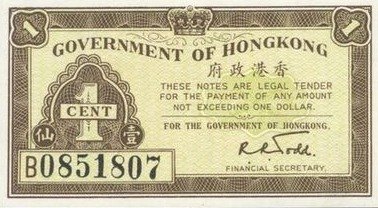
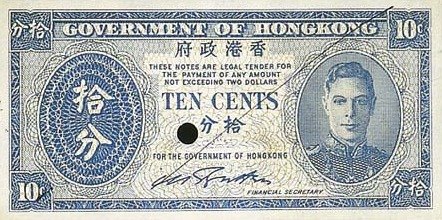
What came instead were the notes the catalogue does list. The 1 cent, 5 cents and 10 cents printed by Bradbury Wilkinson were, as their pages say, flown into the colony in September 1945. Which 1 dollar came with them is a question of its own: K. Y. Tang (1975) and Fred Schwan (1984) both make the blue 1 dollar signed Butters the note of the liberation, against the catalogue's date of 1940 to 1941. Their arguments are set out in The Government notes of Hong Kong in the collectors' journals and sales, 1963 to 2022.
What would settle it
- For 1941: the Gazette of 1941, and the accounts of the note fund behind the 2,400,000 dollars that Money in British East Asia names.
- For 1945: the papers of the British Military Administration, and Braun's own book, The Banknote that Never Was, which was not among the sources read; it is known here only through Schwan's column.
- A photograph of each note for the catalogue. The article on the cent notes of 1941 and the emergency 1 dollar of the siege says that no picture of the siege note has been found. Pictures of the Bank of China 5 yuan with the 1 dollar overprint are in Smythe's catalogue of 2002 (plate on p. 215) and in Bank Note Reporter of April 2022 (p. 86, Heritage's "1941" note); whether that note is the siege issue of Money in British East Asia turns on the date, which is not settled here. For 1945 there are Schwan's picture of a 1 dollar (1984) and the printer's scraps (June 2021).
Sources
- Money in British East Asia (London, 1957), p. 113, footnote 2, and Table 25, p. 171.
- K. O. Mao, "A Short Account of Hong Kong's Currency", IBNS Journal, Christmas 1963 (vol. 3 no. 3), pp. 12 to 14.
- Joseph E. Boling, "Notes of the South China Expeditionary Army", IBNS Journal, 1980 (vol. 19 no. 2), pp. 40 to 44.
- Fred Schwan, column in Bank Note Reporter, April 1984, pp. 38 and 42 to 43, after Francis Braun, The Banknote that Never Was.
- Kazuya Fujita, "Japanese Military Currency (1937-1945): Quantities Printed And Issued", IBNS Journal, 2003 (vol. 42 no. 2), pp. 24 to 25.
- IBNS Journal, vol. 54 no. 3 (2015), News from the Chapters, East Midlands Chapter, June 2015 meeting.
- Ruth Hill's collection ledgers, Hong Kong sheet 2.
- R. M. Smythe, sale 221, New York, 29th July 2002, lots 3468 and 3470.
- Bank Note Reporter, May 2021, p. 24 (Stack's Bowers, Hong Kong auction, April 2021, lot 40342); June 2021, pp. 76 to 78 (Tracy Schmidt, "Behind the Bank Note with Jeremy Lee"); April 2022, p. 86 (Heritage, April 2022).
- Report of the sitting of the Legislative Council of Hong Kong of 16th June 1948.
Member comments
Log in or register to post a comment.