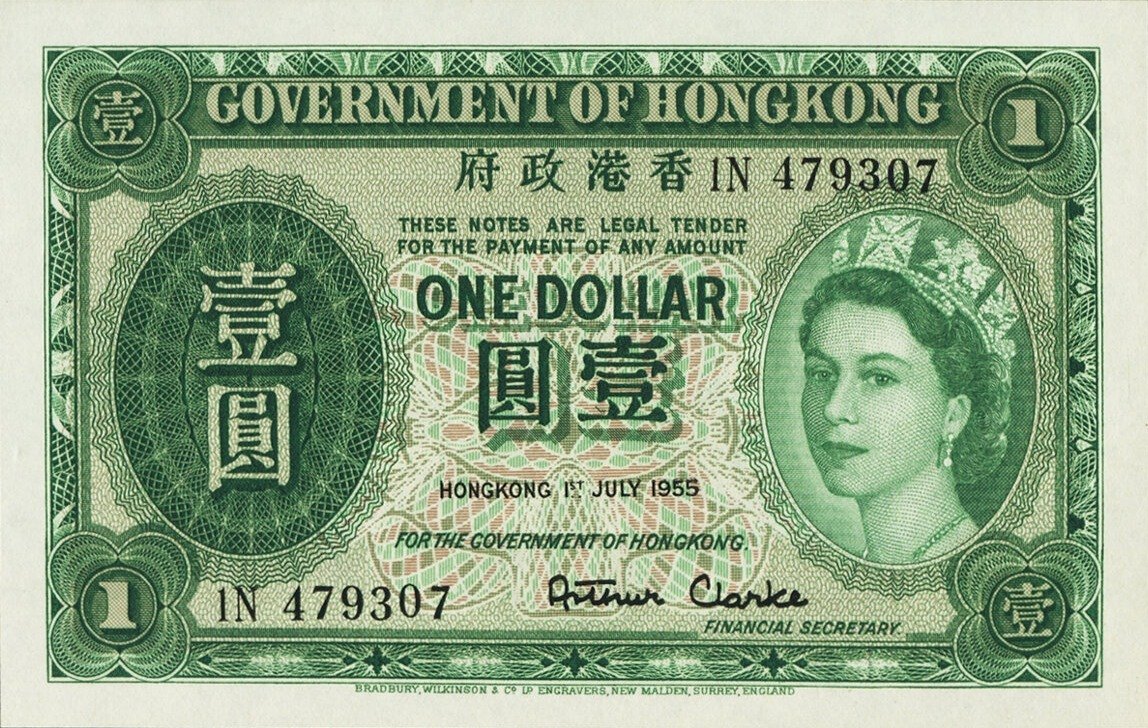
This article brings together the figures that the sources give for the notes of the Government of Hong Kong from 1935 to the early 1950s, and sets beside them the table that K. Y. Tang printed in Bank Note Reporter in 1975. The later figures, from the Financial Secretary's budget speeches of 1955 to 1963, are in The Government 1 dollar note of Hong Kong, 1952 to 1963 and are not repeated here. Every figure is given as its source gives it. No source read gives the number of notes printed for any issue.
The first day
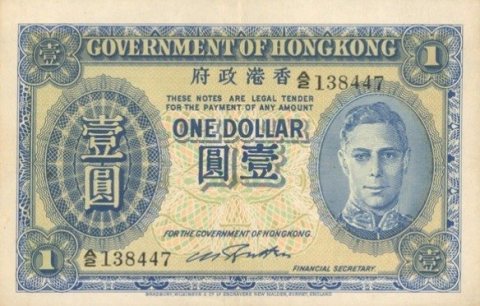
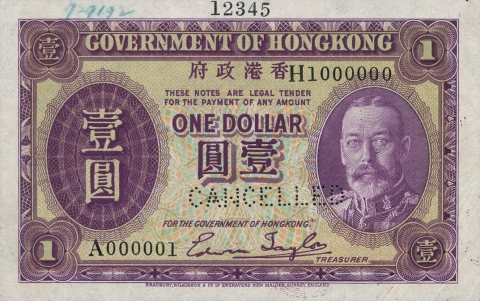
Three dates are on record for the start of the first note, the 1 dollar of 1935. The Legislative Council passed the Dollar Currency Notes Ordinance on 9th November 1935; the report of the sitting gives that day and no day of issue. The catalogue's page gives 12th November 1935 as the day the Government issued the note. A working paper of 2014 by Krus and Schuler on the financial statements of currency boards (p. 126), citing the colony's administrative report for 1935, says the Government began issuing the 1 dollar notes on 11th November 1935. K. Y. Tang, in Bank Note Reporter of July 1975 (p. 7), says only that Hong Kong issued its first 1 dollar notes in 1935. The working paper is a secondary source, and the administrative report it cites was not among the papers read.
The first four years, 1935 to 1938
| End of year | Government 1 dollar notes | Source, and how it was read |
|---|---|---|
| 1935 | 1,280,000 dollars, estimated | Blue Book for 1935, text only |
| 1935 | 1,300,000 dollars "issued to prevent a shortage of currency at the beginning of the new system" | Economic Survey of the Colonial Empire, 1935, p. 176, page image |
| 1936 | 2,300,000 dollars | Blue Book for 1936, text only |
| 1936 | "of which $2,300,000 have been issued" | Economic Survey, 1936, and the annual report for 1936, page image |
| 1937 | 3,625,000 dollars | Blue Book for 1937, text only |
| 1937 | 3,625,000 dollars "in circulation on 31.12.37" | Economic Survey, 1937, page image |
| 1938 | 5,571,000 dollars | Blue Book for 1938, text only |
The Blue Books for 1935, 1937 and 1938 describe the line in the same words: "One Dollar Currency notes issued by the Treasurer. Legal tender to any amount under Ordinance No. 42 of 1935." The Economic Surveys use two different words: "issued" in 1935 and 1936, "in circulation" in 1937. Neither source says whether notes paid back in and reissued are counted once or twice.
The Blue Books also print, among the assets and liabilities of the colony, a separate Note Issue Account (text only). At the end of 1937 it stood at 513,870.42 dollars on current account and 3,000,000.00 dollars on fixed deposit, 3,513,870.42 dollars in all as printed. At the end of 1938 it was 1,480,119.62 dollars on current account and 4,900,000.00 dollars on fixed deposit. These are sums of money, not a count of notes; the Blue Books do not say in so many words that the account is the note security fund the Ordinance of 1935 set up. The Blue Books do not explain why the account stood below the notes out in 1937. The Note Issue Account is named in the balance sheets of 1935 and 1936 too, but its figure for those years cannot be read in the text of the scan.
From October 1937 the Gazette published a statement of the backing of the currency every six months, the first as at 30th June 1937, as the Officer Administering the Government told the Legislative Council on 13th October 1937. Those statements were not read for these pages and may hold the half-yearly figures for the Government notes.
The wartime gap, 1939 to 1948
No Blue Book after 1938 was to hand, and no source read gives a figure for the Government notes in circulation from 1939 to 1948, or any figure for the cent notes of 1941 and 1945 by value. One figure reaches back into these years from after the war. Money in British East Asia (1957) says that 2,400,000 dollars of 1 dollar note liabilities were left without backing when the note fund was reorganised after the war, part of them the emergency notes of the siege of December 1941 (p. 113), and its Table 25 (p. 171) leaves out of the Government 1 dollar figures a "1941 Issue estimated at $2,420,000.00". Those notes are the subject of Hong Kong's emergency overprints of 1941 and 1945.
The Accountant General's figures, 1949 to 1954
Table 25 of Money in British East Asia, "Nominal Currency Supply in Hong Kong", gives the position on 31st March of each year from the Gazettes and the reports of the Accountant General. The two Government columns are these:
| 31st March | Government 1 dollar notes (dollars) | Government subsidiary notes and coins (dollars) |
|---|---|---|
| 1949 | 20,117,447.51 | 8,426,326.81 |
| 1950 | 40,925,000.00 | 10,859,160.12 |
| 1951 | 28,135,000.00 | 14,905,108.29 |
| 1952 | 23,475,000.00 | 17,609,373.24 |
| 1953 | 24,771,500.00 | 17,511,296.24 |
| 1954 | 25,021,500.00 | 17,408,896.24 |
The note on the 1941 Issue is printed against the 1 dollar figures of 1951 to 1954. The table is small print, set sideways on the page; the figures here are as read on the page image. The subsidiary column puts the cent notes and the small coins together, so it gives no count of the cent notes alone.
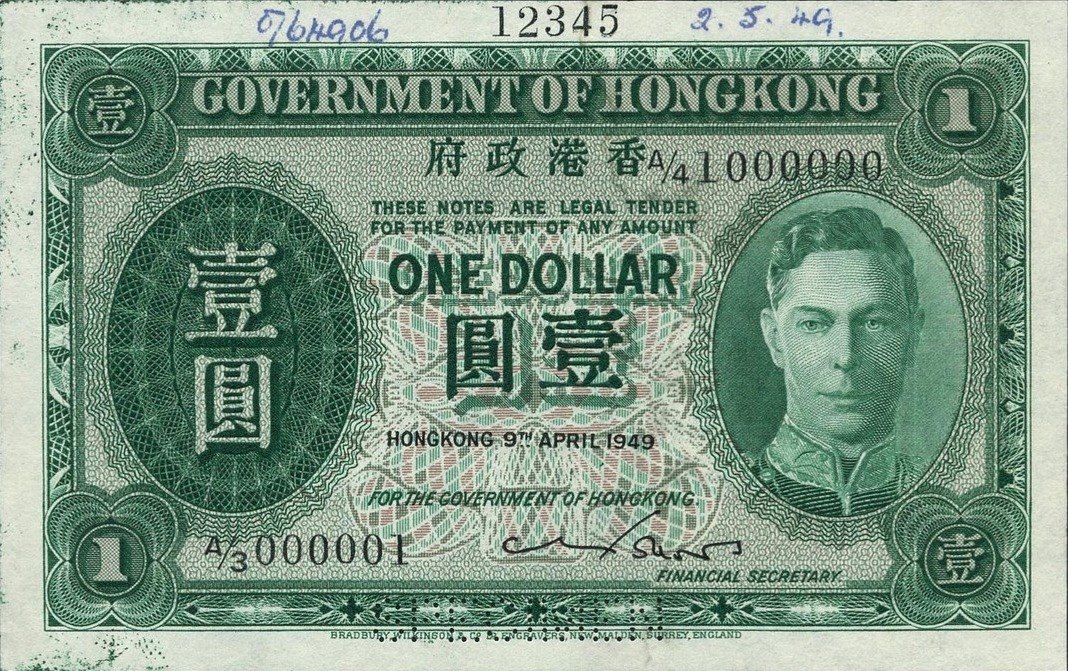
The book adds two things in its text. In 1953, it says (p. 121), a fall in the Government 1 dollar circulation more than offset the rise in the note issue of the Mercantile Bank. And it quotes the colony's annual report for 1954 (p. 110, page image): of a total currency in nominal circulation of 770,851,923 dollars on 31st December 1954, the Government 1 dollar note issue was 26,891,500 dollars and the subsidiary notes and coin 16,469,783 dollars. Of the small notes it says (pp. 113 to 114) that each value had its own security fund, that a proposal of 1949 to merge them had not been acted on, and that the 1 cent, worth about one-seventh of a penny, was the smallest paper note in the Commonwealth.

K. Y. Tang's table of 1975
K. Y. Tang, in "$1 Government Notes of Hong Kong: Part II, Elizabeth II Notes" (so numbered, although it is the third part of the series) in Bank Note Reporter of September 1975 (p. 17), introduces a table as "the number of Elizabeth II notes printed" and heads its column "Amount issued". The sources given under the table are the Hong Kong Government Gazette, Supplement No. 4, and the Hong Kong annual reports of the Accountant General. The table was read in the machine text of the page only.
| Date on the note, as Tang gives it | Tang's "amount issued" | Tang's population estimate |
|---|---|---|
| 1 July 1952 | 24,771,500 | 1,967,000 |
| 1 July 1954 | 25,021,500 | 2,120,000 |
| 1 July 1955 | 28,171,500 | 2,250,000 |
| 1 July 1956 | 32,371,500 | 2,400,000 |
| 1 July 1957 | 38,671,500 | 2,550,000 |
| 1 July 1958 | 35,521,500 | 2,650,000 |
| 1 July 1959 | 44,921,000 | 2,780,000 |
A last column gives notes per person, from 12 to 17. In the text Tang says the notes were issued "229,450,500 in all".
Here Tang's first two figures stand beside the Government 1 dollar column of Table 25 of Money in British East Asia:
| Tang, September 1975 | Tang's "amount issued" | Money in British East Asia, Table 25 | Government 1 dollar notes |
|---|---|---|---|
| 1 July 1952 | 24,771,500 | 31st March 1953 | 24,771,500.00 |
| 1 July 1954 | 25,021,500 | 31st March 1954 | 25,021,500.00 |
Table 25 gives no Government 1 dollar figure after 31st March 1954, so Tang's figures for 1955 to 1959 have nothing beside them there. Tang dates every issue 1st July; the catalogue's page for the green 1 dollar with Queen Elizabeth II gives the 1956 date as 1st June 1956. Neither Tang nor any other source read says more about what Tang's column counts than the words "printed" and "amount issued"; the Gazette supplement Tang names was not among the papers read. The catalogue's pages do not use the table.
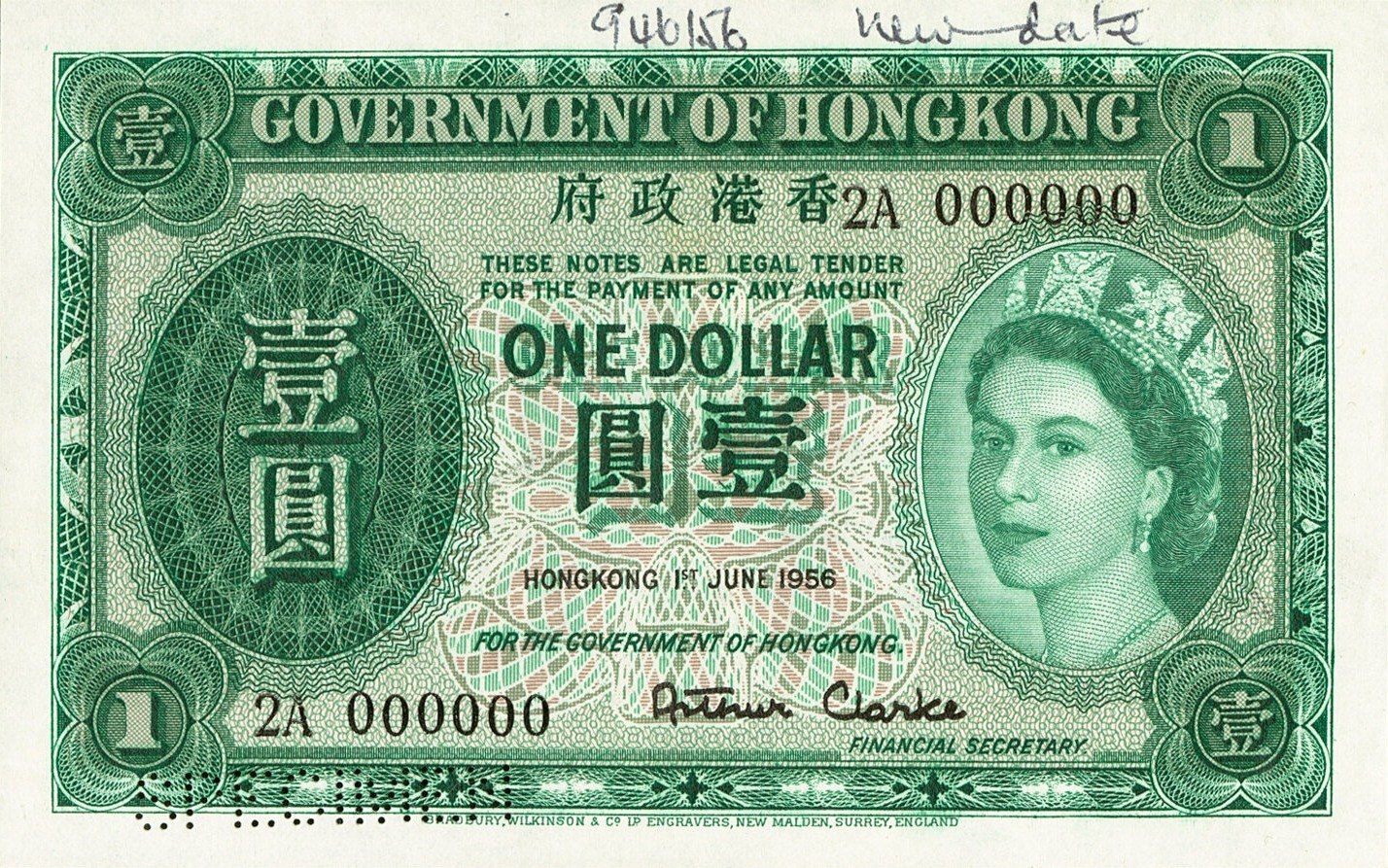
Tang's two later figures, 43,821,487 dollars of Government 1 dollar notes in circulation in 1960 and 26,671,487 dollars in 1962, are told with the budget speeches in The Government 1 dollar note of Hong Kong, 1952 to 1963. The same page of Tang's gives the total mintage of the 1960 dollar coins as 68,225,000. The Financial Secretary told the Council on 27th February 1963 that 80,000,000 dollar coins had been coined by then.
The peak and the end
Looking back on 5th February 1969, the Financial Secretary put the peak circulation at 55 million dollar notes and 5.3 million dollars of the other values, and the notes still outstanding in theory on that day at 11.5 million dollars of 1 dollar notes and 2.8 million dollars of other notes. These figures and the Ordinance of 1969 are told in The Government of Hong Kong's own notes, 1935 to 1995.
What the figures do not tell
- No source gives the number of notes printed or delivered for any Government note, of any value or date.
- No source gives the cent notes of 1941, 1945, 1961 or 1965 by value or by count: the official tables put them with the coin.
- Nothing read fills the years 1939 to 1948; the Gazette's half-yearly statements of the backing of the currency from 1937 are the place to look.
- The Accountant General's figures of 1949 to 1954 are for 31st March; the Blue Books' are for 31st December; the budget speeches mostly give the peak at Chinese New Year. Figures from different series do not measure the same day.
Sources
- Hong Kong Blue Books for 1935 to 1938: the currency return and the statement of assets and liabilities (Note Issue Account).
- An Economic Survey of the Colonial Empire, 1935, 1936 and 1937; the colony's annual report for 1936.
- Reports of the sittings of the Legislative Council of Hong Kong: 9th November 1935, 13th October 1937, 27th February 1963, 5th February 1969.
- Money in British East Asia (London, 1957), pp. 110, 113 to 114 and 121, and Table 25, p. 171.
- Krus and Schuler, working paper on currency board financial statements (2014), p. 126, Hong Kong section.
- K. Y. Tang, "The $1 Hong Kong Note of 1935", Bank Note Reporter, July 1975, p. 7; "$1 Government Notes of Hong Kong: Part II, Elizabeth II Notes", Bank Note Reporter, September 1975, p. 17.
Member comments
Log in or register to post a comment.