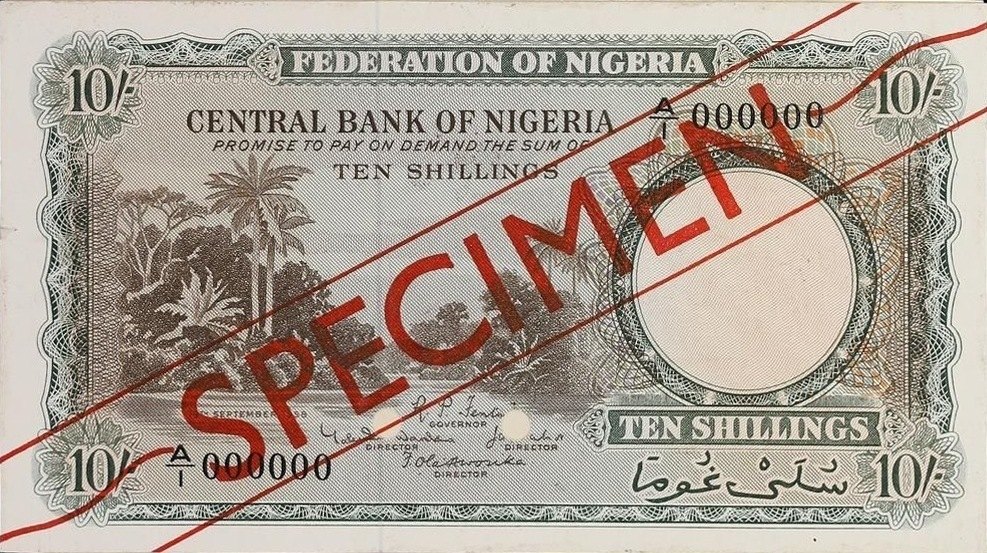
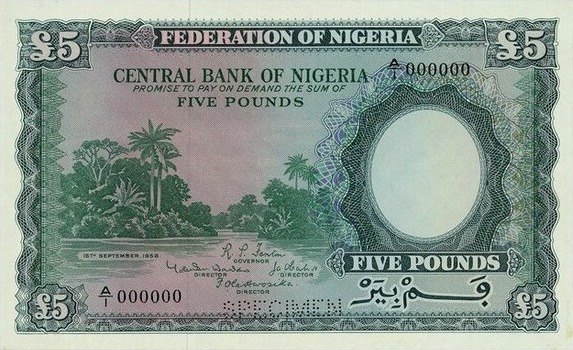
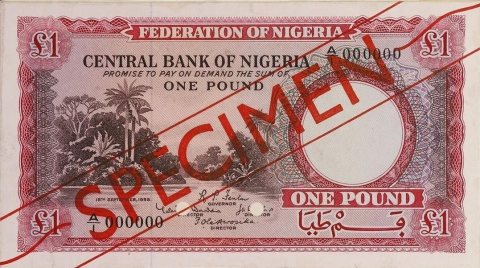
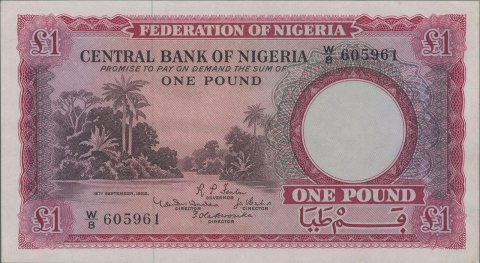
The four notes of the Central Bank of Nigeria dated 15th September 1958 are the last notes in the catalogue for Nigeria. Their pages say that they were withdrawn in 1965, when the undated notes replaced them, and that sources mention 22 January 1968 as the day they ceased to be legal tender. Neither statement names its source. This article sets out what the records read for the catalogue hold on those years, which is mainly one article: Peter Symes, "The Bank Notes of Biafra", in the IBNS Journal, volume 36, number 4 (1997), from page 27. Its passages were read in the machine-read text of the journal; the page images are no longer on this computer.
How the notes of 1958 were planned, printed and first issued is told in The first notes of the Central Bank of Nigeria, and the end of the West African Currency Board's notes in Nigeria in The notes of the West African Currency Board, 1916 to 1962.
What the pages say, and on what
The pages of the 5 shillings, 10 shillings, 1 pound and 5 pounds give two dates for the end:
- withdrawn in 1965, "when the undated notes replaced them" (the withdrawal field of each page reads "Withdrawn 1965");
- ceased to be legal tender on 22 January 1968, introduced by "sources mention".
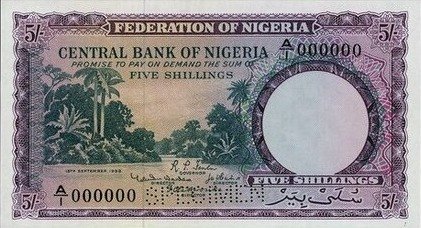
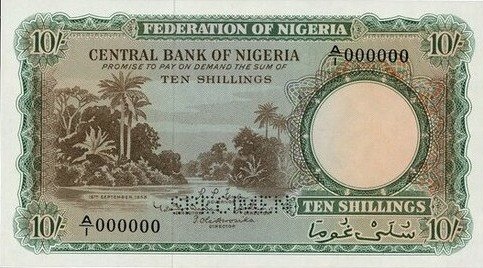
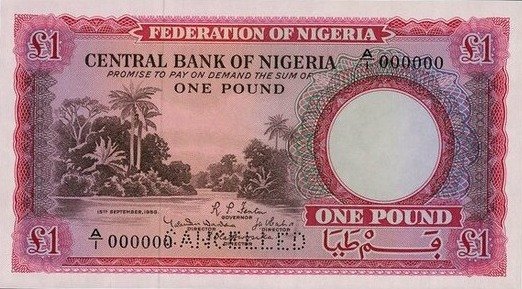
The records read for the catalogue hold no official source for either. The Nigeria annual reports read stop with that for 1957, and the Colonial Office List for 1960 says that the currency in Nigeria was issued by the West African Currency Board and the Central Bank of Nigeria, with notes of 100 shillings, 20 shillings, 10 shillings and 5 shillings.
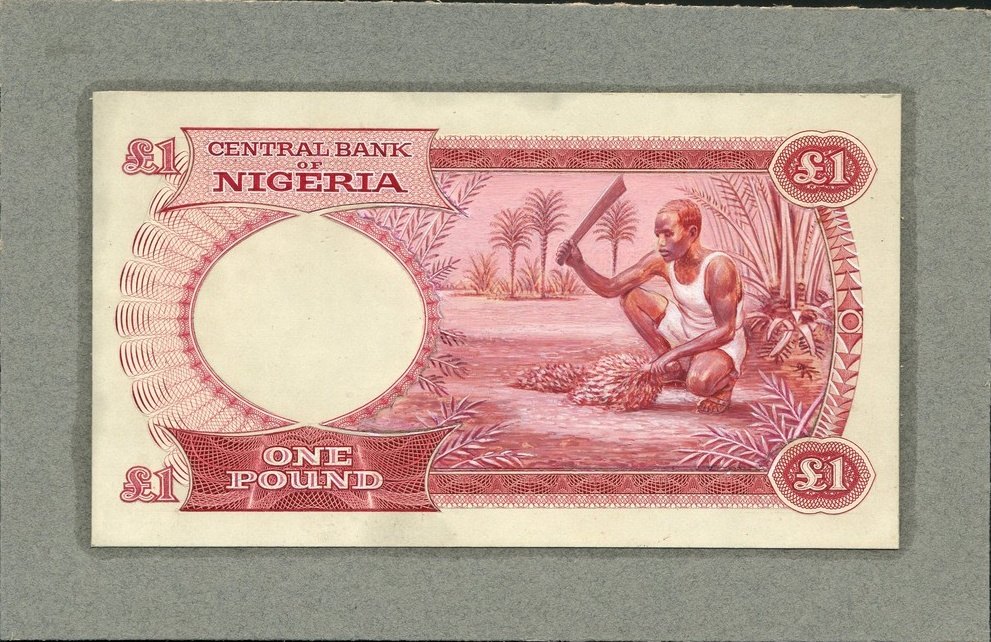
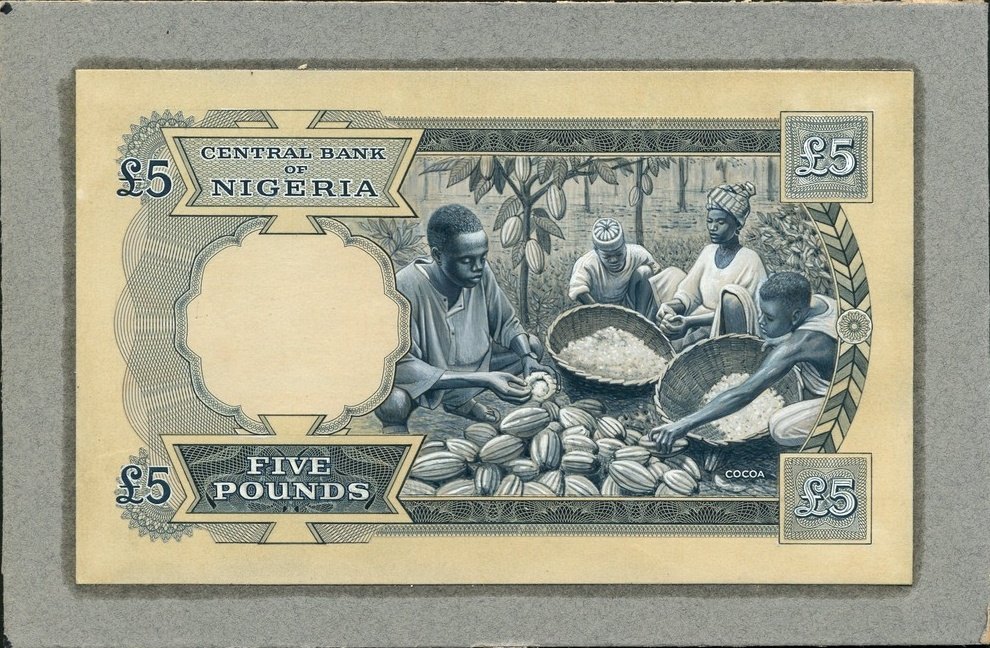
What the houses' descriptions show of the next designs (Spink, 30th September 2014, lots 1444 and 1447) and of the ink date 11. 4. 63 on a group of 5 pounds proofs (Spink, 8th December 2015, lot 429) is told in the article on the first notes. The later notes themselves turn up in the old sales: a 10 shillings of 1968 sits beside a 1 pound of 1958 in Henry Christensen's mail auction 98 of 20th December 1991 (lot 192).
Biafra and the Central Bank's currency, 1967
Symes's article is about the notes of Biafra, but it also tells of the Nigerian currency that Biafra held. Symes gives 30 May 1967 as the day the Eastern Region was declared the Republic of Biafra, and 6 July 1967 as the day the federal government's first offensive began the war.
Symes writes that the Bank of Biafra was set up by Decree No. 3 of 1967, the Bank of Biafra Decree, and quotes it: all property of the Central Bank of Nigeria in the Republic was to pass to the Bank of Biafra; under paragraph 8 the notes and coins of the Federal Republic of Nigeria were to remain legal tender in Biafra until a day the Military Governor would name; and under paragraph 9 the Bank was to keep the existing parity of the Nigerian pound. The Bank's head office was to be at Enugu. Symes places its headquarters at Port Harcourt early in 1968, until the town fell to federal troops on 19 May of that year.
Symes then gives the amounts of Nigerian currency that were said to be in Biafran hands. They are reports and claims, and Symes says that they differ:
| What | Amount | Who said it, as Symes gives it |
|---|---|---|
| Seized by the rebels in the east | some 37 million pounds | Nigeria's Finance Commissioner, 30 December 1967 |
| Collected by Biafra by the end of January 1968 | more than 53 million pounds | the Biafrans |
| Collected by Biafra in the three weeks after Nigeria's announcement | 53 million pounds | Dr. Pius Okigbo, economic adviser to the Biafran regime, on 1 February 1968 |
| In circulation in Biafra at secession | 30 million pounds | another estimate |
| Held in the vaults of the Central Bank at Enugu and Port Harcourt | 40 million pounds | the same estimate |
| Sent to Europe before secession | 6 million pounds | not named |
| Taken from bank vaults at Benin in September 1967, all in 1 pound notes | some 2 million pounds, of 12 million pounds held there | not named |
Symes reports that notes from the Benin haul began to appear in Lagos in October 1967, and that it is not known whether soldiers or dealers brought them. Symes also gives reports of an offer by the Rothschild bank of 12 shillings and 6 pence sterling for each Nigerian pound, which the Biafrans seem to have refused, against an official rate at the beginning of 1968 of one Nigerian pound to 1 pound 3 shillings and 4 pence sterling, and discounts of over 40 per cent on the notes sold in Europe.
The federal answer: new notes in January 1968
Symes describes two federal measures.
- A decree that Nigerian currency taken out of Nigeria, the rebel-held Eastern Region included, after 21 August 1967 would not be redeemed by the Nigerian Government. The machine-read text says the decree was issued "in June" and gives no year; the printed page has not been seen.
- A new series of notes that Biafra would not hold, after which the federal government could stop redeeming the notes of the current issue. On 30 December 1967 the Finance Commissioner announced that the new notes would replace the notes in circulation between 3 January and 22 January 1968.
Symes writes that the Nigerian Government announced that the old currency would no longer be legal tender after 22 January 1968, and that 22 January was the day the Central Bank of Nigeria stopped accepting the old notes. Symes notes a discrepancy in Ojukwu's own accounts: the speech dates the declaration by which Nigerian notes were no longer to be legal tender to 27 January 1968, the day Biafra's new currency was announced, while Ojukwu's "Diary of Events" dates it to 22 January.
The last days of the old notes, 12th to 22nd January 1968
Symes gives the attempts to move the old notes out before the deadline:
- 12 January 1968: more than 20 tons of Nigerian notes were flown into Switzerland on two aircraft. Only 7 tons were allowed to be unloaded. The other 13 tons came on an aircraft registered in Rhodesia, with which Switzerland had no diplomatic relations, and went on to Lisbon.
- 20 January 1968: an aircraft with 7 million pounds of Nigerian currency was seized at Lomé in Togo. The notes were said to be on their way from the Banque Populaire Suisse in Basle to a bank in Ibadan. Togo handed them to the Nigerian Government.
- 22 January 1968: seven suitcases holding 252,000 pounds in Nigerian notes were found at London Airport, bound for Accra, after one of them split open.
Biafra answered with notes of its own. Symes quotes Ojukwu's speech of 27 January 1968 announcing a decree that made Biafran notes legal tender and ended the legal tender of Nigerian notes in Biafra, with the new notes to be issued on 29 January 1968; one source, Symes adds, gives 10 January. Before that, the Biafran Government had given receipts for the Nigerian notes people handed in.
What this does not settle for the notes of 1958
Symes never names the series of the notes exchanged in January 1968: the article speaks only of "the old currency" and "notes of their current issue". The catalogue's own pages say that the 1958 notes were withdrawn in 1965, when the undated notes replaced them; those undated notes have no page in this catalogue. So two readings stay open:
- The reading of the Pick pages, under "sources mention": the notes of 1958 ceased to be legal tender on 22 January 1968, the day Symes gives for the old currency as a whole.
- The other reading, which no source read for the catalogue states and none rules out: the notes of 1958 had ceased to be legal tender at some earlier date, and Symes's 22 January 1968 concerns only the notes that replaced them.
No source read for the catalogue chooses between them. The day in 1965 on which the 1958 notes stopped being issued is not in the records either. What would settle both: the Central Bank of Nigeria's annual reports for 1965 and 1968, the Federal Government's notices in its Official Gazette of December 1967 and January 1968, or the Bank's own history of its notes.
Sources
- Peter Symes, "The Bank Notes of Biafra", IBNS Journal, volume 36, number 4 (1997), from page 27 (read in the machine-read text).
- The Pick pages of the 5 shillings, 10 shillings, 1 pound and 5 pounds dated 15th September 1958.
- The Nigeria annual report for 1957; the Colonial Office List for 1960.
- Spink, 30th September 2014, lots 1444 and 1447; 8th December 2015, lot 429.
- Henry Christensen, mail auction 98, 20th December 1991, lot 192.
Member comments
Log in or register to post a comment.