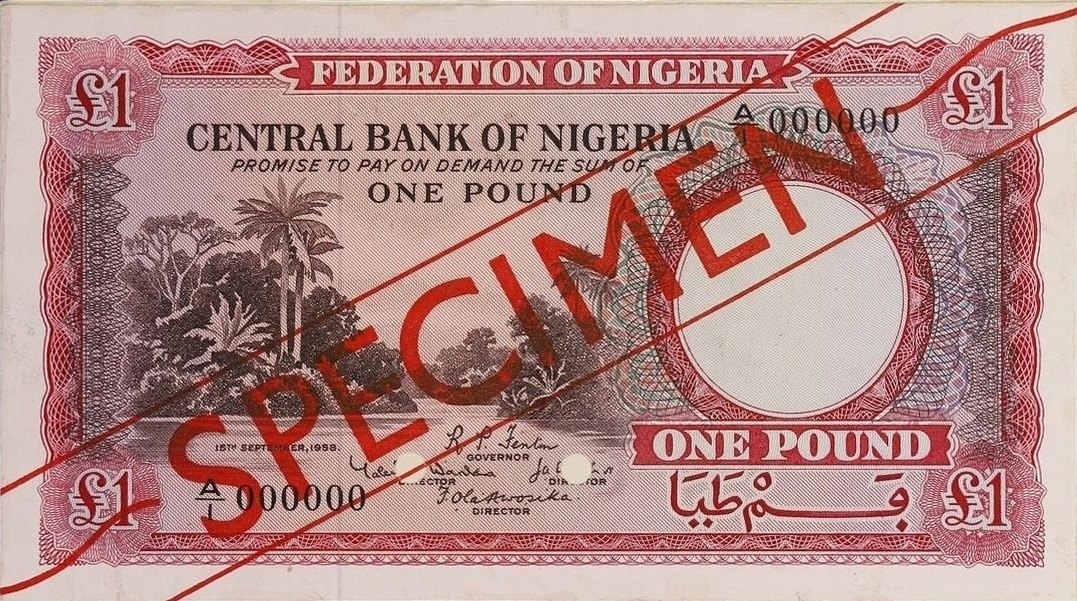
The paper money of Nigeria itself, as against the West African Currency Board's, is two issues: the Government's notes of December 1918 and the Central Bank's notes dated 15th September 1958. This article sets out what collectors have written about them in the IBNS Journal and Bank Note Reporter, as the owner's readings of those journals found it, and where the notes stood in the old sale catalogues read for the catalogue. What collectors wrote about the Board's notes is told in What collectors wrote about the West African Currency Board's notes, 1970 to 2017, and the official story of the two issues in The Government of Nigeria's notes of December 1918 and The first notes of the Central Bank of Nigeria.
The journal passages below were read in the machine-read text of each issue. The page images of the issues are no longer on this computer, so no figure here was checked on the printed page.
Richard Kelly, 1977: two values the catalogues did not have
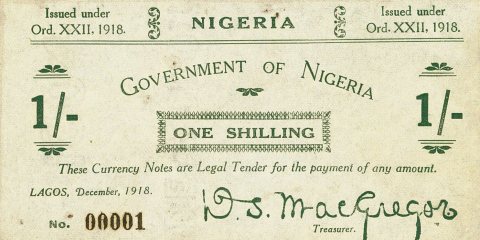
In 1977 Richard Kelly wrote "Blue Books and Bank Histories" for the IBNS Journal (volume 16, number 4, pages 223 to 225). The article was a test of a method: Kelly read the Nigerian Blue Books for 1915 to 1925 to see whether they named notes that collectors did not know. They did. The Blue Book for 1919 records a 10 shillings and a 20 shillings of the Nigerian Government, which Kelly wrote had, "as far as I know, gone uncatalogued". The Blue Book keeps them apart from the Board's notes of the same values, and gives them the same law, Ordinance No. 22 of 1918, as the 1 shilling that the Pick catalogue then listed as Nigeria P1. Kelly concluded that the three notes were issued at about the same time and for the same reason and belonged together.
Kelly then printed the Blue Books' yearly estimates of the three notes still in circulation, which are given in the article on the notes of 1918, and drew from them that the notes were being withdrawn within a year or so of issue. The early withdrawal and the small sums, Kelly wrote, would explain why so few are seen.
The catalogue now lists the three values as the 1 shilling, the 10 shillings and the 20 shillings, P-1, P-1A and P-1B. The pages of the 10 and 20 shillings show pictures from The Banknote Book.
In the issue before (volume 16, number 3, page 151), "Early Paper Money in British West Africa", Kelly had written of the Bank of Nigeria. The source was the minutes of the Emmott Committee of 1911 and 1912, whose report led to the West African Currency Board. Osborne Wilmot, Secretary of the Bank of Nigeria, told the Committee that the bank had had a small issue of 10 shilling notes payable to bearer in Southern Nigeria, that the issue was later held to break the Colonial Regulations, and that it had run for a few years all the same. Wilmot said the notes were of no use, being treated as cheques guaranteed by the bank, and that they could be changed for silver at various places in Nigeria. Kelly adds the bank's history: it was founded in 1898 by a group of traders as the Anglo-African Bank, to compete with the Bank of British West Africa; its first branch was at Old Calabar, with others later at Burutu, Lokoja, Jebba and in the French Ivory Coast; it had become the Bank of Nigeria, Ltd. by 1905, and it was absorbed by the Bank of British West Africa in 1912. Kelly knew of no surviving note. The catalogue has no page for these notes; they are set beside the other bank notes of West Africa in Before the Board's notes and beside them.
Kerry Rodgers, 2004: the 1918 notes in Bank Note Reporter
Kerry Rodgers wrote twice about the 1918 notes in Bank Note Reporter in 2004.
The first piece, "Rare Nigerian issue auctioned in Sydney" (September 2004, page 69), was prompted by a 1 shilling of 1918 in the sale of Noble Numismatics in Sydney, sale 76, held on 27th to 29th July 2004. Rodgers reports that the note did not sell. The article gives no lot number. Its account of the issue runs as follows:
- the West African Currency Board first asked the Bank of England to print 21 million salmon-coloured 1 shilling notes dated 30th November 1918, the 1 shilling of British West Africa;
- before those could arrive, in December 1918, the Board chose to have emergency notes produced locally;
- three values were printed: 1 shilling in green on white, 10 shillings in red on white and 20 shillings in black on white;
- they were issued under Ordinance XXII of the colonial Nigerian Government, so they are Nigeria's notes and not the Board's, and all were signed by D. S. MacGregor as Treasurer (the article opens by saying that they were issued by the Board but bear no reference to it);
- they were withdrawn as soon as the Board's notes printed by the Bank of England arrived, because their security was poor and the authorities did not wish to help the counterfeiters.
Rodgers gives notes to the value of 176,000 pounds in circulation in 1917-1918, without saying in so many words whose notes they were, and higher figures for 1918-1919 and 1919-1920 that the machine-read text of the page runs together, so they are not given here. For the details of the story Rodgers sends the reader to David Vice's book, The Coinage of British West Africa & St. Helena 1684-1958 (Format Publications, Birmingham, 1983). Rodgers numbers the three notes Nigeria P-1 to P-3 in September and P-1, 1A and 1B in November.
The second piece, "Early BWA issues appear at auction in Australia" (November 2004, page 73), is about two of the Board's notes sold by Australian Numismatics at Ballarat in October 2004. It repeats that the Nigerian notes were made locally under the ordinances of the colonial Nigerian Government and that all the emergency notes were withdrawn once the Board's regular notes arrived.
Rodgers beside the official papers
Some of this agrees with the official papers and some does not.
- The Nigeria Handbook of 1919 (page 41) says only that "it became necessary" to issue local notes at the end of 1918, and that Ordinance No. 22 of 1918 made them legal tender. It does not say who took the decision.
- Rodgers's 176,000 pounds fits the Board's own report, which counts 176,445 pounds in the Board's notes in circulation at 30th June 1918; that report is read through in The West African Currency Board's report for the year ended 30th June 1918.
- A withdrawal as soon as the Board's notes came does not fit the Nigeria Blue Books, which still estimate 400 pounds of the 1918 notes in circulation at the end of 1922 and 300 pounds at the end of 1923, and call them "being withdrawn" in those two years.
- Rodgers gives the paper as white. Stack's Bowers, describing a 1 shilling on 12th January 2017 (lot 1285), calls it green ink on tan paper.
Other writers
- Peter Symes, "The Bank Notes of Biafra", IBNS Journal, volume 36, number 4 (1997), from page 27, tells how the notes in circulation in Nigeria were exchanged in January 1968. What it says, and what it does not say about the notes of 1958, is in The end of the Central Bank's notes of 1958.
- An article on the banknotes of Sierra Leone in the IBNS Journal, volume 20, number 1, says that Ghana left the West African Currency Board on its independence in 1957 and that Nigeria followed in 1958. The Bank of England's Quarterly Bulletin for 1962, in "Currency and banking developments in certain Commonwealth countries", gives 1958 for Ghana and 1959 for Nigeria, and the Nigeria Pick pages give 1 July 1959 for the opening of the Central Bank and its exchange of the Board's notes. The records leave the difference as it stands.
- Sarangapani, in the IBNS Journal, volume 56, number 4 (2017), pages 43 to 47, tells of the notes planned for Southern Nigeria in 1907 to 1910; that story is in Before the Board's notes and beside them.
Dealers' lists and advertisements
The journals' advertisements show where the notes were offered, without telling more about them.
- John Pettit Pty Ltd of Sydney advertised a fixed-price list of British colonial notes in Bank Note Reporter for May 2000. Among the pieces it names is a Nigeria Pick 1A, No. 00001, the 10 shillings of 1918. The page of the 10 shillings pictures a note No. 00001 from The Banknote Book; whether it is the same note is not shown.
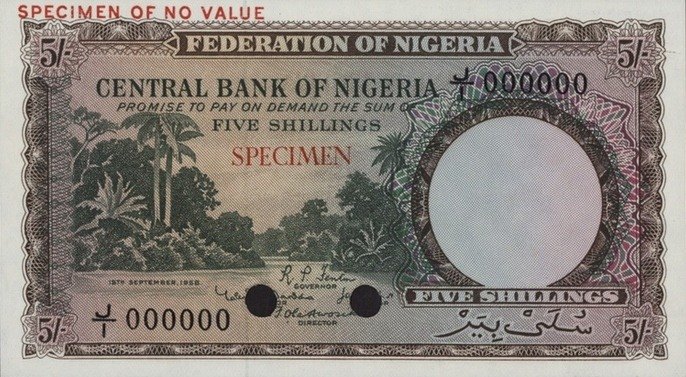
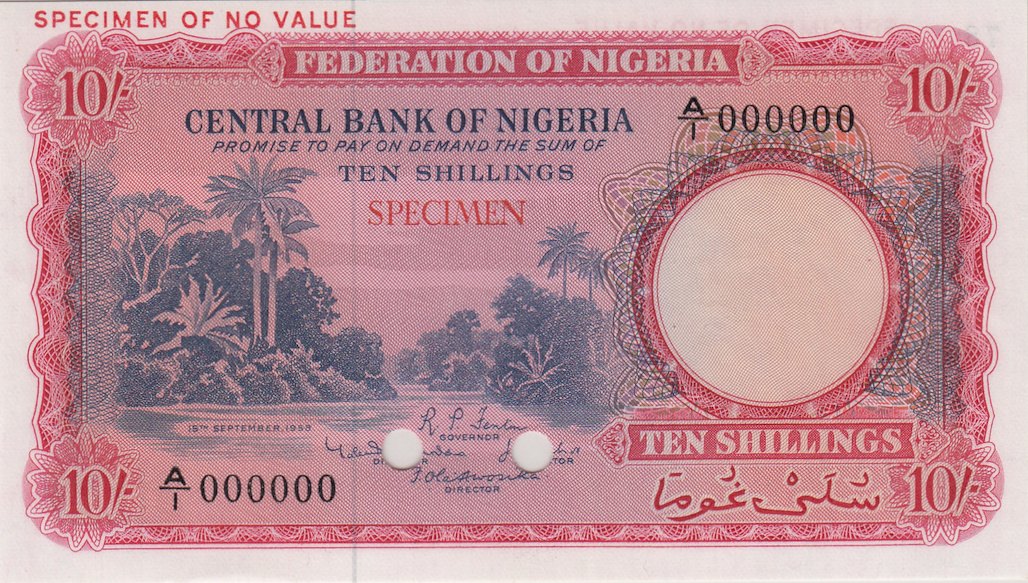
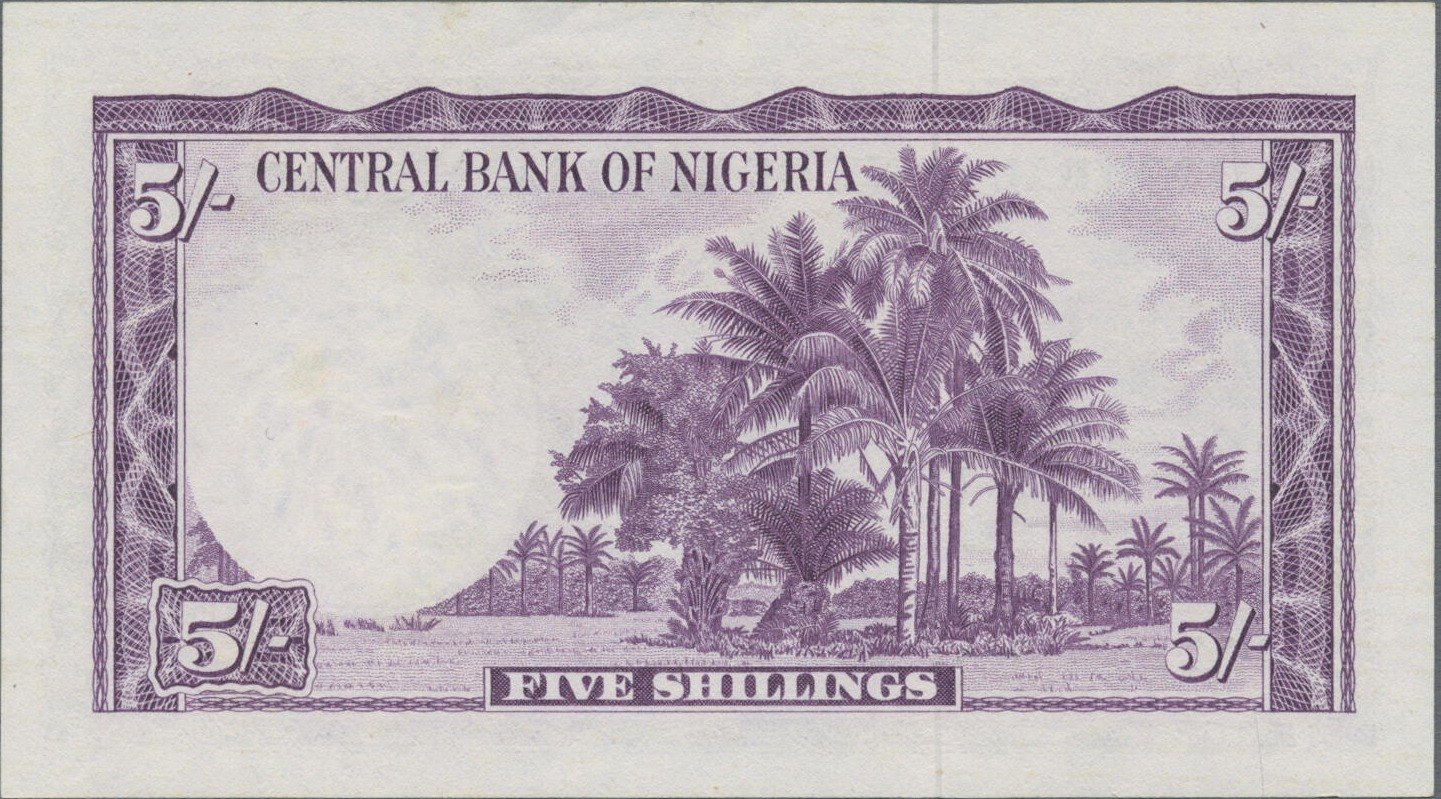
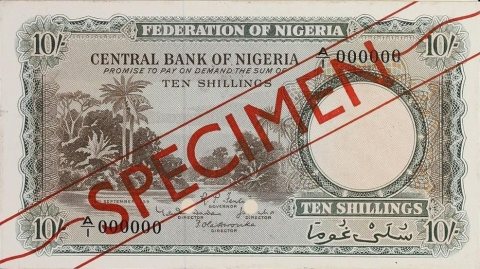
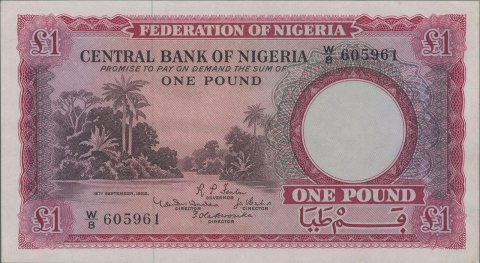
- Champion Stamp Co. of New York advertised its lists of specimens in Bank Note Reporter in March 2003, September 2004, March 2005, July 2010 and January and September 2011. Under Nigeria the lists of 2003 to 2005 name colour trials of the 5 shillings (brown), the 10 shillings (red with blue) and the 1 pound (blue in 2003, blue with green from 2004), and a specimen of the 5 pounds. The lists of 2010 and 2011 no longer name the 10 shillings, and in the machine-read text of July 2010 and January 2011 the Nigerian lines are marked sold. The colours are those of the colour trials of the 5 shillings, 10 shillings and 1 pound of 1958.
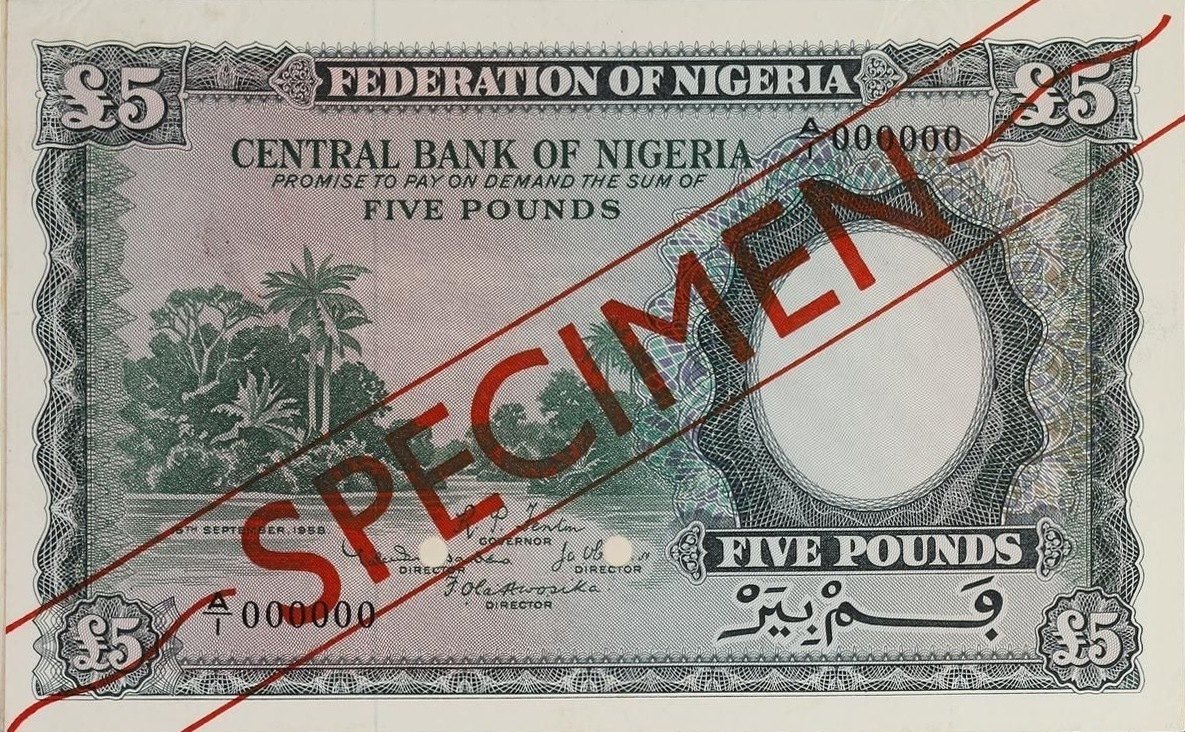
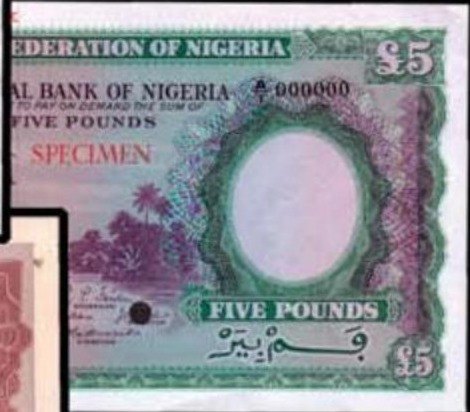
- An advertisement of Ponterio & Associates in the IBNS Journal, volume 47, numbers 3 and 4 (2008), pictures a 5 pounds of 1958 with an all-zero number, a red SPECIMEN overprint and at least one punch hole through the signatures.
- The IBNS Journal, volume 25, number 1, announces a Spink sale to be held in Sydney on 16th and 17th April whose world section was to include a Nigerian specimen set of 1958. The notice gives no lot.
The old sale catalogues
The owner has had several older sale catalogues read for the catalogue. In them Nigeria appears only with ordinary issued notes of 1958 and with later notes that have no page here:
| Date | House and sale | Lot | Nigeria in the lot |
|---|---|---|---|
| 5th December 1974 | Harmer-Rooke, New York, the Albert I. Donn Collection | 133 | a 1 pound of 1958 |
| 5th December 1974 | the same sale | 262 | a specimen set of the Federal Republic, a later issue |
| 9th June 1975 | Glendining, London, catalogued by Spink, the R. J. Ford Collection | 423 to 426 | one each of the 5 shillings, 10 shillings, 1 pound and 5 pounds of 1958, with later undated notes |
| 9th June 1975 | the same sale | 427 | later notes only |
| 7th December 1981 | NASCA, the Stanley Gibbons Collection, part II | 1678 | a 1 pound of 1958 |
| 20th December 1982 | Herbert I. Melnick, the Stanley Gibbons Collection, part V | 2994 to 2996 | a 1 pound of 1958 in each |
| 20th December 1991 | Henry Christensen, mail auction 98 | 192 | a 1 pound of 1958 with a 10 shillings of 1968 |
| 20th December 1991 | the same sale | 249 | a 10 shillings of 1968 among notes of other countries |
| 28th June 2000 | R. M. Smythe & Co., New York, Memphis Mail Bid Sale #200 | 5454 | a 10 shillings of 1958 |
| 27th to 29th July 2004 | Noble Numismatics, Sydney, sale 76 | not given | a 1 shilling of 1918, as Rodgers reports it |

The R. M. Smythe sales of 15th July 1993 (lot 7274), 29th July 2002 (lots 3517 and 3518), 13th June 2003, 22nd October 2004 (lot 3329) and 18th June 2005 hold only Nigerian notes later than 1958.
One piece can be followed from sale to sale. The 5 shillings of the Ford sale, lot 423, is recorded in the catalogue as the same note as the one Spink sold on 27th September 2017 as lot 502. No other Nigerian note of these old sales has been matched to a later one.
Two collectors' records add little. The Ruth Hill ledgers have one sheet for Nigeria, and every line on it is a note of 1973 or later. PMG's gallery of the Dauer Collection holds British India and Ceylon notes only; the 1 shilling of 1918 from the collection of Drs. Joanne and Edward Dauer was sold by Heritage Auctions on 24th April 2020 (lot 26161), as told in the article on the notes of 1918.
What is still open
- Whether the Board, or the Government of Nigeria, decided on the local notes of December 1918. Rodgers, after Vice, says the Board; the Handbook names no one. Vice's book has not been read for the catalogue.
- The number of the Noble lot of July 2004, and whether its note has been sold again.
- Which Spink sale in Sydney held the specimen set of 1958, and in which year.
- As the records list them, none of the old catalogues above offers a 10 or 20 shillings of 1918, or a specimen, proof or colour trial of 1958.
Sources
- Richard Kelly, "Early Paper Money in British West Africa", IBNS Journal, volume 16, number 3 (1977), page 151; "Blue Books and Bank Histories", IBNS Journal, volume 16, number 4 (1977), pages 223 to 225.
- Kerry Rodgers, "Rare Nigerian issue auctioned in Sydney", Bank Note Reporter, September 2004, page 69; "Early BWA issues appear at auction in Australia", Bank Note Reporter, November 2004, page 73.
- Peter Symes, "The Bank Notes of Biafra", IBNS Journal, volume 36, number 4 (1997), from page 27.
- "Banknotes of Sierra Leone", IBNS Journal, volume 20, number 1.
- Sarangapani, IBNS Journal, volume 56, number 4 (2017), pages 43 to 47.
- IBNS Journal, volume 25, number 1 (the Spink sale in Sydney); volume 47, numbers 3 and 4 (2008, the Ponterio & Associates advertisement).
- Advertisements of John Pettit Pty Ltd (Bank Note Reporter, May 2000) and Champion Stamp Co. (Bank Note Reporter, March 2003, September 2004, March 2005, July 2010, January and September 2011).
- The Nigeria Handbook, 1919, page 41; the Nigeria Blue Books for 1922 and 1923.
- The Bank of England's Quarterly Bulletin, 1962, "Currency and banking developments in certain Commonwealth countries".
- Sale catalogues: Harmer-Rooke, 5th December 1974; Glendining, 9th June 1975; NASCA, 7th December 1981; Herbert I. Melnick, 20th December 1982; Henry Christensen, 20th December 1991; R. M. Smythe, 15th July 1993, 28th June 2000, 29th July 2002, 13th June 2003, 22nd October 2004 and 18th June 2005; Spink, 27th September 2017, lot 502.
- Stack's Bowers, 12th January 2017, lot 1285; Heritage Auctions, 24th April 2020, lot 26161.
- The Ruth Hill ledgers; PMG's gallery of the Dauer Collection.
Member comments
Log in or register to post a comment.