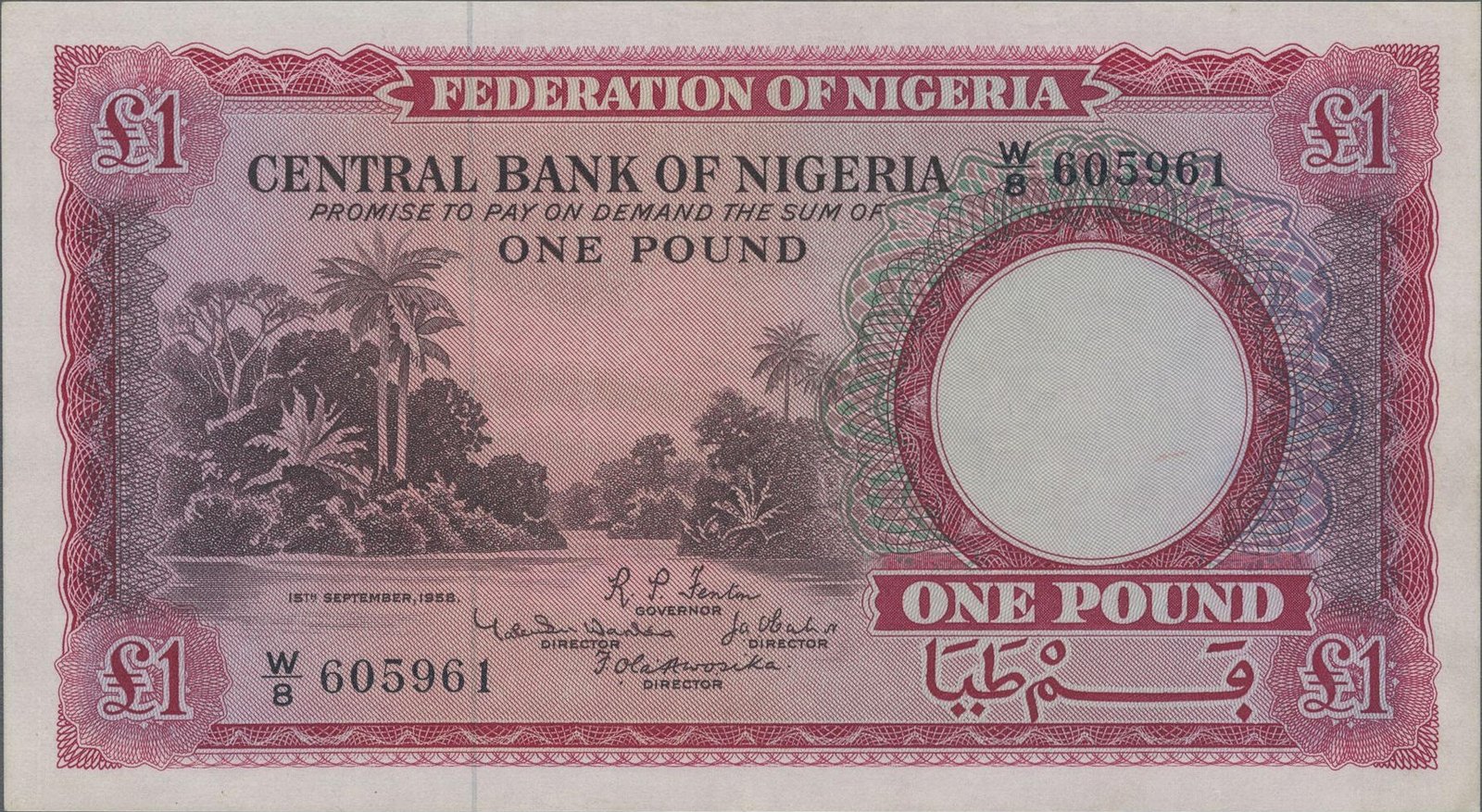
The Central Bank of Nigeria began with four notes, all dated 15th September 1958: a 5 shillings, a 10 shillings, a 1 pound and a 5 pounds. This article tells how the issue was planned, what the notes show and who signed them, and what the specimens, proofs and colour trials tell of the printing. It rests on the catalogue's pages, on the Nigeria annual report for 1957 and the Colonial Office List for 1960, and on the descriptions of Spink, Heritage Auctions, Stack's Bowers and Corné Akkermans Auctions, each given as that house's own statement.
The Loynes report of 1957
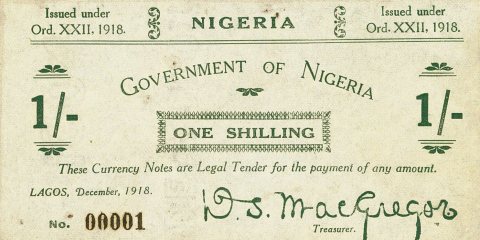
Until 1959 the paper money of Nigeria was that of the West African Currency Board, apart from the Government's own notes of December 1918. The Nigeria annual report for 1957 says that during the year the Federal Government considered a Nigerian currency that would in time replace the West African one, and that at its invitation an expert from the Bank of England reported on the proposal. The report names the paper in a footnote: the Report by Mr. J. B. Loynes on the Establishment of a Nigerian Central Bank, the Introduction of a Nigerian Currency and other Associated Matters, printed by the Federal Government Printer in Lagos in 1957. Under Banking the annual report adds that a Federal institution to do the work of a central bank was projected and had been reported on by Loynes.
The same annual report says the demand for 20 shilling notes was still rising in 1957, while that for the 1 shilling coin fell sharply.
Loynes appears again on the paper money of West Africa: J. B. Loynes signs the twenty shillings of the West African Currency Board dated 17th April 1962. The members of that Board are set out in The members of the West African Currency Board and the notes they signed, 1912 to 1965.
The Bank and its opening on 1 July 1959
The Central Bank of Nigeria was established by the Central Bank Act of 1958. It opened on 1 July 1959, when it exchanged the notes and coin of the West African Currency Board at par for the new Nigerian currency. The Colonial Office List for 1960 says the currency in Nigeria was issued by the West African Currency Board and the Central Bank of Nigeria, with notes of 100 shillings, 20 shillings, 10 shillings and 5 shillings: the four values of 1958. Nigeria became independent on 1 October 1960.
The notes carry a date earlier than the day the Bank opened. No source read for the catalogue says why 15th September 1958 was chosen.
A smaller value was drawn and not made. Photographs of a 2 shillings of the Central Bank, dated 1st July 1958, are described in Values that were never issued.
The four notes
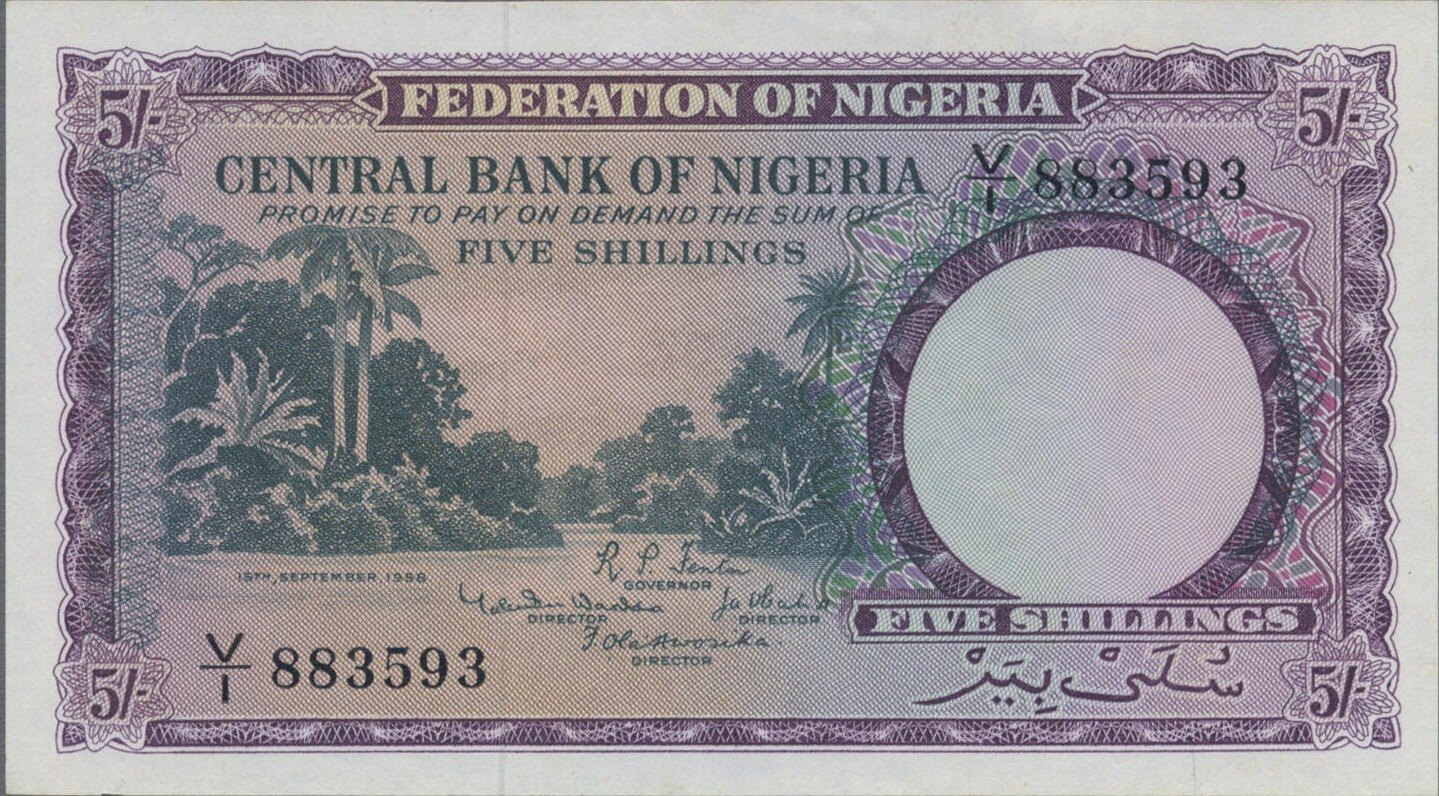
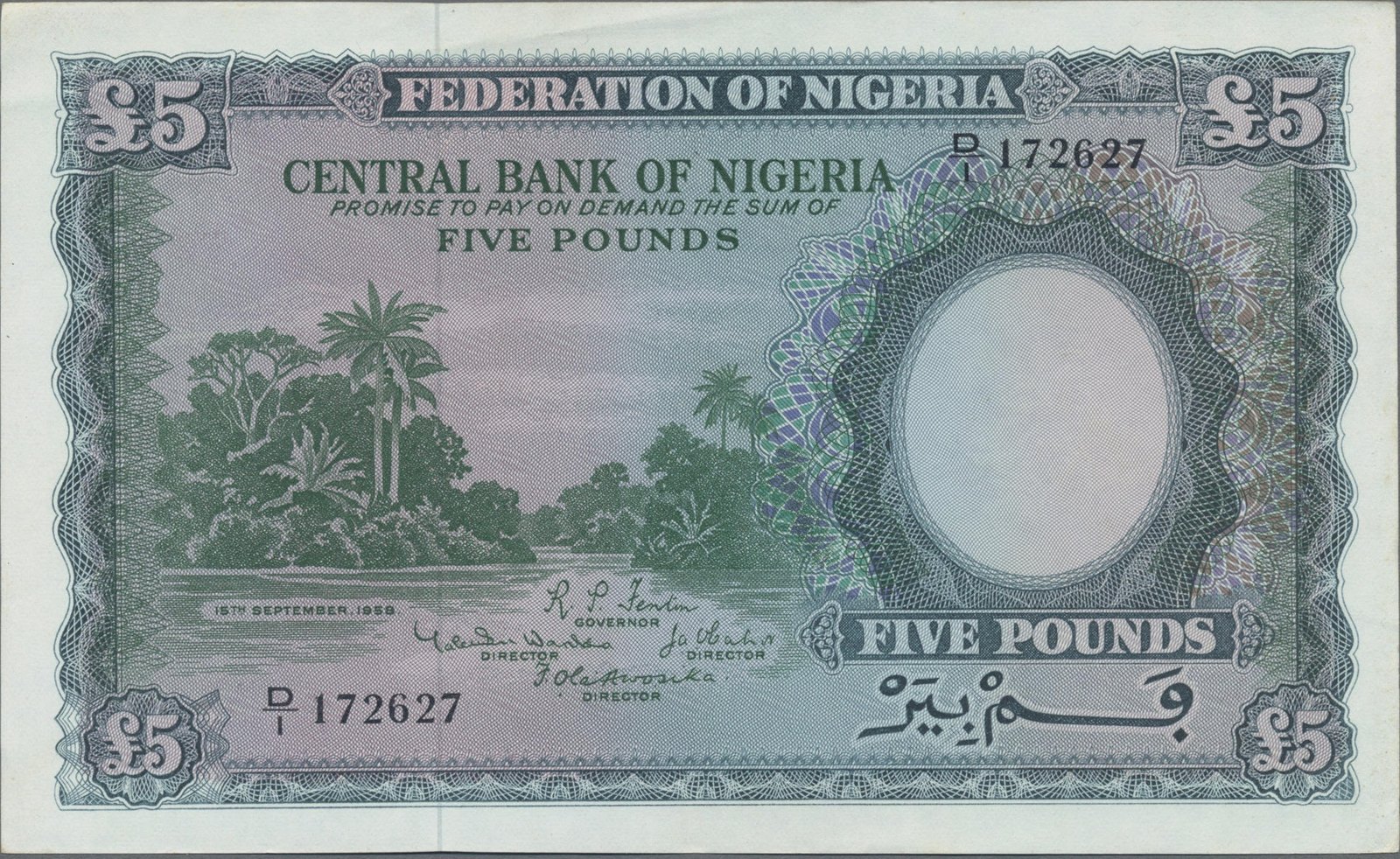
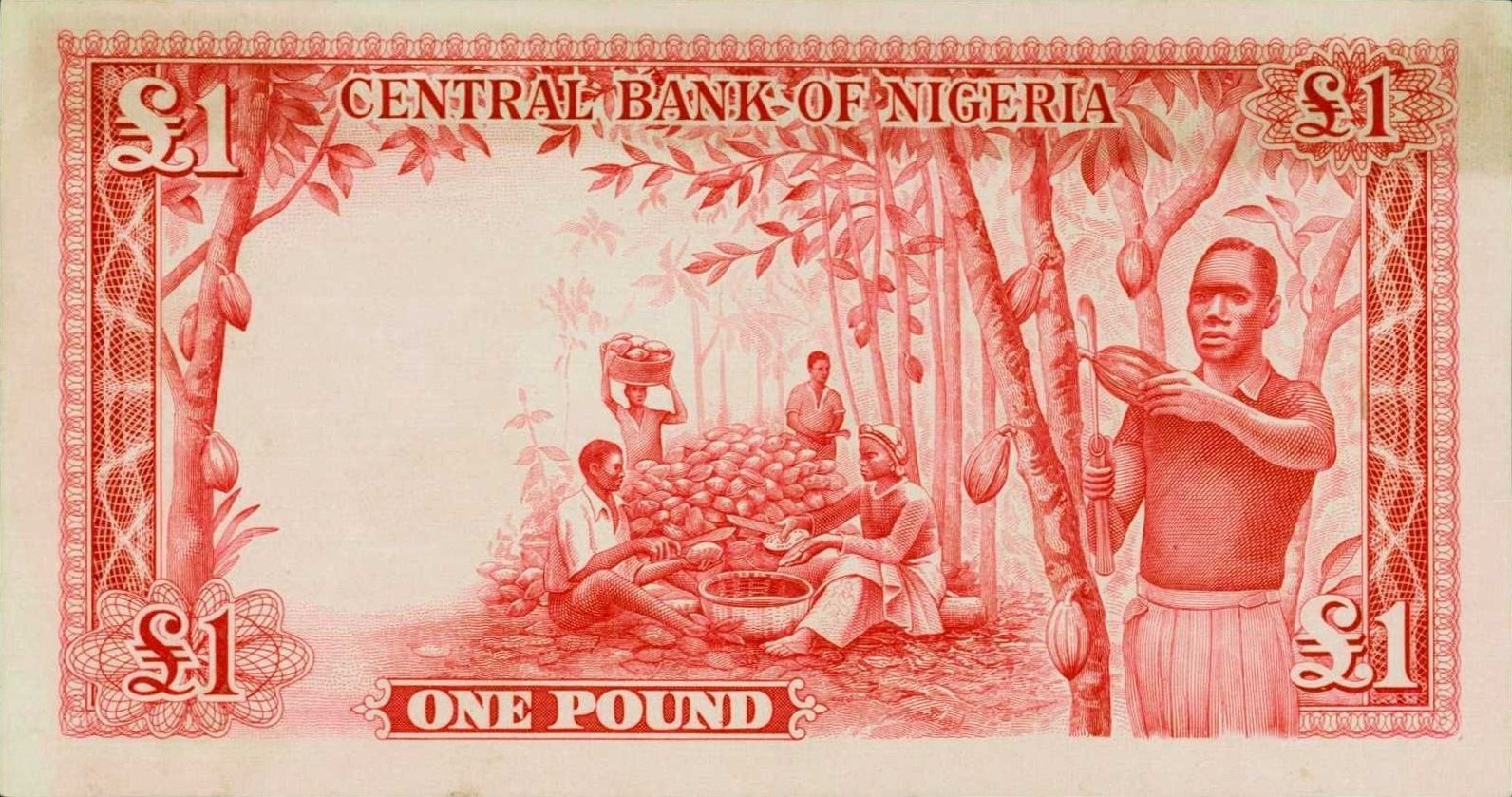
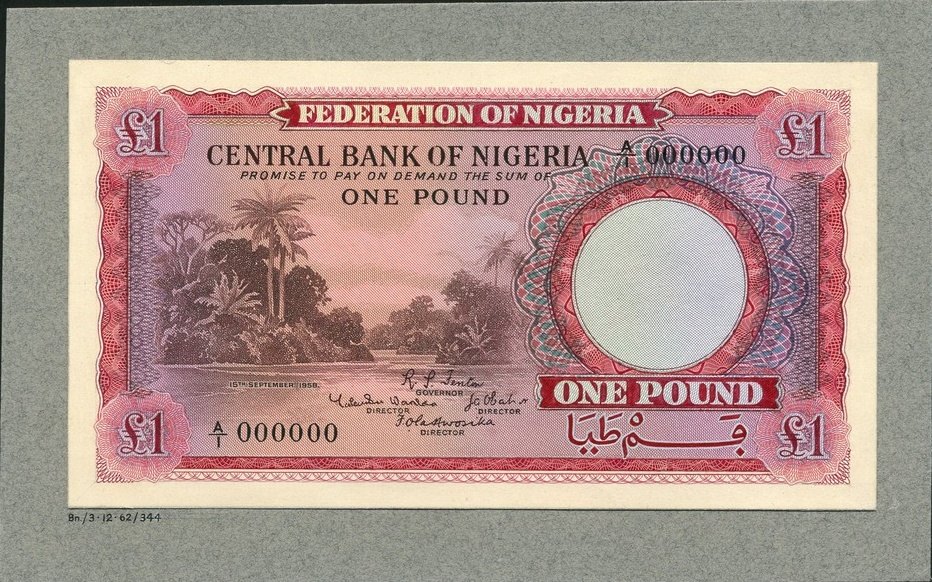
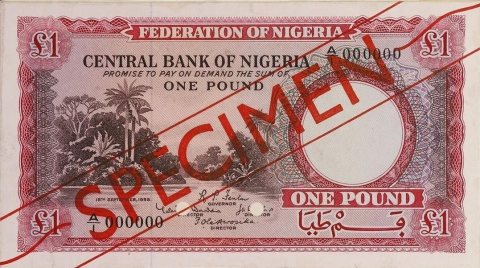
All four notes are headed FEDERATION OF NIGERIA, and the value is repeated in Hausa written in Arabic letters (Ajami). The fronts share one view of the Niger River with palm trees. Each back has its own scene. Spink's description of a set of colour trials in its sale of 8th July 2015 (lot 392) names them: palm trees on the 5 shillings, the sowing of a crop on the 10 shillings, the harvesting of cocoa pods on the 1 pound and the harvesting of palm fruit on the 5 pounds. Corné Akkermans Auctions, in its sale of 21st September 2017 (lot 785), calls the scene on the 10 shillings men working in groundnut fields.
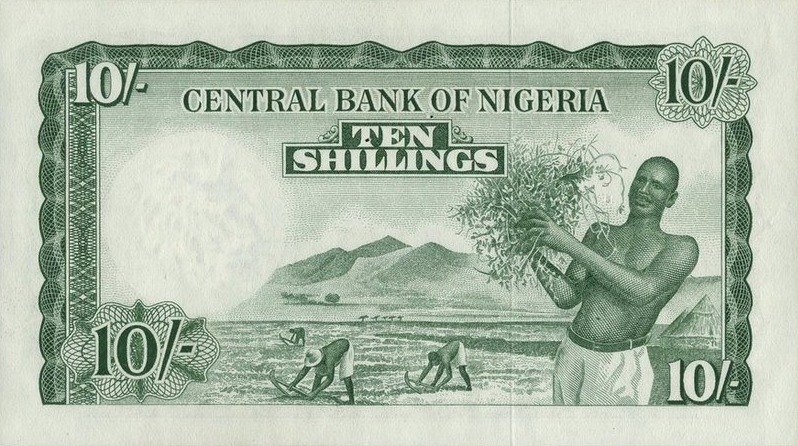
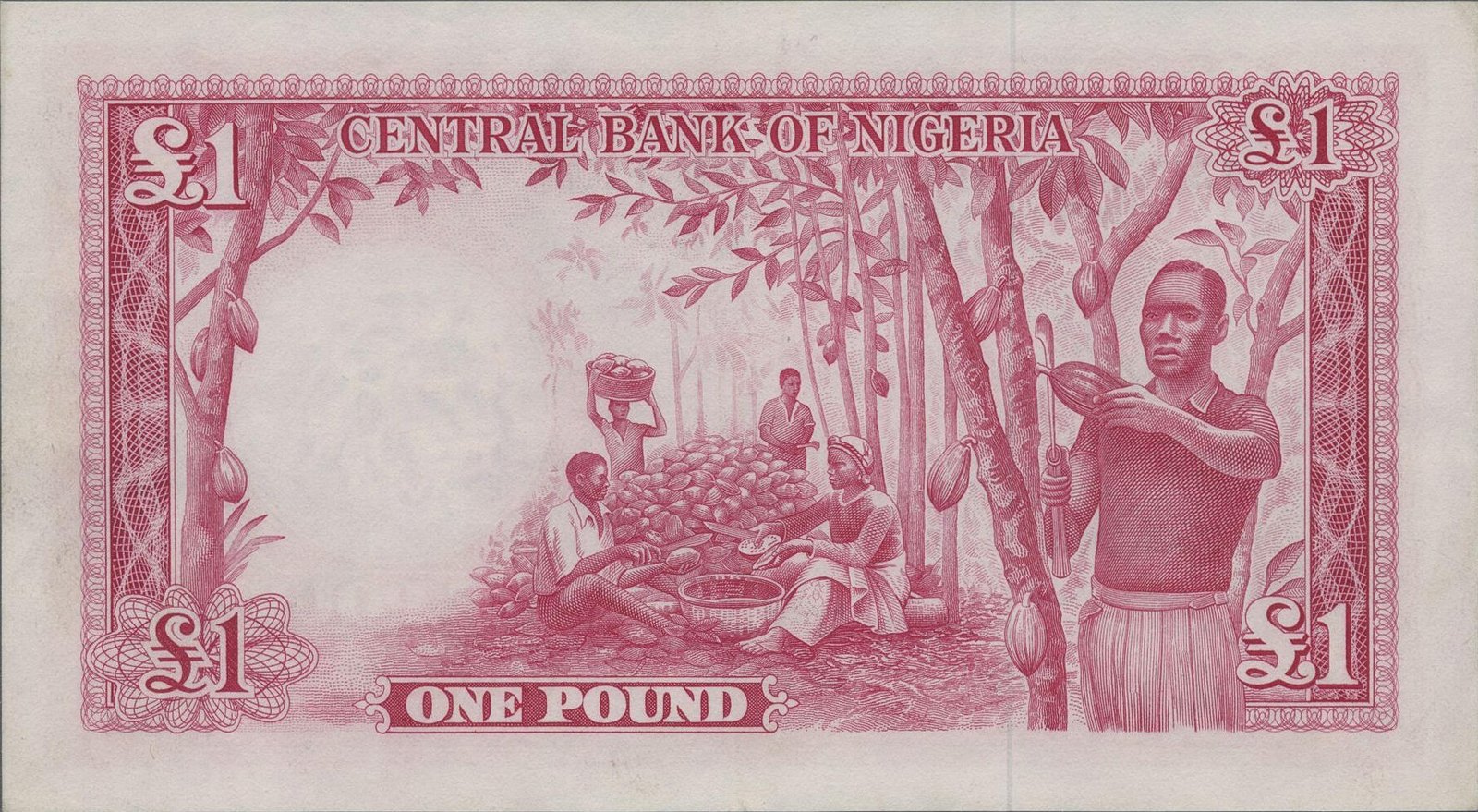
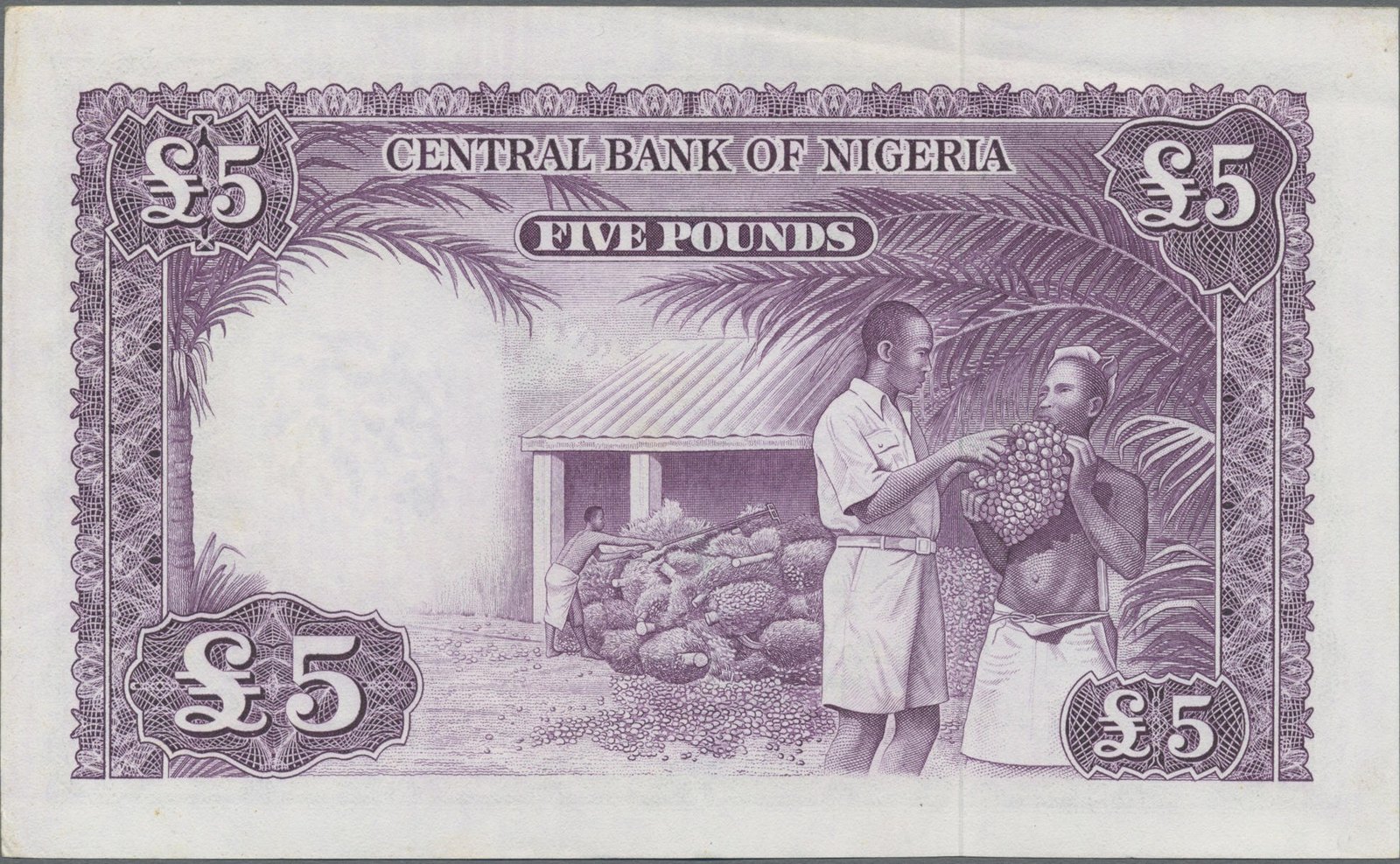
| Value | Size | Prefixes |
|---|---|---|
| 5 shillings | 120 by 65 mm | A/1 to Z/1 and on into the /2 series |
| 10 shillings | 138 by 76 mm | A/1 to Z/1 and on into the /2 series |
| 1 pound | 153 by 83 mm | A/1 to Z/12 and on to G/13 |
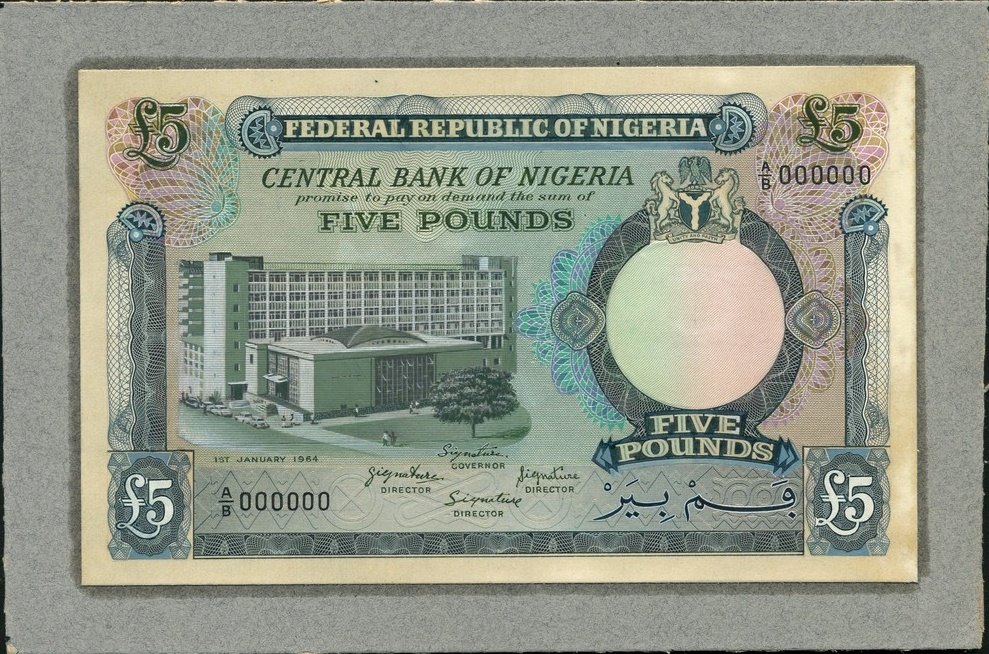
| 5 pounds | 166 by 100 mm | A/1 to E/1 |
The notes were printed by Waterlow and Sons, without an imprint, on paper with a lion head watermark.
Heritage Auctions, describing a 5 shillings on 12th September 2016 (lot 27891), says that many notes of the series were based on the designs of the West African notes before them, that those notes had no 5 shillings, and that the shared river scene made it easy to add the new value by a change of colours. That is Heritage's statement. The catalogue does list a 5 shillings of the West African Currency Board, prepared for 1st March 1920 and never issued.
The Governor and the three Directors
The notes are signed by the Governor, R. P. Fenton, and three Directors, Mallam Yakubu Wanka, F. Ola Awosika and J. A. Obahor. Corné Akkermans Auctions, in its sale of 5th April 2018 (lot 890), gives two of the names in full: Roy Pentelow Fenton and Jabin Asidishor Obahor. No source read for the catalogue gives the dates of their appointments.
Specimens and their printed ranges
The specimens of this issue are of more than one kind. Some have no serial number, some have a prefix and an all-zero number, and some are printed with a range of serial numbers in place of a number. The ranges are given on each note's page. On the 10 shillings, the 1 pound and the 5 pounds the range begins at A/1 000001 and is taken as the first printing; on the 5 shillings the range runs from one prefix series into the next. The ranges show that each prefix ran to 1,000,000 notes.
Spink sold a set of four such specimens on 30th September 2014 (lot 1442). Its description gives the four ranges and mentions traces of mounting and a date in ink in the top margin. Spink's description of a group of the 5 pounds, sold on 8th December 2015 (lot 429), tells of four pieces, all perforated SPECIMEN: two progressive proofs, one of the front alone with the underprint, borders and guilloche only, and one with the same front and a complete back; a proof for colour without serial numbers and with the four signatures; and what Spink calls a printer's archival specimen with a second range of the 5 pounds. Spink adds that the pieces bear the date 11. 4. 63 in ink. The specimen with the second range is known to the catalogue from this text alone and has not been seen.
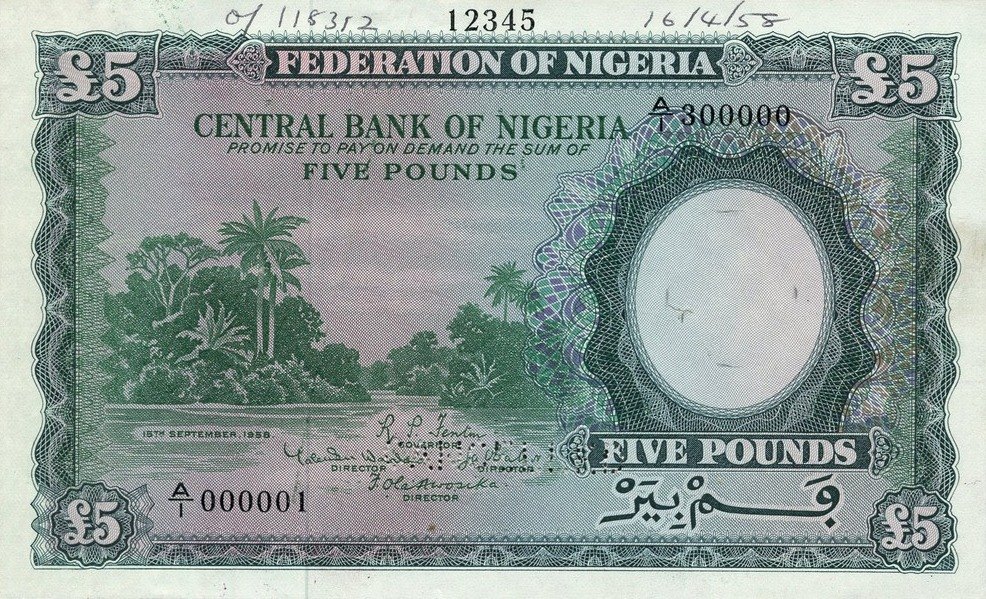
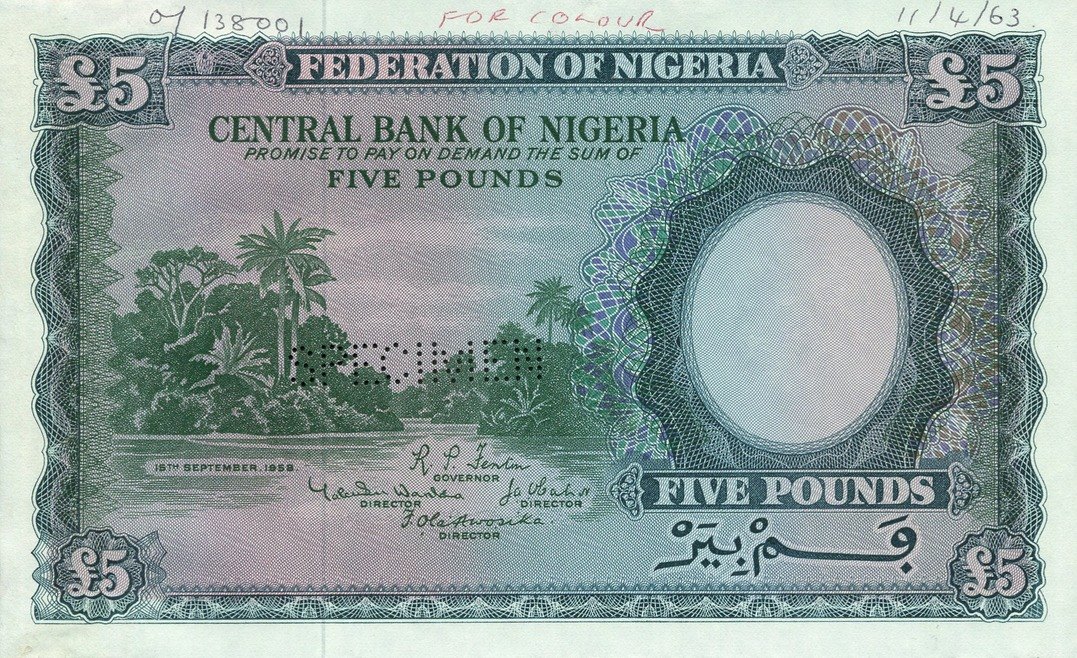
Stack's Bowers, on 2nd October 2025 (lot 50302), sold the four values as specimens on cardboard. Stack's says they appear to be specimens of each side printed on one side only and pasted to card, and that it could not be sure they were not printed on both sides.
A red proof of the back of the 1 pound, printed on one side only, was sold by Stack's Bowers on 16th August 2016 (lot 31535).
Sources mention specimens overprinted SAMFUR, the Hausa word for specimen. None has been seen.
The colour trials
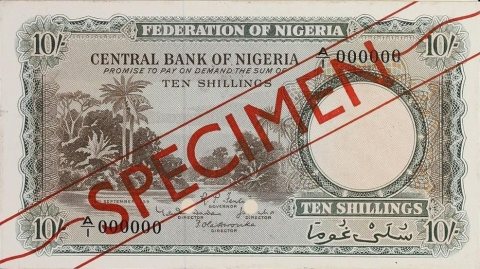
Each value is recorded as a colour trial specimen: the 5 shillings in brown with the prefix J/1, the 10 shillings in red with E/1, the 1 pound in blue with A/1 and the 5 pounds in green with A/1, all with an all-zero number, a red SPECIMEN overprint on front and back and two punch holes. Spink sold sets of the four on 15th July 2014 (lot 952), 8th July 2015 (lot 392), 29th September 2015 (lot 699) and 4th November 2020 (lot 369).
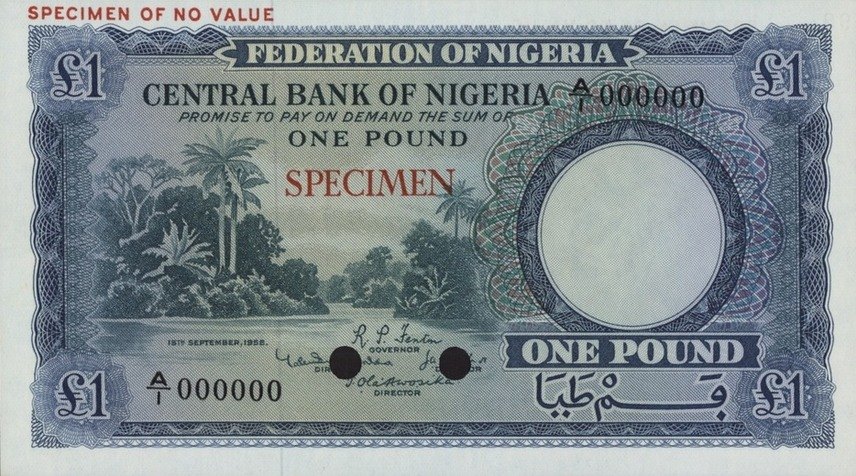
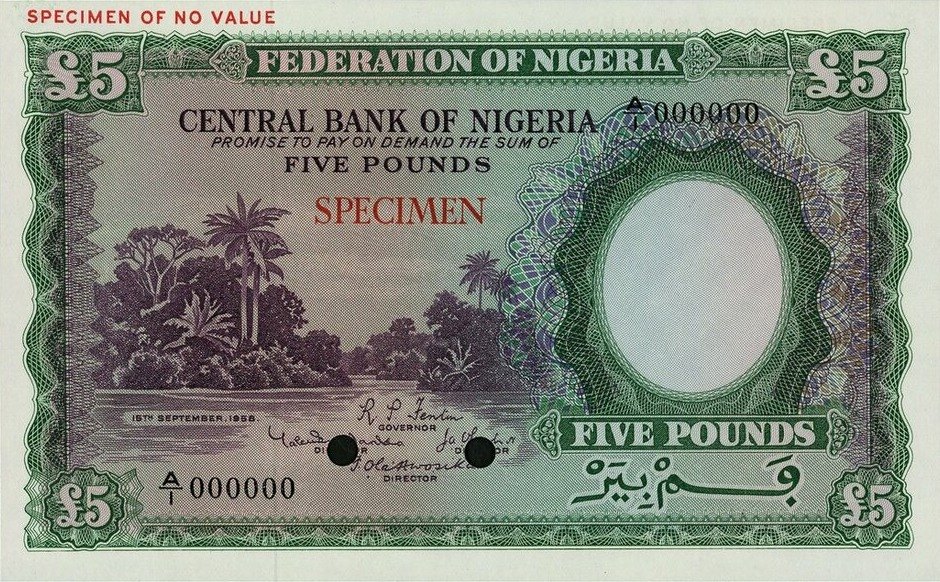
The colours tell a trial from the issued note. Heritage Auctions, on 11th September 2017 (lot 29851), says the trial of the 10 shillings is red where the issued note is green. Spink's description of a set of four specimens perforated SPECIMEN, sold on 29th June 2021 (lot 1610), gives their colours as purple for the 5 shillings, green for the 10 shillings, red for the 1 pound and blue and green for the 5 pounds. The houses do not always name a colour alike: Spink's description of 30th September 2014 (lot 1442) calls the 5 shillings specimen brown and the 5 pounds pale violet and green.
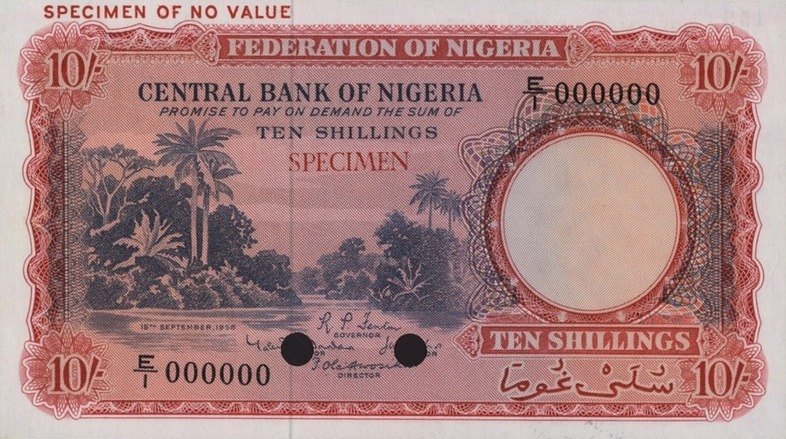
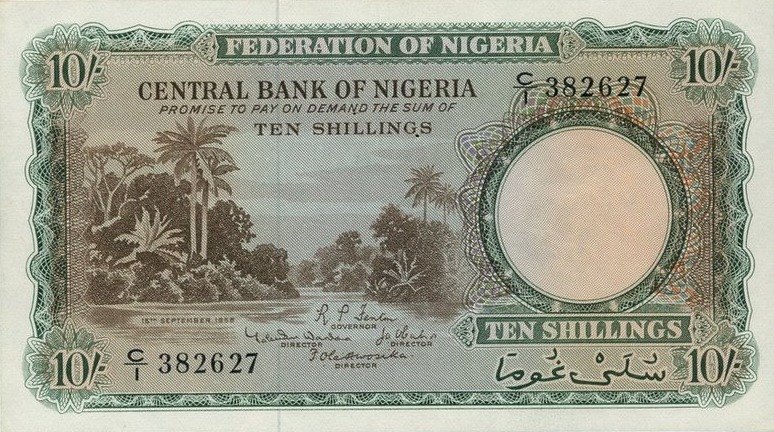
Corné Akkermans Auctions, in descriptions of 2013 to 2018, records two more marks on the trials: the words SPECIMEN OF NO VALUE in the upper left margin, and a black specimen number in the upper left margin of the back, a different number on each piece.
Heritage Auctions, on 30th April 2018 (lot 29219), places the two punch holes in the signature area.
After 1958
The notes were withdrawn in 1965, when the undated notes replaced them. Sources mention 22 January 1968 as the day they ceased to be legal tender. An article on Biafra in the I.B.N.S. Journal, volume 36, number 4 (page 30), says that new notes replaced the old between 3 and 22 January 1968; it does not name the series.
Two pieces sold by Spink on 30th September 2014 show the next designs being made. Spink describes lot 1444 as a composite essay on board for a 1 pound, which it dates 1962, with the river scene of the 1958 note on the front and a new back, and lot 1447 as a composite essay for a 5 pounds dated 1 January 1964 with the bank building on the front.
A painted essay headed BANK OF NIGERIA, of about 1960, is discussed in Central banks that never opened and in From the monarch to national figures.
What the sources do not give
- The number of notes printed of any value. The specimen ranges show the size of single printings, and no source adds them up.
- The day in 1965 on which the notes were withdrawn, and an official source for 22 January 1968.
- Why the notes are dated 15th September 1958.
- Anything on the printing in the official volumes read for the catalogue, which stop at the annual report for 1957.
Sources
- Nigeria annual report for 1957, chapter 4 and the list of publications.
- The Colonial Office List for 1960.
- I.B.N.S. Journal, volume 36, number 4, page 30.
- Spink, 15th July 2014, lot 952; 30th September 2014, lots 1442, 1444 and 1447; 8th July 2015, lot 392; 29th September 2015, lot 699; 8th December 2015, lot 429; 4th November 2020, lot 369; 29th June 2021, lot 1610.
- Heritage Auctions, 12th September 2016, lot 27891; 11th September 2017, lot 29851; 30th April 2018, lot 29219.
- Stack's Bowers, 16th August 2016, lot 31535; 2nd October 2025, lot 50302.
- Corné Akkermans Auctions, 3rd April 2013, lot 991; 21st September 2017, lots 781, 784, 785 and 790; 5th April 2018, lots 886 and 890.
Member comments
Log in or register to post a comment.