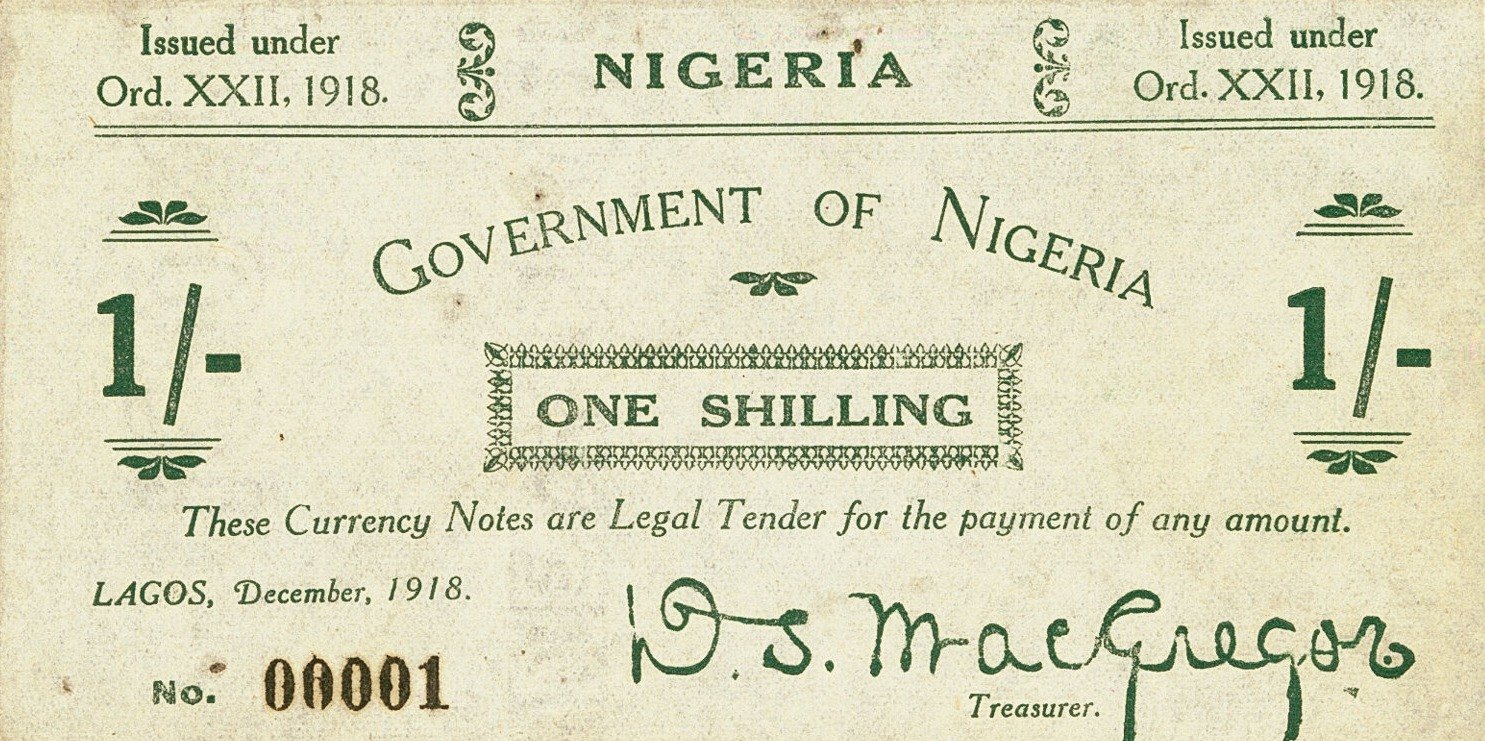
At the end of 1918 the Government of Nigeria put out three notes of its own: a 1 shilling, a 10 shillings and a 20 shillings. This article sets out what the official papers say of them: the Nigeria Handbooks of 1919 and 1922, the Nigeria Blue Books for 1919 to 1923 and the Colonial Office Lists. It adds what the auction houses have written when a note was sold, each as that house's own statement.
Paper money in Nigeria before December 1918
The notes of 1918 were not the first paper money in use in Nigeria. The notes of the West African Currency Board, dated 1916, were already current there; the Nigeria Handbook of 1919 says they were authorised in Nigeria by Ordinance No. 11 of 1916. Their story is told in The notes of the West African Currency Board, 1916 to 1962.
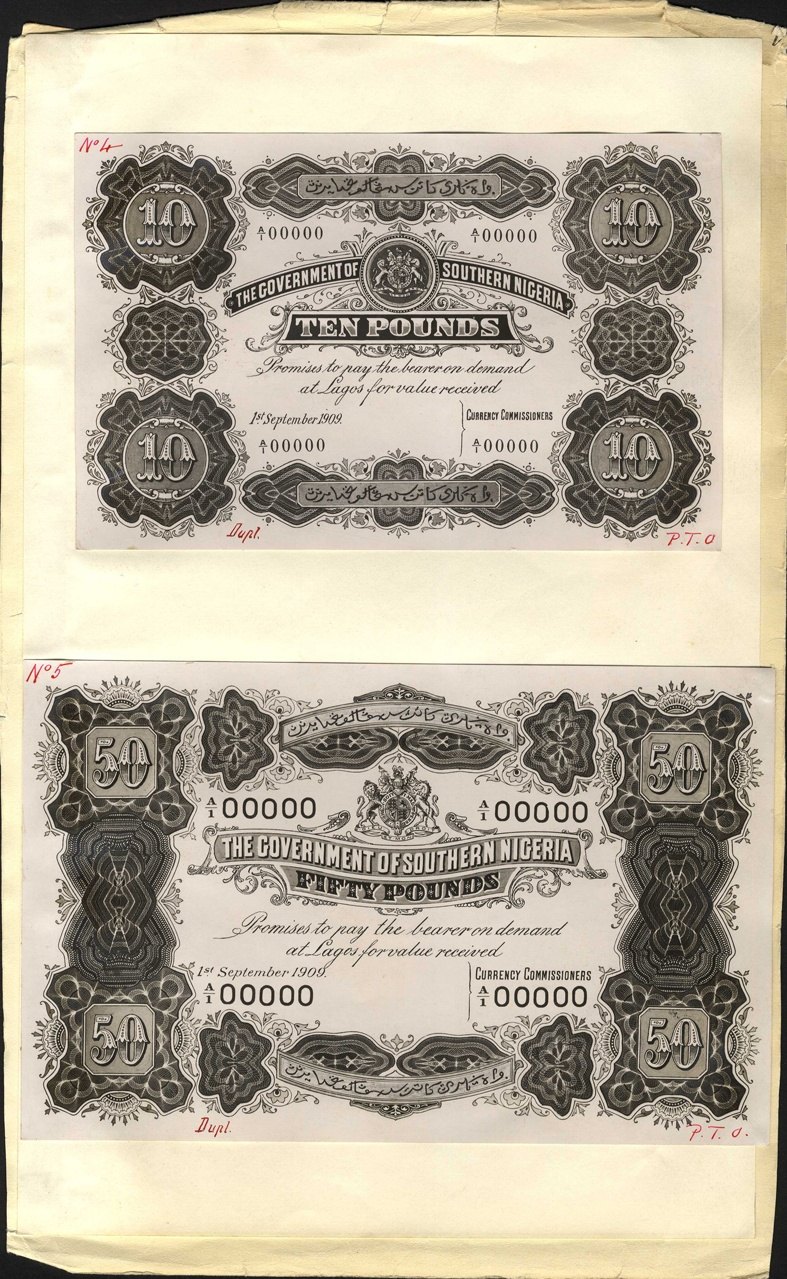
An earlier plan had come to nothing. Sources mention that notes had first been planned for Southern Nigeria alone, De La Rue sending designs for 10 shillings to 50 pounds dated 1st September 1909. An article by Sarangapani in the I.B.N.S. Journal, volume 56, number 4 (2017, pages 43 to 47), says the Governor, Egerton, proposed the notes in November 1907 and that De La Rue sent the designs on 22nd April 1909. An article in the I.B.N.S. Journal, volume 16, number 3 (page 151), says the plan was cancelled in 1910. The same article speaks of 10 shillings bearer notes of the Bank of Nigeria, issued for a few years before 1912 in Southern Nigeria, and says none is known to survive. The designs of 1909 are pictured and discussed in Values that were never issued.
The shortage of coin and Ordinance No. 22 of 1918
The Nigeria Handbook of 1919 (page 41) gives the reason for the issue in these words: "there occurred a serious shortage of currency at the end of the year and to meet this it became necessary to issue special local (Nigerian) notes of 20s., 10s., and 1s., of a total value of £73,900. These local notes were declared legal tender by Ordinance No. 22 of 1918." The causes the Handbook names are the difficulty of getting silver and nickel coin from England in 1918, and hoarding.
The notes themselves cite the Ordinance at their upper corners, as Ordinance XXII of 1918. The Handbooks index it as "Nigerian Currency Notes", No. 22 of 1918, and the Handbook of 1922 shows it still unamended. The Nigeria Blue Book for 1919, in its table of paper money in circulation, names them "Nigerian Notes. (20s., 10s., and 1s.) Ordinance No. 22 of 1918."
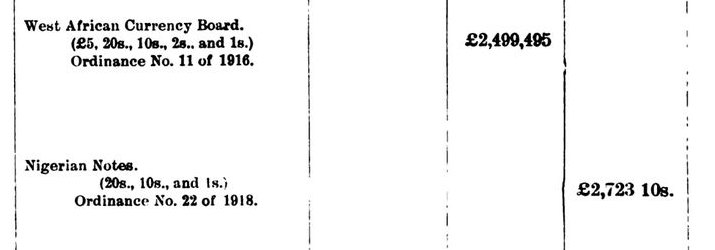
The figure of 73,900 pounds is the total of all three values together. No source read for the catalogue divides it between the 1 shilling, the 10 shillings and the 20 shillings, and none gives the number of notes printed.
The three notes
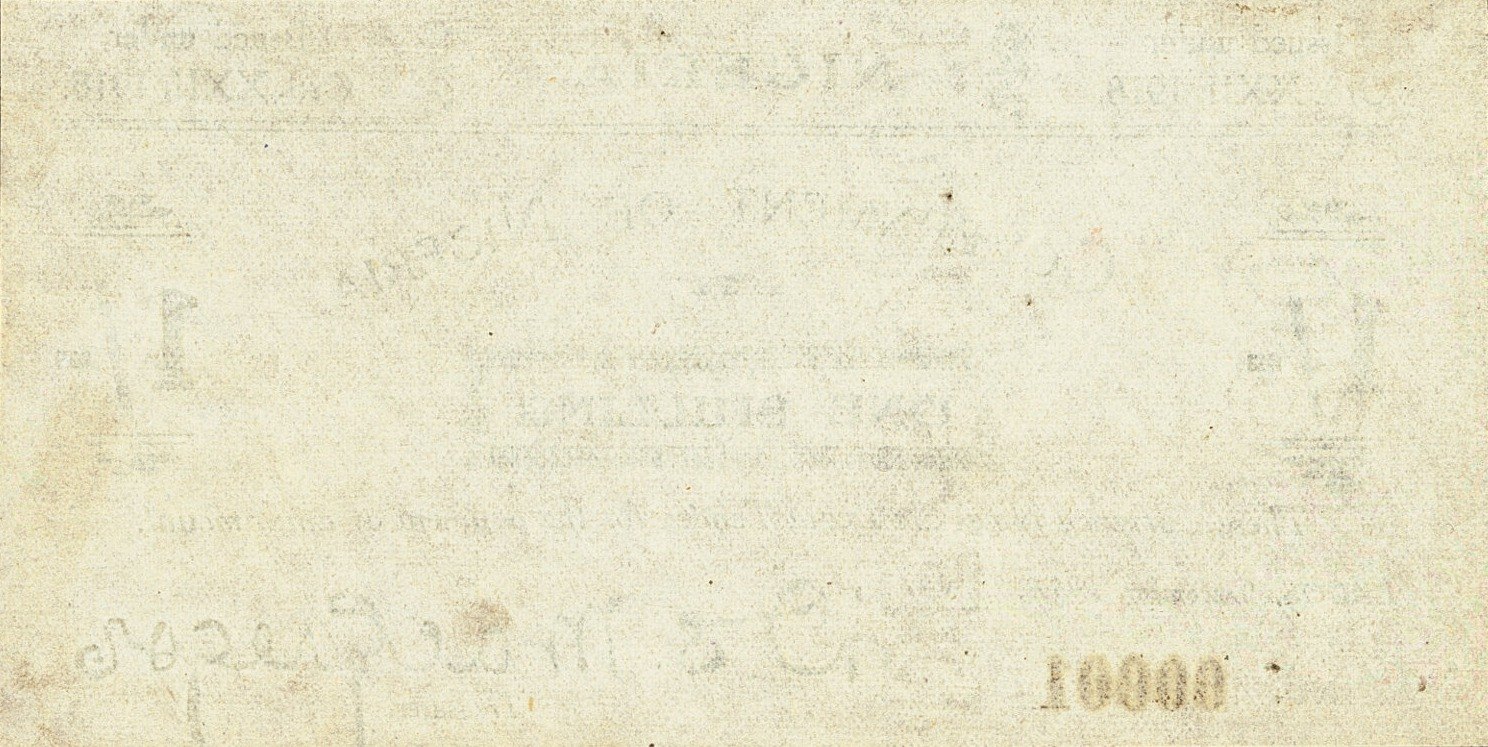
The notes were printed locally. They are uniface, on hand-cut paper, and are numbered without a prefix. The 1 shilling is green and measures 130 by 67 mm, the 10 shillings is red and measures 145 by 80 mm, and the 20 shillings is black and measures 157 by 80 mm. The catalogue records each value on one row, dated Lagos, December 1918. The printer is not known.
Sources mention the 10 shillings and picture two notes of it, and mention the 20 shillings and picture one. The pictures shown on the two pages are taken from The Banknote Book; that of the 10 shillings is of the note numbered 00001.
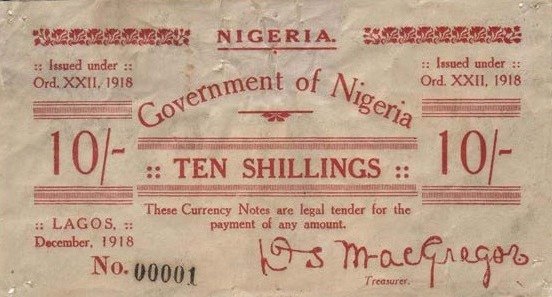
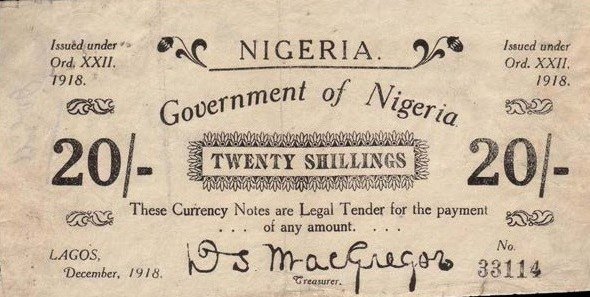
Stack's Bowers, describing a 1 shilling in its sale of 12th January 2017 (lot 1285), notes the large signature of the Treasurer, green ink on tan paper and black serial numbers.
D. S. MacGregor, Treasurer and Currency Officer
All three notes are signed by D. S. MacGregor as Treasurer. The Nigeria Blue Book for 1921 lists David Sliman MacGregor in the Civil Establishment as Treasurer from 27th May 1914, with 200 pounds a year as Currency Officer. The Colonial Office Lists for 1921 and 1923 give the same date in the record of service. MacGregor is still in the List for 1924 and is gone from that of 1925.
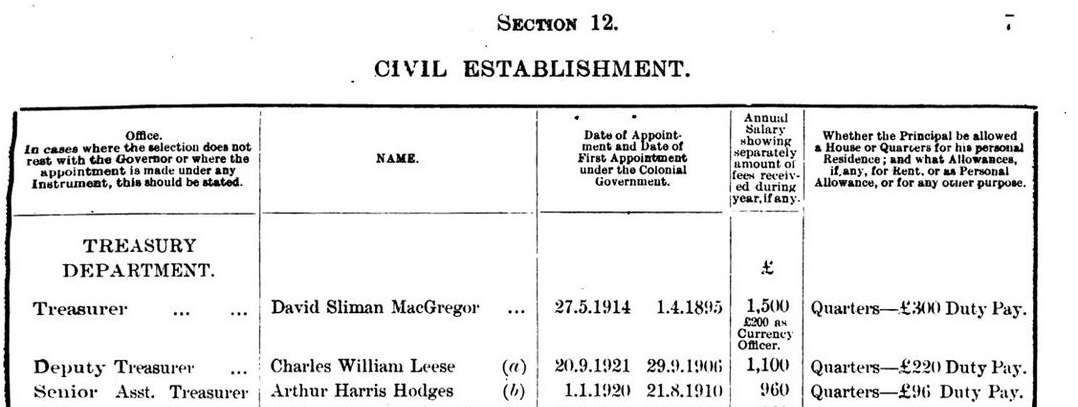
The second office was that of the West African Currency Board. The Nigeria Handbooks of 1919 and 1922 call the Treasurer the local Currency Officer of the Board, so the officer who signed Nigeria's own notes was also the Board's officer in Nigeria.
The Blue Book for 1919 notes an acting Treasurer, J. H. D. Bratt, from 20th September to 31st December 1919. That is after the date of the notes, and the catalogue records no note of those months.
What was still in circulation, 1919 to 1923
The Nigeria Handbook of 1922 (page 67) repeats the account of 1919 and adds: "Most have now been withdrawn." The Nigeria Blue Books give a figure for each year. Section 19 of each Blue Book, the estimated amount of paper money in circulation at the end of the year, has a line for these notes:
| End of year | Estimated in circulation |
|---|---|
| 1919 | 2,723 pounds 10s |
| 1920 | 1,476 pounds 10s |
| 1921 | 457 pounds 3s |
| 1922 | 400 pounds |
| 1923 | 300 pounds |
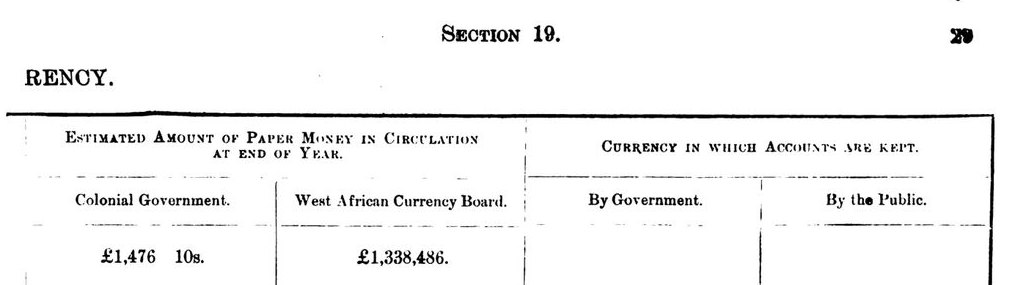
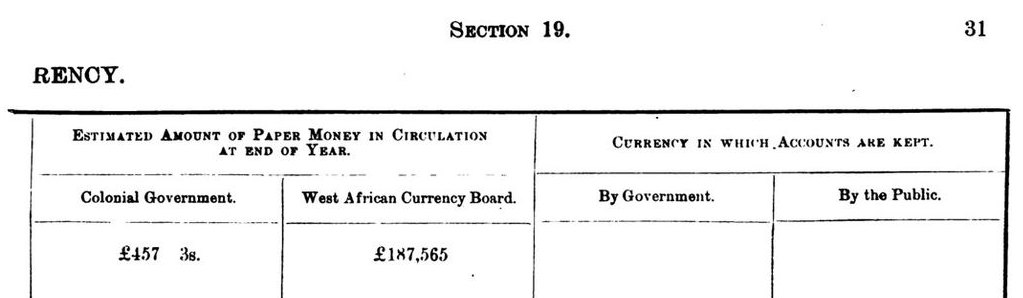
The Blue Books for 1922 and 1923 add that the notes were "being withdrawn from circulation".
The Blue Books carry a second line, in the Treasury's balance sheet, under the heading Nigerian Currency Notes. It stands at 6,200 pounds on 31st December 1919, at 425 pounds 14s on 31st March 1922 and at 350 pounds 9s on 31st March 1923. This is a liability in the Government's books, not an estimate of the notes in the hands of the public, and the two lines are not the same count.
An article in the I.B.N.S. Journal, volume 16, number 4 (page 224), gives the Blue Book figures for 1919, 1920 and 1921 as above, and then 400 pounds for each year from 1922 to 1925, as an estimate. The Blue Book for 1923 read for the catalogue has 300 pounds. No Blue Book after 1923 has been read for these notes, apart from that of 1938.
What the sale catalogues say
Only the 1 shilling has sale descriptions that tell anything of the issue. They are the houses' own statements.
- Heritage Auctions, selling a 1 shilling from the collection of Drs. Joanne and Edward Dauer on 24th April 2020 (lot 26161), said that five examples stood in the population report of the grading company PMG at the time.
- Heritage Auctions, on 28th March 2025 (lot 24406), sold the 1 shilling with serial number 1 and said that nine notes then stood in the same report. Heritage's description says the silver coin of British West Africa was being hoarded, that the coins of 3 pence, 6 pence, 1 shilling and 2 shillings were then struck in sterling silver, and that almost all of the notes circulated until they were unfit for use.
- Heritage Auctions, on 8th March 2024 (lot 24429), wrote that a sharp rise in the price of silver ended silver coinage in British West Africa in 1919 and that the higher values of coin were struck in brass from 1920.
- Stack's Bowers, on 8th May 2025 (lot 50447) and on 17th January 2026 (lot 31336), calls these notes the first paper money issued for Nigeria alone. Stack's gives the second of these notes as from the North of Sunset Collection.
- Heritage Auctions sold another 1 shilling on 5th January 2017 (lot 27734), which it gives as from the Alta California Collection.
What the sources do not give
- The day the notes were first issued. The catalogue dates them December 1918.
- The day they were withdrawn or ceased to be legal tender. The Handbook of 1922 says only that most had been withdrawn, and the Blue Books of 1922 and 1923 that they were being withdrawn.
- The printer, and the number printed of each value.
- Any picture of a note. None of the Handbooks, Blue Books or Colonial Office Lists read for the catalogue shows one.
Sources
- The Nigeria Handbook, 1919 (pages 40 and 41), and the Nigeria Handbook, 1922 (page 67).
- Nigeria Blue Books for 1919, 1920, 1921, 1922 and 1923: Section 19, estimated amount of paper money in circulation at the end of the year; the Treasury balance sheets; the Civil Establishment for 1921.
- The Colonial Office Lists for 1921, 1923, 1924 and 1925.
- Sarangapani, in the I.B.N.S. Journal, volume 56, number 4 (2017), pages 43 to 47; I.B.N.S. Journal, volume 16, number 3, page 151, and volume 16, number 4, page 224.
- The Banknote Book, for the pictures of the 10 shillings and the 20 shillings.
- Heritage Auctions, 5th January 2017, lot 27734; 24th April 2020, lot 26161; 8th March 2024, lot 24429; 28th March 2025, lot 24406.
- Stack's Bowers, 12th January 2017, lot 1285; 8th May 2025, lot 50447; 17th January 2026, lot 31336.
Member comments
Log in or register to post a comment.