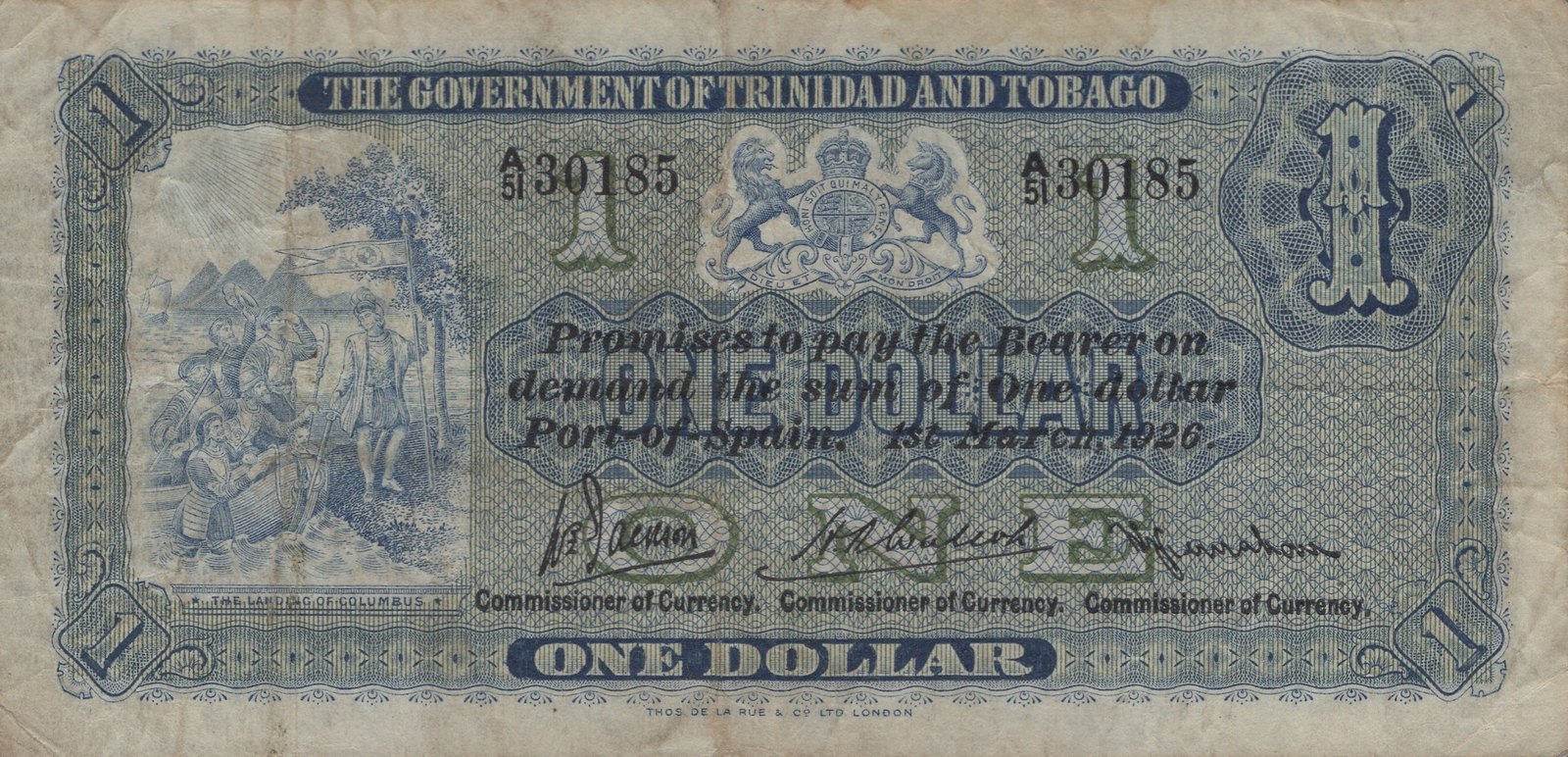
This article gathers in one place the figures for the Government notes of Trinidad and Tobago in circulation, from the first months of the issue in 1906 to the take-over by the British Caribbean Currency Board in 1951. They come from the colony's Blue Books, Year Books and annual reports, the Economic Surveys of the Colonial Empire, the Government Currency Notes Abstracts in the Royal Gazette and the Port of Spain Gazette, as read for the catalogue. Each figure is given as its source prints it, in dollars or in pounds; none is converted or added up here. For each, the table says whether it was read on a page image or only in the machine-read text of a scan.
What the figures are
Every source gives a value, never a number of notes, and none splits the 1 dollar from the 2 dollars. The one exception is the 1,000 dollars: from 1915 to 1922 the Blue Books give the part of the total held in that value, which is also a count of the notes. From the 1940s the reports give only the whole note circulation of the colony, and they do not always say whether bank notes are in it.
1906 to 1913: the first years
| Date | Notes in circulation | Other figures | Source | Read on |
|---|---|---|---|---|
| 10th July 1906 | 348,480 dollars | Government Currency Notes Abstract, as reprinted in the Port of Spain Gazette | text | |
| 10th September 1906 | 348,960 dollars | coin held for the Note Guarantee Fund 233,760 dollars; securities 116,200 dollars | the same | text |
| 10th November 1906 | 360,960 dollars | coin and securities partly unreadable | the same | text |
| June 1910 | 528,960 dollars | coin reserve 276,480 dollars | Port of Spain Gazette, 21st June 1910, from the Royal Gazette statement | text |
The Port of Spain Gazette of 21st June 1910 adds that the coin reserve was close to one half of the issue, the least the Ordinance allowed, and that the rest was invested in Transvaal, Straits Settlements and Nigeria stocks and in Consols.
1914 to 1925: the Blue Books, with the 1,000 dollars
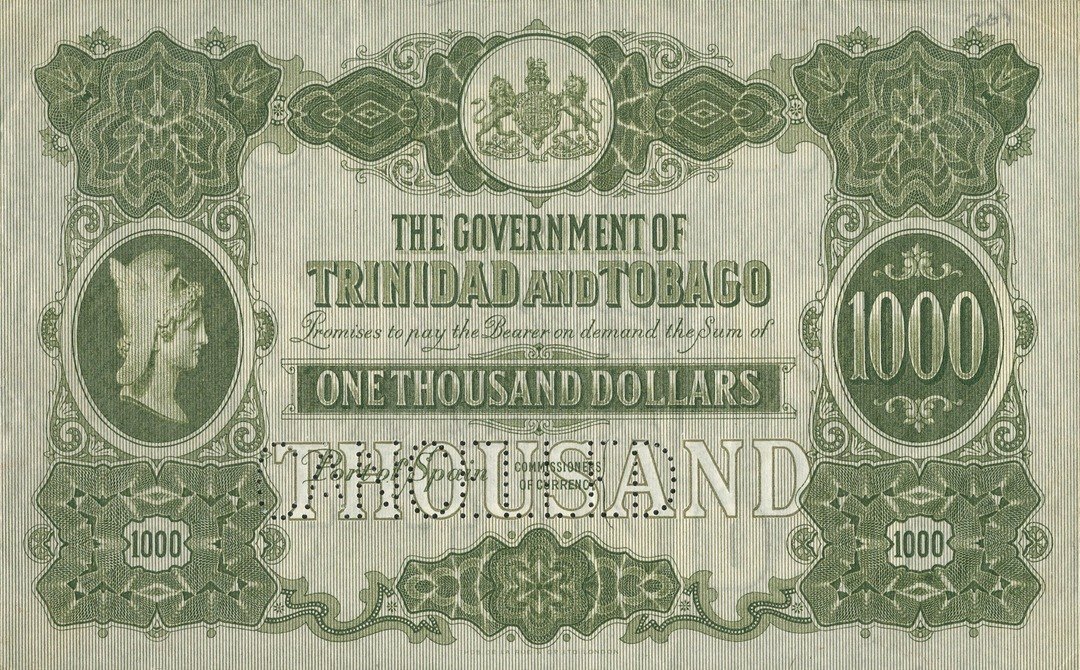
The Blue Books of these years print the same sentence each year under Currency: the Government began to issue the 1 and 2 dollars on 1st February 1906, the first 1,000 dollars on 12th June 1914, and then the total at the end of the year with the part in 1,000 dollar notes. The figures for 1920, 1921, 1922 and 1925 were checked here on the page cuts of the record.
| Date | Government notes in circulation | Of which in 1,000 dollar notes | Source | Read on |
|---|---|---|---|---|
| 31st March 1914 | 576,960 dollars | none yet | Blue Book 1913 to 1914, p. 455 | image |
| 31st December 1915 | 689,800 dollars | 202,000 dollars | Blue Book 1915, p. 275 | text |
| 31st December 1916 | 822,040 dollars | 302,000 dollars | Blue Book 1916, p. 521 | image |
| 31st December 1917 | 846,040 dollars | 341,000 dollars | Blue Book 1917, p. 533 | image |
| 31st December 1918 | 891,040 dollars | 225,000 dollars | Blue Book 1918, p. 551 | image |
| 31st December 1919 | 1,000,040 dollars | 151,000 dollars | Blue Book 1919, p. 537 | image |
| 31st December 1920 | 1,450,040 dollars | 491,000 dollars | Blue Book 1920, p. 348 | image |
| 31st December 1921 | 862,040 dollars | 119,000 dollars | Blue Book 1921, p. 350 | image |
| 31st December 1922 | 716,040 dollars | 89,000 dollars | Blue Book 1922, p. 346 | image |
| 31st December 1925 | 587,000 dollars | not stated | Blue Book 1925, p. 390 | image |

Other sources give figures for the same years:
- The Port of Spain Gazette of 22nd July 1916 gives about 750,000 dollars in circulation in the month to 10th July 1916, with 2,483,525 dollars issued to date and 1,453,325 dollars cancelled; the last digits of the first figure are garbled in the text, and the three do not agree with one another.
- The Auditor General's report for 1919, printed in the Port of Spain Gazette of 4th February 1921, gives 1,000,040 dollars on 31st December 1919, the Blue Book's figure, against 500,100 dollars of coin in the vault, 460,480 dollars in securities and 39,400 dollars in transit for investment (text only).
- The Year Book for 1921 notes that on 20th February 1920 Government notes of 40,000 dollars were delivered to the Colonial Bank, "making total now in circulation $1,078,040" (text only).
- The annual reports give sterling figures: 302,092 pounds for 1920 (para. 40, machine text only), 179,591 pounds 13 shillings 4 pence for 1921 (para. 29, read partly on the image and partly in the machine text, the foot of the page being cut), and 149,175 pounds on 31st December 1922 (report No. 1166, p. 9, para. 30, read on the image).
The 1,000 dollars was in real use: from 202 notes at the end of 1915 to 491 at the end of 1920, then down to 89 at the end of 1922. The Blue Book of 1925 no longer gives that part; the annual reports of 1924 to 1927 still name the 1,000 dollars among the Government notes. Its end in December 1934 is told in The first Government notes of Trinidad and Tobago, 1903 to 1936.

1924 to 1937: the annual reports and the Economic Surveys
| Date | Government notes in circulation | Source | Read on |
|---|---|---|---|
| 31st December 1924 | 147,290 pounds | Annual report for 1924 | image |
| 31st December 1925 | 105,625 pounds | Annual report for 1925, paras. 29 and 31 | image |
| 31st December 1926 | 122,292 pounds | Annual report for 1926, para. 43 | image |
| 31st December 1927 | 122,292 pounds, the same figure as 1926 | Annual report for 1927 | text |
| 1930 | 122,300 pounds | Annual report for 1930 | text |
| 31st December 1931 | 625,400 dollars, in notes of 1 and 2 dollars | Annual report for 1931, No. 1589 | image |
| 31st December 1932 | 525,440 dollars | Economic Survey of the Colonial Empire, 1932 | image |
| 31st December 1933 | 525,440 dollars | Economic Survey, 1933; annual report for 1933, chap. XI, p. 36 | image |
| 30th June 1935 | 525,440 dollars | Government Currency Notes Abstract, Royal Gazette of 8th August 1935, p. 949 | text |
| 31st December 1935 | 668,000 dollars, 1 and 2 dollars only | Economic Survey, 1935 | image |
| 31st December 1936 | 891,026 dollars | Annual report for 1936, chap. XI, para. 3 | image |
| 31st December 1937 | 945,720 dollars | Annual report for 1937 | text |
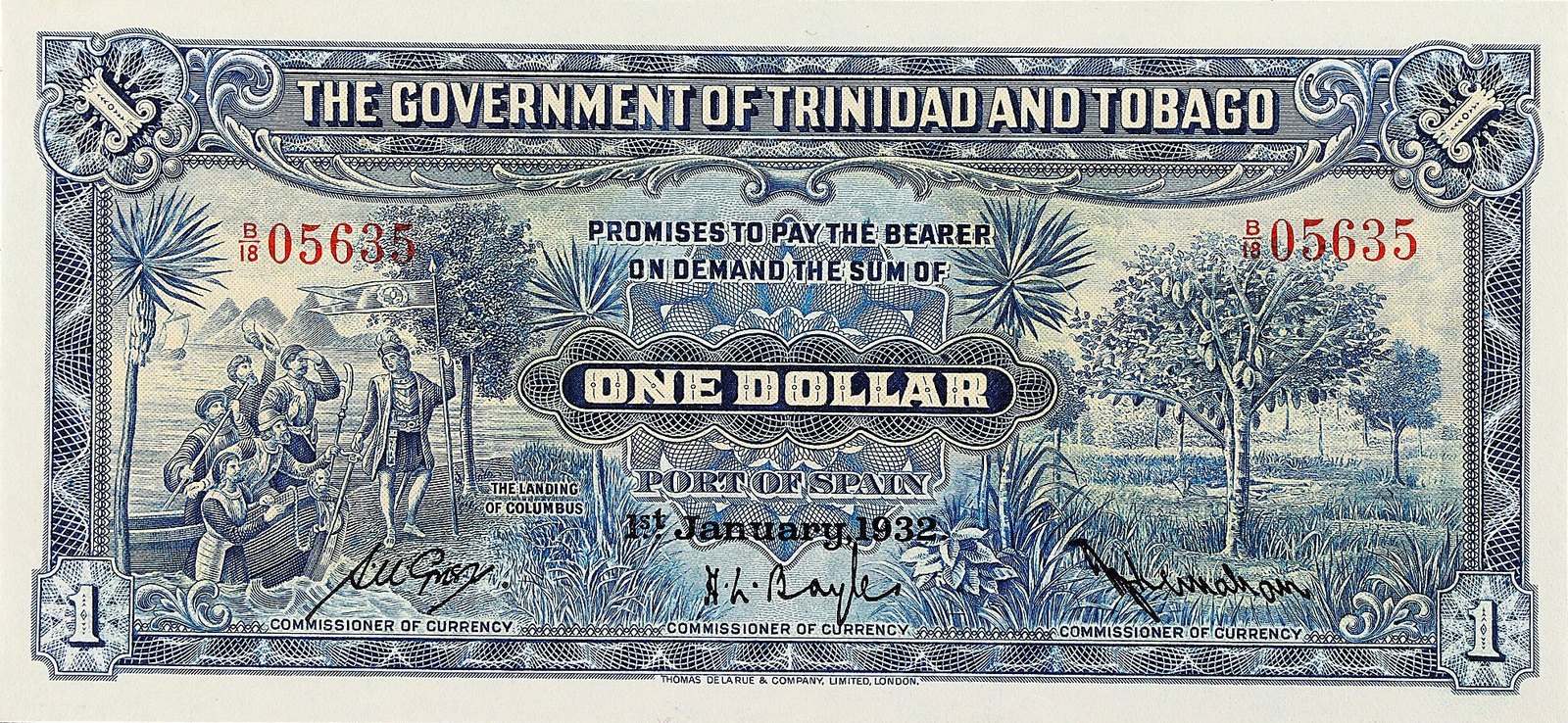
Three points about this table. The Economic Survey prints 525,440 dollars for both the end of 1932 and the end of 1933, so one edition may repeat the other; the annual report for 1933, read on the page image, also gives 525,440 dollars at 31st December 1933; the abstract of 30th June 1935, signed on 29th July 1935 by A. W. Seymour and Errol L. dos Santos as Commissioners of Currency, gives the same figure again, as read in the machine text, and the record does not say why. The Blue Books of 1930, 1931, 1932 and 1934 print the currency table sideways, and their machine text cannot be read; a figure of 920,440 dollars for the end of 1934 is no more than a guess from that text and is not used. The annual report for 1931 says the 5, 20 and 100 dollar notes were then left to the three commercial banks.
The fall from the peak of 1920 to the low of the early 1930s and the rise after 1935 are what the figures show; the sources do not give the reasons.
1944 to 1950: the whole note circulation
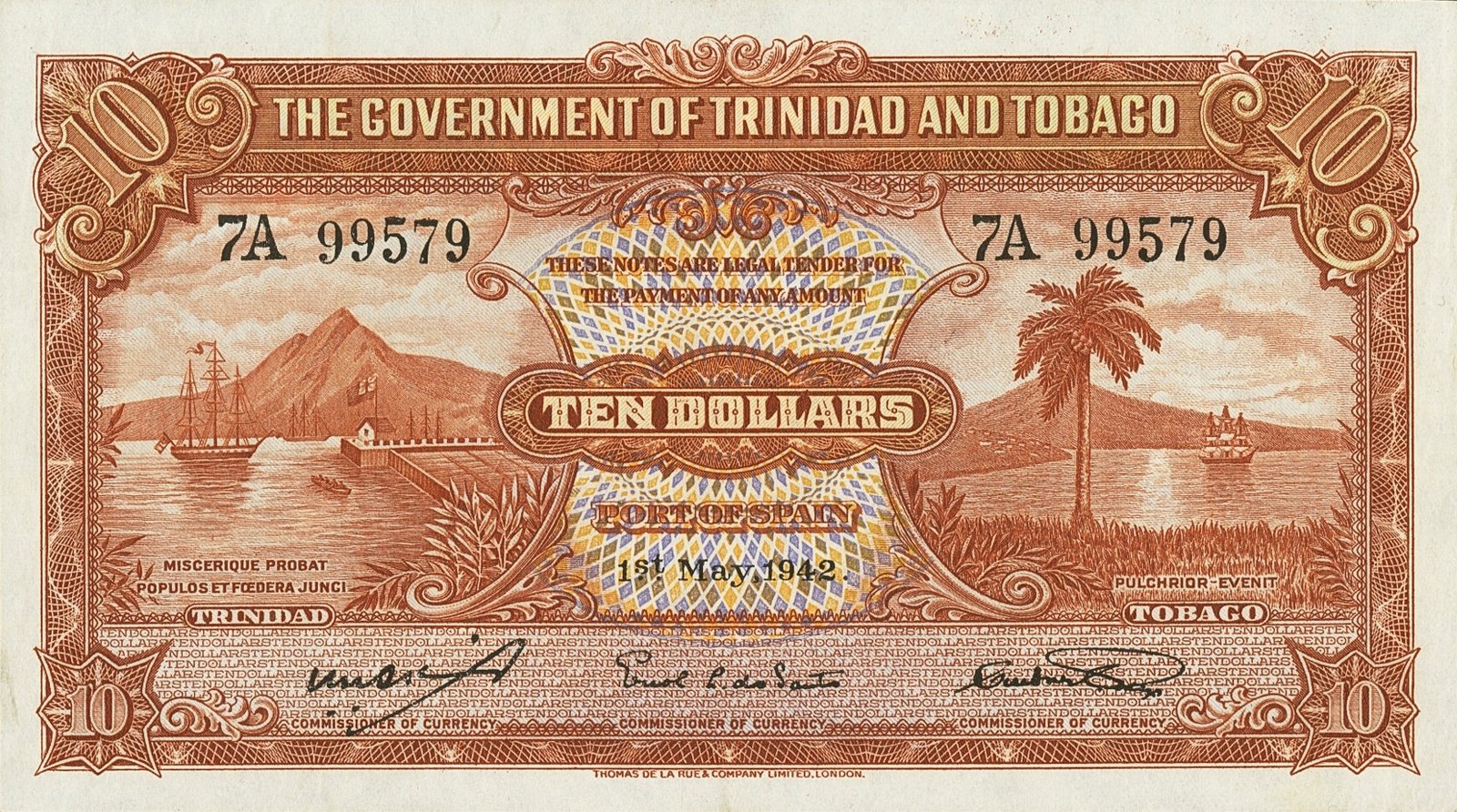
In the 1940s the Government issued the 5 dollars, 10 dollars and 20 dollars as well, and the figures are of another order. The sources of these years do not always make clear what they count.
| Date | Figure | What the source calls it | Source | Read on |
|---|---|---|---|---|
| 2nd November 1944 | 22,597,000 dollars | "currency notes in circulation" | Year Book of 1945, local events | text |
| End of 1946 | 22,199 thousand dollars | Government notes | Economic Survey of the Colonial Territories, 1951, vol. IV | text |
| End of 1947 | 19,499 thousand dollars | Government notes | Economic Survey, 1951, vol. IV | text |
| 31st December 1947 | 19,494,591 dollars | total currency circulation | Annual report for 1947 (the machine text has a stray figure at the end) | text |
| End of 1948 | 17,999 thousand dollars | Government notes | Economic Survey, 1951, vol. IV | text |
| 31st December 1948 | 17,994,647 dollars | all notes | Annual report for 1948 | image |
| End of 1949 | 18,399 thousand dollars | Government notes | Economic Survey, 1951, vol. IV | text |
| 31st December 1949 | 18,399,234 dollars | total currency circulation | Annual report for 1949 | image |
| End of 1950 | 21,369 thousand dollars | Government notes | Economic Survey, 1951, vol. IV | text |
| 31st December 1950 | 22,171,000 dollars | total currency circulation | Annual report for 1950 | image |
The Economic Survey's table, in thousands of dollars, also gives the bank notes and a total for each year: bank notes 824, 506, 943, 1,213 and 802, and totals 23,023, 20,005, 18,942, 19,612 and 22,171, for 1946 to 1950. Its total for 1950 is the annual report's figure for that year, while for 1949 the annual report's "total currency circulation" is the Survey's figure for the Government notes alone; neither source explains the difference.
The Year Books of 1944, 1945 and 1948 list the notes then passing in the colony: Government notes of 1, 2, 5, 10, 20 and 100 dollars, bank notes of 5, 20 and 100 dollars, and the British 1 pound and 10 shilling notes at 4 dollars 80 cents and 2 dollars 40 cents. The annual reports for 1946 and 1947 name only the 1 to 20 dollars among the Government notes, and add that British Guiana and Barbados notes were also legal tender. No issued 100 dollars of 1943 is recorded; the catalogue's page gives it as known only from specimens.
The British Caribbean Currency Board took over 23,599,252 dollars of Trinidad and Tobago Government notes on 1st August 1951. In the table of its report for 1962 the take-over column for Grenada, St Vincent, St Lucia, Dominica, Antigua, St Kitts and Montserrat reads "included in Trinidad and Tobago", and the report says the figure included the circulation of the Leeward and Windward Islands: Trinidad notes had been legal tender in Grenada from 1935 and in St Lucia and St Vincent from 1936. What became of them is in The Trinidad and Tobago Government notes after 1951.
What the figures do not tell
- How many 1 dollar or 2 dollar notes were printed, issued or out in any year before 1951.
- The figures of the half-yearly abstracts of 1935 to 1951 in the Royal Gazette: they were seen for the catalogue but their totals were not copied into the record.
- The Blue Book figures for 1923, 1924 and 1926 to 1934, which are either not held or not readable.
- Whether the totals of the 1940s include bank notes, where the source does not say.
Sources
- Blue Books of Trinidad and Tobago, 1913 to 1914, 1915 to 1922 and 1925, section V, Currency.
- Annual reports (Colonial Reports, Annual) on Trinidad and Tobago for 1920, 1921, 1922 (No. 1166), 1924 to 1927, 1930, 1931 (No. 1589), 1933, 1936, 1937 and 1946 to 1950.
- Economic Survey of the Colonial Empire, editions for 1932, 1933 and 1935; An Economic Survey of the Colonial Territories 1951, vol. IV.
- Year Books of Trinidad and Tobago for 1921, 1944, 1945 and 1948.
- Royal Gazette, 8th August 1935, p. 949: Government Currency Notes Abstract for 30th June 1935.
- Port of Spain Gazette: the abstracts of 1906 as reprinted; 21st June 1910; 22nd July 1916; 4th February 1921 (the Auditor General's report for 1919).
- Report of the Executive Commissioner of the British Caribbean Currency Board for 1962.


Member comments
Log in or register to post a comment.