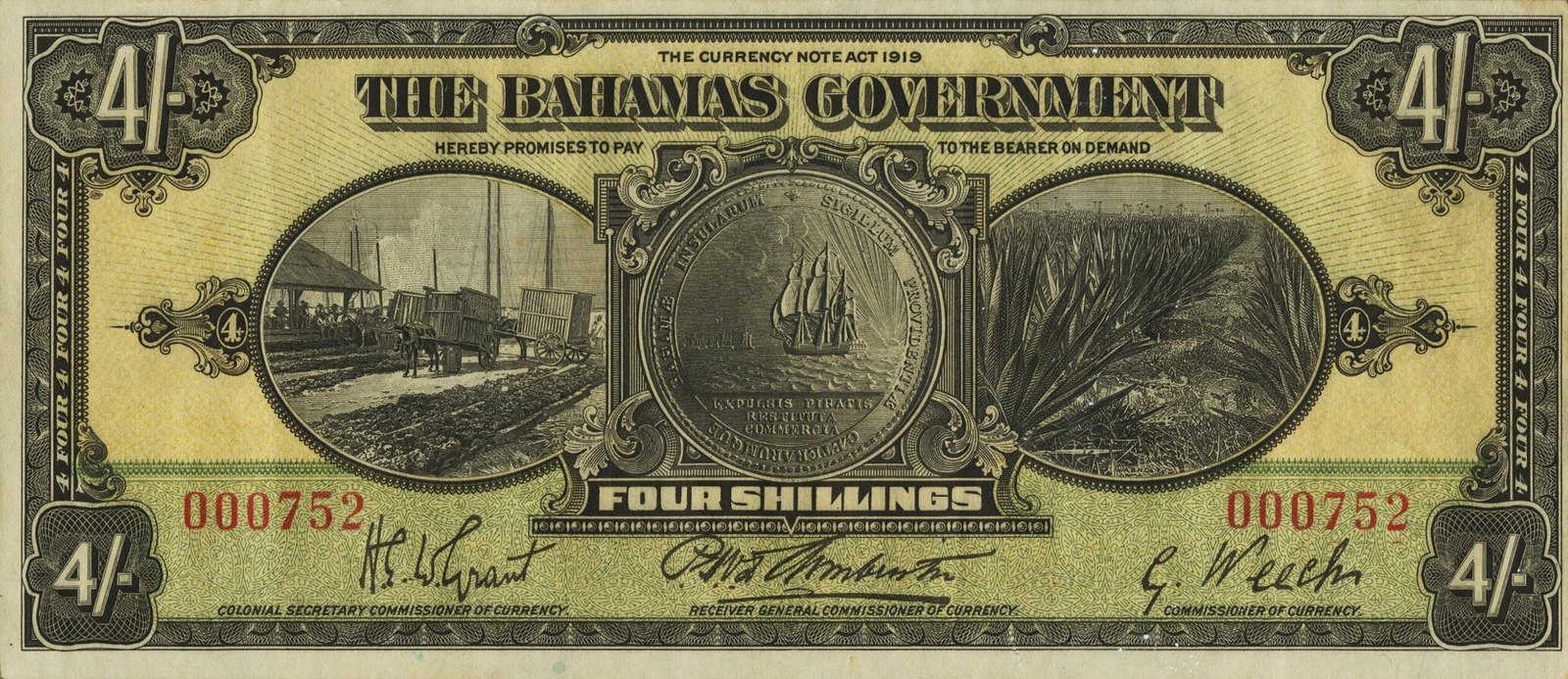
The catalogue's pages for the Bahamas begin with the Government's notes under the Currency Note Act 1919. This article sets out what came before them: two short issues of Treasury notes, about 1841 and in 1868 to 1869, and the notes of the Bank of Nassau from 1888 to 1917. It rests on the yearly reports on the colonies, the Bahamas Blue Books, Robert Chalmers's History of Currency in the British Colonies of 1893, the Government's notices in the Nassau Guardian, Samuel L. Smith's study of the Treasury notes in the I.B.N.S. Journal, and the old sale catalogues that offered the bank's specimens. None of these notes has a page in the catalogue.
Treasury notes for small sums, about 1841
The earliest paper is known here from one sentence. The Reports showing the Present State of Her Majesty's Colonial Possessions for 1847, printed in 1848, say under the revenue and expenditure of the Bahamas that the surpluses of 1844, 1845 and 1846, 5,000 pounds in the three years, were spent in redeeming "an issue of Treasury notes for small sums, which appear to have been put in circulation in 1841". All were paid off but 14 pounds, which was then ordered to be paid.
The report gives no values, no form of the notes and no law. The words "appear to have been" are the report's own.
The Treasury notes of 1868 and 1869
Samuel L. Smith told the story of the second issue in "Bahamas Government Treasury Notes of 1868-1869", I.B.N.S. Journal, volume 16, number 4, pages 212 to 218; the cover of that number carries the year 1978. Smith's notes cite Paul Albury's The Story of the Bahamas, the Governor's despatches of 1868 and 1869, the minutes of the Executive Council of 1868 and the Blue Books of 1868 to 1875. What follows is Smith's account, read in the text of the journal; the scan itself is no longer on this computer.
Why they were made
The blockade running of the American Civil War brought the colony a boom, which ended in the middle of 1865. In 1866 came the hurricane that was afterwards called the Great Bahama Hurricane. The Governor, Rawson W. Rawson, proposed to London an issue of legal tender notes secured by specie in the Public Bank. In March 1867 the Secretary of State told the Governor to withdraw the measure and allowed the colony to raise money by debentures. By late June 1868 gold and silver were draining from the colony and the local bank had called for the repayment of debentures. The Governor and the Executive Council pressed London again, and pointed to the note issues of Canada and Mauritius.
Towards the end of August 1868 a bill for an issue of currency was brought into the Assembly through the Attorney General. Members added long provisions for retrenchment, and the bill died.
The order of 17th October 1868
On 17th October 1868, after the Assembly had adjourned, the Governor in Council resolved unanimously to issue notes of 1 pound and 5 pounds for the payment of public officers. The resolution called for 5,000 notes of 1 pound printed in blue and 1,000 notes of 5 pounds printed in red. In despatch No. 173 of the same day to the Duke of Buckingham and Chandos, the Secretary of State, the Governor enclosed a hand-drawn facsimile of the 5 pounds, which had been ordered to be lithographed by the Major and Knapp Engraving, Manufacturing and Lithography Company of New York, as the journal's text names it. The notes bore interest at 6 per cent a year and were receivable in payment of duties and taxes.
The provisional certificates printed in Nassau
The Executive Council expected the notes from New York to come late. On 23rd October 1868 it settled the form and wording of provisional certificates to be printed in Nassau. When salaries fell due at the beginning of November, 951 pounds of these certificates were issued. They were "Receivable for Duties at the Public Treasury" but had no standing as legal tender at the Public Bank.
Issue, the end of the interest and the stop
The first notes lithographed by Major and Knapp were issued in December 1868. Smith writes that contractors and other creditors of the Government, as well as public servants, were then willing to take them.
At the end of December 1868 Earl Granville followed the Duke of Buckingham and Chandos as Secretary of State, and in January 1869 James Walker followed Rawson as Governor. From 1st February 1869 any note issued to a civil servant had the words on legal interest struck out. At the Executive Council of 12th February 1869 a confidential despatch from Earl Granville was read that forbade any further issue. In all, 2,000 pounds of Treasury notes had been issued under Governor Rawson's order.
Redemption, 1869 to 1875
| Date | What Smith found in the Blue Books |
|---|---|
| 1868, 1869 and 1870 | no record of the rate of redemption |
| 31st December 1871 | 300 pounds outstanding |
| 1872 | records not available to Smith |
| End of 1873 | 8 pounds unredeemed |
| 1874 | one note of 1 pound redeemed |
| 1875 | the remaining 7 pounds redeemed |
The Reports on the Colonial Possessions for 1869-70 print Governor Walker's speech at the opening of the Legislature (page 64), which says that the "Treasury notes, as they were called, have been nearly all cancelled". The speech gives no amount and does not describe the paper it means.
What survived, as Smith counted it
Smith pictured two sets of the notes from private collections. Among them are a 5 pounds numbered A/B 0144, with the reckoning of interest on its back, and the 1 pound numbered H/K 0850, which Smith identifies as the single note redeemed in 1874. Smith knew of a third set in private hands and of a pair in the collection of the Central Bank of the Bahamas, and wrote that all three private sets had come from one source about twenty years earlier. A printer's proof of the 5 pounds was offered in Spink's Bank Note Quarterly of winter 1976. The hand-drawn form of the 5 pounds and a provisional certificate of 1 pound of November 1868 were in the Bahamas Archives.
Smith remarks that almost half a century passed, until 1920, before the Government of the Bahamas circulated currency again.
The Bank of Nassau and its notes, 1888 to 1917
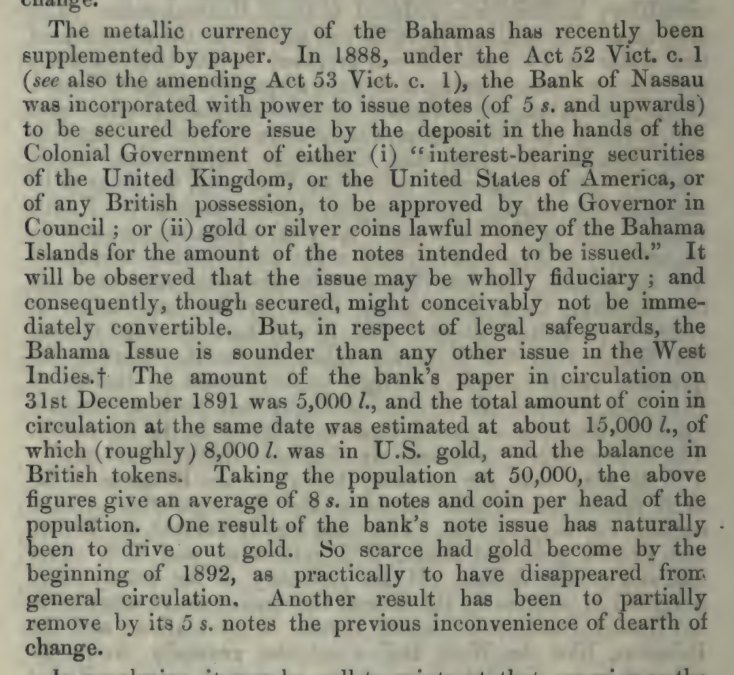
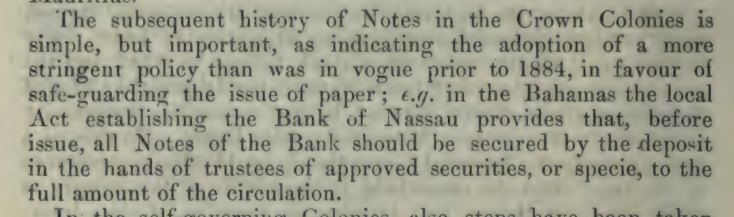
Chalmers's History of Currency in the British Colonies (1893, page 168) records that the Bank of Nassau was incorporated in 1888 under the Act 52 Vict. c. 1, with power to issue notes "of 5 s. and upwards". Before issue the notes had to be secured by a deposit with the Colonial Government of interest-bearing securities or of gold or silver coin. The bank's paper in circulation on 31st December 1891 was 5,000 pounds. In an earlier chapter (page 36) Chalmers has the security deposited "in the hands of trustees". Both passages were read in the text of the book only.
The yearly reports and the Blue Books follow the bank from 1909.
| Year | Notes of the Bank of Nassau in circulation | Government paper | Source |
|---|---|---|---|
| 1909-10 | 6,500 pounds | Colonial Reports, Annual No. 650, paragraphs 10 and 11, page 6 | |
| 1911-12 | 6,500 pounds | none | Colonial Reports, Annual No. 741, page 7 |
| 1913, the year to 31st March 1914 | 6,500 pounds | Nil | Blue Book for 1913; the annual report for 1913-14 |
| 1915-16 | 6,500 pounds | Nil | Blue Book for 1915-16 |
| 1916-17 | the bank is no longer listed | Nil | Blue Book for 1916-17 |
| 1918-19 | no bank of issue listed | Nil | Blue Book for 1918-19 |
The report for 1909-10 says the bank had a paid-up capital of 10,000 pounds and deposits in the colony of 66,000 pounds, that it was established in 1888 and was doing business under the Banking Act of 1909, and that it "issues local notes of the values of £1 and four shillings". The report for 1913-14 puts the deposits at 74,066 pounds and calls the notes "fully secured". The Blue Book for 1913 names the two laws: 52 Vic. cap. 1 and 9 Edw. VII cap. 4. In the Blue Book for 1916-17 the Royal Bank of Canada is the only bank, with no note issue.
The values differ between the sources. Chalmers gives the notes as "of 5 s. and upwards" in 1893; the reports of 1909 to 1914 name notes of 1 pound and 4 shillings only. No official source read says when the 4 shillings came in or when the 5 shillings and the 10 shillings went out.
The same report for 1909-10 says that United States gold and silver certificates were not legal tender but were accepted, those of 5 dollars and upwards at the rate of United States gold and those below 5 dollars "at the rate of four shillings to the dollar". In 1920 the Government's own first notes included a 4 shillings. The reports do not say why that value was chosen. The paper of other issuers that passed in the colony is treated in Whose paper passed? Other people's notes in the colonies, 1909 to 1929.
The bank's notes as collectors have seen them
Brian Kemp, in "British West Indies", I.B.N.S. Journal, volume 15, number 1 (1976), page 12, writes that colour trials of the Bank of Nassau for 1 pound, 10 shillings and 5 shillings, all with a vignette of Queen Victoria, had lately come onto the market as trials for the first issue of 1888, and that Kemp had never seen an issued Bahamas note of before 1900. The back cover of the I.B.N.S. Journal, volume 14, number 1 (1975), pictures a Bank of Nassau 1 pound proof in brown dated 1888.
Three American sales of 1979 to 1982 offered the bank's specimens, as their catalogue texts read:
| Sale | Lots | What the house describes |
|---|---|---|
| NASCA, London Collection, second volume, 18th July 1979 | 2819 to 2821 in the text (the plate captions number them one lower) | 5 shillings and 10 shillings specimens punched "C. Skipper & East"; a 1 pound "unlisted in Pick" punched in the same way; a 4 shillings dated 1910 with the name Charles Skipper & East, punched SPECIMEN; lot 2825 adds a 5 shillings specimen in orange to a specimen set of eight dollar notes, "Pick-26 to 33" |
| NASCA, Stanley Gibbons Collection part II, 7th December 1981 | 111 to 123 | 5 shillings, 10 shillings and 1 pound specimens in several colours and 4 shillings specimens, punched "SPECIMEN C. SKIPPER & EAST"; one 1 pound described as a remainder |
| Herbert I. Melnick, Stanley Gibbons Collection part V, 20th December 1982 | 2040 to 2045 | a set of three and single specimens, punched "SPECIMEN C. SKIPPER & EAST" |
These are the houses' descriptions, read in the text of the catalogues; the scans are not on this computer. The sale of 1979 dates its 4 shillings 1910; the Banks Act of 1909 set 4 shillings as the lowest value. No source read says which printings were issued. None of these notes has been followed from sale to sale here.
The Banks Act of 1909
The Nassau Guardian of 28th August 1909 printed the list of the Acts of the session of 1909. Chapter 4, Banks, lets the banks named in its schedule issue notes until 21st November 1919 (the "twenty-" of the day is plain in the text of the page and faint on its image). The notes must be secured by a deposit of coin or security with the Treasurer of the Colony. The lowest value of a note is 4 shillings, and each note, besides the signatures of officers of the bank, must be countersigned by the Treasurer of the Colony. The names of the banks in the schedule cannot be read in the copy of the newspaper that was used. The Nassau Guardian of 21st July 1909 reports that the select committee's bill limited the note issue of each bank to ten thousand pounds.
The Currency Note Act that gave the Government its own notes is dated 18th December 1919. The banks' power to issue had run out on 21st November 1919.
The redemption of July 1917
The Bank of Nassau did not reach 1919. The Nassau Guardian of 7th July 1917 carries a notice under the Banks Act 1909, dated 3rd July 1917 and signed by P. W. D. Armbrister as Receiver General and Treasurer. By an Order in Council of 2nd July 1917 the securities held for the bank's note issue were realised for 6,500 pounds, the amount of the issue, and paid into "The Bank of Nassau Bank Note Redemption Account" at the Royal Bank of Canada. The notice reads: "the Treasurer is now prepared to redeem the Bank Notes of the Bank of Nassau and to pay in specie to any holder thereof the amount of any such Bank Note". The notes would no longer be taken in payment of any sum due to the Treasury or to a Government department. The same papers show that the bank had ceased business, that an interim receiver, Edwin Charles Moseley, had been appointed by an order of the Supreme Court of 18th December 1916, and that the Royal Bank of Canada bought the bank's assets.
The Royal Bank of Canada followed with a notice of its own, printed in the Nassau Guardian of 11th July 1917 and repeated on 14th and 18th July. Because the notes of the Bank of Nassau had been ordered to be redeemed, the Royal Bank would not accept them for deposit or in payment of any debt.
P. W. D. Armbrister, who signed the notice of redemption, signed the Government's first notes three years later. Those notes are the subject of The Bahamas Government's sterling notes, 1919 to 1966 and of The first Bahamas Government notes in the Nassau Guardian, 1920 to 1922.
What is not known
- The values, the form and the law of the Treasury notes of about 1841. Only the sentence of the report for 1847 is to hand.
- How many of the 5,000 notes of 1 pound and 1,000 notes of 5 pounds ordered in 1868 were delivered, and how the 2,000 pounds issued was divided between the two values and the provisional certificates. Smith gives the total only.
- How many notes of the Bank of Nassau were redeemed in 1917 and how many were never presented.
- Who printed the Bank of Nassau's notes. The specimens in the sales of 1979 to 1982 are punched with the name C. Skipper & East, but no official source read names the printer.
Sources
- Reports showing the Present State of Her Majesty's Colonial Possessions for 1847 (1848), Bahamas, Revenue and Expenditure; the same series for 1869-70 (1870), page 64. Both read in the text only.
- Samuel L. Smith, "Bahamas Government Treasury Notes of 1868-1869", I.B.N.S. Journal, volume 16, number 4 (cover dated 1978), pages 212 to 218.
- Robert Chalmers, A History of Currency in the British Colonies (1893), pages 36 and 168.
- Colonial Reports, Annual: No. 650, Bahamas 1909-10, page 6; No. 741, Bahamas 1911-12, page 7; Bahamas 1913-14.
- Bahamas Blue Books for 1913, 1915-16, 1916-17 and 1918-19, section on currency and banking.
- Nassau Guardian: 21st July 1909; 28th August 1909 (Acts of the session of 1909, Chapter 4, Banks); 7th July 1917 (notice of 3rd July 1917 under the Banks Act 1909); 11th, 14th and 18th July 1917 (notice of the Royal Bank of Canada).
- Brian Kemp, "British West Indies", I.B.N.S. Journal, volume 15, number 1 (1976), page 12; I.B.N.S. Journal, volume 14, number 1, back cover.
- NASCA, London Collection, second volume, 18th July 1979, lots 2819 to 2821; NASCA, Stanley Gibbons Collection part II, 7th December 1981, lots 111 to 123; Herbert I. Melnick, Stanley Gibbons Collection part V, 20th December 1982, lots 2040 to 2045.
Member comments
Log in or register to post a comment.