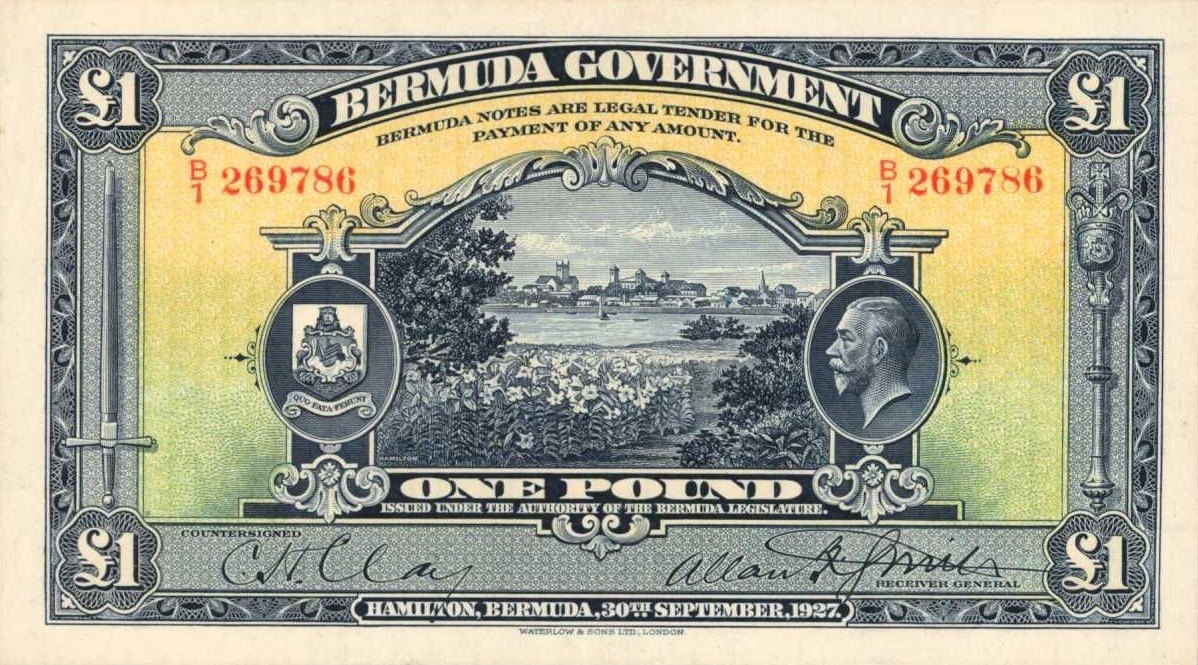
The pages of the Bermuda notes quote a handful of yearly figures, and Bermuda's Government notes, 1914 to 1936 gives those up to 1931. The volumes behind them hold a figure for nearly every year from 1917 to 1971. This article sets them out: the Bermuda Blue Books for 1918, 1920, 1921, 1944 and 1946 to 1948, the Colonial Office annual reports on Bermuda from 1912 to 1957-58, the Bermuda Reports from 1959 to 1971 and An Economic Survey of the Colonial Territories, 1951.
One caution applies to every table. Some volumes were read on an image of the printed page and some only in machine-made text, where a digit can be lost. The last column of each table says which.
Before the Government's notes
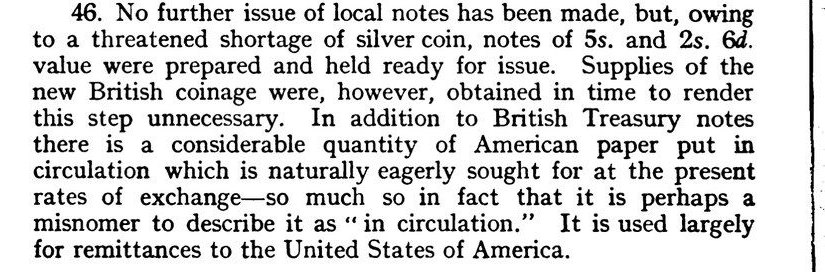
The annual report on Bermuda for 1912 says that the paper money in use was "a limited number of Bank of England notes" and, in the winter, a large amount of United States notes. It names two local banks, the Bank of Bermuda, Limited, and the Bank of N. T. Butterfield and Son, Limited, and does not say that either issued notes. A report on 1914 says the same of the paper money in use. The Blue Books for 1918, 1920 and 1921 put it in one word under private banks' notes: none.
The wartime pound, 1917 to 1928
The 1 pound of 1914 is the only note the reports and balance sheets count to the end of 1928. The reports call it an "inconvertible" note and carry it among the liabilities of the Colony, with a fund of investments held as surety.
| End of year | Wartime 1 pound notes | Fund held against them | Source | Read |
|---|---|---|---|---|
| 1917 | 10,000 pounds put out in the year | 10,000 pounds invested in 1917 "towards redemption of Bermuda Government Notes" | Blue Book for 1918, comparative statement of revenue and expenditure | text |
| 1918 | 28,000 pounds, "Act 5 of 1915"; "No issue of notes in 1918" | not given | Blue Book for 1918 | text |
| 1920 | 28,000 pounds | 35,623 pounds nominal | annual report for 1920, p. 9; Blue Book for 1920 | image (report); text (Blue Book) |
| 1921 | 28,000 pounds | 37,366 pounds nominal | annual report for 1921, p. 7; Blue Book for 1921 | image (report); text (Blue Book) |
| 1922 | 28,000 pounds | 38,995 pounds nominal | annual report for 1922 (No. 1167), p. 8 | image |
| 1923 | 28,000 pounds | stock of 41,076 pounds 17 shillings 3 pence nominal under the Government Notes Redemption Act, 1915 | annual report for 1923, p. 6 | image |
| 1924 | 28,000 pounds | stock of 43,317 pounds 10 shillings 1 penny | annual report for 1924 | text |
| 1925 | no count of notes; liabilities "on account of" the notes 36,783 pounds 10 shillings 11 pence | not given | annual report for 1925, p. 6 | image |
| 1926 | 38,000 pounds | not given | annual report for 1926, p. 6, balance sheet | image |
| 1927 | 38,000 pounds "out of a total of £40,000 authorized by law" | 47,886 pounds on 1st January 1927; 50,378 pounds at the end of 1927 | annual report for 1927, pp. 5 and 6 | image |
| 1928 | 38,000 pounds, and 2,000 pounds "issued 1928" | not given | annual report for 1928, pp. 6 and 7, balance sheet | text |
Three things in this table need a word.
The figure of 28,000 pounds does not move in seven years. In the three Blue Books it stands in a column headed "Estimated Amount of Paper Money in circulation", so it may be a standing figure and not a new count each year.
The 1925 figure is a total of liabilities, not a count of notes, and no report explains how the amount rose from 28,000 pounds to 38,000 pounds between 1924 and 1926.
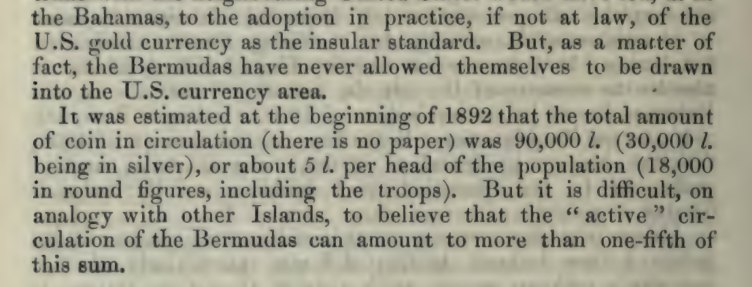
The balance sheet for 1928 shows the 38,000 pounds and a further 2,000 pounds "issued 1928"; the law allowed 40,000 pounds. The balance sheet does not say whether those notes were of the wartime design or of the new one. The report for 1927 says that notes of a new design to the nominal value of 150,000 pounds were ordered in London during that year "to replace the existing stock, which was manufactured in the United States in wartime, and to provide for exchanging old and defaced notes". The catalogue gives the printer of the wartime pound as the American Bank Note Company in Ottawa, and a back proof of the note carries the Ottawa imprint.
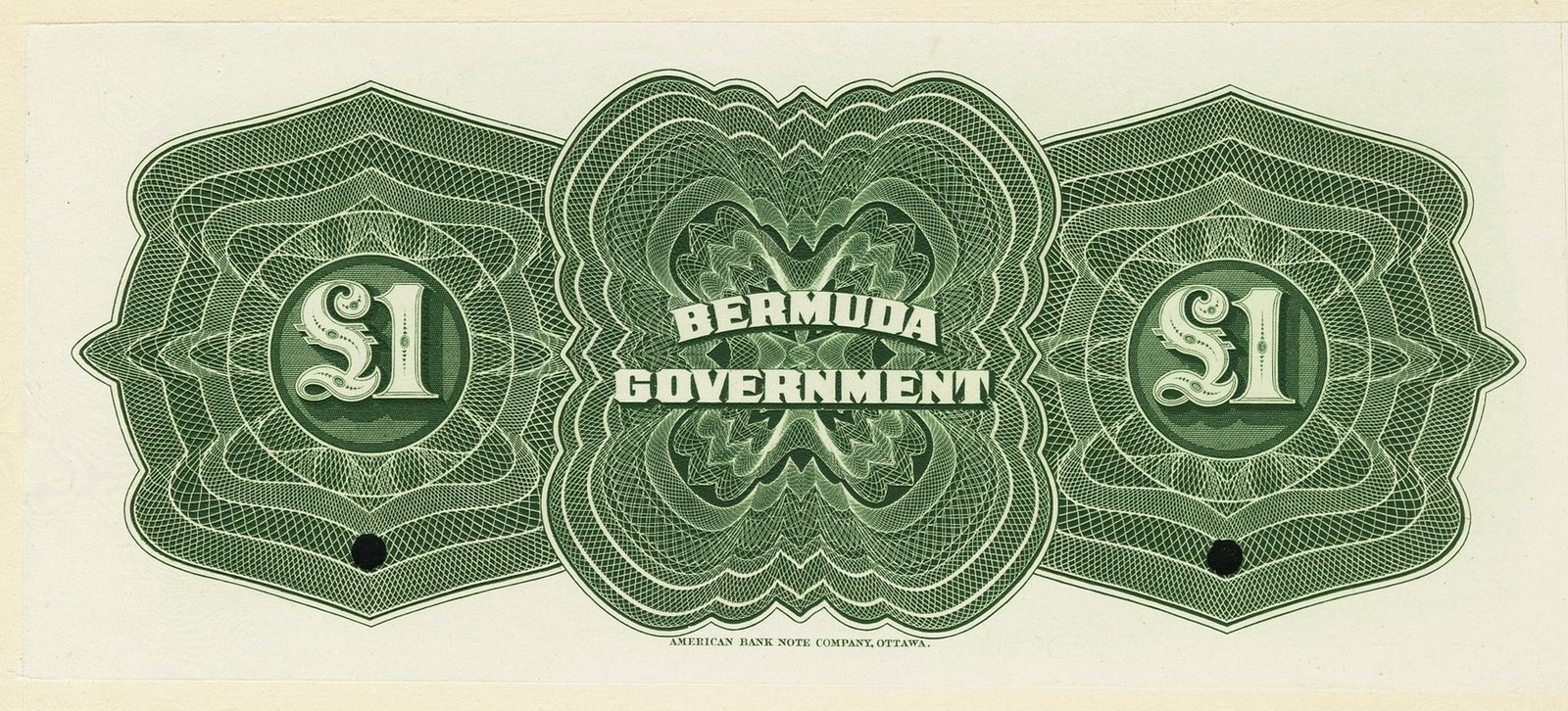
The local notes were not the only paper in the island. The annual report for 1920, paragraph 46, adds that besides British Treasury notes "there is a considerable quantity of American paper put in circulation", so eagerly sought at the rates of exchange of the day that the report thought it "perhaps a misnomer" to call it in circulation: it went largely in remittances to the United States.
The same figures touch another catalogue page. The page of a Barbados 1 pound of 1915 to 1917, said to have been printed to the number of 28,000, now asks whether that note existed at all, because no official source read so far names a Barbados Government note before 1938 and Bermuda had 28,000 pounds of 1 pound notes outstanding in the same years.
The note issue of 1929 to 1931
The 10 shillings and 1 pound dated 30th September 1927 change the scale. For three years the reports give a "Government Note issue" and say how much of it was put out during the year.
| End of year | Government note issue | Put out during the year | Investments held as security | Source | Read |
|---|---|---|---|---|---|
| 1929 | 83,000 pounds | 43,000 pounds of 1 pound and 10 shillings notes | 101,208 pounds on 1st January 1930 | annual report for 1929 | text |
| 1930 | 131,223 pounds | 48,223 pounds of 1 pound and 10 shillings notes | 155,097 pounds on 1st January 1931 | annual report for 1930 (No. 1546), p. 5 | image |
| 1931 | 221,289 pounds | 89,954 pounds of 1 pound and 10 shillings notes | 221,840 pounds on 1st January 1932 | annual report for 1931 (No. 1596) | text |
The reports for 1929 and 1930 add: "There is no coin reserve." The passage read from the report for 1931 does not show the sentence.
Notes in circulation, 1932 to 1939
From 1932 the reports give "Notes in circulation" at 31st December, and the figure falls. The wording changed in the year in which the count changed, so the 1931 and 1932 figures are not of the same kind.
| End of year | Notes in circulation | Values the source names | Security | Source | Read |
|---|---|---|---|---|---|
| 1932 | 194,690 pounds | 1 pound, 10 shillings | investments 245,961 pounds on 1st January 1933 | annual report for 1932 | image |
| 1933 | 171,817 pounds | 1 pound, 10 shillings | investments 211,758 pounds on 1st January 1934, and a liquid reserve of 10,000 pounds in England | annual report for 1933, p. 14 | text |
| 1934 | 156,816 pounds | 1 pound, 10 shillings | 215,967 pounds held for redemption | annual report for 1934 (No. 1737) | image |
| 1935 | 166,943 pounds | 1 pound, 10 shillings, 5 shillings | market value of investments 211,336 pounds on 1st January 1936, and the liquid reserve of 10,000 pounds | annual report for 1935 (No. 1774), pp. 13 and 14 | image |
| 1936 | 203,943 pounds | 1 pound, 10 shillings, 5 shillings | market value of investments 268,528 pounds on 1st January 1937 | annual report for 1936, p. 11 | text |
| 1937 | 190,943 pounds | not named | not given | An Economic Survey of the Colonial Territories, 1951, vol. IV, p. 51 | text |
| 1938 | 200,943 pounds | 1 pound, 10 shillings, 5 shillings | Note Security Fund 249,443 pounds | annual report for 1938, p. 14 | text |
| 1939 | 210,943 pounds | not named | not given | An Economic Survey of the Colonial Territories, 1951, vol. IV, p. 51 | text |
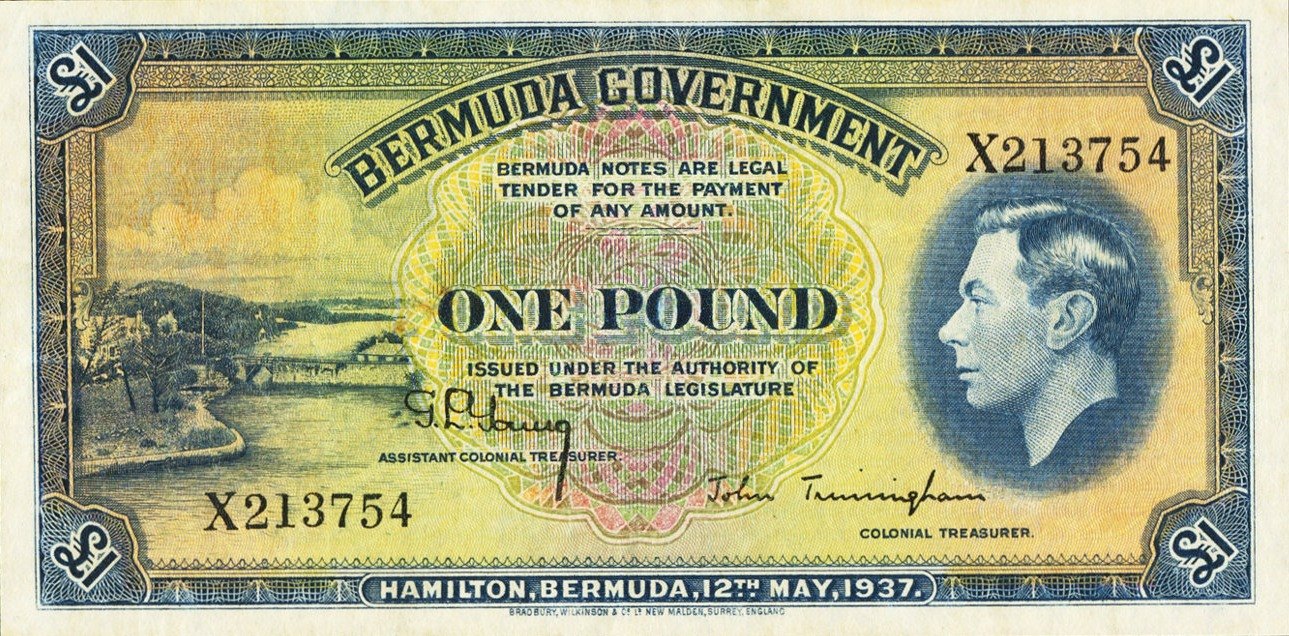
The values in the third column date two notes. The reports for 1932, 1933 and 1934 name only the 1 pound and the 10 shillings, and An Economic Survey of the Colonial Empire for 1932 does the same. The report for 1935 is the first to name the 5 shillings, and the Economic Survey for 1935 follows it. The report for 1936 explains what the local notes were for: they were issued "to supplement the supply of English notes, which is small".
The 1 shilling and the 2 shillings 6 pence dated 1st March 1939 are never named in any report, which agrees with their pages: they were not issued.
The war and after, 1944 to 1958
No figure was found for 1940 to 1943 or for 1945. When the series begins again, a 5 pounds has been added to the values.
| End of year | Notes in circulation | Note Security Fund, as the report gives it | Source | Read |
|---|---|---|---|---|
| 1944 | 854,496 pounds | not given | Blue Book for 1944 | text |
| 1946 | 783,422 pounds | 763,161 pounds at 31st August 1946 | annual report for 1946; Blue Book for 1946 | image (report); text (Blue Book) |
| 1947 | 757,346 pounds | 873,649 pounds at 31st December 1947 | annual reports, 1946 to 1957-58; Blue Book for 1947 | image (report); text (Blue Book) |
| 1948 | 912,096 pounds | 874,399 pounds at 31st August 1948 | annual reports, 1946 to 1957-58; Blue Book for 1948 | image (report); text (Blue Book) |
| 1949 | 884,096 pounds | 1,019,237 pounds | annual reports, 1946 to 1957-58 | image |
| 1950 | 905,846 pounds | about 1,038,957 pounds | annual reports, 1946 to 1957-58 | image |
| 1951 | 1,077,145 pounds | 1,168,800 pounds | annual reports, 1946 to 1957-58 | image |
| 1952 | 1,078,395 pounds | 1,171,445 pounds | annual reports, 1946 to 1957-58 | image |
| 1953 | 1,194,396 pounds | 1,180,679 pounds | annual reports, 1946 to 1957-58 | image |
| 1954 | 1,164,896 pounds | 1,351,340 pounds | annual reports, 1946 to 1957-58 | image |
| 1955 | 1,139,895 pounds 10 shillings | 1,214,028 pounds | annual reports, 1946 to 1957-58 | image |
| 1956 | 1,123,895 pounds 10 shillings | 1,183,186 pounds | annual reports, 1946 to 1957-58 | image |
| 1957 | 1,085,395 pounds 10 shillings | 1,140,059 pounds, market value and liquid funds | annual reports, 1946 to 1957-58 | image |
| 1958 | 1,229,395 pounds 10 shillings | 1,358,496 pounds 13 shillings 2 pence | annual reports, 1946 to 1957-58 | image |
The figures for 1947 to 1958 stand in the Colonial Office annual reports on Bermuda that are bound together for 1946 to 1957-58. The Blue Books for 1947 and 1948 give the liability as 757,346 pounds 5 shillings and 912,096 pounds 5 shillings. An Economic Survey of the Colonial Territories, 1951, repeats the figures for 1948 to 1950 and says that the notes "are issued by the Bermuda Currency Commissioners in denominations of 5s., 10s., £1, and £5". Its figure for 1947 reads 157,346 pounds in the machine text, which is doubtful beside the report's 757,346 pounds.
By value, 1944 to 1948
The Blue Books of these years are the only volumes read that divide the issue by value. They head the notes "Bermuda Government Notes. (Act 5 of 1915 and Act 32 of 1930)". All four were read in machine text only.
| Blue Book | 5 pounds | 1 pound | 10 shillings | 5 shillings | Notes in circulation |
|---|---|---|---|---|---|
| 1944 | 402,005 pounds | 351,137 pounds | a figure ending 0,179, first digit lost | a figure ending 175, first digits lost | 854,496 pounds |
| 1946 | 367,225 pounds | 314,682 pounds | 55,114 pounds | 46,400 pounds | 783,422 pounds |
| 1947 | 366,215 pounds | 292,128 pounds | 53,658 pounds | 45,345 pounds | 757,346 pounds 5 shillings |
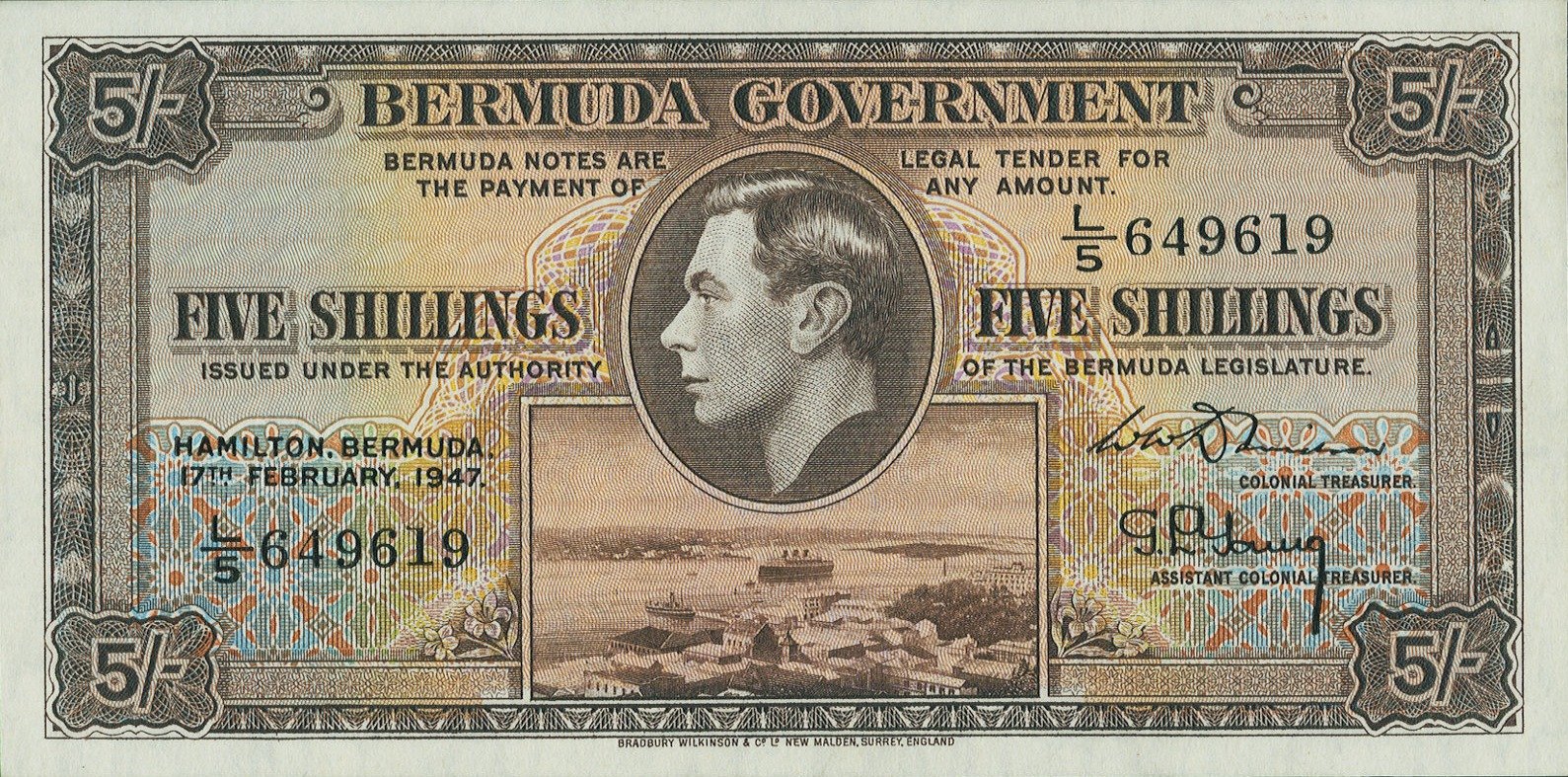
The four values of the 1948 Blue Book do not add up to its own total in the machine text, so one of them is misread and they are not given here.
English notes shut out
The annual report for 1946 says: "United Kingdom bank notes are not legal tender in Bermuda at the present time due to the continued operation of currency and exchange control regulations which were instituted during the war." The reports repeat this until 1957-58, when United Kingdom notes "were still not legal tender" but were being accepted by the banks "in reasonable quantities" after some relaxation of the regulations. The law behind this is set out in The law behind Bermuda's notes, 1915 to 1969.
The last sterling years, 1959 to 1971
The Bermuda Reports continue the series to the end of the pound. All were read in machine text only.
| End of year | Notes in circulation | Note Security Fund | Source |
|---|---|---|---|
| 1959 | 1,354,895 pounds 10 shillings | 1,502,444 pounds 3 shillings 9 pence | Bermuda Reports, 1959 to 1970 |
| 1960 | 1,451,995 pounds 10 shillings | 1,564,299 pounds 1 shilling 4 pence | Bermuda Reports, 1959 to 1970 |
| 1961 | 1,577,295 pounds 10 shillings | 1,718,346 pounds 3 shillings 10 pence | Bermuda Reports, 1959 to 1970 |
| 1962 | 1,565,945 pounds 10 shillings | 1,805,857 pounds 9 shillings 9 pence | Bermuda Reports, 1959 to 1970 |
| 1963 | 1,554,045 pounds 10 shillings | 1,824,850 pounds 2 shillings 4 pence | Bermuda Reports, 1959 to 1970 |
| 1964 | 1,799,945 pounds 10 shillings | 2,038,940 pounds 6 shillings 9 pence | Bermuda Reports, 1959 to 1970 |
| 1965 | 1,857,145 pounds 10 shillings | 2,215,036 pounds 19 shillings 7 pence | Bermuda Reports, 1959 to 1970 |
| 1966 | 2,141,995 pounds 10 shillings | 2,543,812 pounds 0 shillings 4 pence | Bermuda Reports, 1959 to 1970 |
| 1967 | 2,382,320 pounds 10 shillings | 2,820,264 pounds 17 shillings 2 pence | Bermuda Reports, 1959 to 1970 |
| 1968 | 2,949,195 pounds 10 shillings | 3,403,041 pounds 13 shillings 7 pence | Bermuda Reports, 1959 to 1970 |
| 1969 | 3,582,195 pounds 10 shillings | 3,855,363 pounds 16 shillings 4 pence | Bermuda Reports, 1959 to 1970 |
| 1970 | old pound notes unredeemed: 227,269 pounds 10 shillings | Bermuda Report for 1969 and 1970, p. 23 | |
| 1971 | old pound notes unredeemed: 205,400 pounds | Bermuda Report for 1971, p. 36 |
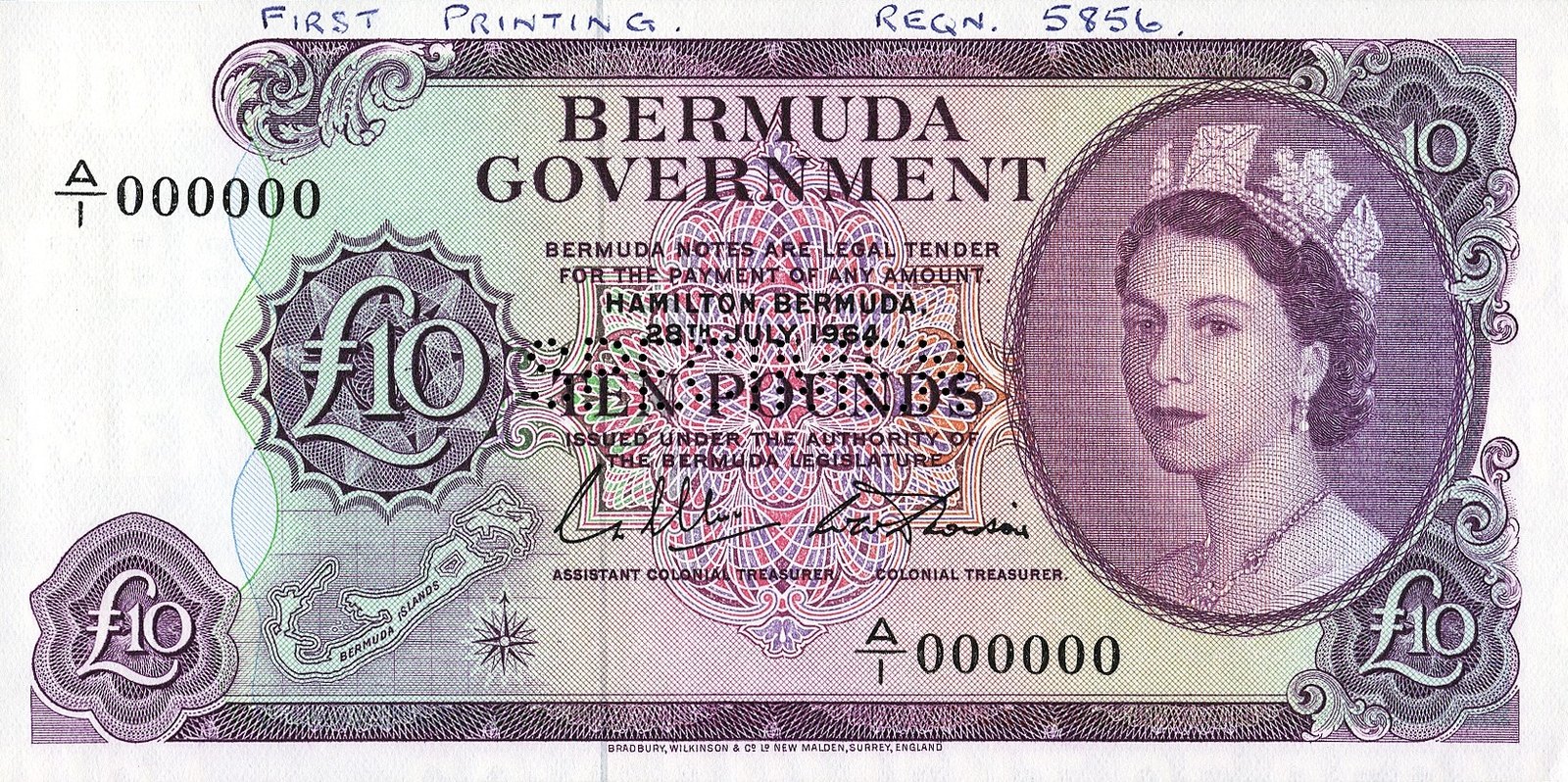
The Bermuda Report for 1961 and 1962 lists the notes as 5 pounds, 1 pound, 10 shillings and 5 shillings. The report for 1963 and 1964 is the first to add the 10 pounds: "The currency consists of Bermuda Government notes in denominations of £10, £5, £1, 10s. and 5s. and British metal coinage."
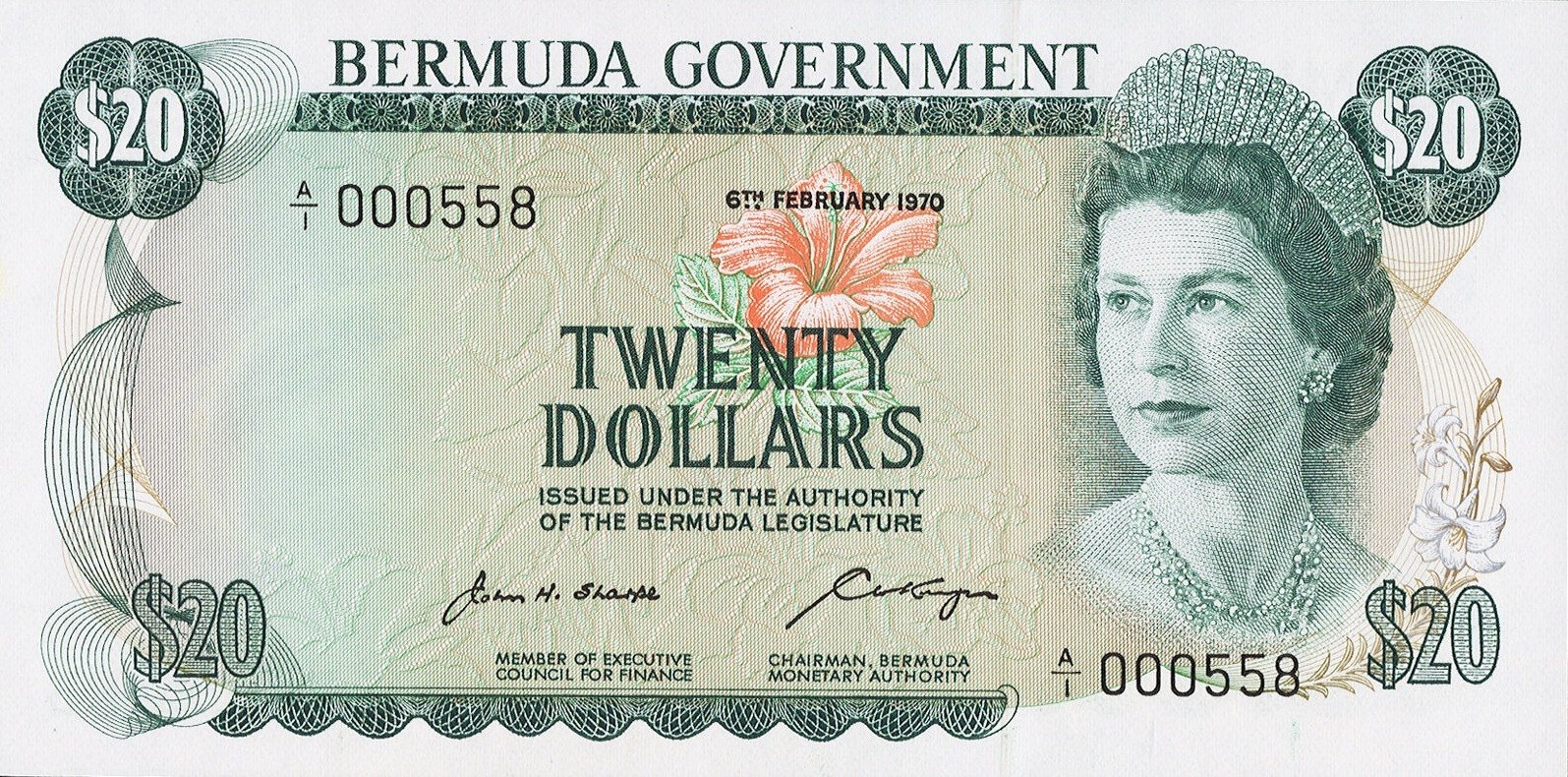
The report for 1969 and 1970 records the change: "On the 6th February, 1970, the currency was decimalised and new notes were issued by the Bermuda Monetary Authority in denominations of $50, $20, $10, $5 and $1." The parity was set by order of the Governor at 2.40 Bermuda dollars to the pound. At 31st December 1970 the notes in circulation were 9,373,756 dollars and the coin 610,200 dollars. The withdrawal itself is told in The last sterling notes of Bermuda, 1952 to 1970.
What the figures do not tell
- No figure was found for 1919, for 1940 to 1943 or for 1945.
- Apart from the Blue Books of 1944 to 1948, no volume divides the notes by value, so the figures cannot be set against the printings of any one note.
- No report says how many notes were printed, withdrawn or burnt in a year.
- No report or Blue Book read names a notice that withdrew the wartime pound, and none says how many 5 shillings and 2 shillings 6 pence notes of 1920 were printed or where they were kept.
- The Bermuda Annual Report for 1975, p. 11, has a table of the dollar notes by value and of the old pound notes still outstanding, from 10 pounds to 5 shillings, at 31st December 1975. It is held in the Johns Hopkins archive of currency boards and its figures were not taken down, so the unredeemed pound notes cannot be followed here beyond 1971.
Sources
- Bermuda Blue Books for 1918, 1920 and 1921 (sections Currency and the comparative statement of revenue and expenditure), and for 1944, 1946, 1947 and 1948 (Currency; Statement of Assets and Liabilities).
- Colonial Reports, Annual: Bermuda for 1912, 1914, 1920, 1921, 1922 (No. 1167), 1923, 1924, 1925, 1926, 1927, 1928, 1929, 1930 (No. 1546), 1931 (No. 1596), 1932, 1933, 1934 (No. 1737), 1935 (No. 1774), 1936 and 1938.
- Colonial Office annual reports on Bermuda, 1946 to 1957-58.
- Bermuda Reports for the years 1959 to 1970, and the Bermuda Report for 1971.
- An Economic Survey of the Colonial Empire (1932) and (1935); An Economic Survey of the Colonial Territories, 1951, vol. IV, p. 51.
- The Bermuda Annual Report for 1975, p. 11, as listed in the Johns Hopkins archive of currency boards (not read for its figures).


Member comments
Log in or register to post a comment.