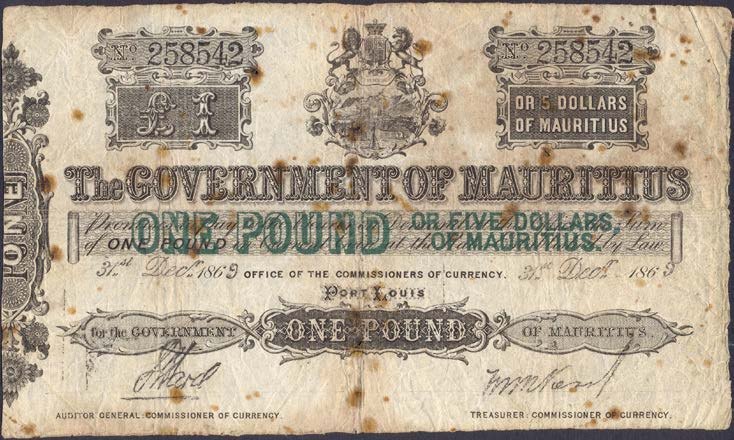
This article lists the laws behind the notes of the Government of Mauritius and the first notes of the Bank of Mauritius, in order of time. It is drawn from the Mauritius Government Gazette, the Mauritius Blue Books, Bolton's Mauritius Almanac for 1851, the Mauritius Almanac for 1920, Chalmers' History of Currency in the British Colonies (1893), a Treasury file in the National Archives (T 1/8866/1517C, read in the scans of the currency board archive at Johns Hopkins University), the annual reports on Mauritius and the first annual report of the Bank of Mauritius. Where a law is known by its title only, or where two sources give it differently, the list says so. The story of the notes themselves is in The Government of Mauritius notes, 1860 to 1934 and the three articles that follow it.
Before the sterling notes, 1843 to 1859
| Law | Date | What it said | Read in |
|---|---|---|---|
| Ordinance 10 of 1843 | approved 10th June 1844 | "Putting a stop to the issue of promissory notes payable to bearer, issued by unauthorized companies" | Bolton's Mauritius Almanac for 1851, list of Ordinances |
| Ordinance 9 of 1846 | approved 28th April 1847 | Extended Ordinance 10 of 1843 | Bolton's Almanac for 1851 |
| Ordinance 7 of 1848 | 1848 | "Establishing a Paper Currency" | Bolton's Almanac for 1851 |
| Ordinance 31 of 1848 | approved 10th April 1849 | Amended Article 13 of Ordinance 7 of 1848 "as regards forgery of notes" | Bolton's Almanac for 1851 |
| Ordinance 6 of 1849 | passed 20 August 1849; in force by Proclamation of 22nd August 1849 | "For establishing a Paper Currency". The Board of Commissioners of the Currency is the Colonial Secretary, the Auditor General and the Colonial Treasurer | Bolton's Almanac for 1851; the text as Clément Rey printed it from Government Gazette No. 40 of 1 September 1849 (IBNS Journal 27:3-4, 1988, p. 85) |
| Ordinances 28 of 1852, 13 of 1855, 16 of 1858, 10 of 1859 and 42 of 1860 | 1852 to 1860 | Continued the Board | named in Ordinance 10 of 1864 (Gazette of 7 May 1864) |
The notes under the laws of 1848 and 1849 were of 5 and 10 rupees. The Mauritius Blue Books for 1894 and 1909 still describe them as "Notes issued under Ord. Nos. 7 of 1848 and 6 of 1849, of Five and Ten Rupees each".
One number is given two ways. Chalmers (1893, p. 367) writes that "under Ordinance No. 9 of that year" a Government Currency Board was established in 1849. Bolton's Almanac of 1851, the Blue Books for 1894, 1909, 1920 and 1921 and Ordinance 10 of 1864 all give the number as 6.
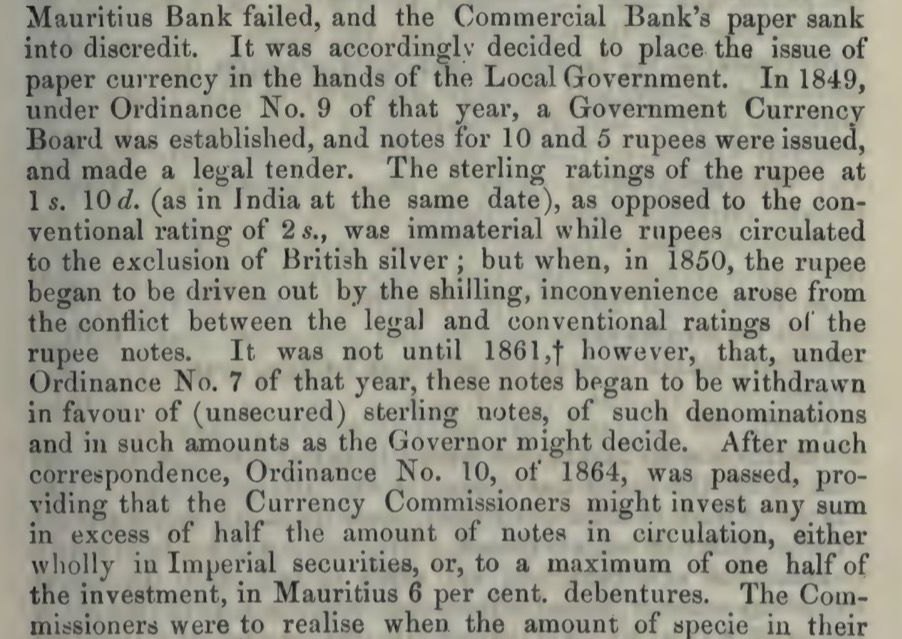
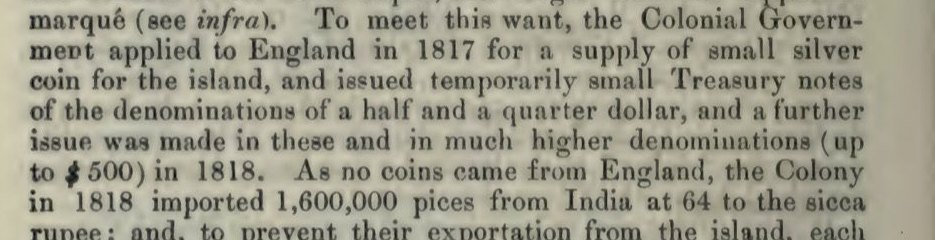
Chalmers (pp. 362 and 363) also records older Government paper: small Treasury notes of a half and a quarter dollar issued in 1817, a further issue in 1818 in these and higher values up to 500 dollars, a Proclamation of 25th June 1821 that called the issues in, and their demonetisation from 24th December 1824. Chalmers gives no law number and no amount. The reader of the Blue Books of 1847 to 1874 recorded a line of their yearly return headed "Government paper of 1812-1830", which does not fully agree with Chalmers' years; that heading has not yet been checked on the page itself. The passage is given here as Chalmers' statement only, and nothing is settled by it.
The sterling and dollar notes, 1861 to 1876
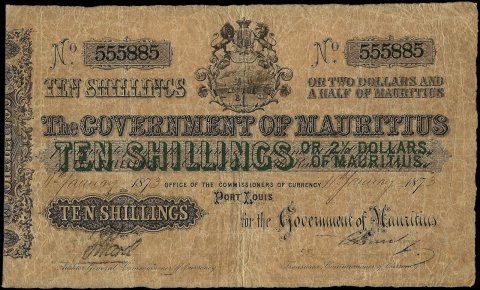
These are the laws of the 10 shillings or 2 1/2 dollars, the 1 pound or 5 dollars and the 5 pounds or 25 dollars.
| Law | Date | What it said | Read in |
|---|---|---|---|
| Ordinance 7 of 1861 | sent to London with despatch 65 of 4 April 1861 | Re-constituted the Board of Commissioners of Currency on the arrival of the new notes | a printed Treasury memorandum on Mauritius, National Archives T 1/8866/1517C, Document 4, p. 16 |
| Ordinance 7 of 1863 | 1863 | Removed the Governor's power to fix the denominations of notes. The reader of the memorandum marked this point as not confirmed | the same memorandum |
| Ordinance 10 of 1864 | dated 2 May 1864 | Re-established the Board: the Colonial Secretary, the Auditor General and the Colonial Treasurer. On a Governor's warrant the Board issues to the Treasurer, against specie, notes of 10 shillings (2 1/2 dollars), 1 pound (5 dollars) and 5 pounds (25 dollars). Every note bears the signatures, or facsimiles, of the Commissioners or any two of them, who must be in office on the date the note bears | Government Gazette of 7 May 1864 (No. 26) |
| Ordinance 19 of 1865, Article 5 | 1865 | A depreciation fund for the investments held against the notes | Chalmers (1893), p. 368 |
| Ordinance 20 of 1874 | 1874 | Repealed that Article | Chalmers (1893), p. 368 |
Chalmers (p. 367) dates the change from the rupee notes differently from the note pages: "It was not until 1861, however, that, under Ordinance No. 7 of that year, these notes began to be withdrawn in favour of (unsecured) sterling notes". The note pages date the sterling notes from 13 August 1860, and the Blue Book returns show most of the rupee notes already gone by the end of 1860.
The rupee notes, 1876 to 1931
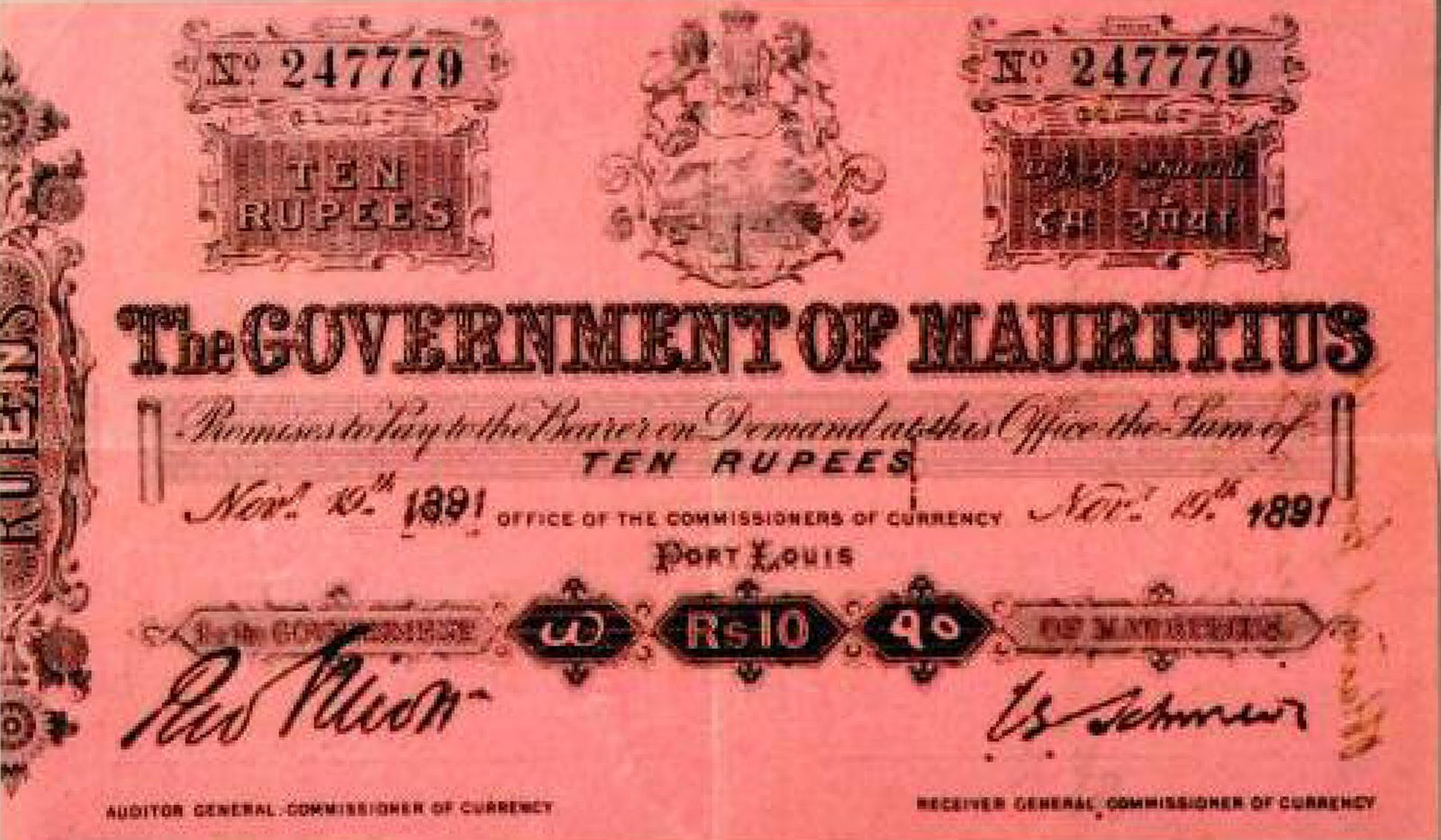
These laws stand behind the 5 rupees, 10 rupees and 50 rupees of 1876, the 5 rupees, 10 rupees and 50 rupees of 1907 and the 1 rupee of 1919.
| Law | Date | What it said | Read in |
|---|---|---|---|
| Order in Council and Proclamation | 12th August 1876; in force from 1st January 1877 by Proclamation of 25th November 1876 | Made the Indian rupee the only legal tender | Chalmers (1893), p. 368 and its footnote |
| Ordinance 28 of 1876 | passed in Council 14 November 1876; dated 17th November 1876 | The Board is the Colonial Secretary, the Receiver General and the Auditor General. On a Governor's warrant it issues to the Receiver General, in exchange for silver rupees of India, notes of Five, Ten and Fifty Rupees. At least one third of the circulation is held in specie. The old sterling or "dollar" notes cease to be legal tender, with claims on the Commissioners until 31st December 1877. Forging a note carries up to 20 years, and having an unsigned or incomplete note up to 2 years | the printed Ordinance in National Archives T 1/8866/1517C, Document 4, pp. 84 and 86; Chalmers (1893), pp. 369 and 370 |
| Paper Currency (Amendment) Ordinance and Proclamation No. 8 | 1898 | Suspended Article 5 of Ordinance 28 of 1876 | Mauritius Blue Book for 1898 (read in the text only) |
| Ordinance 16 and Proclamation 10 of 1899 | 1899 | Undid the suspension | Mauritius Blue Book for 1899 (text only) |
| Ordinance 3 of 1912 | 1912 | Abolished the post of Auditor General. From then the Commissioners of Currency are the Colonial Secretary, the Receiver General and the Collector of Customs | Mauritius Almanac for 1920, pp. A. 59 and B. 14 |
| Ordinance 12 of 1919, the Paper Currency (Amendment) Ordinance | passed 29 July 1919, published 31 July 1919 | Put "R. 1, Rs. 5, Rs 10 and Rs. 50" in place of "Rs. 5, Rs. 10 and Rs. 50" in the law of 1876 | Mauritius Almanac for 1920 |
| Ordinance 30 of 1920 | 1920 | "Indian Currency Notes of all denominations are legal tender to the full amount expressed on such notes" | Mauritius Blue Book for 1920, p. U 1 |
| Proclamation 24 of 1923 | 10th September 1923 | "Treasury Notes wrecked on S/S Engineer". Title only | Mauritius Blue Book for 1923 (Government Gazette, page 397) |
| Ordinance 47 of 1931 | 1931 | "To amend the law regarding the Paper Currency": Article 9 of Ordinance 28 of 1876 amended, Article 10 repealed | annual report on Mauritius for 1931 (text only) |
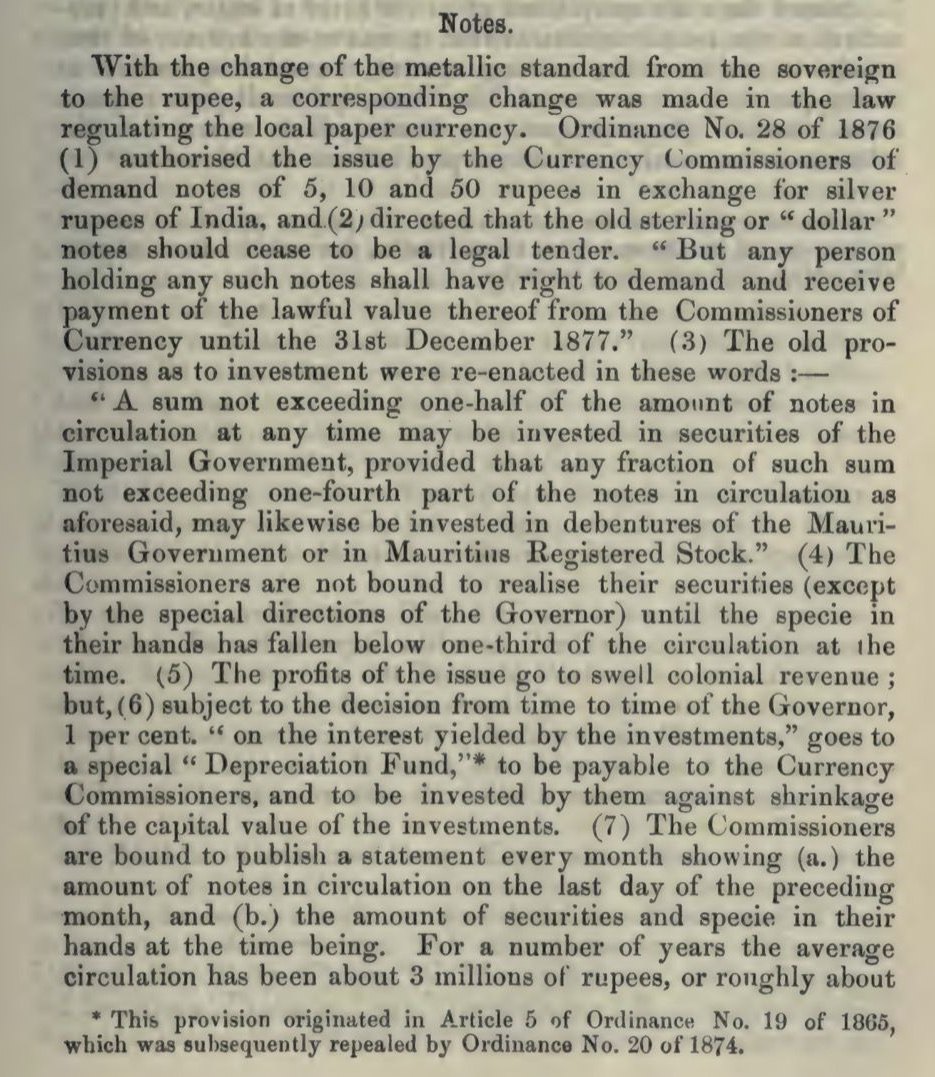

The scan of Ordinance 28 of 1876 in the National Archives file lacks sections 3 to 11, so its clause on signatures has not been read. The Blue Books do not say what Article 5 required, so the meaning of the suspension of 1898 and 1899 is not known. In the same year 1899 the Commissioners lent 1,050,000 rupees towards the Planters' Loan (Blue Book, text only). The annual report for 1931 does not say what Ordinance 47 changed.
One more difference of wording is open. The annual report on Mauritius for 1929 rests the rupee currency on "Proclamation No. 28 of 1876", where Chalmers and the printed Ordinance have Ordinance 28 of 1876.
The portrait notes, 1934 to 1957
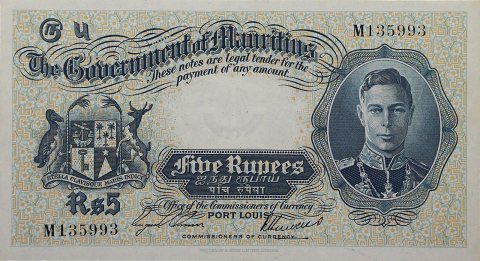
These laws stand behind the notes from the George V 5 rupees and 10 rupees to the Elizabeth II 5 rupees and its companions.
| Law | Date | What it said | Read in |
|---|---|---|---|
| Ordinance 13 of 1934, the Mauritius Currency Notes Ordinance 1934 | enacted March 1934; with effect from 1st May 1934 | "to make provision with respect to the currency notes of the Colony and to place the issue of such Currency Notes upon a permanent basis". Notes issued on demand against sterling lodged with the Crown Agents in London, at one rupee for one shilling and sixpence; a Note Security Fund held by the Crown Agents | annual report on Mauritius for 1934, p. 33; An Economic Survey of the Colonial Empire (1933), p. 255 |
| Proclamation 21 of 1934 | 1 September 1934 | Ended the legal tender of every earlier issue on 15 December 1934 | the catalogue's note pages; no official Mauritius source has been found for it |
| Mauritius Currency Notes Regulations | 1938 | Named in Government Notice No. 64 of 1956. Not read | the annual reports on Mauritius of 1946 to 1967 |
| Ordinance 38 of 1941, the Mauritius Currency Notes (Amendment) Ordinance | assented 9 July 1941 | The Board shall consist of the Accountant General and two other persons holding public offices, chosen by the Governor | Legal Supplement to Gazette No. 64 of 12 July 1941 |
| Proclamation 33 of 1942 | 9 November 1942 | The emergency 1 rupee of 27 March 1942 ceases to be legal tender from 1 December 1942 | Mauritius Government Gazette No. 125 of 14 November 1942 |
| General Notice 790 | 29 September 1943 | Under section 4 of Ordinance 13 of 1934 the Commissioners have issued new currency notes of 50 cents and 25 cents. Signed S. Moody, Colonial Secretary | Gazette of 29 September 1943, p. 468 |
| Ordinance 23 of 1944 | 1944 | The revised 25 and 50 cents followed under it | the catalogue's note pages |
| General Notice 855 | 14 September 1946 | "The Mauritius Currency Notes Ordinance, 1934". Title only | contents page of the Gazette |
| Proclamation 33 of 1946 | apparently December 1946 | "To declare that currency notes of certain Denomination shall cease to be legal tender". Title only | Mauritius Blue Book for 1946-47 (text only) |
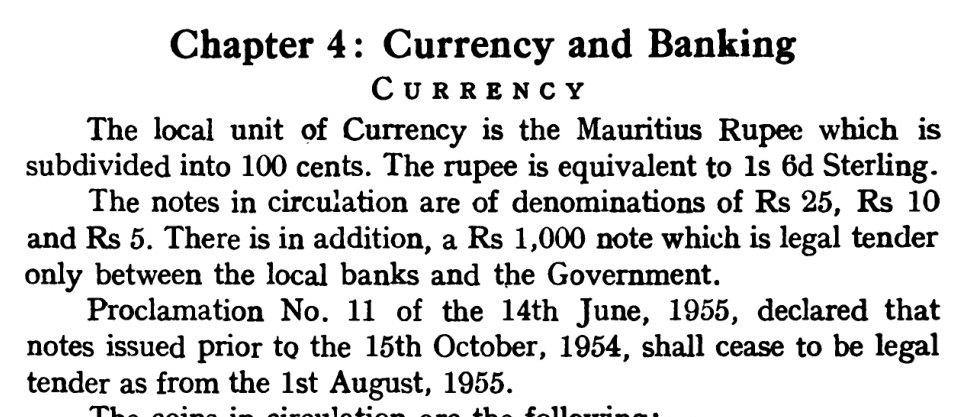
| Proclamation No. 11 of 1955 | 14th June 1955 | "notes issued prior to the 15th October, 1954, shall cease to be legal tender as from the 1st August, 1955" | annual report on Mauritius for 1955 |
| General Notice 588 | Gazette No. 43 of 23 July 1955 | "Demonetisation of Currency Notes". Title only | contents page of the Gazette |
| Government Notice No. 64 of 1956 | 1956 | Amended the Regulations of 1938 to shorten the destruction of notes of 10 rupees and under | the annual reports on Mauritius of 1946 to 1967 |
| Ordinance No. 21 of 1957, the Mauritius Currency Notes (Amendment) Ordinance | 1957 | Let part of the backing of the notes be held in local Government securities | the annual reports on Mauritius of 1946 to 1967 |
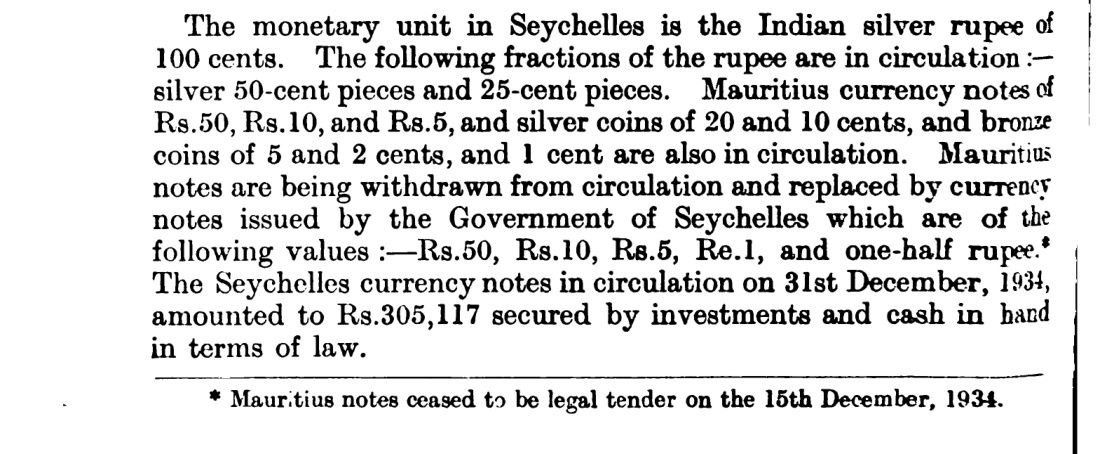
Proclamation 21 of 1934 is the weak place in this list. The annual report on Mauritius for 1934 gives no day for the end of the old notes and names no Proclamation. The day itself has official support from the neighbouring colony: the annual report on the Seychelles for 1934 says "Mauritius notes ceased to be legal tender on the 15th December, 1934", and An Economic Survey of the Colonial Empire (1935) says their legal tender there "was terminated by Proclamation on the 15th of December, 1934".
Proclamation 33 of 1942 is the official source for the end of the emergency 1 rupee.
Proclamation 33 of 1946 names no values in the Blue Book's list. By its timing it may concern the 25 cents and 50 cents, for which the note pages give 30 June 1947, but that is not proved until the Gazette is read.
The Proclamation of 1955 is called "Proclamation No. 11" in the annual report for 1955. A working paper on currency board accounts by Krus and Schuler (2014), citing the same report, calls it Ordinance No. 11 of 14 June 1955. The annual report's own word is Proclamation. Neither the Proclamation nor General Notice 588 has been read, so it is not shown whether every value, the 1,000 rupees included, was meant.
The last years of the Board and the Bank of Mauritius, 1962 to 1968
| Law | Date | What it said | Read in |
|---|---|---|---|
| General Notice 1115 | 6 October 1962 | "Board of Commissioners of Currency". Title only | contents page of the Gazette |
| Mauritius Currency Ordinance 1962, No. 39 of 1962 | 1962 | The Commissioners' half-yearly statements are made under it from 1965 | Gazette statements of 1965 and 1966 |
| Bank of Mauritius Ordinance, No. 43 of 1966 | passed by the Legislative Assembly on 26 July 1966; assented to on 28 September 1966 | Set up the Bank, which took over from the Board the issue and redemption of notes and coin | Bank of Mauritius annual report for the year ended June 1968, pp. 1 and 2; the number 43 from the annual report on Mauritius for 1967 |
| Decision to demonetise the Government notes | with effect from the 14th October 1968 | From that day the old notes "would be exchanged only at the Bank of Mauritius" | Bank of Mauritius annual reports for 1968 and 1969 |
The note pages add that Ordinance 43 of 1966 was proclaimed on 15 October 1966. The annual report on Mauritius for 1967 says "No date has yet been fixed for the final redemption of notes of the former Currency Board". The first notes of the Bank are in The Bank of Mauritius and its first notes, 1967 to 1988.
What has still to be read
- The Mauritius Government Gazette or Blue Book for 1934, for Proclamation 21 of 1 September 1934.
- The Government Gazette for 1923, page 397, for what Proclamation 24 ordered about the notes from the Engineer.
- The Gazette of December 1946, for the values named in Proclamation 33 of that year.
- The Gazette of 1955, for Proclamation No. 11 and General Notice 588.
- Sections 3 to 11 of Ordinance 28 of 1876, and Article 5 with the amending laws of 1898 and 1899.
- Ordinance 47 of 1931, Ordinance 23 of 1944, the Regulations of 1938 and the Ordinance of 1962, none of which has been read in its own text.
Sources
- Bolton's Mauritius Almanac for 1851, list of Ordinances.
- Mauritius Government Gazette: 7 May 1864 (No. 26); Legal Supplement to No. 64 of 12 July 1941; No. 125 of 14 November 1942; 29 September 1943, p. 468; contents pages of 14 September 1946, 23 July 1955 (No. 43) and 6 October 1962; the Commissioners' statements of 1965 and 1966.
- Mauritius Blue Books for 1894, 1898, 1899, 1909, 1920, 1921, 1923 and 1946-47.
- Mauritius Almanac and Commercial Handbook for 1920, pp. A. 59, A. 60 and B. 14.
- Robert Chalmers, A History of Currency in the British Colonies (1893), pp. 362, 363 and 367 to 370.
- National Archives, T 1/8866/1517C, Document 4: a printed Treasury memorandum on Mauritius and the printed Ordinance 28 of 1876.
- Clément Rey, "The Board of Currency Commissioners of Mauritius - Update", IBNS Journal 27:3-4 (1988), p. 85.
- Annual reports on Mauritius for 1929, 1931, 1934, 1955 and 1967, and the reports of 1946 to 1967 for the laws of 1938, 1956 and 1957; annual report on the Seychelles for 1934.
- An Economic Survey of the Colonial Empire (1933), p. 255, and (1935).
- Bank of Mauritius annual reports for 1968 and 1969.
- Krus and Schuler, Currency Board Financial Statements (working paper, 2014), p. 179.
- The catalogue's note pages, for Proclamation 21 of 1934, Ordinance 23 of 1944 and the proclamation of Ordinance 43 of 1966.
Member comments
Log in or register to post a comment.