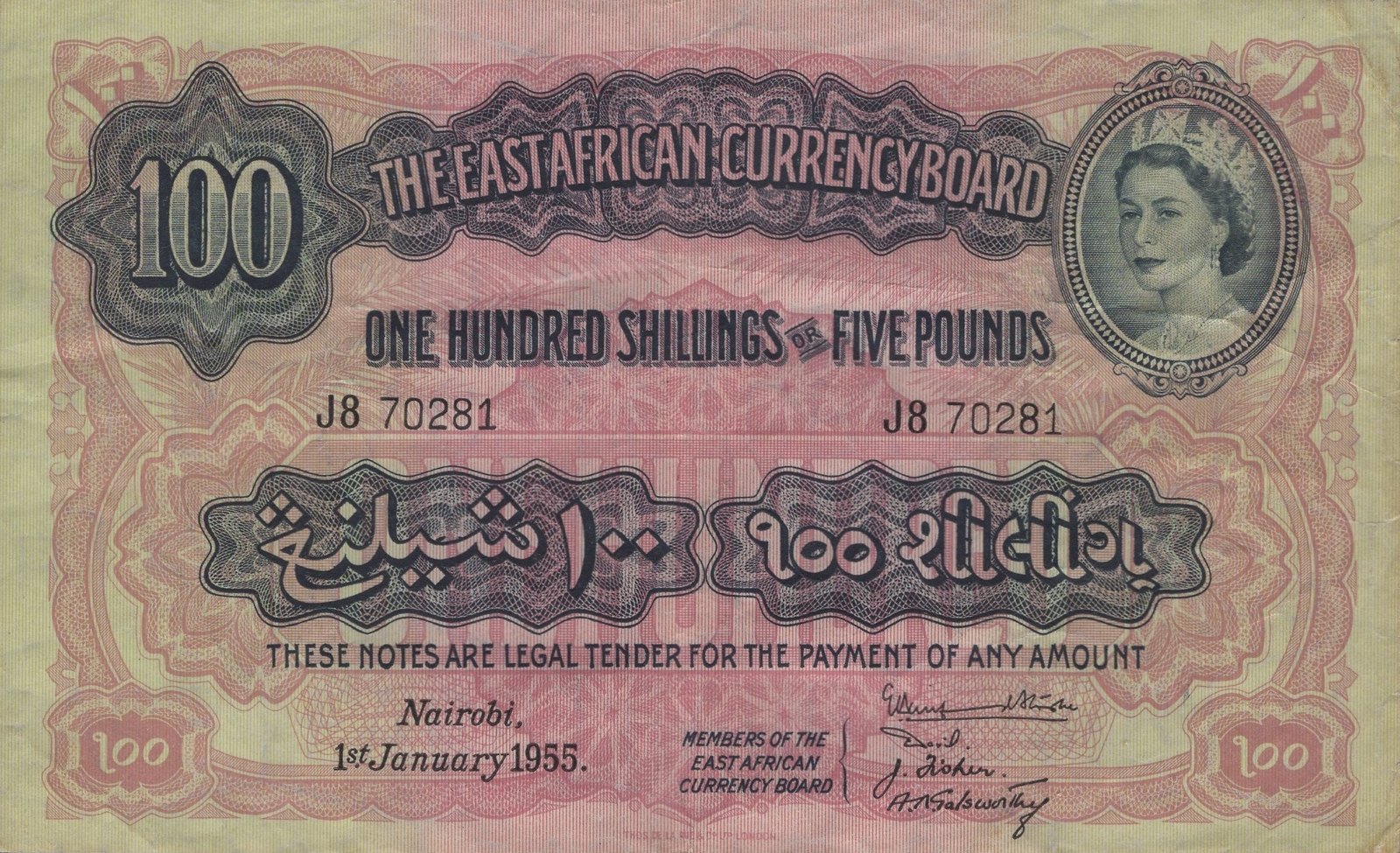
This article sets out the paper money of East Africa in order of time, from the first notes issued to the public on 2nd April 1906 to the last months of the East African shilling in 1967. It is drawn from the catalogue's 65 note pages, with a few facts from the web pages of the Central Bank of Kenya and the Bank of Tanzania and from Hansard. Four subjects have articles of their own, linked where they come up: the Protectorate's rupee notes, the change from rupee to florin to shilling, the three highest shilling notes, and the wartime notes.
The Protectorate's rupee notes, 1905 to 1919
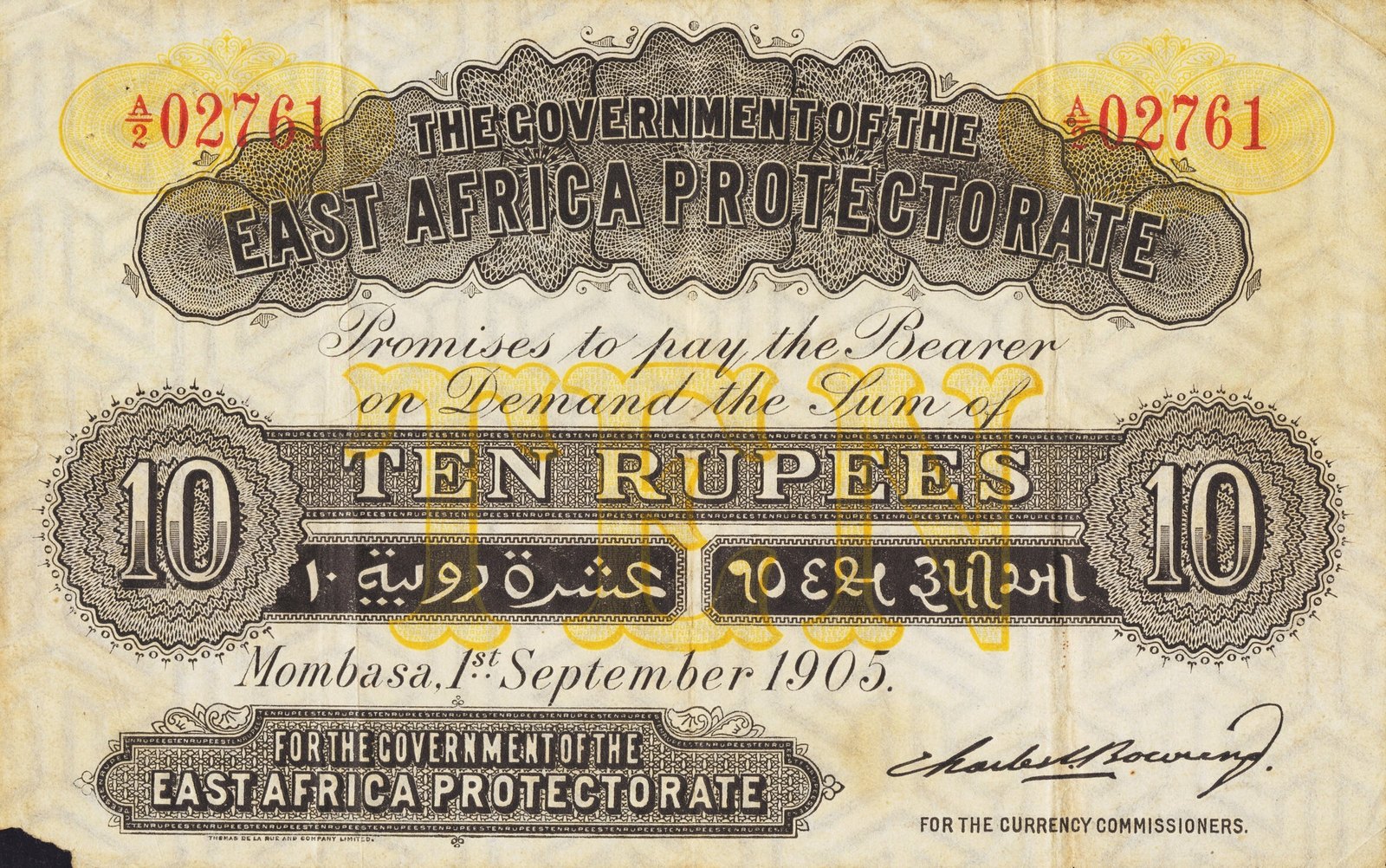
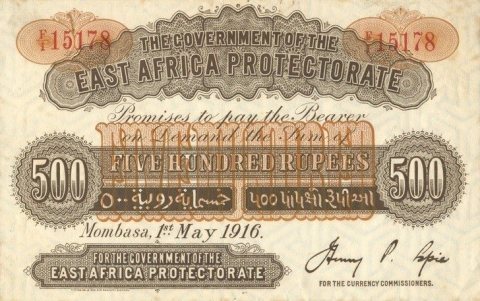
The first notes were those of the Government of the East Africa Protectorate, issued under the East Africa and Uganda Order in Council of 10th February 1905 by Commissioners of Currency and legal tender in Uganda as well. They are dated 1st September 1905 and were first issued to the public on 2nd April 1906. There were values of 5, 10, 20, 50, 100 and 500 rupees, with a 1,000 rupees known only as a proof, and later dates from 1912 to 1919. The Order, the Commissioners, the signers and the Board's counts are in The rupee notes of the East Africa Protectorate, 1905 to 1919.
The Currency Board, the 1 rupee and the florin, 1919 to 1921
The Central Bank of Kenya's page on the history of the currency says a decision was made in December 1919 to replace the Mombasa Currency Board with a London based East African Currency Board. The Bank of Tanzania's history page gives the same month and says the Board worked at first in Tanganyika, Kenya and Uganda, and that Zanzibar joined in 1936. In the House of Commons on 11 November 1936 Mr. Ormsby-Gore said that the Board operated in Kenya, Uganda and Tanganyika and had been extended to Zanzibar that year.
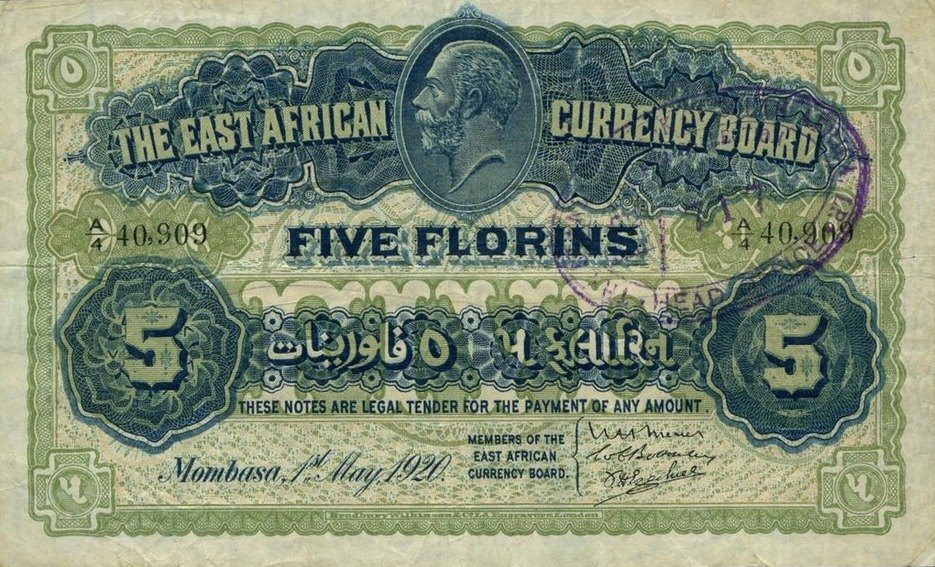
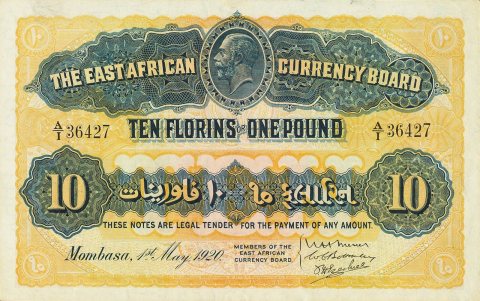
The Board's first notes were the 1 rupee of 7th April 1920 and seven florin notes dated 1st May 1920, from 1 florin to 500 florins. The florin lasted less than two years. The Orders, the numbers shipped and the end of the rupee and florin notes as legal tender at midnight on 31st December 1931 are in Rupee, florin and shilling, 1918 to 1932.
The first shilling notes, 15th December 1921
The first shilling notes are dated Mombasa, 15th December 1921, and were printed by Thomas de la Rue and Company. There are seven values: 5 shillings, 10 shillings, 20 shillings = 1 pound, 100 shillings = 5 pounds, 200 shillings = 10 pounds, 1,000 shillings = 50 pounds and 10,000 shillings = 500 pounds. The two lowest measure 152 by 95 mm, the 10,000 shillings 184 by 115 mm and the others 164 by 102 mm.
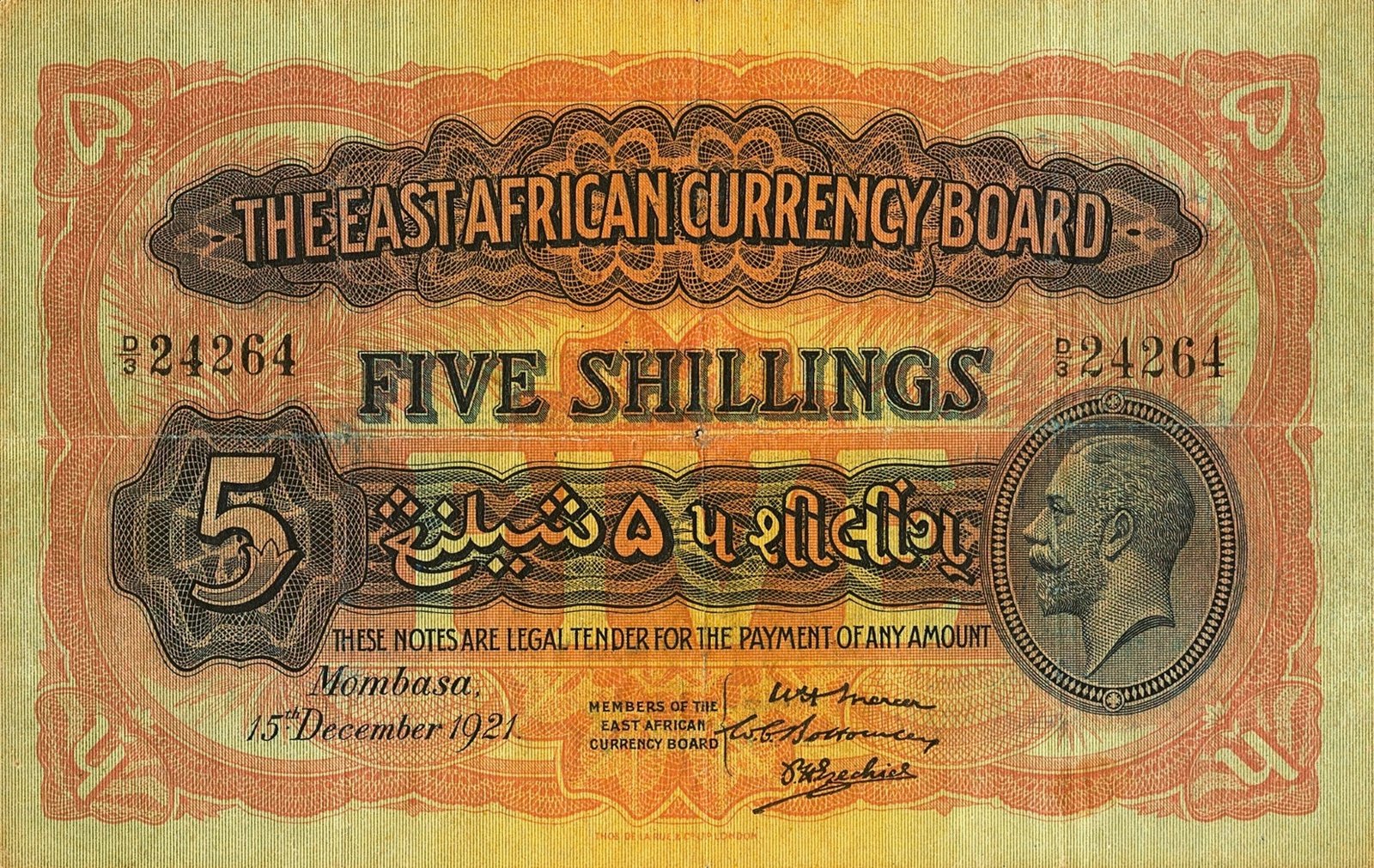
The notes are signed by Mercer, Bottomley and Ezechiel as Members of the East African Currency Board. The Palestine Bulletin of 1st September 1926, on its first page, says that Percy Ezechiel, Secretary to the Crown Agents for fifteen years and a Crown Agent from 1920, had been a member of this Board since 1919, and from 1926 was also Chairman of the Palestine Currency Board.
On the 5 shillings the letters A to F are seen, each with a number from 1 to 10 under it. The Official Gazette's half-note notices of 1922 to 1925 name 5 shillings notes with every prefix from A/1 to A/10, sixteen of them with A/1, and one with B/1.
One error of the issue has a row of its own: a 10 shillings printed over the red-orange underprint of the 5 shillings, with the red-orange FIVE SHILLINGS back, in place of the green of the 10 shillings. Spink (3 October 2018, lot 1024, and 17 April 2019, lot 418) says only two examples are known; the examples recorded in the catalogue have the prefix A/10.
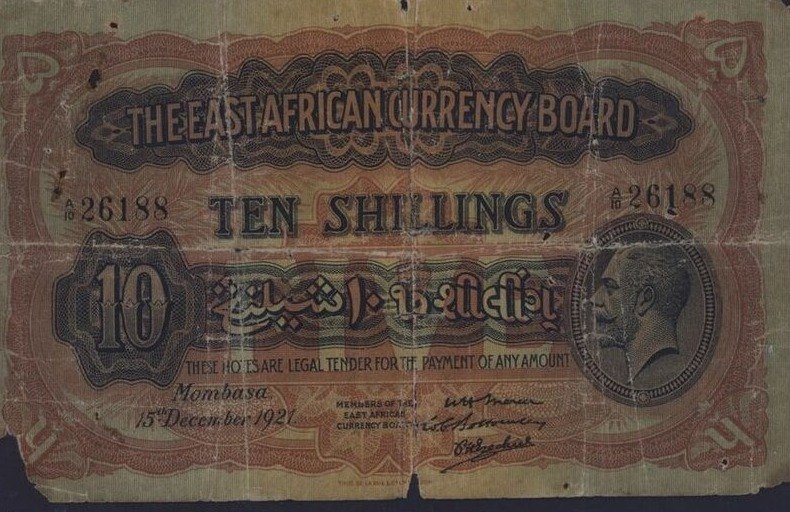
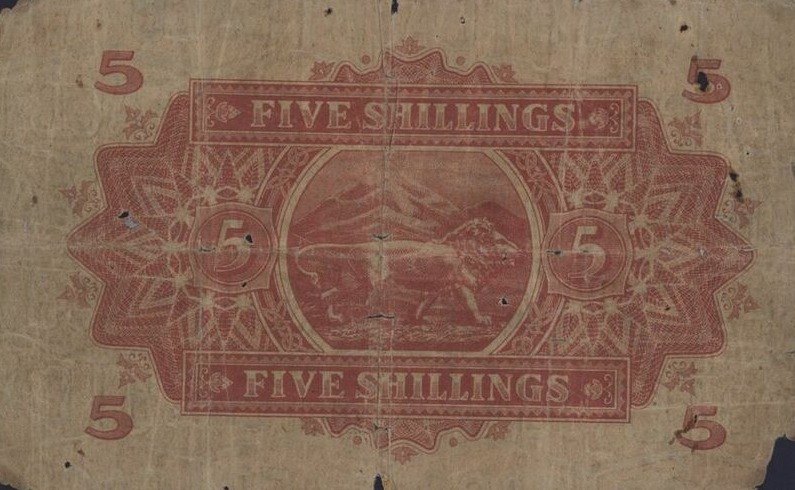
Dr. David Lott wrote in Bank Note Reporter in March 1985 that a set of uniface front and back proofs of the shilling notes dated 15th December 1921, numbered 000 000, hung framed in the library of the Foreign Office in London, almost hidden behind a pillar. The article does not list the values in the frame or say where it is now.
The three highest values, used mainly by the banks, are followed in The 200, 1,000 and 10,000 shillings of East Africa, 1921 to 1965.
The Nairobi date, 1st January 1933
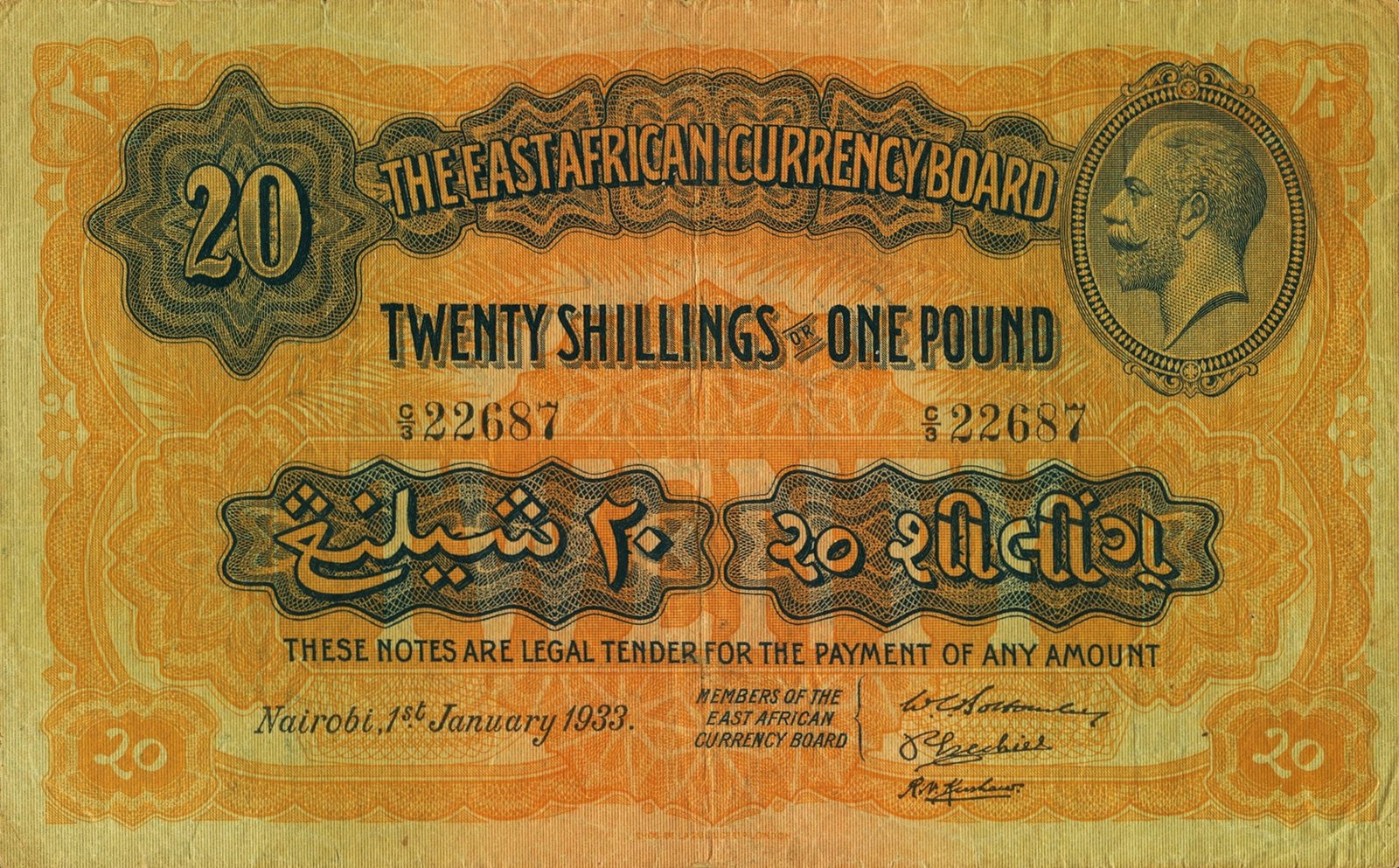
The designs of 1921 were printed again dated Nairobi, 1st January 1933, with the place of issue moved from Mombasa and a new board of Bottomley, Ezechiel and Kershaw: 5 shillings, 10 shillings, 20 shillings, 100 shillings, 200 shillings, 1,000 shillings and 10,000 shillings.
The issued 20 shillings of 1933 run from B/8 to C/6. Every 100 shillings of 1933 recorded carries the prefix A/4, which is also the last prefix of the 1921 issue, so the date and the signatures place an A/4 note. An undated, unsigned CANCELLED specimen of the 10 shillings cannot be tied to either date.
King George VI, 1938 to 1952
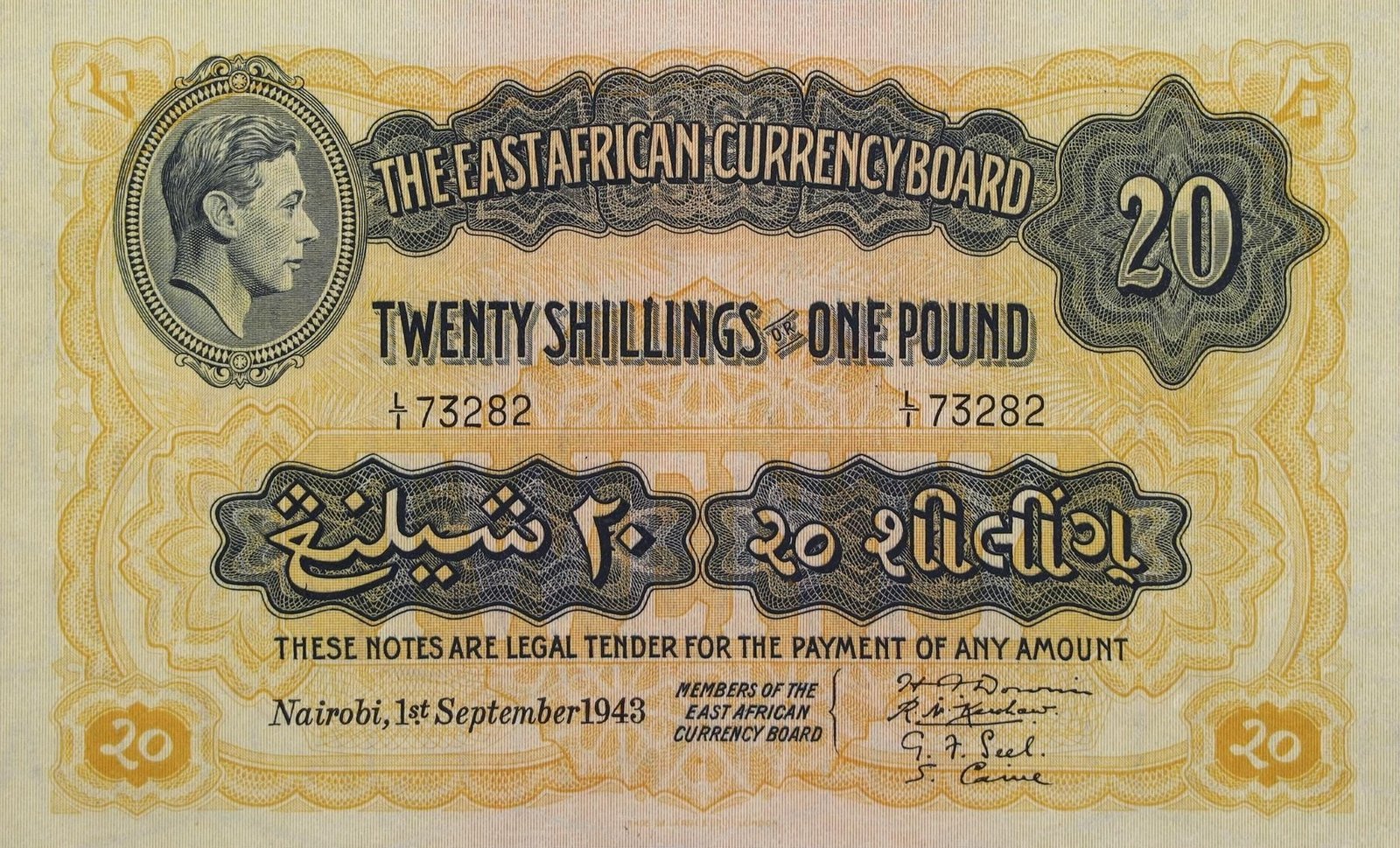
The notes with the portrait of King George VI were printed for these dates: 1st January 1938, 2nd January 1939, 1st June 1939, 1st July 1941, 1st September 1943, 1st January 1947, 1st January 1949, 1st September 1950, 1st August 1951 and 1st January 1952. The 100 shillings has 1st October 1949 in place of 1st January 1949 and stops at 1st August 1951. The pages are the 5 shillings, 10 shillings, 20 shillings and 100 shillings.
The war years brought three printings dated 1st June 1939 by two printers, a printing of 1st August 1942 made in India and a 1 shilling note dated 1st January 1943. They are told in East Africa's wartime notes, 1939 to 1946.
Queen Elizabeth II, 1953 to 1957
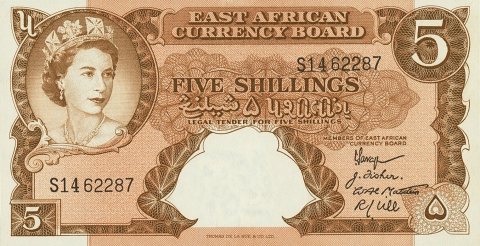
The 5 shillings and 10 shillings have five dates, all at Nairobi and each with its own board of four signatures: 31st March 1953, 1st April 1954, 1st January 1955, 1st February 1956 and 1st October 1957. The 20 shillings and 100 shillings have the first four dates only; no note of either value dated 1st October 1957 has been recorded. From 1953 the prefixes carry no slash, and each letter runs through its numbers before the next letter begins.
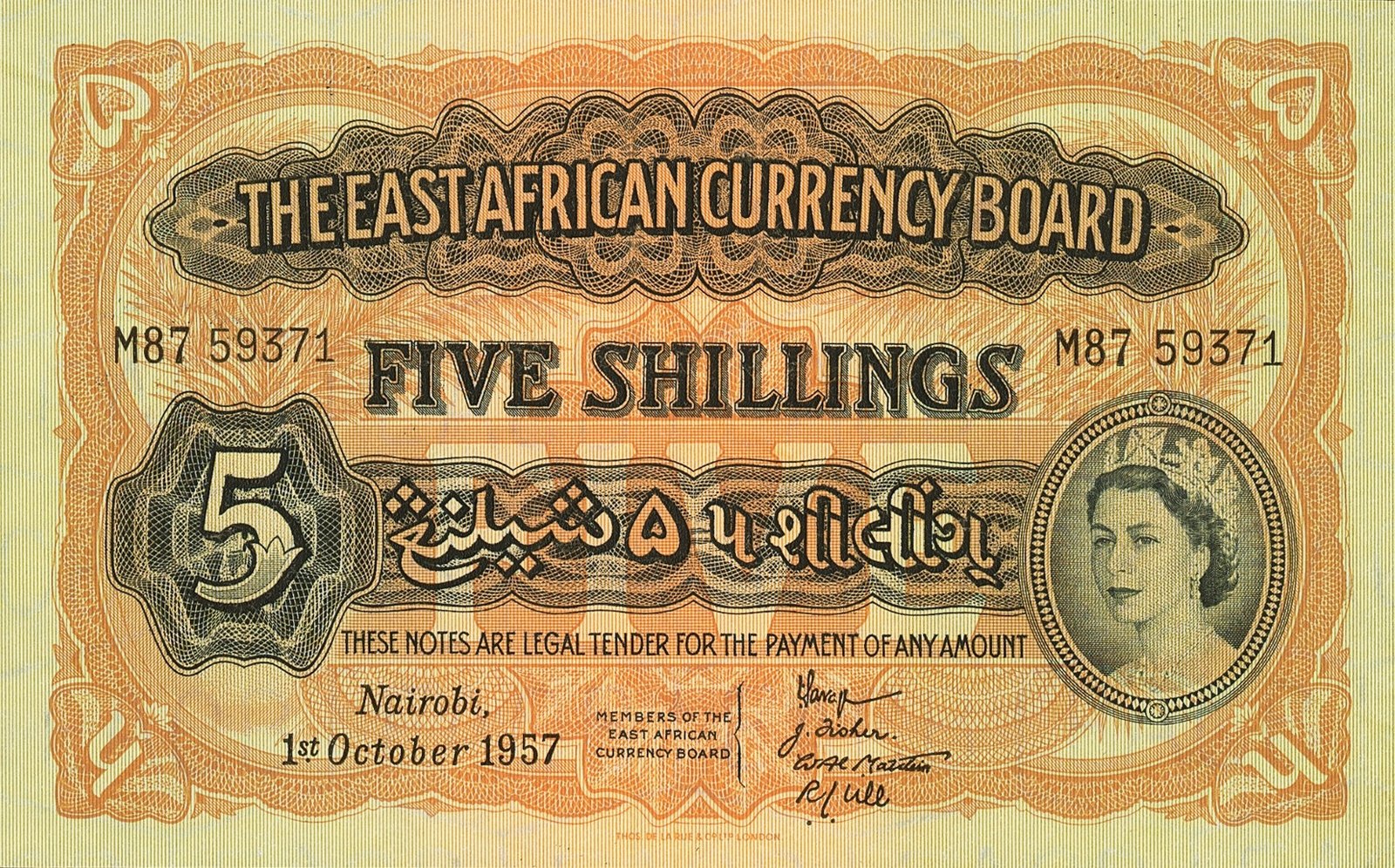
Sources mention that the portrait follows a 1952 photograph by Dorothy Wilding, in a De La Rue engraving used only on these notes, with the eyes a little more closed than on other notes.
The theft of July 1956
Dr. David Lott, writing in Bank Note Reporter in March 1985 from the Board's reports, says that in July 1956 four cases, each holding 25,000 notes of 20 shillings, were stolen from the security printers. In October 1969, after ten years of court cases in Italy, the Banca d'Italia in Milan handed over the rest of the notes, which were counted, cancelled and burned: 24,876 notes, not 24,878 as reported before. The article does not say which date the stolen notes carried.
The G79 notes
Stack's Bowers (8 July 2025, lot 70123) says the 20 shillings notes of 1st January 1955 with the prefix G79 come from a hoard, and Heritage (14 January 2019, lot 29147) also speaks of a small hoard saved. G79 is the prefix that closes the 1955 band and opens the 1956 band; every G79 note recorded so far is dated 1st January 1955.
The new design, 1958 to 1960
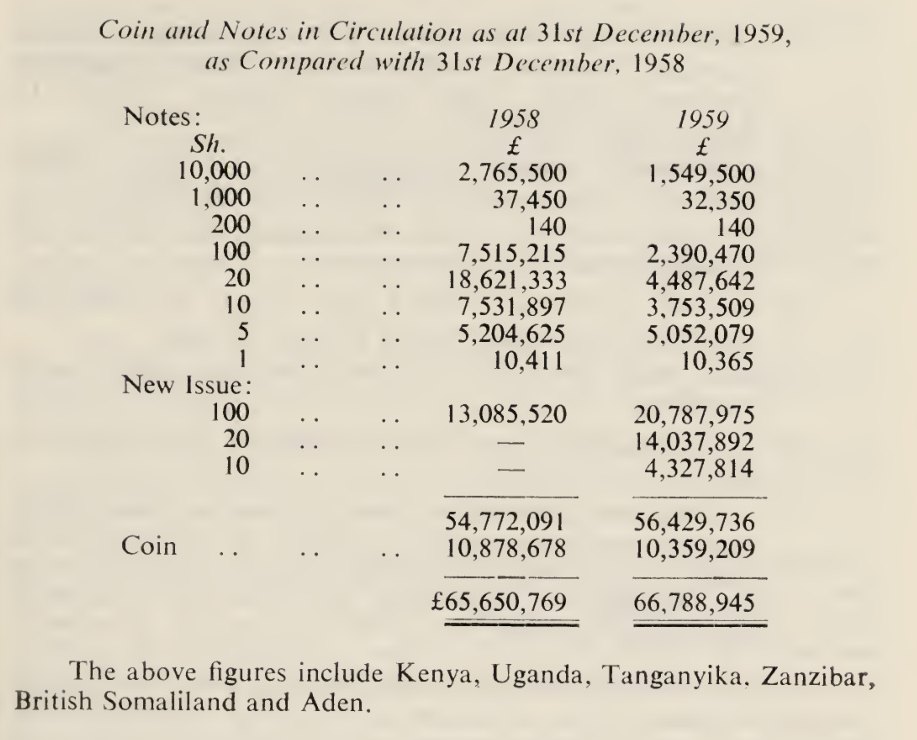
The East African Currency Board announced notes of a new, smaller design on 16th June 1958. The four values came out one at a time, and the annual reports on Kenya for 1958 to 1960 count the new notes against the old at the end of the year of issue.
| Note | Put into circulation | New design in circulation | Older design in circulation | At the end of |
|---|---|---|---|---|
| 100 shillings | 15th September 1958 | £13,085,520 | £7,515,215 | 1958 |
| the same | £20,787,975 | £2,390,470 | 1959 | |
| 20 shillings | 16th March 1959 | £14,037,892 | £4,487,642 | 1959 |
| 10 shillings | 15th September 1959 | £4,327,814 | £3,753,509 | 1959 |
| 5 shillings | 15th March 1960 | £4,355,122 | £849,017 | 1960 |
The day of issue of the 5 shillings was fixed by Gazette Notice No. 4943 of 15th December 1959. Under it the older 5 shillings kept its legal status, but was not issued again once it came back to a bank.
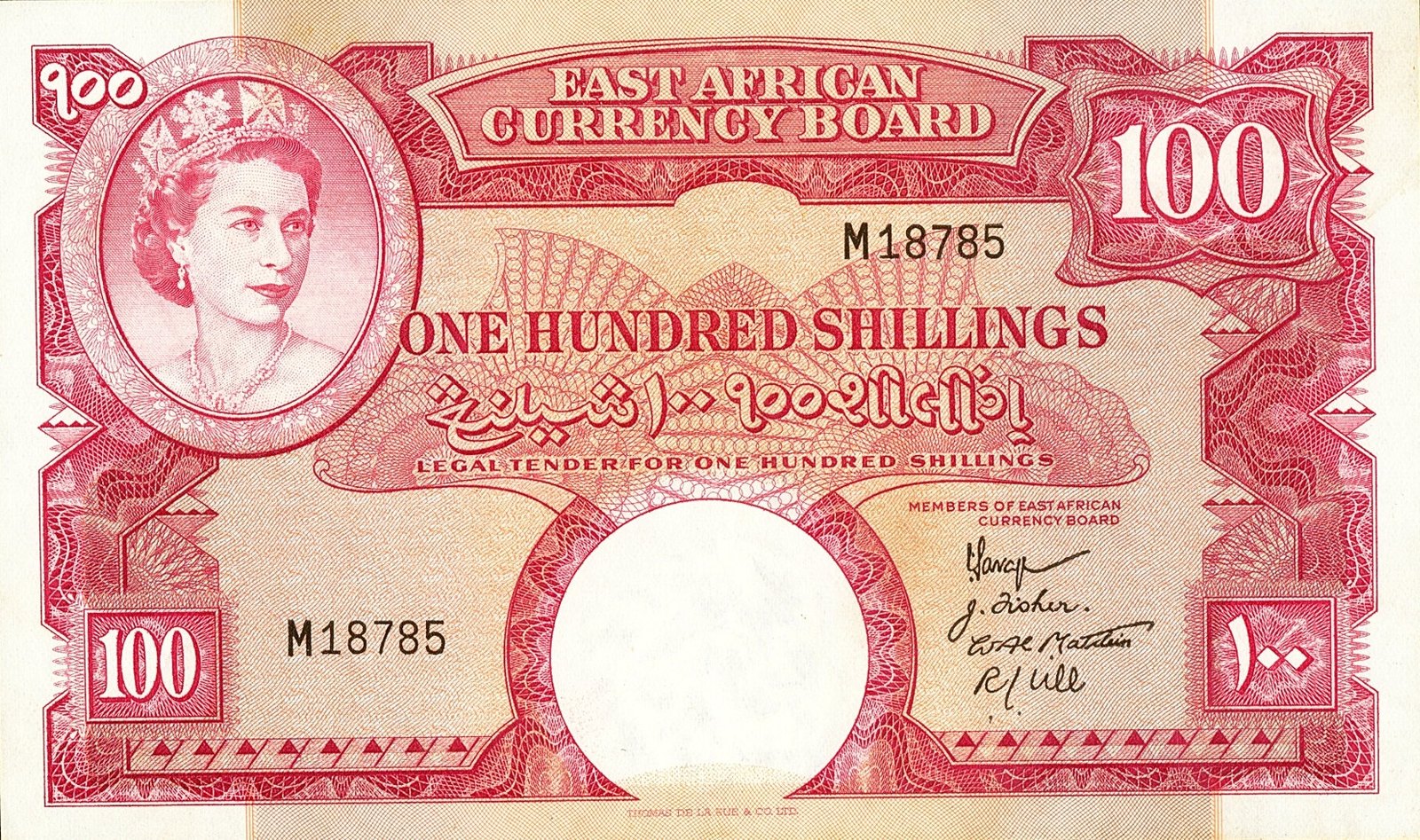
These notes are undated and carry four signatures at the right. Sources mention that the portrait follows a 1954 photograph by Dorothy Wilding.
Seven signatures, 1961 to 1963
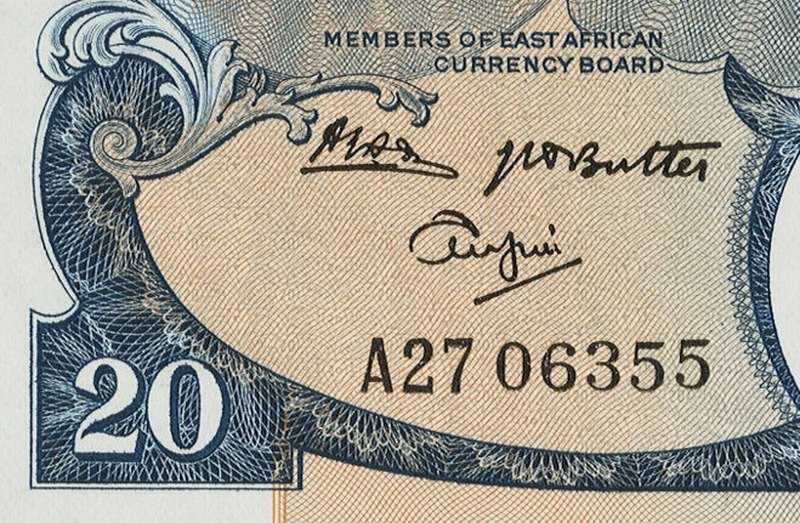
The Bank of England Quarterly Bulletin of 1962 says the Board itself moved from London to East Africa in August 1960, with a member for each of Kenya, Tanganyika, Uganda, Zanzibar and Aden, an independent chairman and a currency expert, seven in all. That matches the next printing of the same designs, which carries seven signatures: three at the left under a second MEMBERS OF EAST AFRICAN CURRENCY BOARD heading and four at the right. The pages are the 5 shillings, 10 shillings, 20 shillings and 100 shillings.
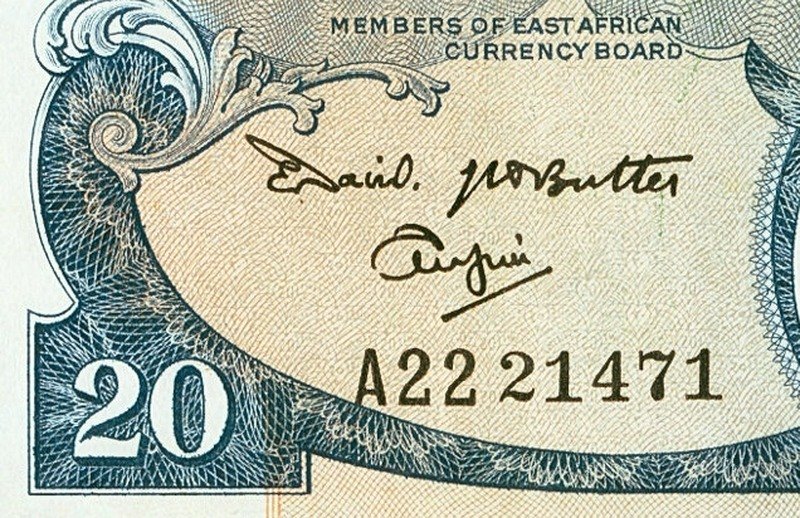
Each value has two forms that differ only in the top-left signer: David, then Adu. The catalogue dates the David notes 1961 and the Adu notes 1962 to 1963.
The last notes, 1964
The Board's last notes are undated, printed by Bradbury Wilkinson and signed by the Chairman and the Secretary of the Board: 5 shillings, 10 shillings, 20 shillings and 100 shillings. The Central Bank of Kenya's page says the notes with the Lake Victoria design were known as the "Lake Issue".
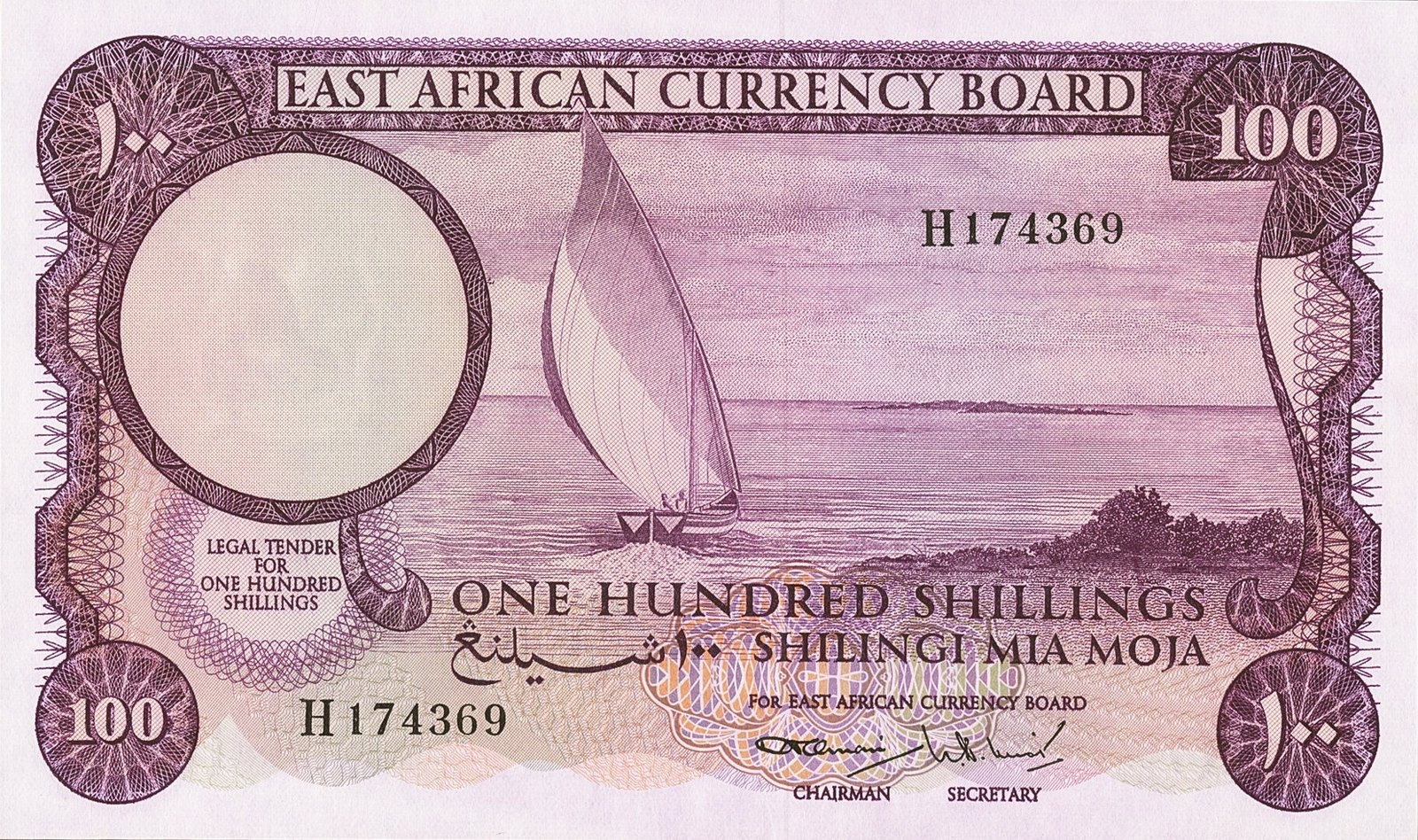
The specimens that print a number range record the printings, each prefix numbering a million notes:
| Value | Printings as the specimens give them |
|---|---|
| 5 shillings | A 000001 to L1 1000000, and M1 000001 to P1 1000000 |
| 10 shillings | A 000001 to F1 1000000, and G1 000001 to H1 1000000 |
| 20 shillings | A 000001 to F1 1000000, and G1 000001 to L1 1000000 |
| 100 shillings | A 000001 to K 1000000 |
Sources mention 3,000,000 notes of 20 shillings ordered, which the two printing ranges do not support. For the 10 shillings the first range comes from the description of a specimen sold in 2015 that is not photographed.
Spink (12 January 2024, lot 86, and again 30 July 2024, lot 65) offered a pair of hand-executed essays for the front and back of the 10 shillings, in green with a small sailing boat, from the Alan Pickering collection. Stack's Bowers (2 October 2025, lot 50111) points out that these notes, though listed under East Africa beside the earlier issues, were issued after Kenya became independent in late 1963.
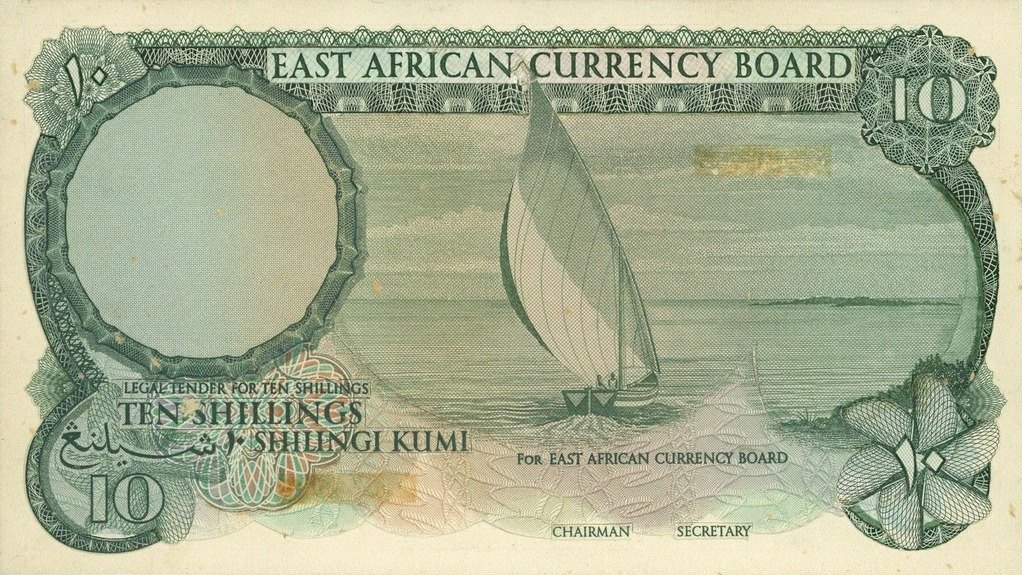
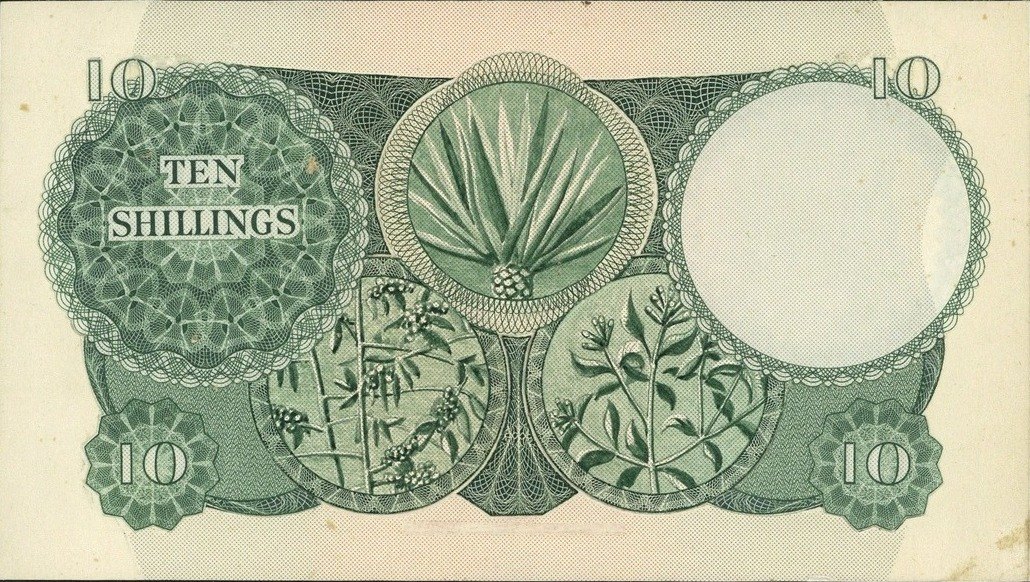
One point does not agree. The pages of the four notes say that sources mention a portrait after a 1954 photograph by Dorothy Wilding. The Central Bank of Kenya's page says that as the territories became independent, from 1962, the Board ceased to issue notes with the image of the monarch. The photographs on the note pages are the test.
The end of the Board's notes
The Bank of Tanzania opened on 14 June 1966, the Bank of Uganda on 1 July 1966 (its own currency from 15 August 1966) and the Central Bank of Kenya under an Act of 1966. The East African shilling stayed in use until 14 September 1967. The Central Bank of Kenya's page agrees: it says the Board's banknotes ceased to be legal tender in September 1967, and adds that its coins were demonetised in April 1969.
When the Board itself ended is given three ways. The page of the 200 shillings says, from its sources, that 13 notes were still unredeemed when the Board closed in 1972. The Bank of Tanzania's page says the Board ended its work in 1966. Spink's description of the essays says the Board was dissolved in 1965.
Sources
- The catalogue's note pages for East Africa, and through them: the Official Gazette of Kenya, 1922 to 1925; Gazette Notice No. 4943 of 15th December 1959; the annual reports on Kenya for 1958 to 1960; the Bank of England Quarterly Bulletin, 1962.
- The Palestine Bulletin, 1st September 1926, p. 1.
- Dr. David Lott, Bank Note Reporter, March 1985.
- Central Bank of Kenya, "Currency History", centralbank.go.ke.
- Bank of Tanzania, "History of the Bank", bot.go.tz.
- House of Commons Debates, 11 November 1936, volume 317, columns 851 to 852.
- Spink, 3 October 2018, lot 1024; 17 April 2019, lot 418; 12 January 2024, lot 86; 30 July 2024, lot 65.
- Stack's Bowers, 8 July 2025, lot 70123; 2 October 2025, lot 50111.
- Heritage Auctions, 14 January 2019, lot 29147.
Member comments
Log in or register to post a comment.